Stockholm Metro Art: How to Explore the World's Longest Art Gallery Underground
The Stockholm Metro is more than a transit system. Across roughly 90 of its 100 stations, about 150 artists have transformed platforms, tunnels, and ticket halls into a sprawling underground exhibition that stretches 110 kilometres. You pay nothing extra — only the standard SL fare.
Quick Facts
- Location
- Citywide — all three metro lines (Green, Red, Blue)
- Getting There
- Board at T-Centralen (Central Station), served by all three SL metro lines
- Time Needed
- 2–4 hours for a curated art walk; full system exploration takes multiple days
- Cost
- No separate admission — art is included with a standard SL metro ticket (verify current fares at sl.se)
- Best for
- Architecture lovers, art curious travelers, rainy-day explorers, repeat Stockholm visitors
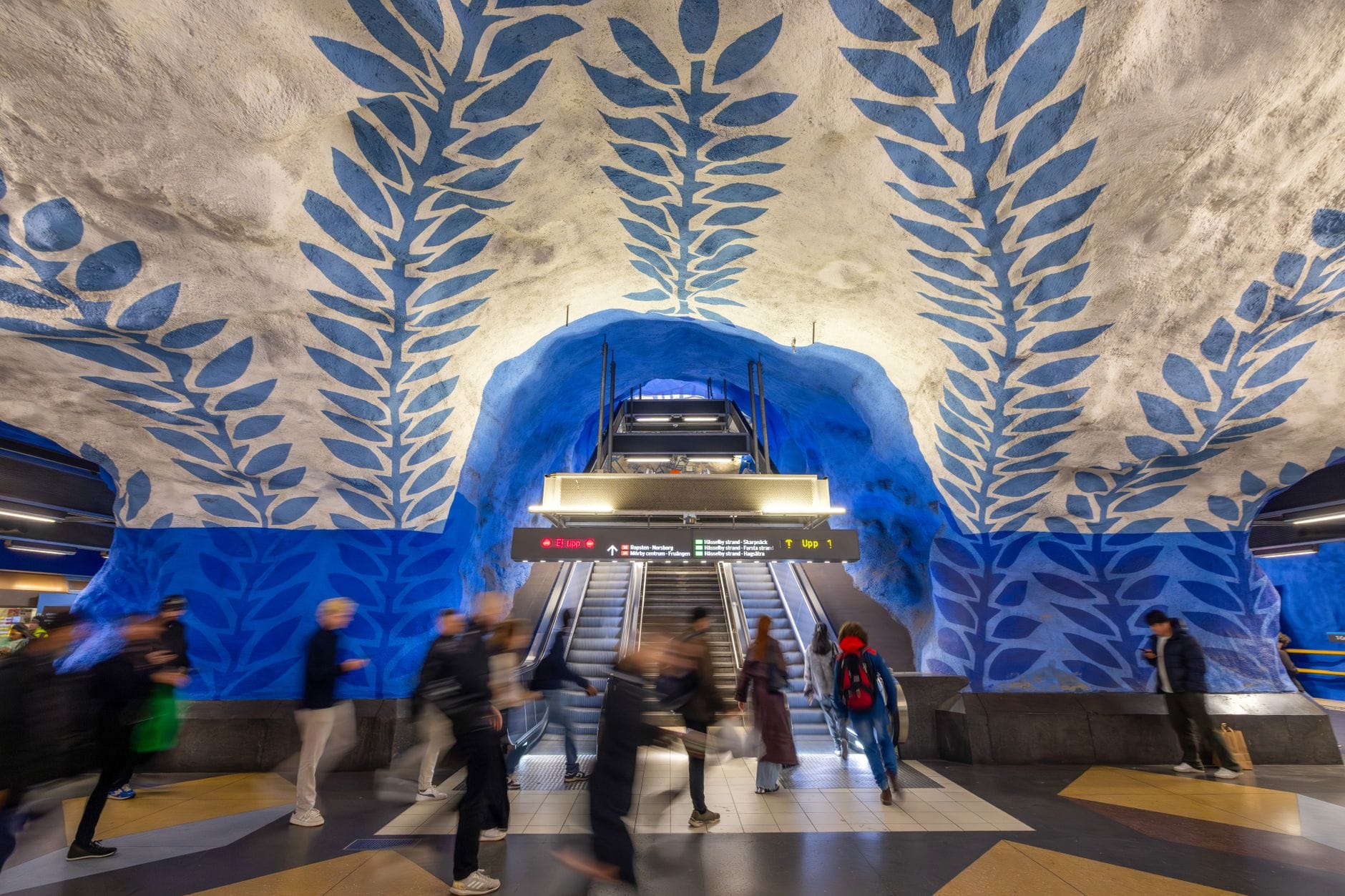
What the Stockholm Metro Art Actually Is
The Stockholm Metro Art, known in Swedish as Konsten i Stockholms tunnelbana, is not a dedicated gallery with an entrance fee and a gift shop. It is a living, functional transit network that doubles as the longest continuous public art exhibition in the world. Roughly 90 of the metro's 100 stations feature permanent works commissioned from around 150 artists, spanning the 1950s through the 2000s and beyond. The total track length covering these artworks stretches approximately 110 kilometres.
The range of media is striking. Some stations are carved directly from bedrock and left deliberately rough, with the raw granite walls painted in deep blues, reds, or greens to create cave-like atmospheres. Others are tiled with mosaics, decorated with ceramic reliefs, or fitted with sculptures that line the platforms. A few feel closer to theatrical stage sets than transit stops. The cumulative effect, as you ride from the centre toward the suburbs on any of the three lines, is a slow reveal of how Swedish public art policy shaped the built environment across seven decades.
💡 Local tip
Start at T-Centralen (Central Station). The Blue Line platforms there feature bold white-on-blue floral motifs by Anders Åberg and Enno Hallek — one of the most photographed spots in the entire system, and a useful orientation point before heading outward.
A Brief History: Why Stockholm Built Art Into Its Subway
Stockholm's metro opened in 1950, making it the first rapid transit system in the Nordic countries. From relatively early in its construction, there was a deliberate civic philosophy at work: public spaces funded by taxpayers should also enrich public life. The integration of art into the metro was not an afterthought or a branding exercise. It grew from Swedish social democratic ideals about culture belonging to everyone, not only those who could afford galleries or concert halls.
The art program evolved significantly over the decades. Early stations tended toward decorative tile work and understated motifs. By the 1970s and 1980s, as the network expanded outward to the suburbs, the commissions became bolder. Artists were given larger briefs and more structural freedom, which produced some of the most dramatic stations — places where the architecture and the art are genuinely inseparable. The result is a system where the experience of traveling outward from the city centre feels like moving through a sequence of distinct visual worlds.
Tickets & tours
Live prices and dates from our booking partner. If you book, we may earn a commission at no extra cost to you.
Underground Metro Art Ride with a local in Stockholm
From 111 €Instant confirmationFree cancellationKickstart your trip to Stockholm with a local - private and personalized tour
From 190 €Instant confirmationFree cancellationStockholm subway system art and photo gallery tour
From 35 €Instant confirmationFree cancellationExplore Stockholm's art and culture with a local
From 87 €Instant confirmationFree cancellation
The Three Lines and What Each Offers
The metro runs on three color-coded lines. Each has a distinct character that reflects when it was built and what kinds of neighborhoods it serves.
The Blue Line: The Most Dramatic Underground Stations
The Blue Line (T10/T11) is the one most travelers reference when they talk about Stockholm Metro Art. Its stations are deep underground, cut through bare rock, and the exposed cave ceilings give artists a three-dimensional canvas unlike anything in a conventional gallery. Kungsträdgården, the easternmost Blue Line terminal, is the most frequently cited showpiece: Swedish artist Ulrik Samuelson filled it with sculptures, pools, and fragments referencing the park above ground. The effect is genuinely strange in the best possible way — you feel like you've descended into an archaeological site that hasn't quite been excavated yet.
Rådhuset station, also on the Blue Line, features walls in deep red and white that suggest the interior of a Roman aqueduct. Solna Centrum, further out on the same line, is painted in green and red with a forest panorama wrapping the entire vault — one of the most cohesive total-environment installations in the system.
The Red and Green Lines: Quieter, but Worth the Detour
The Red and Green Lines were built earlier and their stations tend to be shallower and less dramatically excavated. The art here is often more intimate: ceramic tile work, painted murals, woven textile-inspired graphics. Tekniska Högskolan on the Red Line references scientific and mathematical principles in its geometric ceiling installation. Fridhemsplan on the Green Line has an understated but carefully executed mosaic scheme. These stations reward slower attention rather than the immediate visual impact of the Blue Line's cave spaces.
For travelers who want to connect metro art viewing with above-ground experiences, several stations sit near major attractions. The Red Line stops near Fotografiska, and the Green Line branches serve Södermalm, where stations blend naturally into a neighborhood walk.
How the Experience Changes by Time of Day
Visiting the metro art during off-peak hours, roughly 10:00–15:00 on weekdays, makes a genuine difference to the experience. At rush hour, the platforms fill quickly and the practical reality of commuting crowds out any contemplative looking. You can still see the art, but you're absorbing it in glimpses rather than at the pace the work demands.
In the late morning, many of the more dramatic stations are nearly empty. The acoustic quality changes noticeably: the Blue Line caves produce a low ambient hum that is almost musical in the silence between trains. The lighting in these stations is calibrated to make the rock surfaces read as vivid and textured, and without crowds breaking the sightlines, you can step back and take in full walls and ceilings in a way you simply cannot during peak hours.
Late evening, particularly after 21:00, brings a different kind of atmosphere. The stations are emptier again, the tile work catches the artificial light in sharper relief, and the underground spaces feel more theatrical. Some travelers find this the most atmospheric time. If you are cautious about solo travel in quieter spaces, weekday midmornings are the more practical choice.
ℹ️ Good to know
The metro operates approximately 05:00–01:00 daily, with 24-hour service on Friday and Saturday nights. Art is accessible in public station areas during all operating hours. Confirm current timetables at sl.se before planning a late-night visit.
How to Plan Your Visit
There is no single route that covers all the highlights efficiently. The stations most travelers prioritize are spread across different lines and directions, so any art-focused trip involves some backtracking. The Stockholm Art Walk website (stockholmartwalk.se) maintains a guide with suggested itineraries organized by theme and line, and it is the most practically useful free resource available for planning.
A realistic two-to-three hour introduction might cover four to six stations on the Blue Line, starting from T-Centralen and riding in both directions to catch the key stops. Allow at least 15–20 minutes at each major station to actually look rather than just pass through. A full system survey, including the outer stations on all three lines, realistically takes multiple visits spread over several days.
The metro art fits naturally alongside other Stockholm experiences. Travelers following a 3-day Stockholm itinerary can weave station visits into transit between neighborhoods rather than treating it as a separate excursion. If budget is a consideration, this is one of Stockholm's most substantial free cultural experiences — you pay only the transport fare you'd likely be spending anyway.
Photography
The Blue Line cave stations photograph well with a wide-angle lens or a phone in wide mode. The challenge is light: platforms are lit for function, not photography, and the contrast between bright ceiling installations and darker platform floors can be tricky to expose correctly. Shooting during low-crowd periods gives you clean lines and better composition options. Flash is generally unnecessary and produces flat results against painted rock surfaces. Long exposures during the brief moments between trains, when platforms are still, work better than burst shots during arrivals.
Practical Details and Accessibility
No separate ticket is required. Art is located in the public areas of metro stations: platforms, ticket halls, escalator shafts, and connecting passages. A valid SL ticket is all you need. Single journey fares, 24-hour passes, and multi-day tourist cards all cover metro travel. Current fares should be confirmed at sl.se, as prices change periodically.
Accessibility varies significantly by station. Many central stations have elevators and escalators, but the older sections of the network and some outer stations may involve stairs. The Blue Line's deepest stations require long elevator rides to reach the platforms. Travelers with mobility considerations should check SL's station accessibility guide before planning a specific route, as conditions differ station by station.
For travelers using the Stockholm Pass, the metro art itself is free regardless, but the pass can be worth cross-referencing with other paid attractions nearby, such as the Vasa Museum or the Nordiska Museet. See the full guide on whether the Stockholm Pass is worth it before purchasing.
⚠️ What to skip
Some art-focused stations are at the far ends of lines and can take 30+ minutes to reach from the centre. Check journey times in the SL app before committing to a full-day station crawl — distances are larger than they appear on the schematic map.
Who Should Manage Their Expectations
The Stockholm Metro Art genuinely rewards curiosity and patience. However, travelers expecting a conventional museum experience, with labels, guided context, and a clear narrative arc, will find the reality more diffuse. The art is embedded in a working transit system, which means noise, crowds during peak hours, and the constant pressure of people in motion. If you cannot spend time in underground spaces, or find transit environments stressful, a targeted visit to one or two showcase stations (Kungsträdgården or T-Centralen Blue Line) is a more realistic goal than a multi-hour system tour.
Families with young children can visit easily, though the deeper Blue Line stations involve long escalator and elevator rides that may need patience from toddlers. The metro art is not specifically designed for children, but the scale and color of the cave stations tends to hold attention in a way that many indoor galleries do not.
Insider Tips
- Ride to Kungsträdgården on the Blue Line first, then work back toward the centre station by station — it's a more rewarding sequence than going outward, because the stations become progressively less dramatic as you approach T-Centralen, giving you a natural descent into the everyday.
- Bring earphones. The ambient sounds of the rock tunnels between trains at quieter Blue Line stations have a distinctive low resonance, and listening to music that suits the visual atmosphere turns the experience into something closer to an installation visit.
- The Stockholm Art Walk website (stockholmartwalk.se) offers a free downloadable guide organized by line and stop. Download it before you go rather than relying on mobile data underground, where connectivity is intermittent at deeper stations.
- Solna Centrum and Näckrosen, both on the Blue Line northwest branch, are a single stop apart and together make a logical 30-minute detour — Solna's forest panorama and Näckrosen's water-themed decoration are among the most cohesive environmental artworks in the network.
- If you are visiting Stockholm in winter, the metro art takes on added value: the underground is warm, the platforms are well-lit, and the cave atmosphere is more immersive when it's dark and cold above ground. January and February are actually excellent months for a focused art walk.
Who Is Stockholm Metro Art For?
- Architecture and design enthusiasts who want to see how public art can be structurally integrated into civic infrastructure
- Repeat Stockholm visitors looking for a layer of the city that most first-timers miss
- Travelers on a tight budget who want a substantial cultural experience for the cost of a transit fare
- Photographers interested in underground light, texture, and large-scale environmental installations
- Rainy-day or winter visitors who need an indoor, walkable experience that covers significant ground
Nearby Attractions
Combine your visit with:
- Birka Viking Town
Founded around AD 750 on a remote island in Lake Mälaren, Birka was one of Scandinavia's earliest true urban trading centers. Today it survives as part of the UNESCO World Heritage Site Birka and Hovgården, reached only by seasonal boat from Stockholm, where around 2,000 Viking-age graves still dot the surrounding landscape. It is one of the most historically significant half-day excursions available from the Swedish capital.
- Drottningholm Palace
Drottningholm Palace is Sweden's most complete royal domain, a UNESCO World Heritage Site on Lovön island just about 10 km west of Stockholm. The baroque complex includes the palace, a working 18th-century theatre, a Chinese Pavilion, and formal gardens that shift in character across every season.
- Royal National City Park (Ekoparken)
The Royal National City Park, known locally as Ekoparken, is the world's first national urban park and one of Stockholm's most remarkable features. Stretching around 27 km² from Djurgården in the south to Ulriksdal in the north, it wraps around the city in a continuous arc of ancient oak forests, royal palaces, museum islands, and open waterways. Entry is free and the park never closes.
- Hagaparken
Hagaparken is a 144-hectare English landscape park just north of central Stockholm, laid out for King Gustav III in the late 18th century. Free to enter year-round, it offers a rare combination of royal history, open meadows, and waterside walking paths within easy reach of the city. Individual attractions inside the park, including the Butterfly House and royal pavilions, charge their own fees.
Planning a trip? Discover personalized activities with the Nomado app.