Vasa Museum: Stockholm's 17th-Century Warship Up Close
The Vasa Museum on Djurgården houses a 69-metre warship that sank in 1628 and was salvaged 333 years later, more than 98% intact. It is one of the best-preserved wooden ships in the world, and one of Stockholm's most visited attractions for good reason.
Quick Facts
- Location
- Galärvarvsvägen 14, Djurgården, Stockholm
- Getting There
- Tram 7 to Nordiska museet/Vasamuseet; Bus 67, 69, 76; Ferry from Slussen or Nybroplan
- Time Needed
- 2 to 3 hours
- Cost
- 195–240 SEK adults; under 18 free. Seasonal pricing applies.
- Best for
- History lovers, families, first-time Stockholm visitors
- Official website
- www.vasamuseet.se/en
What the Vasa Museum Actually Is
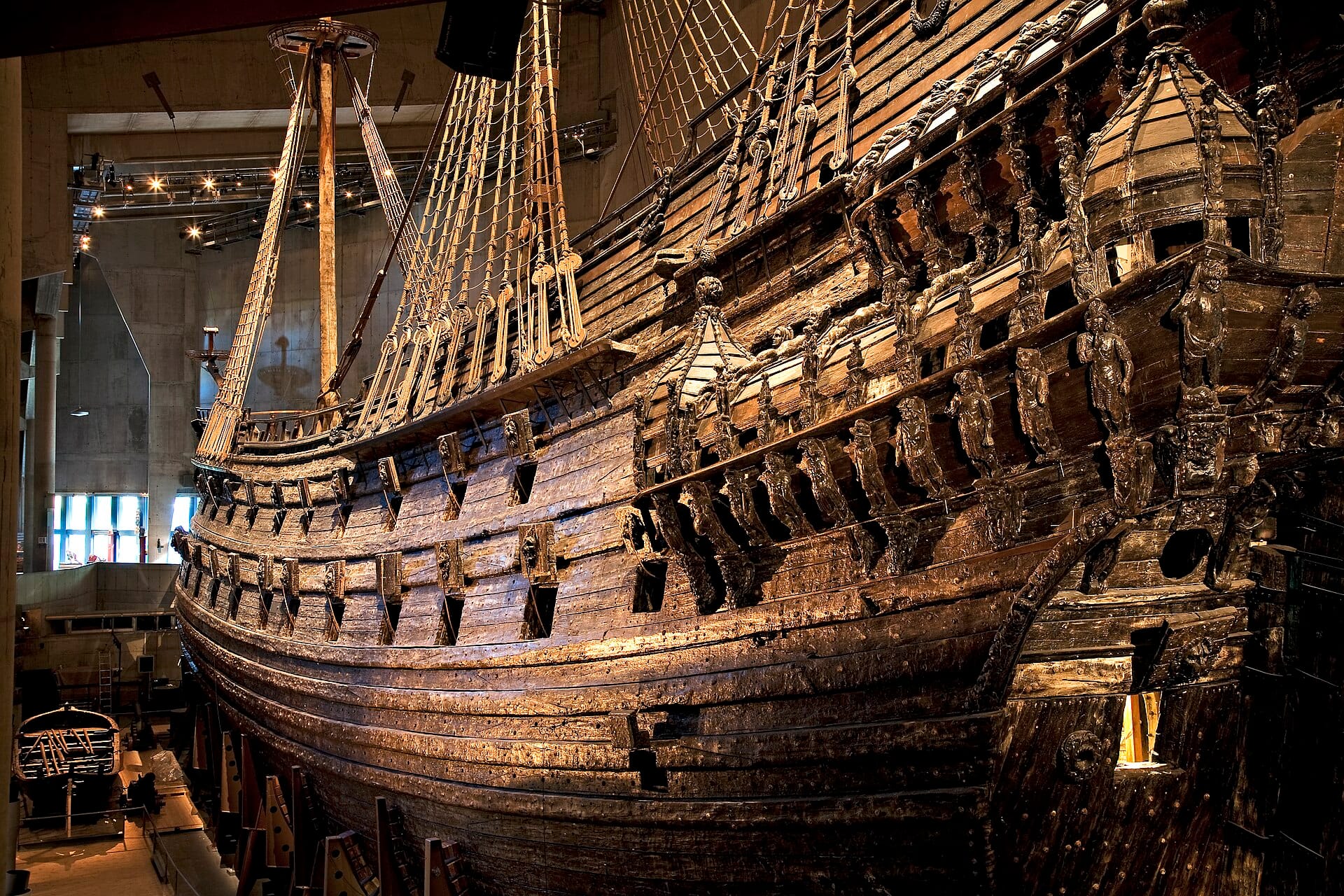
The Vasa Museum (Swedish: Vasamuseet) exists for one reason: to house a single ship. The warship Vasa was built on the orders of King Gustav II Adolf, launched in 1628, and sank less than a mile into her maiden voyage in Stockholm harbor. She sat on the seabed for 333 years before being salvaged in 1961. What came up was extraordinary: more than 98% of the original ship, including hundreds of carved wooden sculptures still attached to the hull. No comparable find exists anywhere in the world.
The museum opened on 15 June 1990 in a purpose-built building on Djurgården, designed to fit around the ship rather than the other way around. The result is a structure that feels like a cathedral from the outside, and delivers on that impression inside: you walk through the entrance and the hull of a 69-metre, 17th-century warship fills the space from floor to ceiling. There is nothing quite like the first few seconds of that view.
💡 Local tip
Book tickets online in advance, especially between June and August. Summer morning queues at the door can stretch long, and buying ahead lets you go straight in.
The Ship Itself: What You Are Looking At
The Vasa is not a replica, a reconstruction, or a model. It is the original ship, treated with polyethylene glycol during a decades-long conservation process that stabilised the waterlogged wood without replacing it. The hull is dark brown, almost black in places, and the grain of the timber is clearly visible. Decorative carvings cover the stern in dense layers: lions, warriors, biblical figures, Roman emperors, mermaids, and grotesque faces, many still with traces of their original red, blue, and gold paint. The effect is somewhere between a warship and a baroque altarpiece.
The ship carried 64 bronze cannons arranged on two gun decks, which was one of the reasons it capsized: it was top-heavy by design, built to impress as much as to fight. On the lowest level of the museum, you can look up directly at the keel. On the upper walkways, you are level with the gun ports. The walkways encircle the ship at six levels, each offering a different relationship to the hull. Allow yourself time at each level rather than rushing to the top.
Tickets & tours
Live prices and dates from our booking partner. If you book, we may earn a commission at no extra cost to you.
Stockholm city tour with private driver and Vasa Museum
From 172 €Instant confirmationFree cancellationThe best of Stockholm tour with Vasa Museum
From 600 €Instant confirmationFree cancellationBest of Stockholm private 3-hour walking tour
From 357 €Instant confirmationFree cancellationGuided tour of the Vasa Museum and its historic warship
From 55 €Instant confirmationFree cancellation
The Exhibition Floors and What Each Covers
The museum organises its permanent exhibitions thematically across multiple floors. The lower levels focus on the salvage operation itself, including footage and photographs from 1961 and the engineering challenge of lifting a waterlogged wooden ship without destroying it. This section tends to be overlooked by visitors moving quickly toward the upper walkways, but it deserves time: the scale of what was accomplished is genuinely impressive.
Mid-level exhibitions cover the life of the people on board: the crew of around 445 sailors and soldiers, reconstructed from skeletal remains found on the seabed. Forensic analysis has given several of them faces, displayed alongside their belongings, shoes, personal items, and food remains. These displays shift the experience from maritime history to something more intimate. You understand that real people drowned here, and that their bodies lay next to the wreck for centuries.
Upper-level displays address the political context of the era, the Swedish Empire in the early 17th century, and the broader story of wooden warship construction. The carved sculptures are examined in detail in one dedicated section, where conservators explain how the decorations were identified, cleaned, and reattached. This is particularly interesting if you want to understand the iconography of the carvings beyond simply admiring them.
The Vasa Museum sits in good company on Djurgården. Directly across the road is the Nordiska museet, Sweden's largest museum of cultural history. A short walk further brings you to Skansen, the open-air museum and zoo. If you are planning a full day on the island, check the Stockholm Pass — it covers the Vasa Museum and several other Djurgården attractions.
How the Visit Changes by Time of Day
The museum is indoors and climate-controlled, so weather has no effect on the experience. What does change is crowd density. Between 10:00 and 14:00, particularly in July and August, the museum fills with tour groups. The walkways around the ship become congested, and the lower exhibition halls lose their quiet. Arriving at opening time (08:30 in summer, 10:00 the rest of the year) gives you the ship almost to yourself for the first 30 to 45 minutes.
Wednesday evenings are worth noting. The museum stays open until 20:00, and after 17:00 on weekdays the visitor numbers drop substantially. The ship takes on a different quality in lower foot-traffic conditions: the ambient sound changes, the recorded audio guides compete with less background noise, and you can stand at the rail of an upper walkway and look at the stern carvings without anyone jostling for the same position. If your schedule permits mid-week flexibility, Wednesday evening is the best option outside of early morning.
ℹ️ Good to know
Opening hours: June–August daily 08:30–18:00. September–May daily 10:00–17:00, Wednesdays until 20:00. Closed 24–25 December; limited hours on 31 December (10:00–15:00).
Practical Walkthrough: Getting There and Around
Djurgården is easy to reach from central Stockholm. Tram 7 runs from Sergels torg through Östermalm and stops directly at Nordiska museet/Vasamuseet, the closest stop to the museum entrance. The journey from the city centre takes around 15 minutes. Bus lines 67, 69, and 76 also serve the island. In warmer months, a ferry service operates from Slussen and Nybroplan to Djurgården, making the water approach one of the more enjoyable ways to arrive.
Djurgården is part of a larger green corridor known as Ekoparken, the world's first urban national park. Getting there is straightforward, and the SL public transport network covers Djurgården well enough that a car is never necessary.
Inside the museum, the building is fully accessible. Lifts connect all exhibition levels, and wheelchairs are available at the entrance. The floor surfaces are smooth and even throughout. Adapted toilets are located on multiple floors. Parents with strollers should know the museum can be navigated entirely by lift, though the upper walkways have some narrow sections at peak times.
Photography is permitted throughout the museum without flash. The lighting inside is deliberately dim to protect the ship, which makes photography a genuine challenge on the lower levels. A wide-angle lens or a phone with good low-light capability works better than a standard zoom. The best single photograph from inside the building is from the lowest level, looking straight up the bow. The best overall view of the stern carvings is from the third or fourth walkway level.
Tickets, Costs, and Honest Limitations
Admission costs 195 SEK per adult from January to April and October to December, rising to 240 SEK from May to September. Children and young people under 18 enter free. A combination ticket with the Vrak Museum, a newer shipwreck museum in the city, costs 315 SEK (low season) or 359 SEK (high season) and is worth considering if maritime history is a particular interest.
The museum is included in the Stockholm Pass, which may represent better value if you are visiting multiple paid attractions across several days. For families with children under 18, the admission cost is effectively the adult ticket only, which makes this one of the more family-friendly attractions in the city from a cost perspective.
Is the Vasa Museum overhyped? Not really, which is unusual for a top-ranked attraction. The ship is genuinely extraordinary and the context is well explained. The main criticism worth noting is that the permanent exhibition, aside from the ship itself, does not change. Return visitors will find little new unless a temporary exhibition is running. For a first-time visit, the experience delivers fully on its reputation.
⚠️ What to skip
The museum does not have a dedicated restaurant, only a cafe. If you are planning a full day on Djurgården, carry a snack or plan lunch at one of the nearby options on the island before or after your visit.
Who Should Think Twice
Visitors with no interest in history or ships sometimes find the experience flat after the initial visual impact of the hull. If you are not drawn to the context behind the object, two hours inside a museum building focused on a single artefact can feel long. In that case, a shorter visit of 60 to 90 minutes covering the ship and the crew exhibition only is a reasonable option.
Travelers with children under five may find the lower exhibition halls hard to navigate at pace, and the historical content is oriented toward older children and adults. For younger families, Junibacken on the same island is designed specifically for small children and pairs well with a shorter Vasa visit.
Insider Tips
- Arrive within the first 30 minutes of opening. In summer this means showing up at 08:30. The ship in a near-empty hall is a fundamentally different experience from the ship surrounded by school groups.
- Walk the lowest level first, slowly. Most visitors move upward quickly and miss the perspective from directly below the keel. Take five minutes here before climbing.
- The audio guide is worth using. The physical panels in the museum are informative but dense. The audio guide sequences the information more naturally and covers details the panels omit, particularly around the carved sculptures.
- The museum shop carries serious publications on the Vasa's history, conservation, and the sculptural programme. If maritime archaeology or 17th-century Scandinavian history interests you, the bookshelf here is better curated than most general museum shops.
- Wednesday late opening (until 20:00) is not widely publicised in tourist materials. After 17:00, the museum is noticeably quieter. This is the best non-morning option for avoiding crowds.
Who Is Vasa Museum For?
- First-time visitors to Stockholm looking for a world-class, rainy-day or any-day attraction
- History and archaeology enthusiasts interested in 17th-century Scandinavian history
- Families with children aged 6 and up: the crew exhibits and ship scale connect well with older children
- Photography-focused travelers willing to work with low indoor light
- Travelers combining the Vasa with a full day of museums and outdoor space on Djurgården
Nearby Attractions
Other things to see while in Djurgården:
- ABBA The Museum
ABBA The Museum is Stockholm's most popular music attraction, a permanent interactive exhibition dedicated to Sweden's most famous pop group. Located on Djurgården, it combines costumes, memorabilia, and hands-on experiences in a way that appeals well beyond die-hard fans.
- Gröna Lund
Gröna Lund has been drawing Stockholmers to Djurgården since 1883, packing around 30 rides, live concert stages, and seasonal events into just 3.8 hectares on the waterfront. This guide covers what the experience actually feels like across different times of day, who will love it, and who might want to skip it.
- Junibacken
Junibacken is a children's cultural centre on Djurgården dedicated to Astrid Lindgren's literary universe, featuring an indoor Story Train, immersive storybook scenes, live theatre, and a bookshop. Opened in 1996, it draws around 400,000 visitors a year and ranks consistently among Stockholm's most-visited attractions.
- Nordiska Museet
Nordiska museet on Djurgården holds over 1.5 million objects spanning 500 years of Nordic life, from peasant folk costumes to mid-century design. The building alone, a neo-Renaissance palace completed in 1907, earns a look even if you only have an hour. This guide covers what to see, when to go, and how to make the most of the visit.
Planning a trip? Discover personalized activities with the Nomado app.