Fotografiska Stockholm: What to Know Before You Visit
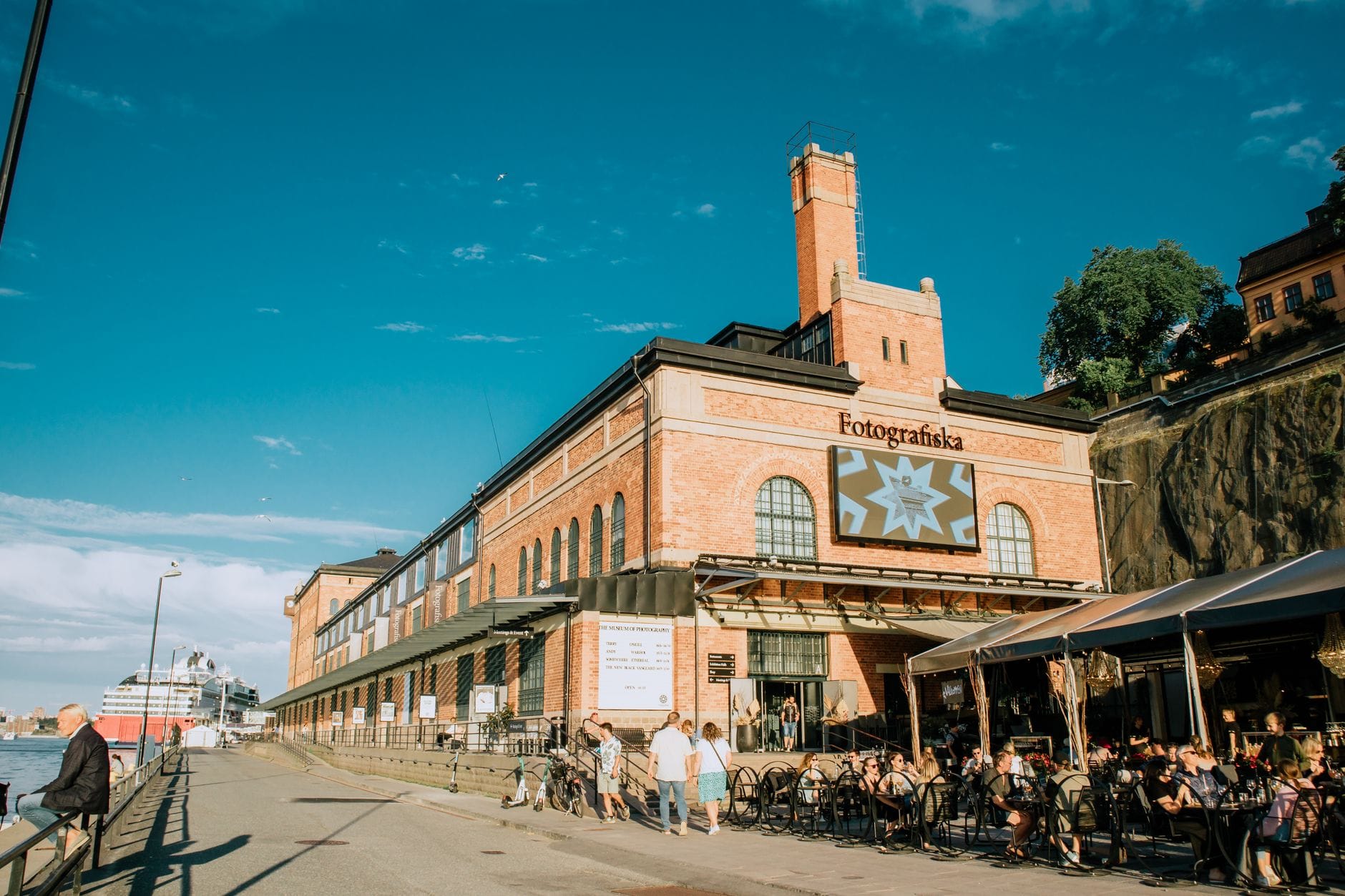
Housed in a 1910 red-brick customs building on Södermalm's waterfront, Fotografiska is one of Europe's most serious photography museums. With rotating major exhibitions, a respected restaurant, and museum doors open until 23:00 every day, it works equally well as an afternoon cultural stop or an evening out.
Quick Facts
- Location
- Stadsgårdshamnen 22, Södermalm, Stockholm
- Getting There
- Slussen metro station (T-bana Red and Green lines), then a 10-minute walk east along the waterfront
- Time Needed
- 2–3 hours for exhibitions; longer if dining
- Cost
- General admission 225 SEK; Reduced 195 SEK; Free for children under 12, youth 13–16, and LMA card holders, all with adult
- Best for
- Photography enthusiasts, evening cultural visits, design-minded travelers
- Official website
- stockholm.fotografiska.com/en
What Fotografiska Actually Is
Fotografiska Stockholm opened in 2010 inside the former Royal Customs House (Kungl. Tullhuset), a substantial red-brick industrial building completed in 1910 on the Stadsgårdshamnen waterfront. The building itself sets an immediate tone: heavy stone archways, tall windows letting in Baltic light, and floors worn smooth by a century of use before photography ever entered the picture.
Unlike a permanent collection museum, Fotografiska operates on a rotating exhibition model. At any given time there are typically four major shows running simultaneously across multiple gallery floors, covering documentary, fine art, fashion, and portrait photography from both established international names and emerging voices. The programming is genuinely ambitious and the curation tends to be thoughtful rather than populist, which means the experience here varies considerably depending on when you visit.
If you care about knowing what's on before you book, check the official exhibition calendar. The museum has since expanded to additional cities, but the Stockholm location remains the flagship. It sits on Södermalm, Stockholm's largest central island, within a 15-minute walk of several of the city's most interesting neighborhoods.
The Building and Its Setting
The Customs House was built to process goods arriving at Stockholm's busy 20th-century harbor. Its north-facing façade looks directly across the water toward Gamla Stan and the Royal Palace, a view that is genuinely striking and effectively free. In warmer months, visitors gather on the outdoor terrace to take in this panorama before or after their visit, and the light on the water in late afternoon can be exceptional.
Inside, the building has been converted with restraint. The original industrial bones remain visible: exposed brick, high ceilings, and structural ironwork. Gallery rooms vary in size and character, which gives different exhibitions room to breathe in ways that purpose-built white-cube spaces don't always allow. The building's materiality is part of the experience.
💡 Local tip
The walk from Slussen along Stadsgårdsleden is straightforward and takes about 10 minutes. Head east from the metro exit with the water on your right. The red-brick building is visible from a distance. Avoid doubling back through Gamla Stan to reach it — it adds unnecessary time.
Tickets & tours
Live prices and dates from our booking partner. If you book, we may earn a commission at no extra cost to you.
Fotografiska Stockholm entrance tickets
From 0 €Instant confirmationFree cancellationGo City | Stockholm All-Inclusive Pass with 70+ Attractions
From 83 €Instant confirmationFree cancellation2-hour archipelago tour on a RIB speedboat
From 122 €Instant confirmationFree cancellationHaunted Stockholm exploration game and tour
From 12 €Instant confirmationFree cancellation
How the Experience Changes by Time of Day
Fotografiska opens at 10:00 every day of the week and stays open until 23:00, which is genuinely unusual for a museum of this caliber in Stockholm. That extended evening window changes how you can plan your day.
Midday on weekends is the busiest period, particularly during major exhibitions. The entrance queue and the gallery spaces near the stairwells can feel congested between roughly 12:00 and 15:00. If you're visiting primarily for the photography, arriving at opening or after 18:00 gives you noticeably more space and a different atmosphere.
Evening visits feel more like a social event than a daytime museum trip. The restaurant fills up, the rooftop bar draws a crowd, and the galleries take on a different quality under artificial light. Some photographic work actually benefits from this, particularly large-format prints and projection-based pieces. Documentary and photojournalism shows, however, are better absorbed in calm natural light — morning visits suit those better.
ℹ️ Good to know
Fotografiska is closed on Midsummer Eve and has reduced hours on Christmas Eve (10:00–20:00). If you're visiting Stockholm around Midsummer, plan accordingly, as Midsummer Eve is the only day of the year the museum is closed.
The Exhibitions: What to Expect
The museum typically runs four simultaneous major exhibitions across its gallery floors. Past shows have included work by Annie Leibovitz, Sebastião Salgado, and Helmut Newton alongside less commercially familiar names whose work often proves equally compelling. There is no permanent collection on display, so repeat visits are common among Stockholm residents.
Exhibition quality is generally high, but unevenness across the four simultaneous shows is worth knowing about. It is entirely possible to find one deeply moving retrospective alongside a fashion collaboration that feels thin by comparison. This is not a criticism unique to Fotografiska — it reflects the challenge of programming a rotating four-gallery institution. Read reviews of the current shows before visiting if the content matters more to you than the building and atmosphere.
Photography lovers already planning a deeper dive into Stockholm's art scene will find Moderna Museet a useful complement. It covers broader modern and contemporary art and sits on Djurgården, about 25 minutes from Fotografiska by foot or a short bus ride.
Food, Drink, and the Rooftop
Fotografiska has developed a reputation for its restaurant that extends well beyond museum café standards. The kitchen takes a sustainability-focused approach and the menu changes regularly. Reservations are advisable for dinner, particularly on weekends. The rooftop bar has some of the better views of Stockholm's waterfront from Södermalm's northern edge, and it draws a post-work crowd that has little interest in the exhibitions.
This dual identity — serious photography venue and destination restaurant/bar — is worth understanding before you arrive. On a Friday evening, the ground floor and upper levels can feel quite social in a way that doesn't suit quiet contemplation of photography. If you're coming specifically to look at the work, aim for earlier in the week or earlier in the day.
If you want to explore more of Södermalm's food culture before or after your visit, the neighborhood around SoFo — roughly 15 minutes' walk southeast — has a dense concentration of independent cafés and restaurants that suit an evening out.
Tickets, Access, and Practical Details
General admission is 225 SEK. A reduced rate of 195 SEK applies to students and seniors, and entry is free for children 12 and under accompanied by an adult, youth aged 13–16, and LMA card holders. Tickets can be purchased online in advance, which is recommended for weekend visits when the entrance can back up.
The museum is part of the Go City Stockholm pass, which covers a large number of the city's major attractions for a flat daily fee. Whether the pass makes financial sense depends on how many other included sites you plan to visit.
For visitors working out the full value of a multi-attraction pass, the guide on whether the Stockholm Pass is worth it runs through the numbers honestly.
The building has lift access between floors, making it reasonably navigable for visitors with mobility considerations. The entrance is at street level from Stadsgårdshamnen. No detailed accessibility statement was available at the time of writing — contact the museum directly if specific requirements need confirming before your visit.
Who Should Skip This
Fotografiska is not a natural fit for visitors who prefer permanent collections with clear historical narratives, or for families with younger children looking for interactive or hands-on experiences. The rotating exhibition model means there's a degree of luck involved in the visit, and admission of 225 SEK for a potentially uneven program is a real consideration if your time in Stockholm is limited.
Families traveling with young children in Stockholm tend to get more out of dedicated family attractions. Junibacken and Skansen on Djurgården are both significantly more rewarding for that age group.
Visitors who arrived in Stockholm expecting a city of purely historic sights and traditional museums can find Fotografiska's contemporary programming jarring. That is, arguably, also its value: it represents what Stockholm's cultural scene actually looks like today, not what it looked like in the 19th century.
Insider Tips
- Book restaurant reservations before your visit, not when you arrive. The dining room at Fotografiska fills up on weekday evenings and is fully booked most weekend nights by mid-afternoon.
- The stairwells between gallery floors contain smaller works and photographs that many visitors walk past quickly on their way to the main rooms. These transition spaces are often where the more unexpected discoveries happen.
- If you're visiting in summer and the weather is clear, walk east along the waterfront from Slussen rather than taking a bus. The approach along Stadsgårdsleden with the water and Gamla Stan visible across the channel is one of the better arrival walks in central Stockholm.
- Fotografiska's museum shop is genuinely good for photography books, including monographs tied to current and past exhibitions. It's one of the better places in Stockholm to find serious photography publications in English.
- Evening light in summer hits the rooftop terrace from the northwest, making the hour before 21:00 especially photogenic for shots across the water toward Gamla Stan and Riddarholmen.
Who Is Fotografiska For?
- Photography enthusiasts who follow contemporary documentary and fine art photography
- Design-minded travelers who appreciate architecture and curated visual spaces
- Evening visitors wanting to combine culture with a quality dinner or rooftop drinks
- Repeat Stockholm visitors looking for something beyond the standard historical attractions
- Travelers visiting on a free day when other major museums are closed — Fotografiska is open seven days a week
Nearby Attractions
Other things to see while in Södermalm:
- Fjällgatan
Perched on the Stigberget cliff in Södermalm, Fjällgatan is a cobbled 18th-century street that doubles as one of Stockholm's finest free viewpoints. The panorama sweeps across Gamla Stan, Skeppsholmen, and Djurgården — and the street itself, lined with preserved wooden houses, is worth the uphill walk on its own terms.
- Katarina Elevator
The Katarina Elevator (Katarinahissen) is a public passenger lift at Slussen that carries you 38 metres up to a walkway on the Södermalm cliff edge, with wide views over Gamla Stan, the Riddarfjärden inlet, and Stockholm's island geography. It reopened in October 2023 after years of renovation, is currently free to ride when operating, and the journey itself takes under 30 seconds.
- Monteliusvägen
Perched about 25 metres above Söder Mälarstrand on northern Södermalm, Monteliusvägen is a 416-metre pedestrian promenade delivering unobstructed panoramas across Lake Mälaren, Gamla Stan, and Stockholm City Hall. Entry is free, the path is open around the clock, and the views change dramatically with the light and the season.
- Skinnarviksberget
Perched 53 metres above sea level on Södermalm, Skinnarviksberget is Stockholm's highest natural point within the inner city. It costs nothing to visit, is freely accessible at all hours (with an alcohol ban in the park between midnight and 7am), and delivers one of the most unobstructed panoramas in the Swedish capital, taking in the City Hall tower, Lake Mälaren, and the rooftops of Gamla Stan.
Planning a trip? Discover personalized activities with the Nomado app.