Stockholm Royal Palace (Kungliga Slottet): The Complete Visitor Guide
The Royal Palace of Stockholm is one of the largest working royal palaces in the world, a colossal Baroque structure sitting at the heart of Gamla Stan. With over 600 rooms spread across multiple museums and state apartments, it rewards visitors who know what to prioritize and when to show up.
Quick Facts
- Location
- Slottsbacken 1, Gamla Stan (Old Town), Stockholm
- Getting There
- Gamla Stan T-bana (metro) station, approx. 5-min walk; multiple SL buses also stop nearby
- Time Needed
- 2–4 hours depending on which museums and apartments you visit
- Cost
- Paid admission; combination tickets available for apartments and on-site museums. Check current SEK prices at kungligaslotten.se before visiting as prices are updated regularly.
- Best for
- History enthusiasts, architecture admirers, families, first-time Stockholm visitors
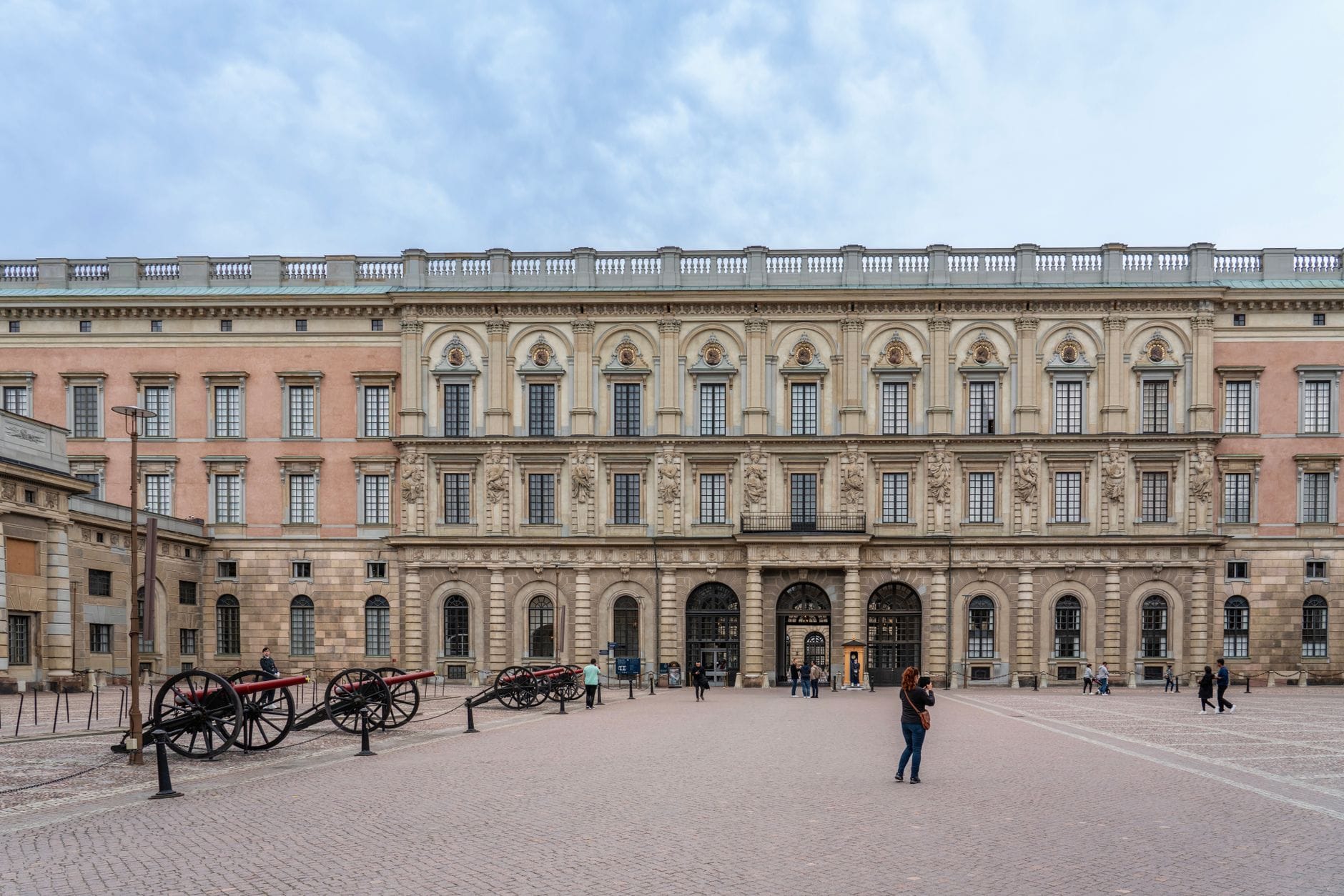
What You're Actually Visiting
The Royal Palace of Stockholm, known in Swedish as Kungliga slottet or Stockholms slott, is not a roped-off relic displayed from a distance. It is an active royal palace where official ceremonies still take place, while simultaneously operating as a major public museum complex. That combination is rarer than you might think, and it gives the place an unusual energy: you are walking through rooms that still carry genuine institutional weight, not just reconstructed grandeur.
The building sits on Stadsholmen, the central island of Gamla Stan, right next to the Swedish Parliament (Riksdag). It is approximately 230 metres long and 125 metres wide, built in Italian Baroque style and containing over 600 rooms. The scale only becomes apparent when you're standing in the inner courtyard looking up at the pale stone facade rising uniformly on all four sides.
ℹ️ Good to know
The palace is open year-round, not just in summer. Hours vary by season, typically opening at 10:00. Always check the current schedule at the official site before you go, as individual sections (state apartments, treasury, museums) can have different access windows on the same day.
History: From Tre Kronor to Baroque Monument
The story of the current palace begins with a fire. The medieval Tre Kronor castle that previously occupied this site burned down in 1697, and construction of the replacement stretched across most of the 18th century. The architect Nicodemus Tessin the Younger drew up the plans, and what emerged was one of the most ambitious royal building projects in northern Europe at the time: a uniform Baroque palace designed to project the authority of the Swedish crown at its imperial peak.
Sweden in the early 18th century was still a significant European power, and the palace's scale reflects that ambition. The long decades of construction meant that successive monarchs adjusted and added to the program, which is why the interior contains layers of decorative periods sitting beneath the Baroque shell. Rooms furnished in Rococo, Gustavian neoclassicism, and later styles sit alongside the original ceremonial spaces.
Understanding that history helps when navigating the visit. For deeper context on Sweden's royal and medieval past, the Swedish History Museum (Historiska museet) on Östermalm offers an excellent complement, particularly for the Viking and early medieval periods that predate the palace itself.
Tickets & tours
Live prices and dates from our booking partner. If you book, we may earn a commission at no extra cost to you.
What to See Inside: Rooms, Museums, and the Changing of the Guard
The palace is organized into several distinct visitor sections, and it helps to decide in advance which ones matter to you. The State Apartments form the ceremonial core: the Hall of State, the Gallery of Karl XI, and the Bernadotte Apartments are among the most formally impressive rooms. The Hall of State in particular, with its silver throne, is the kind of space that justifies the admission cost on its own.
The Treasury (Skattkammaren) houses the Swedish royal regalia, including crowns, sceptres, and orbs used at coronations and state funerals. These objects are surprisingly arresting in person: small, dense with craftsmanship, and oddly intimate given their historical weight. The display cases bring you very close to them.
The Gustav III Antique Museum on the lower level holds a collection of classical sculpture assembled during the 18th century, while the Three Crowns Museum (Tre Kronor museet) traces the history of the medieval fortress beneath the current building, using excavated remains and models. That underground section is genuinely atmospheric and tends to be less crowded than the main apartments.
💡 Local tip
The Changing of the Guard ceremony takes place in the outer courtyard on a regular schedule (times vary by season and day of week). It draws a crowd, but it is free to watch from outside the gates. Arrive 10–15 minutes early to secure a clear sightline. Check the official site for the current schedule.
How the Palace Changes by Time of Day
Morning visits, especially on weekdays, offer noticeably quieter corridors. By 10:00 when the doors open, the first hour sees mostly serious visitors moving at their own pace through the state apartments. The light entering the courtyard at that hour is also at its cleanest, which matters both for photography and for reading the architectural detail on the facades.
By midday the tour groups arrive in force. The inner courtyard fills up before the Changing of the Guard, and the main staircase and Hall of State see steady queues. If you plan to spend three or more hours inside, starting at opening and saving the Treasury for the early afternoon tends to work well, since the Treasury draws fewer visitors than the main apartments regardless of time.
Late afternoon light hits the western facade of the palace with a warm quality that makes the Baroque stonework glow in a way that midday does not produce. If photography matters to you, the exterior is worth revisiting at that hour. The streets of Gamla Stan immediately around the palace also become slightly less crowded once the midday surge moves toward the waterfront.
Getting There and Moving Around the Area
The palace is at Slottsbacken 1, a short walk from Gamla Stan metro station on the green line. From Stockholm Central Station, the walk takes roughly 15 minutes along the waterfront, crossing Centralbron to the Old Town island. The route is flat, straightforward, and passes several landmarks along the way.
Gamla Stan is compact, and the palace sits at its northern tip, which makes it a natural starting point for a broader exploration of the Old Town. Gamla Stan's medieval street grid lies immediately to the south, and most visitors naturally drift that direction after the palace. The narrow lanes of Köpmangatan and Österlånggatan are within five minutes on foot.
Nearby and worth combining in a single visit: Storkyrkan (Stockholm Cathedral) sits directly adjacent to the palace on the south side, and the Nobel Museum is on Stortorget square just a few minutes further into the Old Town. Both can be added to the same half-day without difficulty.
⚠️ What to skip
The cobblestone streets around the palace and throughout Gamla Stan are uneven. Visitors with mobility limitations should check the palace's dedicated accessibility information page before arrival, as elevator access and adapted routes exist for some sections but not all areas of the building.
The View From Outside and the Surrounding Square
Even visitors who skip the interior will find the palace exterior worth the detour. Standing on Lejonbacken, the open terrace on the north side facing Norrström, the full length of the facade becomes visible at once. The formal symmetry of the Baroque design reads most clearly from that vantage point, and it frames the view across the water toward Norrmalm in a way that is characteristic of Stockholm's particular relationship between architecture and water.
The waterfront below, along Skeppsbrokajen, is one of the main embarkation points for archipelago boats. If you're planning to explore the islands beyond Stockholm, the Stockholm Archipelago ferries depart from very close to the palace, making a natural continuation of a Gamla Stan morning.
For those interested in Stockholm's broader cityscape, the views from the Riddarholmen Church island, visible from the palace's western side, provide a different perspective on the Old Town cluster and the water channels that divide the city's central islands.
Who Should Think Twice Before Visiting
The Royal Palace is not a discovery for everyone. Travelers who find formal interiors repetitive, or who are not drawn to ceremonial history, may find the visit long relative to its impact. The state apartments follow a progression of richly decorated rooms that require patience and genuine interest to appreciate fully. A visitor expecting dramatic interactive experiences or modern museum storytelling may feel under-served.
The palace also does not have a rooftop or elevated viewing platform open to the public, so if spectacular city views are your primary goal, other options in Stockholm serve that purpose more directly. Visitors on a single-day schedule who have not yet seen the Vasa Museum or Skansen should probably prioritize those first, as they offer broader appeal and tend to hold the attention of a wider range of travelers.
Insider Tips
- Combination tickets covering multiple on-site museums (State Apartments, Treasury, Gustav III's Antique Museum, Three Crowns Museum) typically offer better value than individual entries. Decide which sections interest you before buying at the door.
- The Three Crowns Museum in the palace basement is consistently less crowded than the main apartments and offers some of the most atmospheric spaces in the complex, with visible medieval stonework from the original Tre Kronor castle.
- If you want to photograph the palace exterior without tour group congestion, the outer courtyard is accessible for free and is quietest before 10:00 when the interior opens.
- The Changing of the Guard is free to watch from outside the gates. The ceremony is more elaborate on Wednesdays and Sundays during summer months, when the full guard parade includes a marching band. Confirm the current schedule on the official site.
- Gamla Stan metro station is only a few minutes' walk, but exiting at the Kungsträdgården station (also on the green line, one stop north) and walking south across the bridge gives you a better first view of the palace facade approaching from the waterfront.
Who Is Stockholm Royal Palace For?
- First-time visitors to Stockholm who want to understand the city's royal and political history in a single stop
- Architecture enthusiasts interested in northern European Baroque on a significant scale
- Families with older children (10+) who can engage with the historical collections and the drama of the royal regalia
- Travelers combining a morning at the palace with an afternoon walking Gamla Stan's medieval streets
- Photography-focused visitors working the early morning light on the Old Town waterfront
Nearby Attractions
Other things to see while in Gamla Stan:
- German Church (Tyska Kyrkan)
Tucked into the medieval street grid of Gamla Stan, Tyska Kyrkan (the German Church, officially Saint Gertrude's Church) is one of Stockholm's most architecturally striking religious buildings. Built between 1638 and 1642 for the city's German-speaking merchant community, it rises 96 metres above the Old Town rooftops and rewards visitors who seek it out with elaborate Baroque interiors elaborate Baroque interiors in a quieter corner of Gamla Stan.
- Gamla Stan: Stortorget & the Medieval Streets
Gamla Stan is the historic island at the heart of Stockholm, where the city was founded in the 13th century. Its central square, Stortorget, is the oldest in Stockholm and carries a weighty past. The entire district is free to explore and open at all hours, making it one of the most rewarding walks in Scandinavia.
- Nobel Museum
Housed in Gamla Stan's 18th-century Stock Exchange Building, the Nobel Prize Museum brings over a century of human achievement to life through exhibits on laureates, Alfred Nobel's life, and the prize itself. It is thoughtful, compact, and genuinely moving for curious visitors.
- Riddarholmen Church
Riddarholmskyrkan is one of Stockholm's oldest preserved churches and the burial place of many Swedish monarchs from the medieval era through the 20th century. Standing on its own small island just west of Gamla Stan, it is one of the most historically significant buildings in Sweden.
Planning a trip? Discover personalized activities with the Nomado app.