Galerías Pacífico: Buenos Aires' Most Beautiful Shopping Centre
Galerías Pacífico is a 19th-century landmark on Florida Street where five Argentine muralists painted a 450 m² central dome. Shopping here is almost incidental to the architecture — and entry is free.
Quick Facts
- Location
- Av. Córdoba 550, corner of Florida Street, San Nicolás / Microcentro, Buenos Aires
- Getting There
- Subte Line B — Florida station (walk up via the Florida pedestrian street); Subte Line C — San Martín or Lavalle stations (short walk via San Martín or Lavalle streets)
- Time Needed
- 45 minutes to browse; up to 2 hours if you linger under the dome and eat
- Cost
- Free entry. Shopping and food at standard mall prices.
- Best for
- Architecture lovers, first-time visitors, rainy-day outings, art enthusiasts
- Official website
- www.galeriaspacifico.com.ar
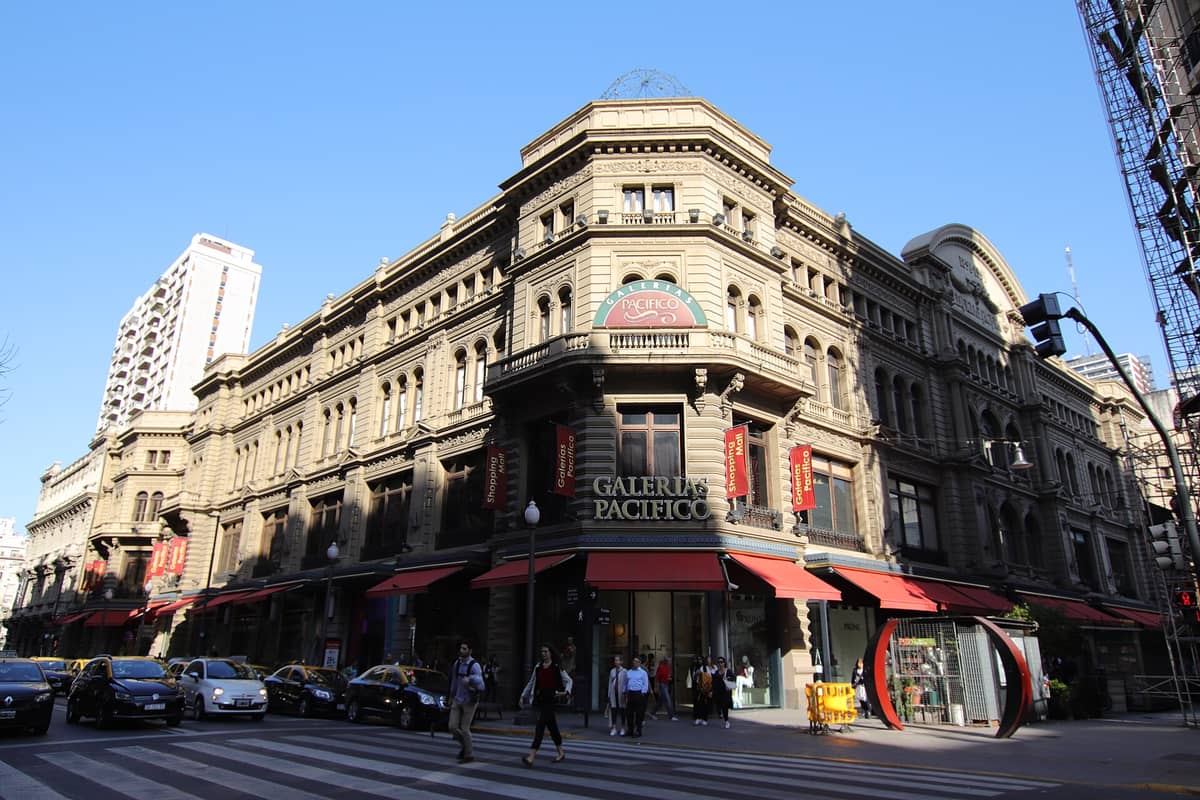
What Galerías Pacífico Actually Is
Galerías Pacífico is a working shopping mall occupying a grand 19th-century building at the corner of Avenida Córdoba and Florida Street in the Microcentro. From the outside, its Italian Renaissance-influenced facade blends into the dense commercial streetscape. Step through the entrance on Florida, though, and the scale changes immediately: you are standing beneath a broad four-armed gallery, each arm terminating at a central rotunda covered by a painted dome roughly 450 m² in area. The architecture stops most first-time visitors in their tracks.
The mall hosts over 180 stores across multiple levels, covering fashion, accessories, home goods, and cosmetics, along with a full food court and several restaurants. But calling it just a mall undersells it significantly. Galerías Pacífico was declared a National Historic Monument of Argentina in 1989, and the murals overhead were painted by five of the country's most important 20th-century artists. You are shopping inside a piece of Argentine cultural heritage.
💡 Local tip
Entry is completely free. You do not need to buy anything to walk in, look up at the dome, and leave. Treat it as a free art stop on any Microcentro walk.
The Building's Long History Before the Shops Arrived
The building was projected by architect Roland Le Vacher and constructed under engineer-architect Emilio Agrelo from 1888–1889 with the intention of housing an Au Bon Marché-style department store. That plan never materialized. Instead, from 1896 to 1940, the structure served as the first permanent home of the Museo Nacional de Bellas Artes, Argentina's national fine arts museum — which explains why the proportions feel more gallery than mall.
In 1908, the Buenos Aires al Pacífico Railway acquired part of the building, lending it the name Edificio Pacífico. The railway connection gave the building a commercial identity that eventually led to its current incarnation. After decades of changing use and partial neglect, a major restoration project returned the structure to something close to its original splendor. It reopened as a shopping centre in 1992.
The building's transformation from art museum to railway office to shopping destination mirrors the mixed fortunes of the surrounding Microcentro itself, a district that has cycled between commercial peak and urban stress across different economic eras of Argentine history.
Tickets & tours
Live prices and dates from our booking partner. If you book, we may earn a commission at no extra cost to you.
Madero Tango Show tickets with optional dinner
From 32 €Instant confirmationFree cancellationBuenos Aires small-group city tour with optional lunch and cruise
From 25 €Instant confirmationFree cancellationPiazzolla Tango Show VIP tickets with transfer and optional dinner
From 112 €Instant confirmationFree cancellationBuenos Aires shopping tour
From 15 €Instant confirmationFree cancellation
The Dome Murals: The Real Reason to Visit
The central rotunda ceiling is the attraction within the attraction. In the early 1940s, five Argentine artists were commissioned to paint the dome: Lino Eneas Spilimbergo, Antonio Berni, Juan Carlos Castagnino, Manuel Colmeiro, and Demetrio Urruchúa. The result is a large-scale figurative work spanning the entire interior of the dome, representing themes of fraternity, work, abundance, and national identity.
Antonio Berni and Lino Spilimbergo, in particular, are major figures in Argentine art history. Berni is best known for his socially charged realist painting and mixed-media work; Spilimbergo trained in Europe and was associated with muralism influenced by the Mexican tradition. Seeing their work here, in situ and at scale, is a different experience from encountering their canvases in a gallery.
The best viewing position is the center of the rotunda floor, looking straight up. The proportions are generous enough that you do not need to strain your neck uncomfortably. In the morning, natural light filters through the dome's glass sections and illuminates the figures clearly. By afternoon, the light flattens slightly. If you care about the murals, aim for a late-morning visit.
💡 Local tip
Photography of the dome is generally permitted and easy. Use a wide-angle lens or your phone's ultra-wide mode. The automatic exposure tends to overexpose the brighter sections — dial down your exposure compensation slightly for accurate colors.
What a Visit Feels Like at Different Times of Day
Weekday mornings between 10:00 and 12:00 are the calmest period. The shops are open, the food court is largely quiet, and you can stand under the dome without weaving through crowds. The sound of the space at this hour is a low, echoing hum of ventilation and distant footsteps on the marble-effect floors. The building smells faintly of coffee from the ground-floor cafes and the subtle warmth of conditioned air.
Lunchtime from around 12:30 to 14:00 draws office workers from the surrounding Microcentro blocks. The food court becomes genuinely busy, with queues at the more popular counters. The galleries fill with pedestrian traffic moving between Florida Street entrances and the side exits onto Viamonte and San Martín. This is still perfectly manageable, but less comfortable if you want to stand still and observe the architecture.
Saturday afternoons bring a different energy entirely. Families, tourists, and groups of teenagers from across the city make this one of the more crowded sessions of the week. If crowds bother you, Sunday morning is noticeably quieter, though some smaller shops may open later.
⚠️ What to skip
Florida Street itself — the pedestrian thoroughfare leading to the mall — attracts street vendors and informal money-changers who approach passersby. Ignore unsolicited offers of currency exchange. For guidance on handling Argentine pesos and exchange, see the Buenos Aires currency guide.
Getting There and Practical Details
The mall sits at Avenida Córdoba 550, occupying the block bounded by Florida, Viamonte, San Martín, and Córdoba. The most natural approach is along Florida Street from the south, which brings you to the main entrance. Subte line B stops at Florida station, and line C at nearby San Martín and Lavalle stations, making this one of the best-connected points in the city for public transport.
Shops are open daily from approximately 10:00 to 21:00, and many food outlets extend to around 21:00–22:00, though hours can shift — confirm on arrival or check the official site before visiting. For broader orientation around the Microcentro and what else to see nearby, the Buenos Aires walking tours guide covers logical route combinations in this part of the city.
The building has internal elevators connecting the levels, and the main galleries are wide and flat. Visitors with mobility requirements should note that the building is a designated National Historic Monument, which can affect the scope of structural modifications. Current accessibility specifics are best confirmed directly with mall management before your visit.
What to Shop and Eat
The tenant mix skews toward mid-range Argentine and international fashion brands, with a concentration of local clothing retailers, footwear, and leather goods stores. Leather is worth paying attention to: Argentine leather goods have a long tradition, and several vendors here stock jackets, bags, and belts at prices that can be reasonable compared to import-market equivalents in other countries, though this varies with the exchange rate environment.
The food court occupies the upper level and covers the standard range of Argentine fast food: empanadas, pizza by the slice, lomitos (steak sandwiches), and the usual international chains. It is convenient rather than memorable. For a more considered meal in the Microcentro area, the Buenos Aires café culture guide points toward better options within walking distance, including the historic Café Tortoni a few blocks south on Avenida de Mayo.
How Galerías Pacífico Fits Into the Surrounding Area
The mall sits at the northern end of the Florida pedestrian street, one of the main commercial axes in Buenos Aires. Walking south along Florida takes you past shops, street performers, and eventually toward Plaza de Mayo and the historic Monserrat district. Walking north from the Córdoba entrance connects quickly to the Teatro Colón area and Recoleta beyond.
A short walk east leads to the redeveloped Puerto Madero waterfront, and a few blocks south stands the Palacio Barolo, one of the most architecturally striking buildings in the city. If you are interested in Buenos Aires architecture more broadly, the Buenos Aires architecture guide covers the Microcentro's layered building stock in useful detail.
The Galerías Pacífico stop fits naturally into a half-day Microcentro circuit. It works especially well as a weather refuge on a hot summer afternoon or a rainy day when outdoor sightseeing loses appeal.
Who Should Skip It
If shopping centres hold no interest for you and you have limited time in Buenos Aires, Galerías Pacífico is probably not worth a dedicated journey. The dome murals are genuinely significant, but travelers with only a day or two who prioritize outdoor landmarks, tango, or food neighborhoods will find more return elsewhere. Experienced South American travelers who have visited similar restored landmark malls in other cities may also find the experience less revelatory than first-timers do.
It is also worth being honest about the retail offer: the shops are standard mall fare. If you are specifically looking for design goods, independent Argentine brands, or artisan crafts, dedicated shopping neighborhoods like Palermo Soho or the San Telmo market will serve you better.
Insider Tips
- The Centro Cultural Galerías Pacífico operates within the building and occasionally hosts free art exhibitions and cultural events in the basement level — check their schedule separately from the mall's retail hours.
- The Córdoba Avenue entrance (north side) is less trafficked than the Florida Street entrance and gives you a cleaner first view of the dome as you walk in from the quieter side.
- Late morning on a weekday is the single best time to photograph the dome: natural light is at its best, the rotunda floor is relatively clear of people, and the overhead lighting supplements without overpowering.
- The building occupies an entire city block. If one entrance seems crowded or you want to exit toward a specific street, you can walk through the gallery and emerge on Florida, Viamonte, San Martín, or Córdoba — useful for navigation as well as shopping.
- If you are visiting with the architecture as your primary interest, download a floor plan or look up the names of each mural panel before you arrive. Knowing which section was painted by Berni versus Spilimbergo makes the experience considerably richer.
Who Is Galerías Pacífico For?
- First-time visitors to Buenos Aires wanting a quick, free introduction to the city's architectural ambition
- Art and mural enthusiasts who want to see major Argentine figurative painting in an unusual in situ context
- Travelers caught in summer heat or a sudden rainstorm needing a central, comfortable place to pause
- Shoppers specifically interested in Argentine leather goods and mid-range fashion in one concentrated space
- Anyone walking the Florida Street corridor who wants context beyond the retail strip
Nearby Attractions
Other things to see while in Microcentro & Monserrat:
- Avenida Corrientes
Avenida Corrientes is the cultural backbone of central Buenos Aires, a long avenue lined with independent bookshops, mid-century theatres, and late-night pizzerias. Free to walk at any hour, it rewards visitors who linger past midnight as much as those who arrive at noon.
- Avenida de Mayo
Stretching 1.35 km through the heart of Buenos Aires, Avenida de Mayo connects the seat of government at Plaza de Mayo to the National Congress. Inaugurated in 1894 and declared a National Historic Site in 1997, it remains the city's most architecturally dense corridor — free to walk, open at all hours, and best explored at a deliberate pace.
- Cabildo de Buenos Aires
Standing at the western end of Plaza de Mayo, the Cabildo de Buenos Aires is where Argentina's independence process began in May 1810. Today it operates as the Museo Nacional del Cabildo de Buenos Aires y de la Revolución de Mayo, offering free admission and a carefully curated look at colonial-era governance and revolutionary history. Few buildings in the country carry this much political and architectural weight.
- Café Tortoni
Founded in 1858 on Avenida de Mayo, Gran Café Tortoni is the oldest continuously operating café in Buenos Aires. Its marble counters, stained-glass ceilings, and literary history make it one of the city's most photographed interiors — though the lines outside and tourist-oriented service mean expectations need calibrating before you walk in.
Planning a trip? Discover personalized activities with the Nomado app.