De Negen Straatjes (The Nine Streets): Amsterdam's Most Character-Rich Shopping District
De Negen Straatjes, or The Nine Streets, is a grid of nine historic cross-streets threading through Amsterdam's Canal Ring between the Singel and Prinsengracht. Free to explore at any hour, the area blends 17th-century canal architecture with independent boutiques, specialist food shops, and unhurried café culture. It rewards slow walkers and curious browsers far more than shoppers with a checklist.
Quick Facts
- Location
- Between Raadhuisstraat and Leidsegracht, Canal Ring, Amsterdam
- Getting There
- Trams 2, 4, 11, 12, 14, and 24 — alight at Koningsplein
- Time Needed
- 1.5 to 3 hours (longer if you browse shops or stop at a café)
- Cost
- Free to enter; individual shops and cafés charge separately
- Best for
- Independent retail, architecture walks, slow-travel exploration
- Official website
- de9straatjes.nl
What Is De Negen Straatjes?
De Negen Straatjes, officially styled De 9 Straatjes, is a compact retail and residential district occupying nine short cross-streets in Amsterdam's Canal Ring. The streets run perpendicular to the four great canals: Singel, Herengracht, Keizersgracht, and Prinsengracht. Bounded by Raadhuisstraat to the north and Leidsegracht to the south, the district sits just a short walk west of Dam Square and the Royal Palace.
The streets themselves date to the first half of the 17th century, when Amsterdam's famous canal expansion programme linked the main waterways with cross-canals and connecting streets. For centuries they housed merchants, craftsmen, and small traders. The collective identity and marketing name De 9 Straatjes emerged in the 1990s, when a group of local entrepreneurs formed an association and began promoting the district under a single brand. The name stuck, and the area has attracted an increasing number of independent shops, galleries, and restaurants ever since.
Unlike the major retail spine of Kalverstraat, De Negen Straatjes has no chain stores to speak of. Its identity comes precisely from what is absent: no international fast fashion, no souvenir factories, no queuing crowds. What fills the space instead is a dense concentration of owner-operated specialty shops, concept stores, vintage clothing, specialist books, artisan food, and design objects.
💡 Local tip
The streets are public and free to walk at any time of day or night. Most shops open roughly 09:00–17:30 on weekdays and Saturdays, with Sunday hours generally shorter, around 11:00–17:30. Hours vary by shop, so expect some variation outside peak season.
The Streetscape: What You Actually See
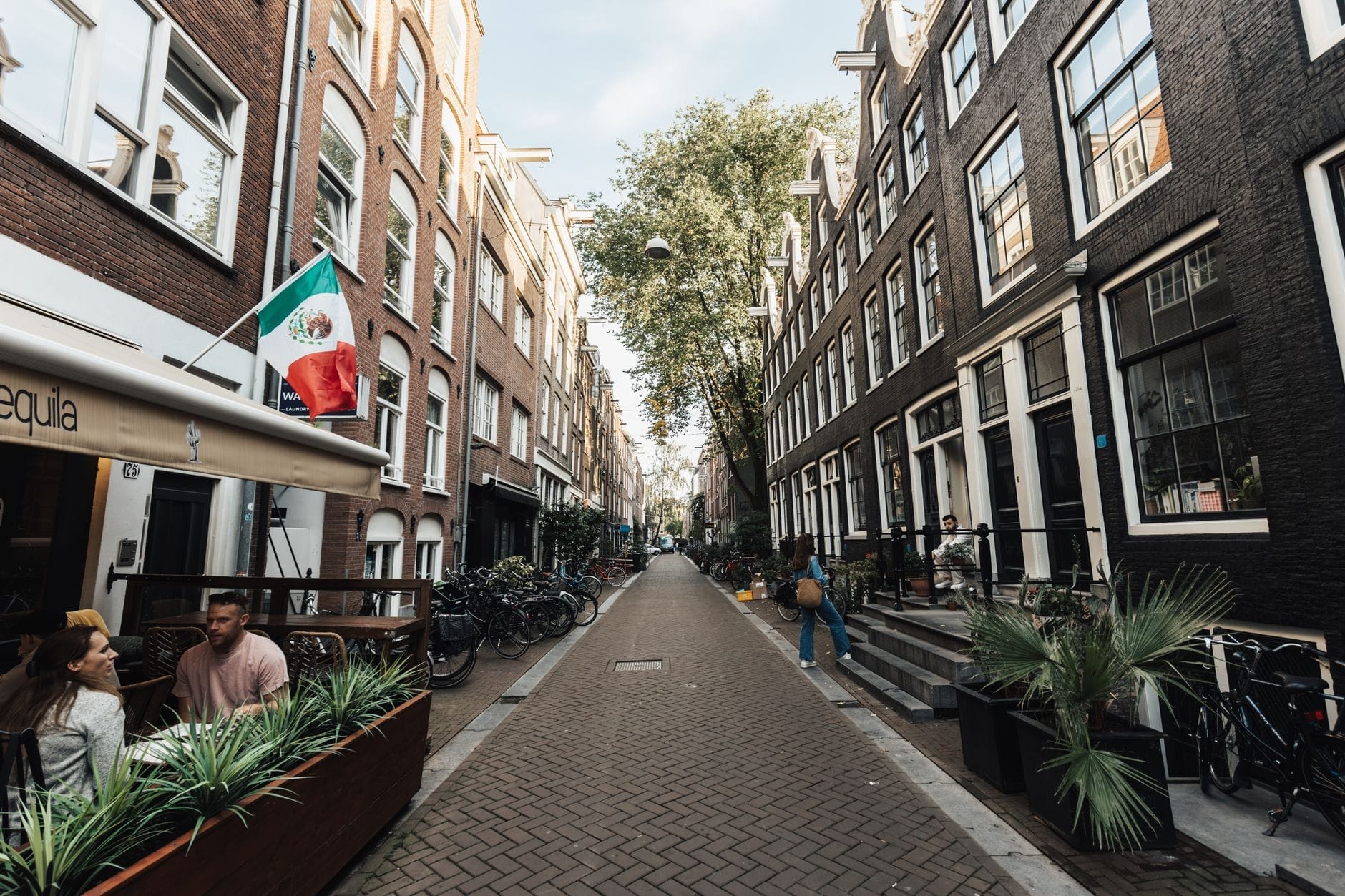
Each of the nine streets is short, typically between 150 and 250 metres, and narrow enough that you can scan both sides without crossing the road. The buildings are characteristic Amsterdam canal-house architecture: stepped or spout gables, large sash windows at ground level turned into shop fronts, and facades that lean slightly forward, a feature engineered for hoisting goods to upper floors. The brickwork ranges from dark brown to pale ochre, and the ground floors have been adapted over centuries without erasing the original proportions.
Canal bridges punctuate each street as it crosses Herengracht, Keizersgracht, and Prinsengracht. The bridges are small, arched, and mostly stone or brick. On a clear morning the reflections in the canal water below are sharp enough to photograph cleanly. By late afternoon the western light falls directly along the canals, and the gable facades catch an orange-gold tone that makes the whole area look noticeably different from how it appeared at noon.
Street-level details reward slow movement: hand-lettered window signs, stacked vintage magazines visible through glass, potted plants balanced on bridge railings, and the occasional interior courtyard glimpsed through a propped-open door. The cobblestone surface in parts of the area is uneven, which matters if you are walking for hours or pushing a stroller.
Tickets & tours
Live prices and dates from our booking partner. If you book, we may earn a commission at no extra cost to you.
Gray Line Canal Cruise with snackbox & Heineken Experience
From 48 €Instant confirmationFree cancellationAmsterdam evening canal cruise
From 18 €Instant confirmationFree cancellationJewish Museum and Portuguese Synagogue entrance ticket
From 20 €Instant confirmationFree cancellationAdmission ticket for Artis Royal Zoo and Micropia
From 39 €Instant confirmationFree cancellation
How the Experience Changes Through the Day
Weekday mornings before 10:00 are the quietest the streets get. Shopkeepers are setting up, deliveries are trickling in on cargo bikes, and the cafés are filling with locals rather than visitors. If you want the canal reflections and gable facades without other people in your frame, this is the time.
From late morning through early afternoon on weekends, the area draws its densest crowds. Saturdays in spring and summer can feel genuinely packed on the narrower streets, particularly around café terraces that spill onto the pavement. The character shifts but does not disappear: there is more energy, more conversation, and the shops are fully staffed and open. If you enjoy the atmosphere of a neighbourhood that is visibly well-loved, the weekend buzz is part of the appeal.
Sunday afternoons have a different tempo again. Many locals treat Sunday in De Negen Straatjes as a slow ritual: brunch, a browse, a second coffee. Shops open later and the pace is noticeably unhurried. For visitors who find Saturday's crowds off-putting, Sunday morning before noon often represents a useful middle ground.
ℹ️ Good to know
Weather genuinely changes the experience here. On rainy days the canal reflections become more dramatic and the streets empty out. Most shops have small interiors, so browsing stays comfortable regardless of conditions. A light waterproof layer is worth carrying in any season.
What to Expect from the Shops and Cafés
The retail offer in De Negen Straatjes is broad in category but consistent in character. You will find vintage and second-hand clothing shops ranging from carefully curated to maximally crammed. There are booksellers, including English-language specialists. Cheese, chocolate, and specialist food shops appear at regular intervals. Design and homewares boutiques display Dutch and Scandinavian-influenced objects at prices that reflect the neighbourhood's desirability. Several antique dealers and curiosity shops stock items with genuine age rather than manufactured vintage aesthetics.
Cafés are woven into the same fabric. Many are small, with just a handful of tables, and the menu is typically coffee, tea, and a short selection of Dutch or European baked goods. Some have canal-facing windows or terrace seats on the bridge approaches. These spots fill quickly on weekend mornings, and you may wait for a table if you arrive after 10:30.
There are also a few notable museums and cultural venues within or immediately adjacent to the district. The Houseboat Museum on the Prinsengracht is a short walk from the southern edge of De Negen Straatjes, and the Anne Frank House is just north of the district on the same canal, making a natural pairing for a half-day in the neighbourhood.
Getting There and Moving Around
The most direct public transport route from Amsterdam Centraal is any tram on lines 2, 4, 11, 12, 14, and 24. Alight at Koningsplein and you are at the southern edge of the Canal Ring, a three to five minute walk from the nearest streets of De Negen Straatjes. The journey from Centraal takes around ten minutes depending on traffic.
Cycling is the most natural way to arrive and leave, consistent with how the neighbourhood functions day-to-day. Bike racks are available throughout the area, though they fill on weekend afternoons. For visitors joining a cycling tour of Amsterdam, the nine streets form a logical waypoint between the Canal Ring and the Jordaan just to the north.
Walking from Dam Square takes around fifteen minutes through the canal streets, passing several of Amsterdam's most photographed canal views en route. This is a worthwhile approach if you have the time.
⚠️ What to skip
Accessibility is inconsistent across the district. Cobblestones, narrow bridge crossings, and step-entry shop fronts can make mobility difficult for wheelchair users. There is no coordinated accessibility infrastructure for the area as a whole. Check with individual venues directly if this is a concern.
Cultural and Historical Context
The nine streets sit within Amsterdam's broader Canal Ring, which was added to the UNESCO World Heritage List in 2010 for its exceptional example of 17th-century urban planning. The grid of canals and cross-streets in this district represents the rational, commercially-driven city expansion that made Amsterdam one of the wealthiest cities in the world during what the Dutch call the Golden Age.
The neighbourhood immediately to the north, the Jordaan, developed slightly differently: built for the working class while the canal houses were occupied by wealthy merchants. Today the boundary between the two areas is blurred, and visitors often walk between them without noticing the transition. The Jordaan has its own set of small streets, courtyards, and specialist shops that complement a visit to De Negen Straatjes.
The commercial identity of De Negen Straatjes is genuinely distinct from much of central Amsterdam. The absence of chain retail is not accidental. The local business association has maintained a deliberate focus on independent operators, and the result is an area that still functions as a real neighbourhood rather than a visitor corridor. Residents do their weekly shopping here alongside tourists browsing for gifts.
Photography and Practical Details
The most photographed views combine the arched canal bridges, the water, and the gabled facades in a single frame. The best positions are from the middle of a bridge looking along the canal, ideally with morning or late afternoon light coming from the side. Canal-side trees add a seasonal dimension: bare in winter, bright green in spring and summer, gold and rust in October.
For travellers thinking about broader context, De Negen Straatjes sits at the intersection of several different Amsterdam experiences. It is close enough to the Anne Frank House and the Westerkerk to combine with a history-focused morning, and it leads naturally into Westerkerk or further into the Jordaan for the rest of the afternoon. The Amsterdam canal cruise routes pass along the Prinsengracht and Keizersgracht and provide a useful way to see the area from water level before or after walking.
Travellers who find Amsterdam's most visited attractions crowded and impersonal tend to respond well to De Negen Straatjes. It does not reward those seeking major monuments or a quick sightseeing tick. But for anyone who wants to understand how the city functions at street level, spends time in shops that have actual opinions about what they sell, and stops for coffee when a place looks right rather than when the itinerary says to, this is exactly the right kind of place.
Insider Tips
- The streets named Hartenstraat and Wolvenstraat tend to have the highest concentration of design and specialty boutiques. If your time is short, these two alone give a representative sample of the district's character.
- Sunday mornings before noon offer the quietest weekend conditions. Shops are open by 11:00, the lunch crowds have not yet arrived, and you can move through the streets without constant pausing.
- The canal bridges that cross Herengracht and Keizersgracht between the nine streets offer some of the best unobstructed canal photographs in central Amsterdam, and they see far fewer tripods than the standard tourist viewpoints.
- Several shops do not accept cards or prefer cash for small purchases. Carrying some euros is useful, though Amsterdam in general is increasingly cashless.
- If you are visiting in late autumn or winter, the Haarlemmerstraat to the north and the shops along Prinsengracht provide good shelter and indoor options when temperatures drop, extending your time in the neighbourhood without needing to return to the busier centre.
Who Is De Negen Straatjes (The Nine Streets) For?
- Independent shoppers looking for Dutch design, vintage clothing, and specialist food products outside mainstream retail
- Architecture and photography enthusiasts interested in 17th-century canal-house facades and UNESCO-listed streetscapes
- Slow travellers who prefer exploring a working neighbourhood over checking off monuments
- Couples or pairs who want a half-day combining canal walks, café stops, and casual browsing
- Visitors pairing the area with nearby attractions like the Anne Frank House, Westerkerk, or the Jordaan
Nearby Attractions
Other things to see while in Jordaan:
- Amsterdam Cheese Museum
Tucked into a building on Prinsengracht, often described as dating from around 1600, the Amsterdam Cheese Museum offers a free, compact introduction to Dutch cheese culture, complete with tastings and exhibits. It sits two minutes from the Anne Frank House, making it a natural addition to a Jordaan afternoon.
- Amsterdam Tulip Museum
Tucked into a canal house on Prinsengracht, directly across from the Anne Frank House, the Amsterdam Tulip Museum traces 400 years of tulip history, from Ottoman origins to the chaos of Tulip Mania and the flower's enduring grip on Dutch identity. Small in scale but precise in focus, it rewards curious visitors who want context beyond the postcard.
- Het Schip Museum
Museum Het Schip occupies a landmark 1919 public housing complex designed by Michel de Klerk, the defining genius of the Amsterdam School movement. Part architecture museum, part social history, it offers one of Amsterdam's most distinctive and undervisited cultural experiences.
- Lindengracht Market
Every Saturday, Lindengracht transforms into one of Amsterdam's most genuine street markets, stretching over more than 900 metres through the heart of the Jordaan. With 232 stalls selling everything from farm-fresh cheese to vintage clothing, it draws locals far more than tourists. Free to enter and easy to reach, it rewards an early morning visit.
Planning a trip? Discover personalized activities with the Nomado app.