Cuandixia Village: A Well-Preserved Ming and Qing Dynasty Mountain Settlement
Cuandixia Village (爨底下村) in Mentougou District is a well-preserved Ming and Qing dynasty rural settlement in northern China. With over 70 original courtyards, stone-paved alleyways, and a dramatic hillside setting roughly 90 km west of central Beijing, it rewards visitors who make the effort to get there.
Quick Facts
- Location
- Zhaitang Town, Mentougou District, Beijing — approximately 90 km west of central Beijing
- Getting There
- Pingguoyuan Subway Station (Line 1 west terminus), then scheduled Bus 929 branch service toward Cuandixia Village entrance; alternatively, Bus 892 to Zhaitang followed by local transport
- Time Needed
- 3–5 hours on site; allow a full day including travel from central Beijing
- Cost
- Adults CNY 35; students/seniors CNY 18; children under 1.2 m free
- Best for
- Architecture enthusiasts, photographers, history travelers, and anyone wanting a genuine escape from urban Beijing
- Official website
- http://www.cuandixia.com
What Cuandixia Village Actually Is
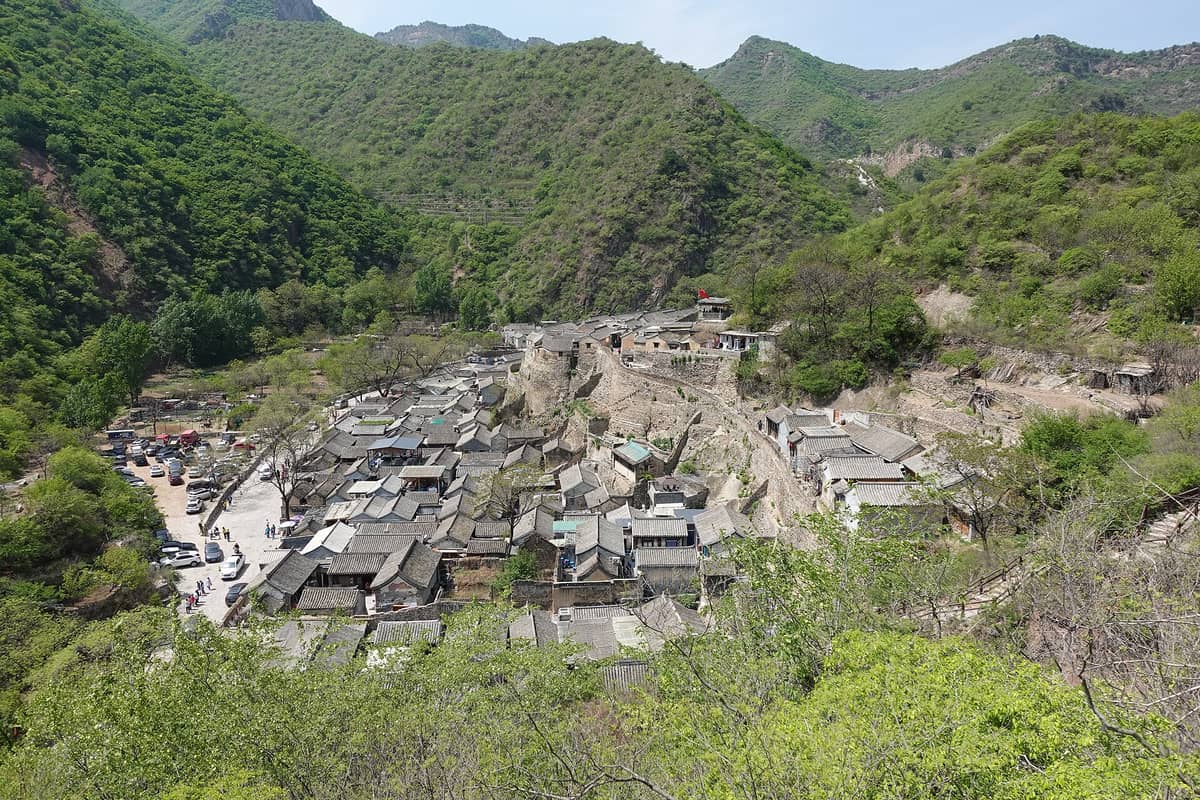
Cuandixia Village (爨底下村, pronounced roughly 'Tswan-dee-shya') sits on a south-facing slope in the Zhaitang River valley, tucked between ridgelines in Mentougou District's western mountains. The village has more than 400 years of history, and unlike many 'ancient' sites in China that have been reconstructed or heavily commercialized, its core fabric is largely original. More than 70 courtyard compounds from the Ming and Qing dynasties survive, The character '爨' in the village's name is one of the most complex characters in written Chinese, with 30 strokes, and local souvenir sellers are usually happy to demonstrate how to write it.
The village is not a theme park and it is not sanitized. Families still live here, though numbers have declined significantly. Washing hangs in courtyards, cats sleep on stone walls, and some buildings are in a state of gentle decay. That authenticity is exactly what makes it worth the trip from the city.
ℹ️ Good to know
The village is listed as open 24 hours. Confirm locally before travel, or call the site at 010-69819333.
How the Village Feels at Different Times of Day
The first hour after gates open is the calmest. Morning light enters the valley from the east and catches the textured surfaces of the stone walls at a low angle, bringing out the grey and ochre tones in the old masonry. The alleyways are narrow enough that two people passing each other need to turn sideways in places, and in the morning quiet you can hear the sound of your own footsteps on the flagstones, along with whatever the few resident households are doing in their courtyards.
By midday, particularly on weekends and during national holidays, tour groups arrive in volume. The main lane through the village can get genuinely crowded, and the atmosphere shifts from contemplative to more social. Vendors selling walnut cakes, grilled corn, and locally produced millet wine set up along the route. If you are primarily here for photography or quiet observation, arriving early or staying late into the afternoon is worth the planning.
Late afternoon brings a second window of good light. The western ridgeline casts a shadow across the valley floor while the upper terraces of the village remain in full sun, creating strong contrasts that are good for wide shots of the settlement against the mountains. Visitors thin out after 15:00 on most days as tour buses begin returning to Beijing, and the light between 16:00 and 17:00 in autumn is some of the best available.
Tickets & tours
Hand-picked options from our booking partner. Prices are indicative; availability and final rates are confirmed when you complete your booking.
Ming dynasty, village Cuandixia and Liulichang street private tour
From 340 €Instant confirmationFree cancellationSmall group tour of Tian'anmen Square and the Forbidden City
From 43 €Instant confirmationFree cancellationBeijing Summer Palace Entrance Ticket
From 7 €Instant confirmationFree cancellationMutianyu Great Wall and Summer Palace small-group tour from Beijing
From 171 €Instant confirmationFree cancellation
The Architecture: What You're Actually Looking At
The courtyards follow the classic northern Chinese siheyuan form, adapted for a mountain site. Because the village is terraced up a slope, the compounds step up the hillside rather than sitting on a flat plain, and the result is a layered streetscape where rooflines at one level become the pathway for the next. Stone is the dominant material throughout: walls, gates, drainage channels, and paths are all cut from local grey stone, giving the whole village a tonal consistency that a urban architect would have had to deliberately design.
Look closely at the gate piers and roof ridgelines on the larger compounds. The decorative brick and tile work on the better-preserved gates includes traditional good-luck motifs: bats (representing fortune), fish, and geometric patterns typical of late Ming and Qing vernacular architecture. A few gates carry inscriptions, and some courtyards contain small shrines or wall niches that were used for offerings.
The village layout also reflects the feng shui principles that governed rural Chinese settlement planning: a hill to the north provides shelter from cold winds, the slope faces south for maximum winter sun, and the village gate is oriented away from the direct prevailing mountain gusts. For travelers with a deeper interest in Chinese architectural history, pairing a visit here with the Ming Tombs or the courtyard sections of Beijing's hutong neighborhoods gives useful context for how the same era's building traditions played out at different scales and social levels.
Getting There and Back: The Honest Version
Cuandixia is not easy to reach without a car, and that is a significant factor in whether this day trip works for a given traveler. Public transit can start at Pingguoyuan Station, the western terminus of Beijing Subway Line 1, where scheduled Bus 929 branch service runs toward Cuandixia Village entrance. Another commonly cited option is Bus 892 to Zhaitang Town, followed by local transport for the final stretch to the village, which is roughly 5 km north of National Highway 109 (G109).
The total transit time from central Beijing is typically 2.5 to 3.5 hours each way under normal conditions. That makes the round trip genuinely long for a day visit. Many travelers choose to rent a car, hire a private driver, or join an organized day tour from the city, which compresses door-to-door travel significantly and removes the complexity of the multi-stage bus connection.
💡 Local tip
If you drive, follow G109 (the old Jingzang Highway) westward through Mentougou. Exit near the 84 km marker and continue approximately 5 km north on the mountain road to the village. Navigation apps (Baidu Maps, Gaode/Amap) work well in this area. There is a parking area near the village entrance.
Combining this trip with a visit to Huanghuacheng Great Wall or another outer-district attraction in the same direction makes geographic sense if you have a private vehicle and a full day. For general day trip planning, the day trips from Beijing guide covers transport options and logistics in detail.
What to Expect on the Ground
After paying admission at the entrance gate (CNY 35 for adults, CNY 18 for students and seniors with valid ID, free for children under 1.2 m), you follow a main path that winds up through the settlement. The village is explored on foot, with traditional flagstone surfaces and steeper options for those who climb to the upper terraces.
Wear shoes with a grip. This matters particularly in wet weather or early morning when the stones are damp and can be slippery. The mountain climate is noticeably cooler than central Beijing at all times of year: expect temperatures roughly 3–5°C lower than the city, stronger winds, and in autumn, genuinely cold air by late afternoon. An extra layer is worth bringing even on days when Beijing itself feels warm.
Some courtyards have been converted into guesthouses offering simple overnight accommodation, and a handful of small restaurants serve local Mentougou dishes including hand-pulled noodles and stewed pork. Staying overnight transforms the experience: the village empties almost completely of day visitors by late afternoon, and what remains is the sound of wind, distant roosters, and the kind of quiet that is genuinely hard to find within Beijing's municipal boundaries.
⚠️ What to skip
Accessibility is limited. The village is a historic mountain settlement with uneven stone paths, steps, and narrow gateways. Step-free access is not confirmed by official visitor information. Contact the village directly at 010-69819333 before visiting if mobility is a concern.
Photography and Seasonal Considerations
Autumn, from mid-October through early November, is the most visually compelling season. The walnut and persimmon trees turn, harvested crops are laid out to dry on courtyard walls and rooftops, and the surrounding mountain slopes shift from green to gold and rust. The combination of warm architectural tones and autumn foliage is what produces the images most associated with Cuandixia.
Spring is quieter and the vegetation fresher, but the village has less harvest-season character. Summer brings full greenery to the slopes but also the highest visitor numbers and occasional rain. Winter visits are possible and unusually atmospheric: snow settles on the stone roofs and courtyard walls, and crowds essentially disappear, but access by public transport becomes harder and some guesthouses and restaurants may close.
For composition, the elevated viewpoint on the upper terrace above the village gives a sweeping view down across the settlement and valley below. A wide-angle lens handles the narrow alleyways; a longer focal length is useful for pulling in the layered rooflines from the opposite hillside. For more on planning photography visits to Beijing's outer sites, the Beijing photography guide covers timing, locations, and practical logistics.
Who Will Get the Most From This Visit — and Who Won't
Cuandixia suits travelers who are genuinely interested in architecture, rural history, or landscape photography, and who are willing to invest a full day in the round trip. The site is quiet relative to major city attractions and has real historical integrity. Those with limited time in Beijing who need to prioritize will find more density of experience inside the city, where the Forbidden City, Temple of Heaven, and the hutong districts deliver more per hour of effort.
Visitors who find rural China more compelling than its imperial monuments will likely consider this among their best days in the region. If your Beijing itinerary is already weighted toward inner-city landmarks, check whether the Beijing hidden gems guide or the 3-day Beijing itinerary offers a better fit for your available time before committing a full day to the trip west.
Insider Tips
- Buy your bus tickets for the return journey at Zhaitang as soon as you arrive — the last afternoon buses fill up, and stranding yourself in the valley with no onward transport is a real risk on busy weekend days.
- The character '爨' on the village entrance sign makes a surprisingly effective conversation opener with local residents and guesthouse owners, most of whom will cheerfully explain how to write and pronounce it.
- Overnight stays are genuinely worth it. Rates at the courtyard guesthouses are modest by Beijing standards, and the experience of the village after day visitors leave is entirely different from the daytime visit — quieter, cooler, and more atmospheric.
- The best elevated viewpoint is accessed by taking the stepped path that climbs the slope on the east side of the village. From the top, you get a full overview of the settlement's terraced layout against the valley — it is the shot that makes sense of the whole site.
- Bring cash. Card payment infrastructure is limited in the village, and while some vendors may accept mobile payment apps, small guesthouses and food stalls often operate cash only.
Who Is Cuandixia Village For?
- Architecture and heritage travelers interested in Ming and Qing dynasty vernacular building
- Photographers targeting autumn foliage combined with historic rural settings
- Travelers seeking a full-day escape from central Beijing's pace and density
- Those interested in staying overnight in an authentic historic village guesthouse
- Repeat Beijing visitors who have already covered the major inner-city monuments
Nearby Attractions
Combine your visit with:
- Longqing Gorge
Longqing Gorge (龙庆峡) is a dramatic natural gorge in Yanqing District, roughly 80 km northwest of central Beijing. Stretching approximately 7,000 meters through sheer limestone walls, it draws visitors for its reservoir boat rides in summer and its spectacular ice-and-lantern festival in winter. This is not a polished city attraction; it requires planning, a longer commute, and realistic expectations about the experience.
- Marco Polo Bridge (Lugou Qiao)
Built in 1189 and later rebuilt in 1698, Lugou Qiao spans the Yongding River in Fengtai District. It is both an architectural landmark and the site where the opening shots of China's full-scale war with Japan were fired in 1937. Few places in Beijing carry this much weight in a single span of stone.
- Peking Man Site at Zhoukoudian
The Peking Man Site at Zhoukoudian, carved into the limestone hills of Fangshan District roughly 50 km southwest of central Beijing, is one of the most significant paleoanthropological sites on Earth. Fossils discovered here in the 1920s and 1930s fundamentally changed scientific understanding of human evolution. The site combines outdoor cave excavations with an indoor museum, and rewards visitors who take their time.
- Universal Studios Beijing
Universal Studios Beijing opened in September 2021 as one of the largest Universal theme parks in the world. Located in Tongzhou District, it combines globally familiar franchises with zones designed specifically for Chinese audiences. Here is what you need to know before buying a ticket.