Ming Tombs (Shisanling): What to Expect at Beijing's Imperial Burial Complex
The Ming Tombs, officially 明十三陵, spread across a valley at the foot of Tianshou Mountain in Changping District, roughly 50 km north of central Beijing. Thirteen Ming-dynasty emperors were buried here between 1409 and 1644, making this one of the largest and best-preserved imperial burial complexes in the world. Several tombs plus the Sacred Way are open to visitors, with Changling, Dingling, Zhaoling, and the Sacred Way serving as the regular open attractions; other tombs may require advance reservation., each offering a distinctly different experience.
Quick Facts
- Location
- Shisanling Town, Changping District, Beijing (approx. 50 km north of central Beijing)
- Getting There
- Bus 872 from Deshengmen is a commonly used route to the Ming Tombs area; verify current subway and bus connections before travel
- Time Needed
- Half-day minimum (3–4 hours) for two or three sites; full day to cover all open areas
- Cost
- Dingling ¥60 peak / ¥40 off-season; verify current prices for Changling, Zhaoling, and the Sacred Way before visiting
- Best for
- History and architecture enthusiasts, dynasty-era China, photography, day trips from Beijing
What the Ming Tombs Actually Are
The Ming Tombs, known in Chinese as 明十三陵 (Míng Shísān Líng), are the collective burial grounds of 13 of the 16 Ming-dynasty emperors. Construction began in 1409 under the Yongle Emperor, who chose the site for its geomantic qualities: a horseshoe-shaped valley sheltered by mountains to the north, open to the south, with rivers curving through the terrain. The arrangement follows classical Chinese feng shui principles with unusual rigor. Each tomb is an independent walled compound with ceremonial halls, burial vaults, and a Soul Tower marking the earth mound above the actual burial chamber.
The scale of the complex is easy to underestimate on a map. The tombs are spread across roughly 40 square kilometers of valley and foothills. A single approach road, the Sacred Way, leads into the valley and is flanked by stone statues of officials, warriors, and animals, some of the finest Ming-era stone sculpture anywhere. From that central spine, smaller roads branch to individual tomb compounds. Most visitors see two or three sites in a day; covering all open areas properly requires more time and planning than a standard tour itinerary allows.
ℹ️ Good to know
The complex sits in Changping District, not in any of Beijing's central districts. Plan for at least 90 minutes of travel each way from central Beijing, more during peak traffic hours.
The Sacred Way: Where the Experience Begins
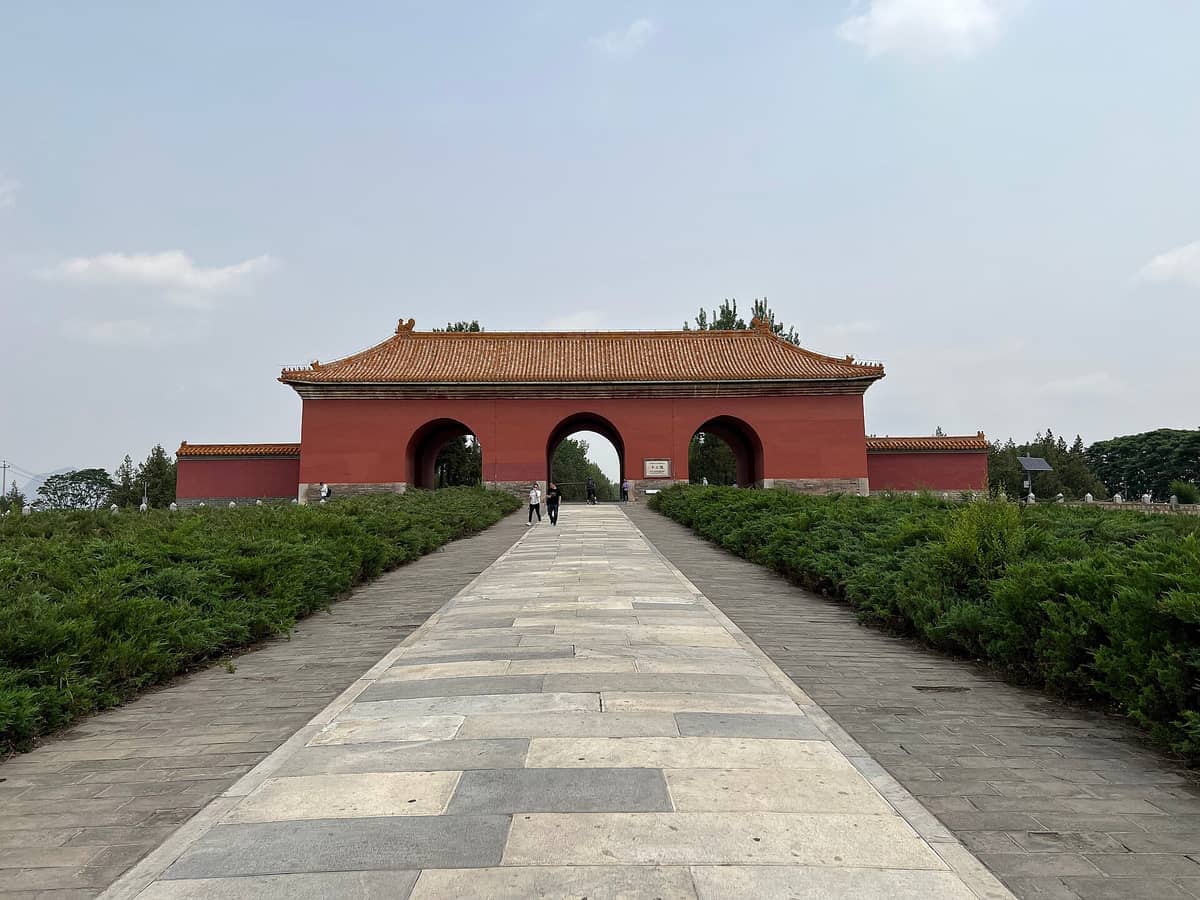
Most visitors enter the Ming Tombs complex via the Shengong Shengde Stele Pavilion and the Great Palace Gate, then walk the Sacred Way (Shendao). The approach is lined with 36 stone figures in total: 12 pairs of animals (lions, xiezhi, camels, elephants, qilins, and horses, each depicted in standing and recumbent positions) followed by 12 human figures representing military officials, civil officials, and meritorious officials. These statues were carved in the early 15th century and have survived remarkably intact.
Walking the Sacred Way takes about 30 to 40 minutes at a comfortable pace. In the early morning, before the tour buses arrive around 09:30, the stone avenue is quiet and the light is soft on the carved surfaces. The textures of the sculptures are striking up close: the layered stonework of elephant skin, the stylized manes of the lions, the formal rigidity of the officials' robes. This is one of those places where photographs genuinely cannot substitute for standing in front of the objects. The scale of each figure, roughly twice human height, only registers in person.
💡 Local tip
Arrive at the Sacred Way by 08:30 if possible. Tour groups from central Beijing typically arrive between 09:30 and 10:30, and the narrow stone path becomes congested quickly.
Tickets & tours
Hand-picked options from our booking partner. Prices are indicative; availability and final rates are confirmed when you complete your booking.
Mutianyu Great Wall and Ming Tombs Private Guided Tour
From 306 €Instant confirmationFree cancellationJuyongguan Great Wall and in-depth tour of Ming Tombs
From 331 €Instant confirmationFree cancellationJuyongguan Great Wall, Sacred Way and Ming Tombs Day Tour from Beijing
From 289 €Instant confirmationFree cancellationJuyongguan Great Wall, Sacred Way of Ming Tombs and Summer Palace tour
From 331 €Instant confirmationFree cancellation
The Three Open Tombs: Changling, Dingling, and Zhaoling
Changling, Dingling, and Zhaoling are the regular open tombs most visitors can explore individually; additional tombs may open by reservation. Each has a distinct character and offers something different.
Changling: The Largest and Most Complete
Changling is the tomb of the Yongle Emperor, the man who commissioned the complex and moved China's capital from Nanjing to Beijing. It is the oldest tomb here and the best preserved. The Ling'en Hall, the main ceremonial structure, is one of the finest surviving examples of Ming imperial timber architecture: 32 massive nanmu hardwood columns support a double-eaved roof, and the interior still smells faintly of the centuries-old wood. The scale and craftsmanship rival the halls of the Forbidden City. The underground burial chamber at Changling has not been excavated, which means what you see above ground is largely original and undisturbed in its setting.
Dingling: The Excavated Underground Palace
Dingling is the tomb of the Wanli Emperor (r. 1572–1620) and is the only Ming tomb where the underground burial chambers have been professionally excavated and opened to visitors. Descending into the stone vault, roughly 27 meters below ground, is a genuinely unusual experience: the air is noticeably cooler and damper, the chambers are vaulted with white marble, and the reconstruction of the burial arrangement gives a concrete sense of imperial funerary practice. Replicas of burial objects are displayed, as the original artifacts were moved to museums. The descent involves steep stairs and requires reasonable mobility.
Dingling tends to draw the largest crowds of the three open tombs, partly because of the underground access and partly because tour itineraries frequently prioritize it. If you visit on a weekend or national holiday, expect queues at the vault entrance.
Zhaoling: The Quietest Option
Zhaoling, the tomb of the Longqing Emperor, receives far fewer visitors than either Changling or Dingling. The compound has been restored and the ceremonial halls are in good condition, but what distinguishes Zhaoling is the atmosphere: on most weekdays it is genuinely uncrowded. If you want to experience the spatial logic of a Ming tomb compound at your own pace, without competing for sight lines, Zhaoling is the better choice. The ticket price is also the lowest of the three.
How the Site Changes Through the Day
The character of the Ming Tombs shifts substantially depending on when you arrive. Before 09:00, the valley is quiet and the air carries the smell of pine and cypress, the trees planted across the site as part of the original funerary landscape. Birdsong is audible. The mountains to the north are often clear of haze in the early morning during autumn. By mid-morning, the site becomes busy with domestic tour groups, school trips, and individual visitors. The Sacred Way in particular becomes a slow-moving procession between roughly 10:00 and 13:00.
Afternoon visits, from around 14:00 onward, see crowds thin noticeably as tour buses depart. The light in the late afternoon is favorable for photography of the stone sculptures and the red and yellow ceremonial halls. If you have flexibility, arriving early and leaving before noon, or arriving after 13:30 and staying close to closing time, gives you a significantly better experience than the midday peak.
Weather has a real effect on the visit. Autumn (September through October) is generally the most rewarding season: temperatures are moderate, foliage begins to turn around the tomb compounds, and visibility tends to be good. Spring visits in April and May can be pleasant but dusty winds occasionally reduce visibility. Summer is hot and rainy, and while the site remains photogenic, the combination of heat and humidity on the exposed Sacred Way is tiring. Winter visits are cold but can offer blue skies and an uncrowded site with frost on the stone figures.
Getting There and Moving Around the Complex
Bus 872 from Deshengmen is a commonly used route to the Ming Tombs area. Subway and local connections can change, so verify the current route and travel time before departure. Driving or taking a pre-booked vehicle is more practical if you want to visit multiple sites without relying on the infrequent local buses that connect individual tombs within the complex.
Inside the complex, the individual sites are spread out. The Sacred Way, Changling, Dingling, and Zhaoling are not within easy walking distance of each other. Electric shuttle buses operate between the main sites, and taxis are usually available near the main parking areas. If you arrive by tour, transport between sites is typically included. Independent visitors should factor in transit time between tombs when planning the day.
The Ming Tombs are often combined with a Great Wall visit into a single day trip from Beijing, with Badaling Great Wall located about 30 km to the northwest. This is a long day and can feel rushed if you want to engage seriously with either site. For a more measured experience of the imperial landscape, consider pairing the tombs with a visit to the Mutianyu Great Wall section on a separate day.
Historical and Cultural Context
The Ming dynasty (1368–1644) ruled China for nearly three centuries. The decision to locate the imperial tombs here, at the foot of Tianshou Mountain in what is now Changping District, reflected both strategic and cosmological thinking. The Yongle Emperor personally inspected the site in 1409 after moving the capital north, and the valley was developed continuously for over two centuries as successive emperors built their own compounds within the sheltered geography.
The Ming Tombs were inscribed as a UNESCO World Heritage Site in 2003, as part of the Imperial Tombs of the Ming and Qing Dynasties nomination. The site is administered as part of Beijing's broader imperial heritage infrastructure, alongside the Forbidden City and the Temple of Heaven. Understanding the tombs as part of that larger system, rather than as isolated monuments, makes the visit more meaningful: the same emperors who resided in the Forbidden City were buried here, and the ceremonial connections between those places were explicit in Ming court ritual.
For those interested in tracing Beijing's imperial history more systematically, the Beijing imperial history guide provides a useful framework before visiting the tombs.
Practical Details: Tickets, Hours, and Accessibility
Opening hours are 08:30 to 17:30 in peak season and 08:30 to 16:30 in the off-season. Individual site hours may vary, so verify current hours directly with the venue before visiting. Verify current hours directly with the venue before visiting, as seasonal adjustments can occur.
Dingling costs ¥60 in peak season and ¥40 in the off-season. Prices for the other attractions, combined tickets, and concessionary admission should be confirmed through the current official ticket notice before visiting.
Accessibility varies across the site. The Sacred Way is paved but has uneven sections. Changling's main hall is accessible at ground level. Dingling's underground vault involves steep staircases that are not suitable for visitors with limited mobility. Zhaoling's compound is relatively flat. Comfortable, closed-toe shoes are essential for all sites; the ground surfaces are often uneven stone or compacted earth.
⚠️ What to skip
The Dingling underground vault involves a steep descent and ascent on narrow stairs. Visitors with mobility limitations, claustrophobia, or cardiovascular concerns should assess the route carefully before entering.
Who This Site Is Not For
The Ming Tombs are not the right destination for every traveler. If your interest in Chinese history is limited, the site can feel repetitive: walled compounds, ceremonial halls, and stone towers follow a consistent architectural grammar across all three open tombs. Without a prior grounding in Ming history, the distinctions between emperors and the significance of individual structures may not register. The site is also spread out enough that visitors who expect a compact, self-contained experience similar to a single palace complex may find the logistics tiring.
Travelers primarily interested in landscape and outdoor experience may find more reward at sites like the Jinshanling Great Wall or the forested paths of Xiangshan Park. The Ming Tombs are a monument-focused destination, and the surrounding landscape, while pleasant, is not the primary draw.
Insider Tips
- Buy tickets for the Sacred Way first and walk it before the tomb compounds open to full crowds. The stone sculptures are the single most impressive element of the entire complex and deserve unhurried time.
- Changling's Ling'en Hall is often described in passing but genuinely warrants careful attention. The 32 nanmu columns are among the largest surviving hardwood pillars from the Ming period. Look up at the bracketing and the ceiling panels, not just along the hall floor.
- If you plan to visit two tombs in one day, pair Changling and Zhaoling rather than Changling and Dingling. The contrast between the grand unexcavated tomb and the quieter restored compound gives a better sense of variation across the complex, and Zhaoling is far less crowded.
- Bring cash or ensure your payment apps (Alipay or WeChat Pay) are fully set up before arriving. Card payment infrastructure at smaller on-site facilities is not guaranteed.
- The site has limited food vendors and no significant restaurant options within the tomb compounds. Bring water and snacks, particularly if you are visiting multiple sites. The walk between the Sacred Way and Changling is longer than it appears on the map.
Who Is Ming Tombs (Shisanling) For?
- History travelers with a specific interest in Ming-dynasty China or imperial funerary practice
- Architecture enthusiasts, particularly those interested in timber-frame construction and ceremonial spatial planning
- Photographers working in the early morning or late afternoon, when the light on stone sculptures and red-painted halls is most favorable
- Day-trippers from Beijing who want a UNESCO World Heritage site with depth rather than spectacle
- Travelers pairing the site with a nearby Great Wall section for a full-day itinerary in Changping or the surrounding area
Nearby Attractions
Other things to see while in Great Wall Area:
- Badaling Great Wall
The Badaling Great Wall is the most visited section of the Great Wall near Beijing, sitting in Yanqing District about 80 km northwest of the city center. Fully restored, highly accessible, and genuinely impressive in scale, it rewards early arrivals and punishes late ones. Here is everything you need to visit well.
- Gubei Water Town
Gubei Water Town (古北水镇) is a large resort village built around Mandarin Duck Lake Reservoir at the foot of the Simatai Great Wall in Miyun District, roughly 120 km northeast of central Beijing. Covering around 9 square kilometres, it blends reconstructed Qing-era canal architecture with modern hotels and evening light shows, making it a popular overnight destination for city residents who want Wall access combined with water scenery.
- Huanghuacheng Lakeside Great Wall
At Huanghuacheng, sections of a Ming-dynasty Great Wall built in 1404 descend directly into a reservoir, creating a landscape found nowhere else on the wall. This guide covers what to expect on the ground, how to get there, and whether it belongs on your Beijing itinerary.
- Jinshanling Great Wall
Jinshanling Great Wall is one of the best-preserved and least-crowded sections of the Ming-dynasty wall. Located in Hebei's Luanping County and easily reached from Beijing, it rewards those willing to make the journey with dramatic ridge-top scenery, original battlements, and a genuine sense of the wall's scale and age.