Gubei Water Town: The Resort Town Below the Simatai Great Wall
Gubei Water Town (古北水镇) is a large resort village built around Mandarin Duck Lake Reservoir at the foot of the Simatai Great Wall in Miyun District, roughly 120 km northeast of central Beijing. Covering around 9 square kilometres, it blends reconstructed Qing-era canal architecture with modern hotels and evening light shows, making it a popular overnight destination for city residents who want Wall access combined with water scenery.
Quick Facts
- Location
- Simatai Village, Gubeikou Town, Miyun District, Beijing
- Getting There
- Official express bus from Beijing (weekends & public holidays: 09:00, 12:00, 14:00, 15:30 departures); by car via Jingcheng Expressway
- Time Needed
- Half day; overnight stay useful for evening activities
- Cost
- Standard admission CNY 140; Simatai Great Wall access ticketed separately
- Best for
- Couples, families, and photographers seeking Great Wall access with scenic waterside surroundings
- Official website
- www.gubeiwatertown.com
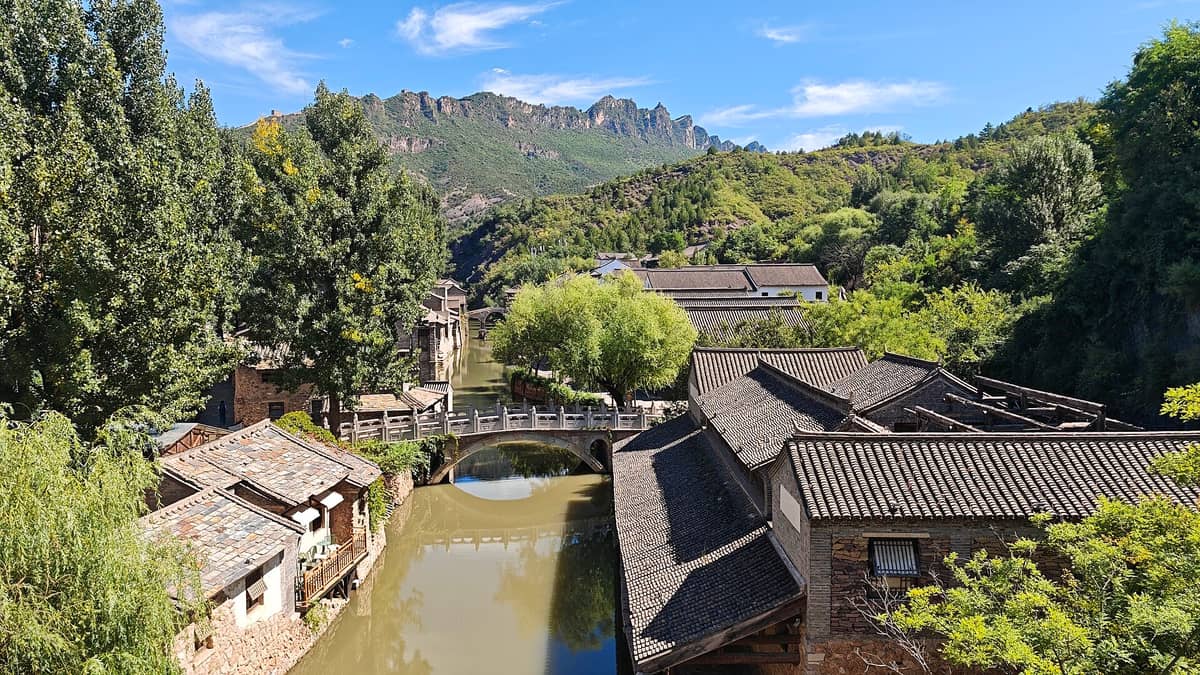
What Gubei Water Town Actually Is
Gubei Water Town is not a historic village that time forgot. It is a purpose-built resort, developed in the early 2010s and officially opened in 2014, designed to evoke the canal-town architecture of northern China's Qing dynasty period. Stone bridges cross narrow waterways, whitewashed walls and grey-tiled rooflines line the lanes, and the whole complex wraps around Mandarin Duck Lake Reservoir with the Simatai Great Wall rising on the ridge directly behind. The setting is genuinely striking. The architecture, however, is reconstruction rather than preservation.
That distinction matters for setting expectations. Visitors who arrive hoping for the layered authenticity of a centuries-old water town will find something different: a well-maintained, photogenic resort with good food options, comfortable hotels, and direct access to one of Beijing's most dramatic Great Wall sections. Visitors who simply want a scenic escape from the city, a backdrop for photographs, and a reason to combine Wall hiking with a relaxed evening by the water will find Gubei Water Town delivers exactly that.
ℹ️ Good to know
Gubei Water Town and Simatai Great Wall are adjacent but separately ticketed. The CNY 140 town admission does not include Great Wall access. Budget time and money for both if the Wall is your primary goal.
The Setting: Simatai Great Wall as a Backdrop
The most compelling reason to choose Gubei over other day-trip destinations near Beijing is the Simatai Great Wall, which rises steeply from the northern edge of the resort. Simatai is widely regarded as one of the least restored Wall sections accessible to visitors, preserving its rough, crumbling original stonework in a way that heavily reconstructed sections like Badaling do not. From the waterside streets of the town, the Wall is visible on the ridgeline throughout the day, shifting from pale gold in the morning to deep amber at sunset.
The Wall's silhouette becomes the centerpiece of the evening light show, when the resort illuminates the watercourses and the lower Wall towers with coloured lighting. This is the moment that most photographs of Gubei Water Town depict. It is theatrical and visually effective, though the light show experience is quite different from daytime hiking. If you are visiting primarily to walk the Wall, plan to arrive early, complete the hike before midday when the path is less crowded, and treat the evening lighting as a bonus rather than the main event.
For a broader understanding of the Wall sections near Beijing and how they compare, the Great Wall sections guide covers the differences between Simatai, Mutianyu, Jinshanling, and others in practical detail.
Tickets & tours
Hand-picked options from our booking partner. Prices are indicative; availability and final rates are confirmed when you complete your booking.
Independent tour to Gubei Water Town and Simatai with how to guide
From 237 €Instant confirmationFree cancellationPrivate Guided Tour to Gubei Water Town and Simatai Great Wall
From 111 €Instant confirmationFree cancellationXiamen night tour with Lujiang Cruise and Zhongshan Old Town
From 282 €Instant confirmationFree cancellationSmall group tour of Tian'anmen Square and the Forbidden City
From 43 €Instant confirmationFree cancellation
How the Experience Changes Through the Day
Mornings at Gubei Water Town are genuinely pleasant. Before 10:00, the lanes are quiet, the light is soft, and the reservoir reflects the surrounding hills. This is the best window for photography without crowds in the frame, and the best time to reach the Simatai cable car or start a Wall hike before midday heat (in summer) or midday crowds (year-round on weekends).
By late morning on weekends and public holidays, the main waterside promenades fill with visitors, particularly Chinese domestic tourists and families from Beijing. The town's lanes are narrow in places, and popular photo spots near the stone bridges can become genuinely congested between 11:00 and 14:00. If you have flexibility, a weekday visit in spring or autumn reduces crowding noticeably.
Afternoon is the slowest period for the town itself as visitors who arrived on the morning bus take their Wall hike. The restaurants and tea houses along the main canal street are busy at lunch, then quieter through mid-afternoon. Late afternoon, from around 16:00 onward, brings the pre-evening crowd: those staying overnight settling in, day-trippers heading for the bus, and the first preparations for the light show. The transition from late afternoon gold to evening illumination, roughly between 17:30 and 19:00 depending on the season, is when the resort is at its most atmospheric.
💡 Local tip
Ticketing operates from 09:00 to 21:00. Evening operating hours are 17:30 to 21:30 on non-weekends and 22:00 on weekends from May through October; from November through April, they end at 21:00 on non-weekends and 21:30 on weekends. Confirm current seasonal hours on the official website before your visit, as schedules vary. If you plan to stay for the light show, confirm current seasonal hours on the official website before your visit, as schedules vary.
Getting to Gubei Water Town from Beijing
The resort is approximately 120 km northeast of central Beijing, in Miyun District. The official express bus service runs from Beijing on weekdays at 09:00, 12:00, and 15:30, and on weekends and public holidays at 09:00, 12:00, 14:00, and 15:30. Confirm exact departure points and current schedules on the official website before travelling, as details are subject to change.
By private car or ride-hailing, the route follows the Jingcheng Expressway. Journey time varies with traffic but is typically 1.5 to 2.5 hours. Driving offers considerably more flexibility for early arrivals, which is particularly useful for Wall hikers who want to start before the busier midday period. A shuttle service connects the main parking area to the town entrance.
Visitors planning a broader Great Wall itinerary in the area may find it useful to read about Jinshanling Great Wall, which lies roughly 10 km west of Simatai and is sometimes combined into a full-day trek between the two sections by experienced hikers.
What to Eat and Where to Walk
The resort contains a range of restaurants and food stalls spread across its canal-side lanes. Options include northern Chinese staples such as hand-pulled noodles, lamb skewers, and dumplings, alongside more tourist-oriented cafes and hotpot restaurants. Prices are higher than central Beijing restaurants of equivalent quality, as is standard at resort destinations. Budget accordingly, particularly if buying drinks or snacks along the waterfront.
The walkable area divides roughly into three zones: the main canal street and its adjacent lanes, which carry most of the visitor traffic; the lakeside promenade around Mandarin Duck Lake Reservoir, which is more open and less crowded; and the approaches to the Simatai Wall entry, which involve ascending terrain. Comfortable, closed-toe shoes with grip are appropriate for all three zones. For the Wall itself, proper walking shoes or light hiking footwear are necessary, as the path is steep and the original stonework is uneven.
Seasons, Weather, and When to Go
Autumn, specifically September through early November, is the strongest season for Gubei Water Town. Temperatures are mild (roughly 8 to 25 degrees Celsius), the surrounding hills show seasonal colour, air quality tends to be better than summer, and the light at both ends of the day has the warm quality that makes the architectural scenery and the Wall particularly photogenic. This is also the busiest season, and weekends during the National Day Golden Week holiday in early October can be extremely crowded.
Spring, from April through May, is a strong second choice. Winter visits are possible and the snow-covered Wall and frozen reservoir create distinctive photographs, but temperatures in Miyun District drop significantly below central Beijing, cold winds are common, and some resort facilities may have reduced hours. Summer brings warmth and lush greenery but also humidity, higher rainfall, and the peak of domestic tourism crowds.
For a broader seasonal overview including how conditions vary across Beijing's attraction types, the best time to visit Beijing guide covers each season in detail.
⚠️ What to skip
Miyun District sits at higher elevation than central Beijing and can be significantly colder, especially in the evenings. Even in autumn, bring a layer for after sunset if you are staying for the light show.
Photography at Gubei Water Town
The most reproduced image from Gubei Water Town is the view of the illuminated canal with the lit Wall towers on the ridge behind, typically shot from one of the stone bridges in the central zone. This shot works best with a tripod during the blue hour, roughly 20 to 40 minutes after sunset, when there is still enough ambient light in the sky to create separation between the ridgeline and the darkness above it.
Daytime photography rewards exploration away from the main promenade. The narrower back lanes, the lakeside edges, and the views back down from the lower Wall access path all offer compositions with fewer people. For wider guidance on capturing Beijing's architectural and landscape sites, the Beijing photography guide includes practical advice on timing and equipment.
Accessibility and Practical Notes
The resort provides an internal shuttle between the parking area and the town entrance, which helps reduce walking distance for those with mobility limitations. The flat, paved lanes of the main resort area are generally navigable, though narrow in places and occasionally uneven near the older-style stonework sections. The official site does not detail comprehensive accessibility provisions or mobility-equipment rental, so visitors with specific requirements should contact the resort directly before booking.
The Simatai Great Wall section itself involves steep ascent on original stone steps with significant gradient changes and handrails that are not continuous along all sections. It is not accessible to wheelchair users and requires reasonable physical fitness for a full hike. A cable car reduces the required ascent to reach the upper sections.
Payment throughout the resort is cashless for most transactions. Chinese mobile payment platforms (WeChat Pay and Alipay) are the dominant method. Visitors using international cards should verify payment options in advance and carry a backup option. Basic Mandarin or a translation app will be useful, as English signage and staff language ability vary across the resort.
Insider Tips
- Book accommodation inside the resort if your budget allows. Overnight guests can access the evening light show without timing the last bus, and early morning before the day-trippers arrive is the most peaceful window in the entire resort.
- The official express bus has return departures to Beijing, including a 21:00 departure; if you want to stay for the evening show beyond the available return service, you will need overnight accommodation or a pre-arranged car or taxi back to Beijing. If you take an early bus from the city and want to stay for the evening show, you will need either overnight accommodation or a pre-arranged car or taxi back to Beijing.
- The lakeside promenade on the southern edge of Mandarin Duck Lake Reservoir sees far fewer visitors than the main canal street but offers open, unobstructed views of both the water and the Wall ridge. Worth the ten-minute walk from the central lanes.
- Simatai Great Wall is one of the few Wall sections that also operates night hiking on selected dates in summer and autumn. This is a separate ticket and requires advance booking. Check the official Gubei Water Town website for current schedules as these change seasonally.
- If you are visiting during a Chinese public holiday, the resort enforces timed-entry quotas. Buying tickets in advance through the official website or a reputable booking platform avoids queues and guarantees entry during peak periods.
Who Is Gubei Water Town For?
- Couples or small groups wanting a Great Wall visit combined with a scenic overnight stay rather than a rushed day trip
- Families with children who want more to do than just hike, including waterside walks, food stalls, and evening atmosphere
- Photographers targeting the combination of water-reflected architecture and Wall silhouette in evening light
- Beijing residents looking for a weekend short break that does not require long-distance travel
- Travellers who have already visited the more commercial Wall sections and want Simatai's rougher, less-restored experience in a comfortable setting
Nearby Attractions
Other things to see while in Great Wall Area:
- Badaling Great Wall
The Badaling Great Wall is the most visited section of the Great Wall near Beijing, sitting in Yanqing District about 80 km northwest of the city center. Fully restored, highly accessible, and genuinely impressive in scale, it rewards early arrivals and punishes late ones. Here is everything you need to visit well.
- Huanghuacheng Lakeside Great Wall
At Huanghuacheng, sections of a Ming-dynasty Great Wall built in 1404 descend directly into a reservoir, creating a landscape found nowhere else on the wall. This guide covers what to expect on the ground, how to get there, and whether it belongs on your Beijing itinerary.
- Jinshanling Great Wall
Jinshanling Great Wall is one of the best-preserved and least-crowded sections of the Ming-dynasty wall. Located in Hebei's Luanping County and easily reached from Beijing, it rewards those willing to make the journey with dramatic ridge-top scenery, original battlements, and a genuine sense of the wall's scale and age.
- Ming Tombs (Shisanling)
The Ming Tombs, officially 明十三陵, spread across a valley at the foot of Tianshou Mountain in Changping District, roughly 50 km north of central Beijing. Thirteen Ming-dynasty emperors were buried here between 1409 and 1644, making this one of the largest and best-preserved imperial burial complexes in the world. Several tombs plus the Sacred Way are open to visitors, with Changling, Dingling, Zhaoling, and the Sacred Way serving as the regular open attractions; other tombs may require advance reservation., each offering a distinctly different experience.