Jinshanling Great Wall: The Complete Visitor Guide
Jinshanling Great Wall is one of the best-preserved and least-crowded sections of the Ming-dynasty wall. Located in Hebei's Luanping County and easily reached from Beijing, it rewards those willing to make the journey with dramatic ridge-top scenery, original battlements, and a genuine sense of the wall's scale and age.
Quick Facts
- Location
- Hualougou Village, Bakeshiying Town, Luanping County, Chengde, Hebei Province (approximately 120 km northeast of central Beijing)
- Getting There
- Long-distance bus from Dongzhimen Bus Station toward Miyun, then minibus to the Jinshanling scenic area; private car or chartered transport is the most practical option
- Time Needed
- 4–6 hours on site; allow a full day including travel from Beijing
- Cost
- CNY ¥65 (high season: Mar 16–Nov 15) / CNY ¥55 (low season: Nov 16–Mar 15). Cable car: ¥40 one way, ¥60 round trip
- Best for
- Serious hikers, photographers, history enthusiasts, and visitors wanting an authentic Great Wall experience without crowds
- Official website
- http://www.jinshanlingchangcheng.com
What Jinshanling Actually Is
The Jinshanling Great Wall (金山岭长城) is a 10.5-kilometer section of the Ming-dynasty wall that runs along a rugged ridgeline in Luanping County, Chengde. Built and strengthened during the Ming dynasty, including during the period associated with the general Qi Jiguang, it contains 67 watchtowers, five passes, and three beacon towers — a density of military architecture that makes it one of the most strategically interesting sections of the entire wall system. Unlike the heavily restored sections at Badaling or Mutianyu, Jinshanling retains much of its original stonework, and the worn, uneven surfaces of its steps and parapets communicate something that a freshly pointed restoration simply cannot.
Technically, Jinshanling sits outside Beijing municipality, in Hebei Province. That geographic detail matters for planning: public transport links are limited, and reaching it requires either a long-distance bus connection from Dongzhimen Bus Station with a minibus transfer, or a pre-arranged private car or chartered vehicle. Most visitors coming from Beijing budget a full day. The extra effort is the point — it is what keeps the crowds manageable.
ℹ️ Good to know
Opening hours vary by entrance gate and season; current listings include main-gate hours of 06:00–17:00 in the low season and east-gate hours of 08:00–16:30. Confirm the current gate-specific schedule with the scenic area before you travel. Hours can vary by entrance gate and are subject to change; confirm with the official site before you travel.
The Experience: What You Will Actually See and Feel
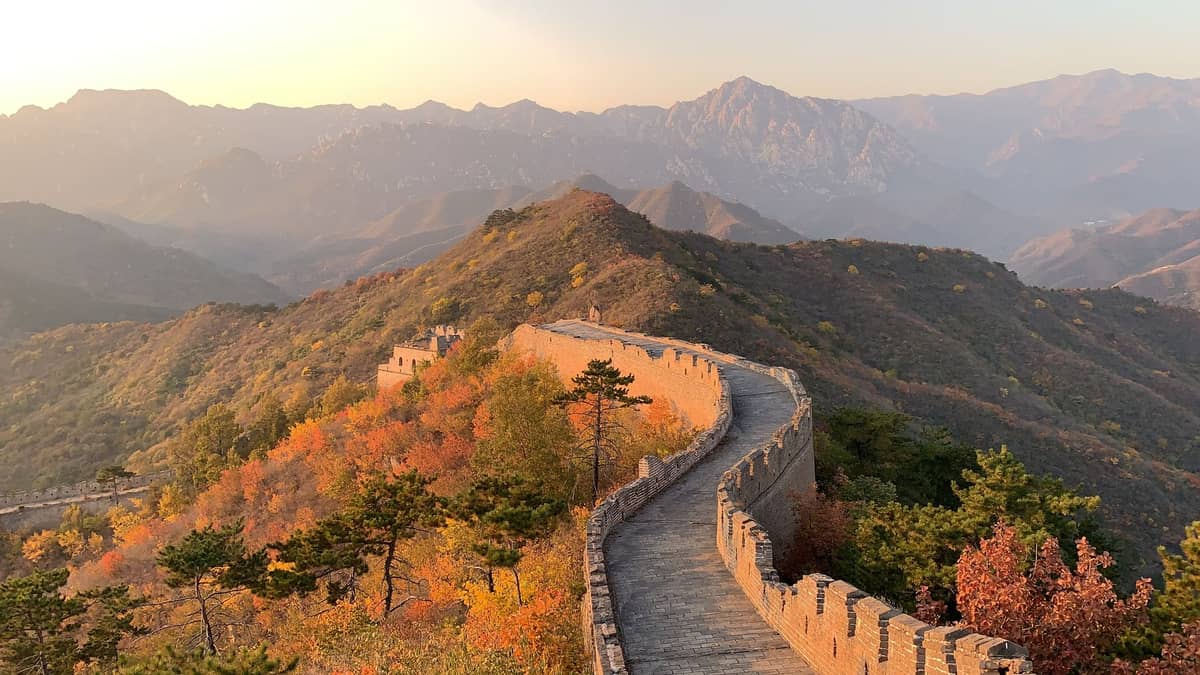
The wall at Jinshanling follows the natural contours of a limestone ridge, so the terrain itself does a large part of the work. You are not walking along a flat promenade. The path climbs, dips, and climbs again, and the towers appear at intervals just when you feel the ascent most acutely. From inside the towers — many of which you can enter freely — the loopholes frame the landscape like a series of narrow paintings, each showing another fold of ridge extending into the distance.
In the morning, particularly in autumn, mist often collects in the valleys below the wall while the ridgeline itself sits in clear light. The contrast between the pale stone of the battlements and the dark forested slopes below is what has made this section a favorite for photographers willing to arrive before 08:30. By midday the light flattens and the haze can thicken, especially in summer. Late afternoon brings longer shadows across the watchtowers and softer colors on the surrounding hills, though you need to plan your descent carefully against the closing time.
The stone underfoot deserves attention. On the steeper pitches the original Ming-era bricks are worn smooth by centuries of foot traffic — not tourists, but soldiers and supply teams moving along the military road that ran the length of the wall. Where the surface is wet, from rain or morning dew, these stones become genuinely slippery. Proper footwear is not optional here.
⚠️ What to skip
Wear sturdy, closed-toe shoes with a grip sole. Sandals and flat-soled sneakers are dangerous on the steep, weathered stone sections. Trekking poles are useful for the descents.
Tickets & tours
Hand-picked options from our booking partner. Prices are indicative; availability and final rates are confirmed when you complete your booking.
Jinshanling Great Wall Private Transfer
From 161 €Instant confirmationFree cancellationIndependent tour to Jinshanling Great Wall with digital guidebook
From 237 €Instant confirmationFree cancellationOriginal section of Great Wall at Jinshanling full day tour
From 361 €Instant confirmationFree cancellationMutianyu Great Wall and Summer Palace small-group tour from Beijing
From 171 €Instant confirmationFree cancellation
Historical and Architectural Context
The Ming dynasty's reconstruction and extension of the Great Wall was one of the largest state engineering projects in pre-modern history, driven by persistent concern about incursions from the north. The Jinshanling section, completed in 1570, represents a mature phase of Ming military architecture. The towers here are notable for their variety: some are square, some rectangular, some two-story, and several feature different roof and ventilation designs — an intentional range of construction that reflects Qi Jiguang's systematic effort to standardize and improve the wall's defensive functions along this corridor.
The section connects at its eastern end with the Simatai Great Wall, and the joint Jinshanling-to-Simatai hiking route has become well known among experienced walkers, though access arrangements between the two sections have changed over the years and should be confirmed in advance. For broader context on the different sections and what sets each apart, the Great Wall sections guide covers the key differences worth knowing before you choose.
Getting There: The Practical Reality
Jinshanling is approximately 130 kilometers northeast of central Beijing. Public-transport arrangements and gate access vary by season, so check the current scenic-area transport information before setting out. Many visitors opt for a private car hire or a small-group tour, which eliminates the transfer complexity and gives you control over your arrival time — important if you want to be at the wall before the morning haze burns off.
If you are planning multiple Great Wall visits during a trip, it helps to think through the full sequence of logistics. The 3-day Beijing itinerary and the 5-day Beijing itinerary both include practical notes on fitting a Great Wall day trip into a wider Beijing stay.
💡 Local tip
If you are hiring a private car from Beijing, negotiate a driver who is willing to wait on site rather than arranging a fixed return time. The wall takes different amounts of time depending on your pace and which towers you enter.
Photography: When and Where to Position Yourself
Jinshanling is consistently recommended among serious photographers as one of the strongest Great Wall locations in the Beijing region, and that reputation is earned. The combination of intact original architecture, varied tower profiles, and a ridgeline that curves visibly into the distance gives photographers the compositional elements that flatter restored sections often lack. For a broader overview of shooting the wall and other Beijing landmarks, the Beijing photography guide covers equipment, timing, and location logistics.
The eastern section of the wall, heading toward Simatai, tends to offer the most dramatic angles because the ridge becomes more pronounced and the towers more closely spaced. Early morning, before 09:00, gives you the best combination of soft light and low foot traffic. In autumn — typically mid-September through October — the surrounding slopes turn amber and rust, and the contrast with the grey stone battlements is at its strongest. Winter visits, on cold clear days, can produce remarkable images of the snow-dusted wall against a blue sky, but the reduced opening hours (closing at 16:00) and icy surfaces require careful planning.
Practical Walkthrough: Pacing Your Visit
From the main entrance, most visitors walk a section of roughly 3 to 5 kilometers before turning back, which takes 3 to 5 hours depending on how much time you spend inside the towers and on the steeper pitches. The full 10.5-kilometer length to Simatai is a serious undertaking and is not suitable for casual walkers. A cable car may operate seasonally, with a reported fare of CNY ¥40 one way and CNY ¥60 round trip; confirm operation and fares before visiting, which can be useful for the ascent if you want to conserve energy for walking the wall itself rather than the approach.
Water and snacks are essential. There are some vendors near the entrance and at a few points along the route, but supply is unreliable and prices reflect the remoteness of the location. Carry at least one liter of water per person, more in warm weather. The sun is direct on the exposed ridgeline for most of the day, so a hat and sun protection matter even in spring and autumn when air temperatures feel mild.
The site does not confirm full wheelchair accessibility, and the terrain makes the main wall sections inaccessible without the ability to manage steep stairs and uneven surfaces. Visitors with significant mobility limitations should contact the site directly to ask about accessible areas near the entrance before making the journey.
Honest Assessment: Is It Worth the Effort?
Jinshanling is genuinely one of the more rewarding Great Wall experiences available from Beijing, but it requires more planning and physical effort than the easier alternatives. If your priority is convenience, the cable cars and well-maintained paths at Mutianyu will serve you better. If you want a section that feels like it belongs to the wall's actual history rather than to a visitor infrastructure project, Jinshanling makes a strong case for itself.
It is also worth being clear about what it is not. It is not a half-day outing from central Beijing unless you have a fast private transfer. It is not suitable for very young children or anyone who struggles with steep, uneven stairs. And on holiday weekends and during the peak autumn foliage season, it attracts more visitors than its reputation as an 'uncrowded alternative' might suggest — arriving early remains the single most effective way to manage crowds.
For those building a broader itinerary around Beijing's imperial history and outdoor sites, pairing a Jinshanling visit with the Ming Tombs in Changping makes geographical sense, as both sites sit in the northern arc outside the city and share a connection to the same Ming-dynasty historical period.
Insider Tips
- Arrive before 09:00. The eastern section of the wall faces roughly northeast, which means morning light falls directly on the battlements and the mist in the valleys below is at its densest. Both conditions disappear by mid-morning.
- The towers on the eastern stretch toward Simatai have more architectural variety than those near the entrance. If you have the energy, push past the first three or four towers before settling on your walking route.
- In autumn, the slope vegetation on the north-facing side of the ridge holds its color longer than the south-facing slopes. Position yourself on the wall looking north for the best foliage backdrops.
- If you are taking public transport, confirm the minibus departure times for the return journey before you head up onto the wall. Missing the last connection adds significantly to your return time and cost.
- The cable car is worth considering for the ascent, not the descent. Walking down on the original stone is easier on the lungs than climbing, and the descent gives you a better sense of the wall's engineering on the steeper pitches.
Who Is Jinshanling Great Wall For?
- Experienced hikers who want a physically engaging Great Wall route with genuine historical texture
- Photographers looking for original Ming-dynasty architecture and strong compositional ridgeline views
- Repeat Beijing visitors who have already seen Mutianyu or Badaling and want a different experience
- History enthusiasts interested in Ming military architecture and the specific design innovations of general Qi Jiguang's construction period
- Autumn travelers: the surrounding hillside foliage in late September and October makes this one of the most visually striking wall sections in the region
Nearby Attractions
Other things to see while in Great Wall Area:
- Badaling Great Wall
The Badaling Great Wall is the most visited section of the Great Wall near Beijing, sitting in Yanqing District about 80 km northwest of the city center. Fully restored, highly accessible, and genuinely impressive in scale, it rewards early arrivals and punishes late ones. Here is everything you need to visit well.
- Gubei Water Town
Gubei Water Town (古北水镇) is a large resort village built around Mandarin Duck Lake Reservoir at the foot of the Simatai Great Wall in Miyun District, roughly 120 km northeast of central Beijing. Covering around 9 square kilometres, it blends reconstructed Qing-era canal architecture with modern hotels and evening light shows, making it a popular overnight destination for city residents who want Wall access combined with water scenery.
- Huanghuacheng Lakeside Great Wall
At Huanghuacheng, sections of a Ming-dynasty Great Wall built in 1404 descend directly into a reservoir, creating a landscape found nowhere else on the wall. This guide covers what to expect on the ground, how to get there, and whether it belongs on your Beijing itinerary.
- Ming Tombs (Shisanling)
The Ming Tombs, officially 明十三陵, spread across a valley at the foot of Tianshou Mountain in Changping District, roughly 50 km north of central Beijing. Thirteen Ming-dynasty emperors were buried here between 1409 and 1644, making this one of the largest and best-preserved imperial burial complexes in the world. Several tombs plus the Sacred Way are open to visitors, with Changling, Dingling, Zhaoling, and the Sacred Way serving as the regular open attractions; other tombs may require advance reservation., each offering a distinctly different experience.