Marco Polo Bridge (Lugou Qiao): Beijing's Oldest Stone Bridge and a Turning Point in History
Built in 1189 and later rebuilt in 1698, Lugou Qiao spans the Yongding River in Fengtai District. It is both an architectural landmark and the site where the opening shots of China's full-scale war with Japan were fired in 1937. Few places in Beijing carry this much weight in a single span of stone.
Quick Facts
- Location
- No. 77 Chengnan Street, Lugouqiao, Fengtai District, Beijing
- Getting There
- Beijing Subway Line 16 to Wanpingcheng Station (walkable); Bus 309, 339, 624, or 952 to Lugou Xinqiao stop
- Time Needed
- 1.5 to 2.5 hours for the bridge and adjacent Wanping Fortress
- Cost
- ¥20 general admission; ¥10 for full-time university students; free for visitors aged 60+, under 18, with disabilities, or active-duty military with valid ID. Closed Mondays; open 7:30–19:00 April–October and 8:00–17:30 November–March.
- Best for
- History enthusiasts, architecture lovers, photography, and travelers combining culture with a quieter day away from central Beijing
- Official website
- http://www.lugouqiao.org.cn
What Is Marco Polo Bridge, and Why Does It Matter?
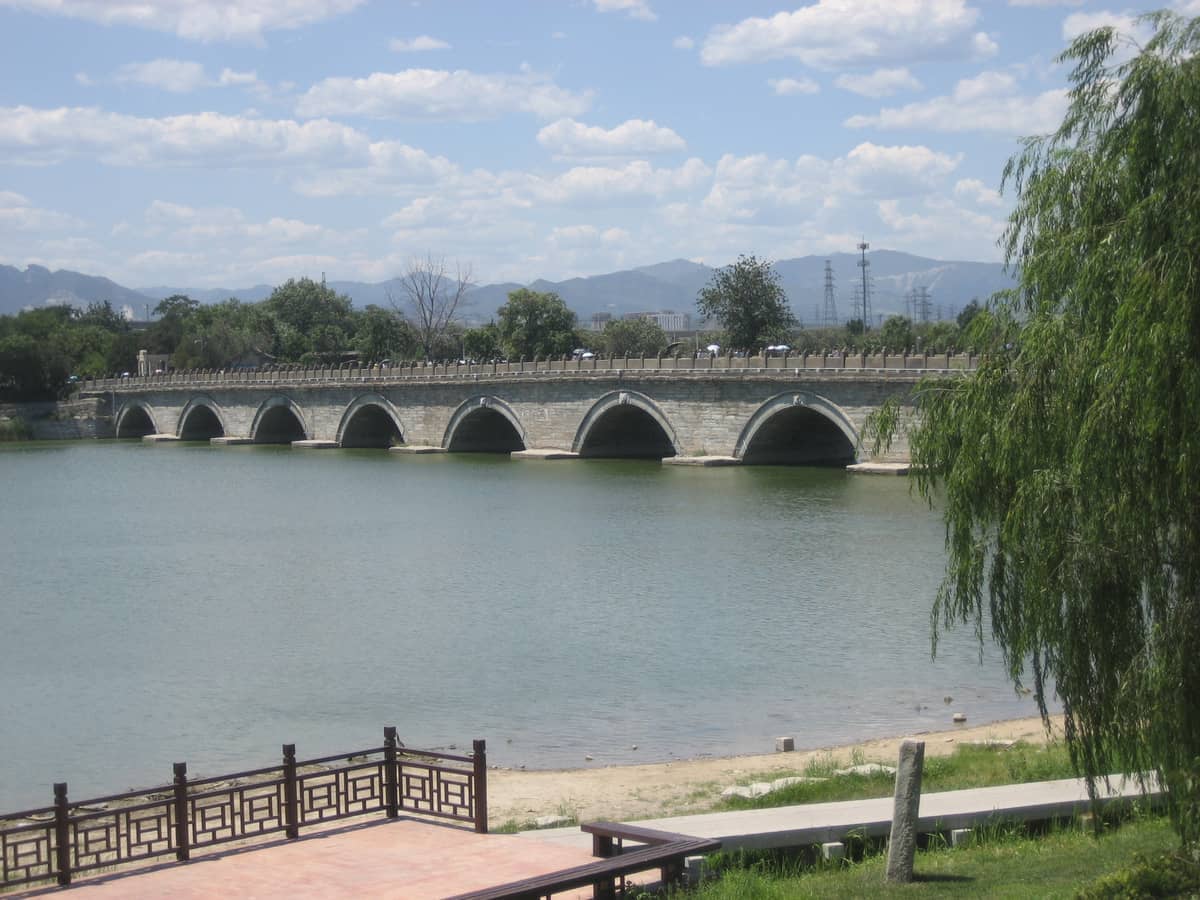
Marco Polo Bridge, known in Chinese as Lugou Qiao (卢沟桥), is a multi-arch stone bridge spanning the Yongding River on the southwestern edge of Beijing. Construction began in 1189 under the Jin Dynasty, and the bridge was later rebuilt in 1698 after flood damage, making it the oldest surviving stone bridge in the Beijing area. It stretches 266.5 metres in length, reaches up to 9.3 metres at its widest point, and rests on 10 piers that support 11 arches. For more than eight centuries, it carried the main road connecting the capital with central and southern China.
The Venetian merchant Marco Polo passed through in the 13th century and described it in his travel accounts as one of the finest bridges in the world, which is how the structure acquired its Western name. That reputation holds up on the ground. The bridge is lined with 485 stone baluster posts, each topped with a carved lion. No two lions are quite the same: some nurse cubs, some are mid-roar, some are worn smooth by centuries of weather, and a few are half-hidden under mossy patina. A Chinese saying holds that counting the lions on Lugou Qiao is impossible, and it is genuinely easy to lose count.
Beyond its architecture, the bridge carries enormous historical significance. On July 7, 1937, an exchange of fire at this location between Japanese troops and Chinese nationalist forces triggered the full-scale Second Sino-Japanese War, a conflict that would eventually fold into World War II. The date is commemorated every year in China, and the adjacent Military Museum of the Chinese People's Revolution places the event in broader context for visitors who want to understand its significance within 20th-century Chinese history.
The Bridge Itself: What You Actually See
Walking onto Lugou Qiao from the eastern gate, the first thing you notice is the texture underfoot. The original stone paving is uneven and polished by centuries of foot traffic, cart wheels, and weather. It is not a smooth tourist promenade. The surface is slightly undulating, which actually reinforces how old this structure is. Wear shoes with grip.
The stone lions are the visual centerpiece. They are carved in different sizes and postures along the balustrades on both sides of the bridge. Some perch on the capitals, others seem to tumble down the posts. The detail on the best-preserved ones is extraordinary: individual teeth, curling manes, small cubs pressed against haunches. On the more eroded posts, the lions have softened into abstract shapes that carry their own dignity. Morning light from the east throws the carvings into relief and is the best time for close-up photography.
At each end of the bridge stand stele pavilions sheltering stone tablets with inscriptions. The northern pavilion houses a tablet inscribed by the Qing Emperor Qianlong in 1751 with the phrase 'Lugou Xiaoyue,' meaning 'Daybreak Moon over Lugou,' which was listed among the Eight Views of Beijing. On clear mornings in autumn, the scene with the moon setting over the river has not fundamentally changed since Qianlong wrote about it.
💡 Local tip
Photography tip: Arrive within the first hour after opening. Morning light hits the eastern face of the lion carvings directly and the crowds are thin. By mid-morning on weekends, tourist groups begin to arrive in numbers that make quiet composition difficult.
Tickets & tours
Hand-picked options from our booking partner. Prices are indicative; availability and final rates are confirmed when you complete your booking.
Small group tour of Tian'anmen Square and the Forbidden City
From 43 €Instant confirmationFree cancellationBeijing Summer Palace Entrance Ticket
From 7 €Instant confirmationFree cancellationMutianyu Great Wall and Summer Palace small-group tour from Beijing
From 171 €Instant confirmationFree cancellationPrivate Guided Tour to Temple of Heaven, Panda House and Summer Palace
From 67 €Instant confirmationFree cancellation
Wanping Fortress: The History You Cannot Skip
At the eastern end of the bridge stands Wanping Fortress (宛平城), a Ming Dynasty walled town built in 1638, one of only two intact ancient walled settlements surviving within the greater Beijing area. It is small, roughly 640 metres long and 320 metres wide, with two gates and intact city walls. Unlike the bridge itself, which you experience as a linear walk, the fortress has the feel of a living community: residents still live here, small shops sell snacks and souvenirs, and there are two significant museums inside the walls.
The Chinese People's War of Resistance Against Japanese Aggression Memorial Museum is located inside Wanping and is included in the site visit. It is a serious, extensively documented museum covering the 1937 incident and the years of war that followed. Exhibits include photographs, artifacts, maps, and documentary footage. The content is presented from the Chinese national perspective, which is worth bearing in mind contextually, and some exhibits include graphic historical images. Allow at least 45 minutes inside, more if you read Chinese.
ℹ️ Good to know
The museum inside Wanping Fortress is part of the Lugou Qiao scenic area and covered by the ¥20 admission ticket. It is closed on Mondays along with the rest of the site.
How the Experience Changes by Time of Day and Season
In the early morning, before 9:00, the site is genuinely quiet. Local residents from the surrounding Fengtai District walk or cycle through, older visitors do slow exercises near the riverside, and the air carries the smell of damp stone and river mud. The Yongding River runs below, its water level varying substantially by season: full and green after the summer monsoon, reduced to a narrow channel in the dry winter months.
Midday on weekends, particularly from April through October, sees tour groups rotating through at pace. The bridge is wide enough that it never feels dangerously crowded, but the contemplative quality disappears. Weekday afternoons in spring and autumn offer a reasonable middle ground: enough visitors to feel lively without dominating the experience.
Winter visits are underrated. December and January bring cold dry air and very low visitor numbers. The lions take on a severe, stripped quality without summer haze, and the city walls of Wanping look particularly austere against a grey sky. Dress warmly: the riverside wind is sharper than anywhere in central Beijing. Check the November to March opening hours before you go, as the site is open 08:00–17:30 during that period and closes earlier than in the warmer months.
July 7th, the anniversary of the 1937 incident, draws significant crowds and official ceremonies to the site. If you are interested in witnessing a major commemoration rather than a quiet historical visit, that date is relevant. Otherwise, it is one of the days to avoid if you prefer smaller crowds. For context on how this event fits into Beijing's broader imperial and modern history, the Beijing imperial history guide provides useful background.
Getting There: The Practical Reality
Beijing Subway Line 16 serves Wanpingcheng Station, from which the fortress gate and the western approach to the bridge are reachable on foot in a few minutes. This is the most straightforward option from central Beijing. Bus routes 309, 339, 624, and 952 stop at Lugou Xinqiao (卢沟新桥), on the newer bridge adjacent to the historic one.
By taxi or DiDi, the ride from central Beijing takes 30 to 50 minutes depending on traffic, longer during peak hours. The address to give is No. 77 Chengnan Street, Lugouqiao, Fengtai District. The bridge is about 15 kilometres southwest of Tiananmen Square, in a part of the city that most central-Beijing visitors do not pass through organically, so some deliberate planning is required.
⚠️ What to skip
The site is closed on Mondays. Arriving on a Monday to find the gates shut is a disappointing and avoidable mistake. Always confirm hours before making the journey from central Beijing.
How to Plan Your Visit
Lugou Qiao combines well with nearby attractions in the southwestern part of the city. The area around Fengtai is not a standard tourist circuit, which is part of its appeal. Travelers who have already covered the central landmarks, including the Forbidden City and Temple of Heaven, will find Lugou Qiao offers something genuinely different: a quieter site with more complex historical weight and almost no international tourist infrastructure around it.
Allow 1.5 to 2.5 hours in total: roughly 30 to 40 minutes on the bridge itself, 45 to 60 minutes in the museum, and additional time to walk the Wanping city walls if they are accessible on your visit. There are small food vendors and simple restaurants inside the fortress walls and immediately outside the eastern gate, but options are limited. Bring water, especially in summer.
If you are building an itinerary around Beijing's historical sites, this pairs naturally with a visit to the Ming City Wall Relics Park on a separate day, or consider the Beijing walking tours guide for curated routes that combine history and on-foot exploration across the city.
Honest Assessment: Who Will Value This, and Who Might Not
Marco Polo Bridge is not a site that delivers immediate visual spectacle. There is no dramatic panorama, no grand interior space, no single jaw-dropping moment. What it offers is depth. The longer you look at the carvings, the more you see. The more you know about the 1937 incident going in, the more the site resonates. Visitors who approach it as just a 'nice old bridge' may find the journey from the city center longer than the reward justifies.
Families with young children may find the museum content too heavy and the bridge walk too short to hold attention. Travelers on a tight two or three-day itinerary are better served prioritizing central landmarks first. But for anyone with even a passing interest in Chinese history, military history, medieval engineering, or photography of historical stonework, Lugou Qiao is worth the effort.
The site also suits travelers who are deliberately looking to step outside the tourist loop. If you have been following the standard 3-day Beijing itinerary and want one excursion that feels genuinely unfiltered, the southwestern approach to Fengtai will feel like a different city.
Insider Tips
- The lion count debate is real: official records cite 485 baluster posts with lions, but the actual number of lion figures, including cubs tucked under paws and hidden on post sides, has been debated for centuries. Spend time on the north balustrade looking closely at eye level rather than just scanning from a standing position.
- For the Qianlong stele pavilion at the northern end, position yourself in the early morning when the light enters from the east. The inscribed characters 'Lugou Xiaoyue' catch the light in a way that photographs poorly in flat midday light.
- The city walls of Wanping Fortress can sometimes be walked along the top, offering an elevated view back toward the bridge. Check with staff at the gate on arrival, as access is not always open.
- The site around the bridge itself is largely exposed with little shade. In summer, sunscreen and a hat are not optional. The riverside also means mosquitoes in the early evening during warm months.
- Combine your visit with a weekday morning to avoid tour groups. The journey from central Beijing takes time, but arriving at or just after opening at 07:30 in summer means you will often have the bridge nearly to yourself for the first 30 to 45 minutes.
Who Is Marco Polo Bridge (Lugou Qiao) For?
- History travelers with a specific interest in 20th-century Chinese history and the events of 1937
- Architecture enthusiasts drawn to Song and Jin Dynasty engineering and medieval stone craftsmanship
- Photographers looking for textured historical stonework with good early morning light
- Repeat visitors to Beijing who have covered the major central sites and want something less-traveled
- Travelers building a full day in Fengtai District combining the bridge with the Wanping museum
Nearby Attractions
Combine your visit with:
- Cuandixia Village
Cuandixia Village (爨底下村) in Mentougou District is a well-preserved Ming and Qing dynasty rural settlement in northern China. With over 70 original courtyards, stone-paved alleyways, and a dramatic hillside setting roughly 90 km west of central Beijing, it rewards visitors who make the effort to get there.
- Longqing Gorge
Longqing Gorge (龙庆峡) is a dramatic natural gorge in Yanqing District, roughly 80 km northwest of central Beijing. Stretching approximately 7,000 meters through sheer limestone walls, it draws visitors for its reservoir boat rides in summer and its spectacular ice-and-lantern festival in winter. This is not a polished city attraction; it requires planning, a longer commute, and realistic expectations about the experience.
- Peking Man Site at Zhoukoudian
The Peking Man Site at Zhoukoudian, carved into the limestone hills of Fangshan District roughly 50 km southwest of central Beijing, is one of the most significant paleoanthropological sites on Earth. Fossils discovered here in the 1920s and 1930s fundamentally changed scientific understanding of human evolution. The site combines outdoor cave excavations with an indoor museum, and rewards visitors who take their time.
- Universal Studios Beijing
Universal Studios Beijing opened in September 2021 as one of the largest Universal theme parks in the world. Located in Tongzhou District, it combines globally familiar franchises with zones designed specifically for Chinese audiences. Here is what you need to know before buying a ticket.