Complesso di Sant'Andrea Priu: Sardinia's Most Remarkable Prehistoric Necropolis
Carved into a volcanic rock outcrop near Bonorva, the Sant'Andrea Priu necropolis is a complex of around twenty domus de janas tombs dating to the Late Neolithic and Copper Age (4th–3rd millennium BC). Its centrepiece, the Tomba del Capo, is one of the largest known hypogean tombs in the Mediterranean and later served as a Christian rock church. This is a site that rewards slow, curious visitors willing to drive into the interior of Sardinia.
Quick Facts
- Location
- Piana di Santa Lucia, approximately 10 km from Bonorva, Province of Sassari, Sardinia
- Getting There
- Car is essential. From Bonorva, take the Bono road for ~6 km, turn right toward the church of Santa Lucia, then continue ~500 m to the fenced site. Bonorva is reached via SS131 from Sassari (~50 km) or Cagliari (~170 km).
- Time Needed
- 1.5 to 2.5 hours for a thorough visit
- Cost
- Adults approx. €7; youth 11–16 approx. €5; under 10 free; groups over 20 approx. €5 per person. Verify current prices before visiting, as fees have changed.
- Best for
- Archaeology enthusiasts, history lovers, travellers seeking Sardinia's prehistoric culture beyond the beach
- Official website
- santandreapriu.mystrikingly.com
What Is the Complesso di Sant'Andrea Priu?
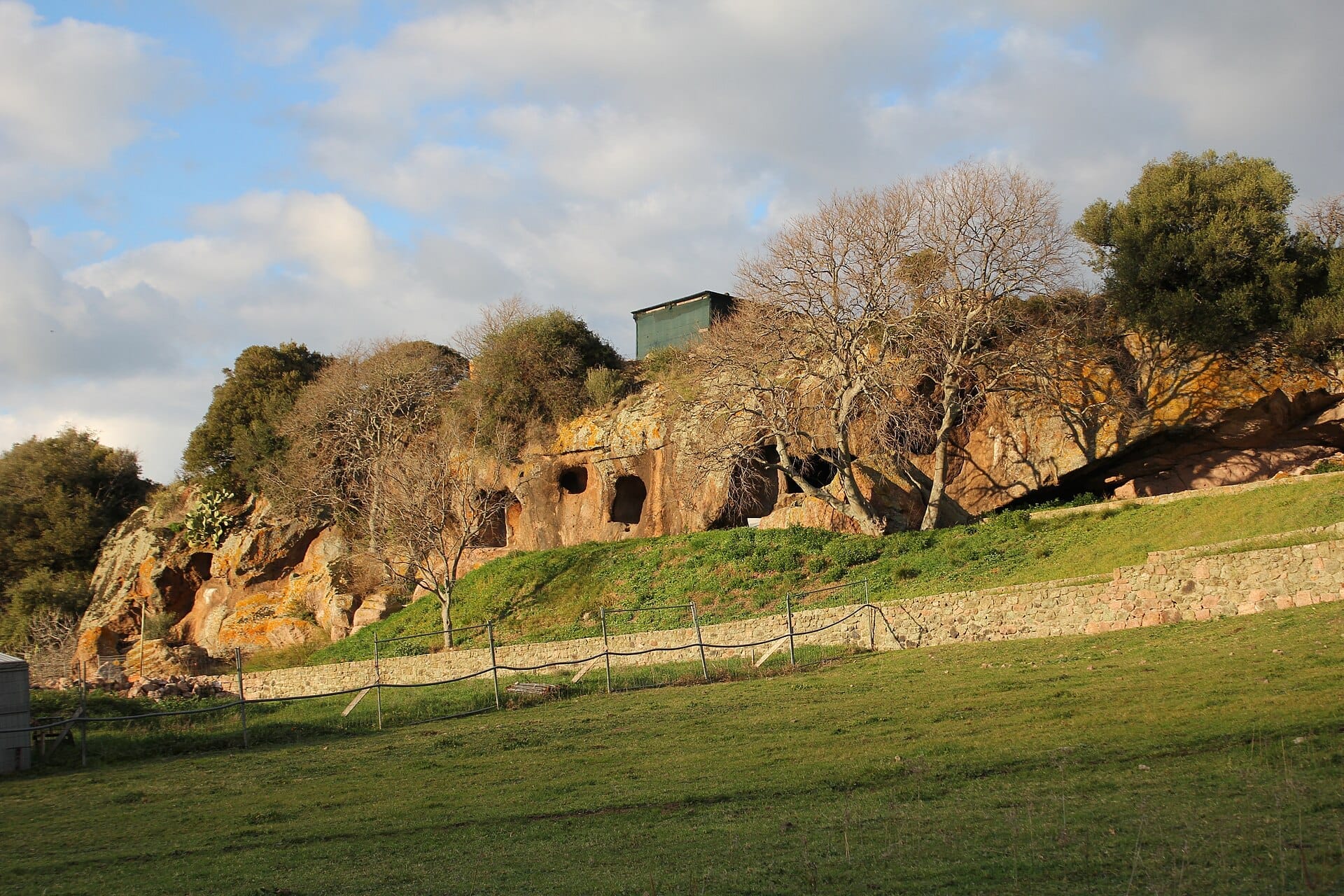
The Sant'Andrea Priu necropolis is one of the most significant prehistoric archaeological sites in Sardinia and, since 2025, a UNESCO World Heritage Site as part of a broader inscription recognising Sardinia's domus de janas tomb complexes. Located near the rural settlement of Bonorva in the province of Sassari, the site consists of around twenty rock-cut tombs carved into a trachytic rock outcrop roughly 10 metres high and 180 metres long.
The tombs were originally created during the Late Neolithic period, associated with the Ozieri culture (approximately 3200 to 2800 BC). Domus de janas, meaning 'houses of the fairies' in Sardinian, are the island's characteristic prehistoric funerary chambers cut directly into rock faces. At Sant'Andrea Priu, the work of Neolithic stone-cutters is layered over by millennia of subsequent human activity: Bronze Age modifications, Roman-era use, Late Antique Christian adaptation, and medieval occupation. Few archaeological sites in the western Mediterranean compress this many cultural phases into a single outcrop.
ℹ️ Good to know
November to February: visits are by appointment only. Outside this period the site is open daily, with hours varying by month. Always check current opening times before driving out, as the site is remote and there are no facilities nearby if it is unexpectedly closed.
The Tomba del Capo: A Room That Holds 5,000 Years
The undisputed centrepiece of the complex is the Tomba del Capo, or Tomb of the Chief. With approximately 18 internal chambers, it is considered one of the largest hypogean (underground rock-cut) tombs in the entire Mediterranean. The scale becomes apparent only when you step inside: a sequence of interconnected rooms, each with ceilings low enough that you feel the weight of the hillside above you, yet articulated with a spatial logic that speaks to careful, deliberate planning by its Neolithic architects.
At some point in Late Antiquity, likely between the 4th and 7th centuries AD, the Tomba del Capo was converted into a Christian rock church. The transformation is visible in the fresco traces that survive on the chamber walls: faint but legible, the remnants of early Christian iconography were painted over the Neolithic stone surfaces. This repurposing was not unusual in Sardinia, where pre-Christian sacred sites were often absorbed into early Christian practice, but the scale and preservation at Sant'Andrea Priu make it exceptional.
The physical experience of moving through the Tomba del Capo is unlike anything at a conventional archaeological museum. The air inside the chambers is noticeably cooler and damper than outside, carrying a faint mineral smell from the trachyte rock. Eyes need a moment to adjust. Bring a small torch if you have one; even on bright summer days, some inner chambers are dim and the fresco details reward close inspection. For context on how this site fits into Sardinia's wider prehistoric landscape, Su Nuraxi di Barumini and the sacred well of Santa Cristina offer complementary perspectives on the island's ancient cultures.
Tickets & tours
Hand-picked options from our booking partner. Prices are indicative; availability and final rates are confirmed when you complete your booking.
Vineyard Guided Tour and 7 Wine Tasting in Palau
From 84 €Instant confirmationFree cancellationFull-Day Sailboat Tour in La Maddalena Archipelago from Cannigione
From 112 €Instant confirmationFree cancellationHiking excursion to the Devil's Saddle
From 35 €Instant confirmationFree cancellationExcursion to the Archaeological site of Nora
From 70 €Instant confirmationFree cancellation
The Rest of the Necropolis: Twenty Tombs Across a Rock Face
Beyond the Tomba del Capo, the remaining tombs of different scales are distributed across the face of the outcrop. Some are small single-chamber niches; others have two or three interconnected rooms. Many entrances are positioned 2 to 3 metres above ground level, their original pedarole (carved footholds) partially or fully eroded away over the millennia. This is one reason that formal guided access is important: the site management team provides the context and practical assistance needed to reach chambers that would otherwise be inaccessible.
The arrangement of the tombs along the extended rock face creates a striking visual impression even before you approach the entrances. Stand back in the morning light, and the pockmarked outcrop reads almost like a cliff-face settlement, the dark rectangular openings arranged at varying heights across the pale volcanic stone. In July and August between around 10:00 and noon, the light falls at an angle that brings out the textural relief of the rock particularly well for photographs.
💡 Local tip
Photography tip: the site faces roughly southwest. Morning light hits the rock face directly and creates good shadow definition. By mid-afternoon in summer, the face can be in partial shade. For interior fresco photography, a small torch produces better results than a phone flash alone.
Historical and Cultural Depth: Five Millennia in Layers
The Ozieri culture, responsible for the original tomb construction at Sant'Andrea Priu, represents one of the most sophisticated Late Neolithic societies in the central Mediterranean. Their domus de janas tombs appear across Sardinia, but Sant'Andrea Priu stands apart in size and in the exceptional continuity of later occupation. After the Ozieri period, modifications were made during the Bronze Age, suggesting the site retained ritual or symbolic importance for communities using different material cultures.
The Christian conversion of the Tomba del Capo placed it within a broader Mediterranean tradition of sacred site reuse. In Sardinia, early Christianity spread through a network of rural communities, and the adaptation of existing sacred spaces was a practical as well as symbolic act. The proximity of the small rural church of Santa Lucia nearby reinforces this pattern of layered sanctity. For travellers interested in the full arc of Sardinian prehistory, the Museo Archeologico Nazionale di Cagliari provides essential context: its collections of Ozieri culture artefacts and Nuragic bronzes give meaning to what you see cut into the rock at Sant'Andrea Priu.
The 2025 UNESCO inscription, which grouped Sant'Andrea Priu with other Sardinian domus de janas sites, marks formal international recognition of what specialists had long understood: this island contains some of the most important evidence of prehistoric Mediterranean funerary culture anywhere in Europe. The inscription also means that conservation standards and visitor management protocols are likely to evolve over the coming years, so access conditions may change.
Getting There and Planning Your Visit
A private vehicle is not just convenient here, it is effectively the only practical option. The site sits roughly 10 kilometres from Bonorva, in rural countryside with no public transport connections. From Sassari, the drive takes about 50 to 55 minutes via the SS131 and then local roads through Bonorva. From Cagliari, allow approximately two hours. Bonorva itself is a small inland town with a bar and a few basic shops, suitable for a coffee stop before or after the visit.
The access road from Bonorva is straightforward: head toward Bono for about 6 kilometres, turn right at the sign for the church of Santa Lucia, pass the church, and the fenced necropolis entrance is approximately 500 metres further on your left. The coordinates are approximately 40°25′17″N, 8°50′50″E, which most navigation apps will handle correctly.
Given that Sant'Andrea Priu sits in the Sassari province, it combines logically with other northern Sardinian archaeology and landscapes. Nuraghe Santu Antine near Torralba is roughly 30 kilometres to the southeast and represents Sardinia's most impressive Nuragic tower. A day trip combining both sites makes for an unusually coherent encounter with the island's prehistoric timeline, from Neolithic tombs to Bronze Age tower architecture.
When to Visit and What to Expect by Season
The ideal visiting window is from April through June and again in September and October. In these shoulder months, the inland Sardinian heat is manageable, light conditions are excellent, and visitor numbers are low. The site rarely becomes crowded in the way that coastal attractions do in summer, but July and August bring tour groups, particularly in the morning hours, and the trachyte rock radiates stored heat after midday.
Winter visits (November to February) require advance booking, but for dedicated travellers this period offers the site essentially in solitude, with low-angled light that can be dramatic across the rock face. Sardinia's interior is significantly cooler than the coast in winter, with occasional rain, so dress accordingly. For broader seasonal planning across the island, the best time to visit Sardinia guide covers coastal and inland variations.
Opening hours shift significantly by season. In July, August, and September the site opens from 10:00 to 19:00, while in March and October hours are 10:00–13:00 and 15:00–17:30. These hours are subject to change, and the site's managing organisation should be contacted directly to confirm current schedules, especially outside peak season. The official site at santandreapriu.mystrikingly.com and local tourism pages are the primary sources for up-to-date information.
Accessibility and Who Should Know Before They Go
The terrain at Sant'Andrea Priu is uneven. The tombs are carved into a natural rock face and many entrances are elevated several metres above ground. Some original carved footholds have been lost to erosion, and parts of the site involve steps, narrow passages, and crouching to enter chambers. Visitors with limited mobility should be aware that access to the upper chambers and several secondary tombs may be restricted or impossible. There is no documented wheelchair access to the main archaeological features.
The site is not well suited to very young children who cannot be kept close in confined and potentially slippery spaces, or to travellers who find enclosed, low-ceilinged spaces uncomfortable. For everyone else, sensible closed shoes with grip are the most important practical preparation. The ground near the rock face can be dusty in summer and muddy after rain.
⚠️ What to skip
There are no cafes, restaurants, or shops at or near the necropolis. Bring water, particularly in summer when temperatures inland can exceed 35°C. The nearest facilities are in Bonorva, about 10 km away.
Insider Tips
- Book ahead for winter visits (November to February), when the site operates by appointment only. Contact the managing organisation directly via the official website before making the drive from Sassari or further afield.
- Ask the guide specifically about the Early Christian frescoes inside the Tomba del Capo. They are easy to overlook without direction, but they represent one of the most unusual survivals in Sardinian archaeology: Neolithic stone walls painted over with Christian imagery more than 4,000 years after the tomb was first cut.
- Combine the visit with Nuraghe Santu Antine (about 30 km southeast near Torralba) for a coherent half-day of prehistoric Sardinia: domus de janas at Sant'Andrea Priu in the morning, Nuragic Bronze Age architecture in the afternoon.
- Arrive within the first hour of opening. Tour groups tend to arrive from mid-morning onward, and the Tomba del Capo's 18 chambers feel noticeably different with 20 people inside versus 3 or 4.
- The UNESCO inscription in 2025 is recent; not all maps and navigation apps have updated site labelling. Use the coordinates 40°25′17″N, 8°50′50″E if your GPS app does not find the site by name reliably.
Who Is Complesso di Sant'Andrea Priu (Bonorva) For?
- Travellers with a genuine interest in prehistoric archaeology and Mediterranean cultural history
- Visitors exploring inland Sardinia beyond the coast, particularly those on a self-drive itinerary
- Photographers drawn to ancient stone architecture and the play of light on volcanic rock faces
- History-focused couples or solo travellers looking for sites that reward careful attention
- Anyone building an itinerary around Sardinia's UNESCO heritage sites
Nearby Attractions
Other things to see while in Sassari:
- Basilica di San Gavino (Porto Torres)
Standing on Monte Agellu in Porto Torres, the Basilica dei Santi Gavino, Proto e Gianuario is the largest Romanesque church in Sardinia and one of the most architecturally singular in Italy. Built in the first half of the 11th century, it is the only Romanesque monument in the country originally designed with two opposing apses. For anyone tracing the island's medieval history, this is as significant as it gets.
- Bosa
Bosa sits on the north bank of the Temo River in western Sardinia, its medieval quarter tumbling down a hillside in layers of terracotta, ochre, and faded pink. It is the only town in Sardinia built along a navigable river, and that distinction shapes everything about it: the old tanneries along the water, the boat-lined banks, the slow pace that has little to do with the island's summer beach circus.
- Castello dei Doria (Castelsardo)
Perched on a volcanic promontory above the Gulf of Asinara, Castello dei Doria is a 12th-century Ligurian fortress that has shaped northern Sardinia for nearly a thousand years. Today it houses the Museo dell'Intreccio Mediterraneo, dedicated to Mediterranean basketry, while its ramparts offer some of the most commanding coastal views on the island.
- Castello Malaspina (Bosa)
Perched 81 metres above the Temo river on Serravalle hill, Castello Malaspina is the medieval landmark that defines Bosa's skyline. Inside its walls stands the Romanesque Church of Nostra Signora de Sos Regnos Altos, sheltering rare 14th-century frescoes. The climb is steep, but the views over terracotta rooftops, vineyards, and coastline are exceptional.