Broadway (Honky Tonk Highway): Nashville's Live Music Strip
Lower Broadway is Nashville's most famous entertainment corridor, stretching from First through Fifth Avenue downtown. Free live country, rock, and blues pour out of many doorways from morning until last call, seven days a week. No cover charge, no reservation required.
Quick Facts
- Location
- Lower Broadway between 1st and 5th Avenues, Downtown Nashville, TN
- Getting There
- WeGo Bus Route 18 from the airport stops at Music City Central (downtown hub), a short walk to Broadway. Ride-hailing drops off directly on 2nd or 4th Ave.
- Time Needed
- 2–5 hours for a casual crawl; a full night easily fills 5+ hours
- Cost
- No cover charge to enter honky-tonks. Budget $5–10 per drink; tipping musicians is customary.
- Best for
- Live music lovers, first-time Nashville visitors, bachelorette groups, country music fans
What Is the Honky Tonk Highway?
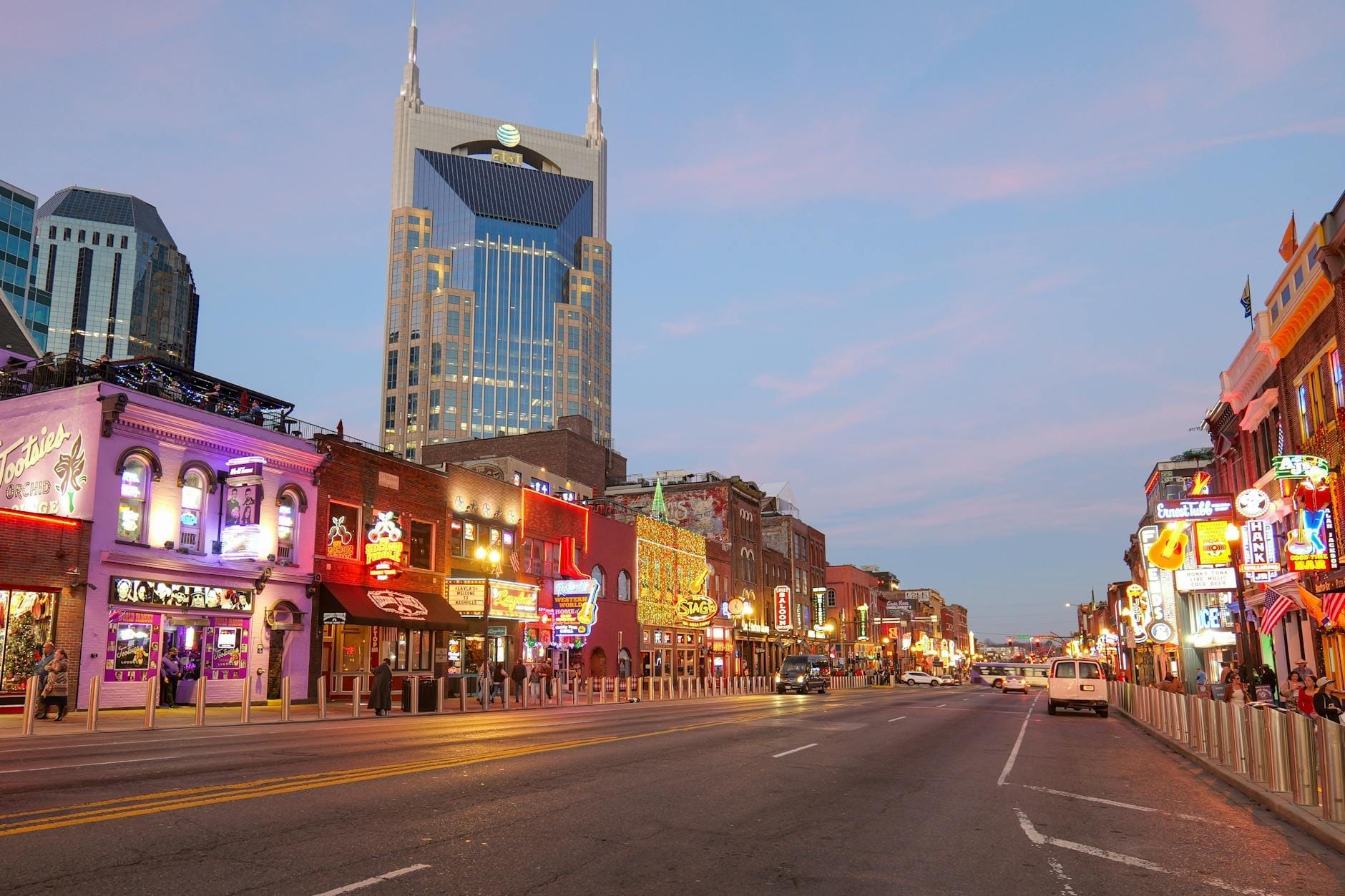
Broadway, or the Honky Tonk Highway as locals and visitors alike call it, is a six-block entertainment district in the heart of downtown Nashville, Tennessee. Running along Lower Broadway between First and Fifth Avenues, it is one of the few places in America where live music plays from 10 in the morning until 3 at night, every single day of the year, with no cover charge at the door. That combination of accessibility, density, and round-the-clock sound makes it unlike almost any other street in the country.
The Broadway Historic District was listed on the National Register of Historic Places on July 18, 1980, recognizing the architectural and cultural significance of its 19th- and early-20th-century commercial buildings. Behind the neon signs and the roar of pedal steel guitars, you are looking at some of the oldest commercial facades in Nashville. The brick fronts, cast-iron details, and narrow storefronts speak to a time when this block served as Nashville's wholesale district, trading in boots, saddles, and dry goods for Tennessee's rural economy.
ℹ️ Good to know
No ticket, no reservation, no cover charge. You walk in, find a spot near the stage, order a drink, and the band plays. Tips in the tip jar near the musicians are customary and appreciated — most honky-tonk performers earn their income from tips rather than a venue salary.
A Street That Changes by the Hour
Broadway in the morning is a different animal than Broadway at midnight. Arrive before noon and the street is almost meditative. The sidewalks are nearly empty, the storefronts are just unlocking, and through the open doors you can hear a lone guitarist running through Hank Williams tunes to a room of maybe six people nursing beers and coffee. The light slants gold through the east-facing windows of the older buildings. It is an unexpectedly good time to visit if you actually want to hear the music clearly.
By mid-afternoon, tour groups and early arrivals begin filling the sidewalks. The sound from competing venues starts layering over itself: country from one door, Southern rock from another, the occasional blues band spilling out a third. The smell of fried food and beer becomes noticeable. Street performers sometimes set up near the corner of 4th Avenue. The temperature in summer can push above 90°F (32°C), so the cool air from an open honky-tonk door is genuinely welcome.
After dark is when Broadway fully becomes what people picture when they imagine Nashville's nightlife. The neon signs glow in red and green, the sidewalks press shoulder-to-shoulder on weekends, and the competing music from a dozen venues creates a wall of sound that you can feel as much as hear. The bass frequencies travel through the pavement. This version of Broadway is electric and chaotic in equal measure, and for many visitors it is exactly what they came for. For others, it can feel overwhelming, particularly on Friday and Saturday nights from about 9pm onward.
Tickets & tours
Live prices and dates from our booking partner. If you book, we may earn a commission at no extra cost to you.
Old Town trolley tour of Nashville
From 54 €Instant confirmationFree cancellationHatch Show Print guided tour
From 21 €Instant confirmationFree cancellationDowntown walking tour of Nashville
From 21 €Instant confirmationFree cancellationNashville Downtown Underground Donut Tour
From 46 €Instant confirmationFree cancellation
The Architecture and History Behind the Neon
The physical streetscape of Lower Broadway is older than its reputation as a music district. Many of the buildings date to the late 1800s, constructed during Nashville's post-Civil War commercial expansion. The city sits at roughly 597 feet above sea level along the Cumberland River, and Broadway was one of the primary commercial spines connecting the riverfront warehouses to the rest of the city. When the wholesale trade declined in the mid-20th century, the buildings were taken over cheaply, and the honky-tonks moved in. The low rents enabled a rough-edged music scene to take hold in the 1940s and 1950s, and the street became synonymous with the working-class country music that later spread across the world.
Several landmark institutions anchor the strip. The Ryman Auditorium sits just one block north of Broadway on 5th Avenue North, and its presence is never far from the energy on the street. It was the original home of the Grand Ole Opry from 1943 to 1974, and its Gospel Tabernacle origins give it an almost reverential quality that contrasts with the rowdiness outside. On nights when a major show is playing, you can watch the crowd streaming down toward Broadway after the performance. The Hatch Show Print letterpress shop, now located inside the Country Music Hall of Fame building nearby, has been producing concert posters since 1879 and represents another layer of Broadway's deep print-and-music history.
How to Navigate the Strip
The practical layout is simple. Broadway runs east to west, sloping slightly downhill toward the Cumberland River at the east end. Starting at 5th Avenue and walking east toward 1st Avenue takes you through the densest concentration of honky-tonks. The most well-known names cluster between 3rd and 5th Avenues. On the north side of the street you will find most of the classic one-story and two-story honky-tonk bars. Several venues have expanded upward over the years, with rooftop bars offering views over the street below and, in some cases, sightlines to the Nashville skyline and the river beyond.
First-time visitors are often surprised that the honky-tonks themselves are quite casual. There is no dress code enforced at street level. You walk in through an open doorway, find standing room or a barstool, and the band is typically set up at the back or on a side stage. For a more storied experience, Tootsie's Orchid Lounge at 422 Broadway is one of the oldest and most historically significant venues on the strip, with walls covered in photographs connecting it directly to the Ryman Auditorium's golden era. Next door, Robert's Western World is widely considered the best option for traditional country music specifically, drawing a slightly different crowd than the tourist-heavy venues on either side.
💡 Local tip
Walk the full length of Broadway before committing to a bar. Each venue has a different band, vibe, and crowd density at any given time. The short walk from 5th to 1st takes less than ten minutes and lets you hear five or six different acts before you decide where to plant yourself.
What Broadway Does Well — and Where It Falls Short
Broadway delivers on its core promise without qualification: free live music, all day, every day. If you want to hear country, Southern rock, or blues in an atmosphere that genuinely feels purpose-built for it, the street is hard to beat anywhere in the world. The concentration of talent is real. Many of the musicians playing afternoon slots on Broadway are skilled professionals who play covers with tight, experienced technique.
That said, the strip has shifted considerably toward large-format entertainment venues in recent years. Several multi-story complexes have opened with corporate ownership, dozens of flat-screen televisions, and rooftop bars that prioritize crowd capacity over acoustic intimacy. The trade-off is a livelier, more spectacle-oriented experience at the cost of the gritty, sawdust-floor character that defined the street for decades. If authenticity in the historical sense is what you are after, the smaller and older venues reward the extra time it takes to find them.
Visitors looking for original songwriters performing their own material will find Broadway a frustrating experience. Nearly all the music here is cover songs, played for a rotating crowd of tourists. For original compositions in a listening-room format, venues like the Bluebird Cafe in Green Hills or the Listening Room Cafe in SoBro offer a completely different experience where the music is the explicit focus and conversation during a set is frowned upon.
Practical Details: Getting There, Getting Around, Staying Safe
Broadway sits in the center of downtown Nashville, making it easy to reach from virtually any hotel in the core. WeGo Public Transit Route 18 connects Nashville International Airport (BNA), located about 8 miles southeast of downtown, to Music City Central, the main downtown bus hub. From there, Broadway is a five-to-ten minute walk south. Uber and Lyft both operate actively in Nashville; drop-off on 2nd or 4th Avenues flanking Broadway avoids the main pedestrian congestion on the strip itself.
Parking is available in several commercial garages within a block or two of Broadway, though weekend rates can be high and street parking near the strip fills quickly after early evening. If you are combining Broadway with a visit to the Country Music Hall of Fame (located just one block south on Demonbreun Street), their parking garage is an option during daytime hours.
The street is generally considered safe in the immediate Broadway area, which maintains a heavy security and police presence on weekends. Like any high-density nightlife district, basic awareness matters after midnight: watch your belongings in crowded bars, and use a designated driver or ride-hail service rather than driving after drinking. WeGo buses do not run 24 hours, so late-night return options are primarily taxis or ride-hailing.
⚠️ What to skip
Friday and Saturday nights between 9pm and 2am are peak crowd hours. The sidewalks on Broadway become genuinely difficult to navigate during this window. Visitors with mobility limitations, sensory sensitivities, or young children will find weekday afternoons or weekend mornings dramatically more comfortable.
Photography on Broadway
Broadway is one of the most photogenic streets in Nashville. The neon signs photograph well after dark, particularly in the golden hour just after sunset when there is still ambient light in the sky to balance the artificial glow. The reflection of the signs in rain-wet pavement, which happens frequently given Nashville's year-round precipitation, creates striking images without any special equipment. Wide-angle shots from the rooftop bars capture the strip's full length and the downtown skyline behind it. Inside the honky-tonks, stage lighting is usually sufficient for phone cameras on a wide aperture, but the low ceilings and tight spaces make shots feel more intimate than the street-level photography.
Insider Tips
- Visit on a weekday between 11am and 2pm. The bands are just as good, the drinks cost the same, you can actually get a barstool, and you can hold a conversation. The Friday night version of Broadway is a crowd event as much as a music event.
- Robert's Western World on the 400 block is the most consistent stop for traditional country music played straight. The crowd skews more local and the sound system is set at a human volume. Their fried bologna sandwich is also a genuine Nashville institution.
- Look up. Many of the multi-story honky-tonks have rooftop bars with unobstructed views of the Nashville skyline and the Cumberland River. Getting up there early (before 7pm on weekends) means you can secure a spot before the lines form.
- Tipping the band is not optional in spirit even if it is in practice. A dollar per song or a few dollars per set is the norm. Most tip jars sit near the front of the stage. The musicians on Broadway are largely paid through tips, not venue salaries.
- If you want a break from the noise and crowds, duck into the Nashville Arcade on 4th Avenue, one block parallel to Broadway. Built in 1903, it is one of the oldest shopping arcades in the American South and is almost always quiet.
Who Is Broadway (Honky Tonk Highway) For?
- First-time Nashville visitors who want to understand why the city is called Music City
- Country music and Southern rock fans who enjoy live performances in informal settings
- Bachelorette and birthday groups looking for a high-energy, no-reservation-required night out
- Daytime visitors who want free live music as a backdrop to an afternoon walk
- Travelers interested in American architectural history and mid-century commercial streetscapes
Nearby Attractions
Other things to see while in Downtown Nashville:
- 3rd & Lindsley
Since 1991, 3rd & Lindsley has been the venue where Nashville musicians play when they want to be heard, not just seen. Located half a mile south of Broadway in the SoBro district, it is an intimate, no-frills room that draws touring acts, local legends, and serious audiences in equal measure.
- Acme Feed & Seed
Housed in a landmark 1943 building at the corner of 1st Avenue and Broadway, Acme Feed & Seed is a multi-level bar, restaurant, and music venue with a rooftop overlooking the Cumberland River. It offers a more layered experience than the typical honky-tonk strip, with a rooftop that earns its reputation for views and a ground floor that still delivers the Broadway energy.
- Adventure Science Center
Adventure Science Center is Nashville's premier interactive science museum, offering 44,000 square feet of hands-on exhibits, a 75-foot adventure tower, and a 63-foot dome planetarium. It has served the city since 1945 and remains one of the most engaging family destinations near downtown Nashville.
- Bicentennial Capitol Mall State Park
Bicentennial Capitol Mall State Park is a free, 19-acre outdoor park in downtown Nashville built to commemorate Tennessee's 200th anniversary of statehood. Anchored by a 200-foot granite map of the state, a 95-bell carillon, and the Rivers of Tennessee Fountains, it doubles as one of the most informative and peaceful green spaces in the city center.
Planning a trip? Discover personalized activities with the Nomado app.