Bethesda Terrace and Fountain: Central Park's Grandest Gathering Place
Bethesda Terrace and Fountain sits at the heart of Central Park, framing the iconic Angel of the Waters sculpture against the backdrop of the Lake. Free to visit any day of the week, it rewards those who arrive at the right hour with light, space, and genuine New York atmosphere.
Quick Facts
- Location
- Mid-Park at 72nd Street, Central Park, Manhattan, NYC
- Getting There
- Subway B/C to 72nd St (Central Park West) or 6 to 68th St–Hunter College
- Time Needed
- 30–60 minutes at the terrace; longer if combining with the Lake and Mall
- Cost
- Free – no tickets or reservations required
- Best for
- Architecture lovers, photographers, families, romantics, and anyone wanting a Central Park focal point
- Official website
- www.centralparknyc.org/locations/bethesda-terrace
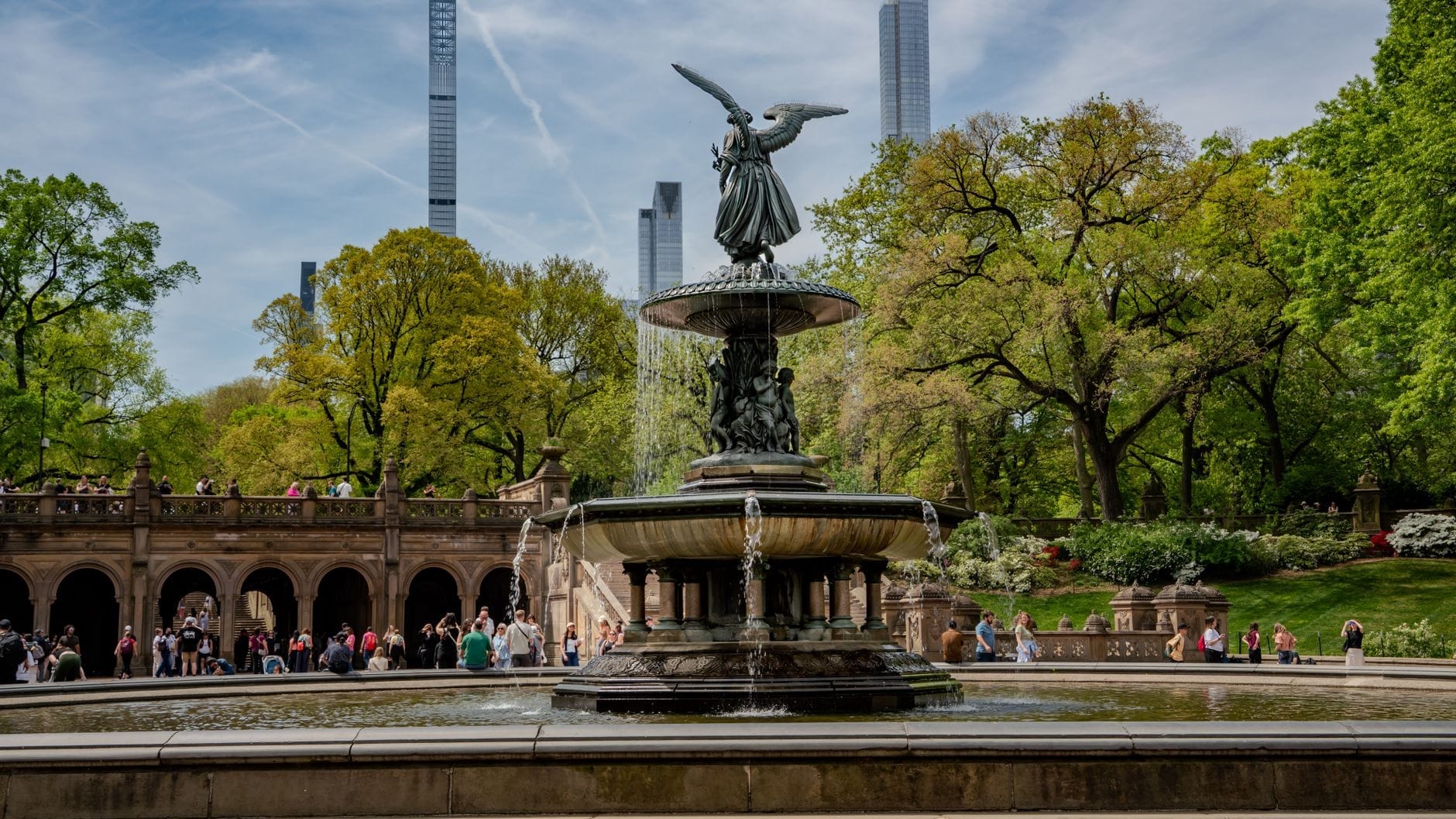
What Bethesda Terrace Actually Is
Bethesda Terrace and Fountain is the architectural centerpiece of Central Park, positioned at mid-park near the 72nd Street Cross Drive, where the formal promenade of the Mall meets the natural shoreline of the Lake. Most visitors come for the fountain, but the terrace itself is the real achievement: a two-level sandstone complex of stairs, balustrades, and an underpass arcade, all decorated with carved tilework that took craftsmen years to complete.
The fountain's central sculpture, officially called Angel of the Waters, was designed by Emma Stebbins and dedicated in 1873. Stebbins was the first woman to receive a public art commission in New York City, a fact that adds quiet historical weight to what might otherwise seem like decorative park furniture. The bronze angel stands roughly 26 feet (7.9 m) above the fountain basin, which itself spans about 96 feet (29 m) across, making it one of the largest fountains in New York.
ℹ️ Good to know
Access is free and no tickets are required. Central Park is open daily from 6:00 a.m. to 12:00 a.m. (midnight), and the terrace follows those same hours year-round.
The Architecture and Its History
Construction on Bethesda Terrace began in the early 1860s, part of Frederick Law Olmsted and Calvert Vaux's original Greensward Plan for Central Park. The terrace was largely complete by 1863, though the fountain arrived a decade later. The design philosophy was deliberate: Olmsted and Vaux wanted a formal architectural transition between the structured Mall and the naturalistic Lake, a place where the city's straight lines could dissolve into open water and sky.
The underpass arcade connecting the upper and lower terrace levels is worth slowing down for. The vaulted ceiling is covered in Minton encaustic tiles, a Victorian-era ceramic technique used extensively in English churches, and the geometric patterns remain remarkably intact. The passage is often overlooked by visitors who descend the stairs instead, which means it is frequently quiet even when the terrace above is packed.
The terrace sits within the broader context of Central Park's Landmark designation. For those interested in how this fits into NYC's wider architectural legacy, the New York City architecture guide covers the park's design alongside other landmark structures across the five boroughs.
Tickets & tours
Hand-picked options from our booking partner. Prices are indicative; availability and final rates are confirmed when you complete your booking.
Statue of Liberty, Ellis Island, and Brooklyn Bridge Happy Hour Cruise
From 49 €Instant confirmationFree cancellationSpirit of New York Dinner Cruise
From 161 €Instant confirmationFree cancellationNew York City Highlights bike tour
From 70 €Instant confirmationFree cancellationNew York Statue of Liberty and Ellis Island tour by ferry
From 55 €Instant confirmation
How the Experience Changes by Time of Day
The terrace shifts dramatically depending on when you arrive. Early morning, from around 7:00 to 9:00 a.m., the lower plaza is nearly empty. The fountain catches low-angle light from the east, and the water sounds carry further without crowd noise to compete. Joggers pass on the surrounding paths but rarely stop. This is the best window for photographs without strangers in frame.
By mid-morning on weekends, particularly between May and October, tour groups begin arriving from both the 72nd Street entrances. By noon, the lower plaza can hold hundreds of people. Street musicians set up near the fountain base, and the acoustic bowl created by the surrounding stone amplifies everything from guitar to saxophone. On a warm Saturday afternoon, the terrace operates as an informal outdoor venue, with the crowd itself becoming part of the spectacle.
Late afternoon light, especially in autumn, strikes the Angel of the Waters from the southwest and turns the bronze a deep amber. This is arguably the most photogenic hour. The Lake reflects both the fountain and the tree canopy behind it, and the Bow Bridge is visible in the middle distance. Winter visits offer a stripped-down version: bare trees, fewer people, and a stillness that the summer months rarely allow.
💡 Local tip
Arrive before 9:00 a.m. on weekdays for the quietest experience and the best photography light. On weekends in summer, expect significant crowds from mid-morning through late afternoon.
Walking the Space: Upper Terrace to Lower Plaza
Most visitors approach from the Mall, Central Park's grand tree-lined promenade, and arrive first at the upper terrace balustrade. From here, the fountain and the Lake open up below in a single wide view. The stone railings are carved with the four seasons in relief, a detail that most people lean against without noticing.
Two symmetrical staircases descend to the lower plaza, but the underpass arcade runs directly through the middle of the terrace structure. Walking through it, the temperature drops a few degrees even in summer, and the tiled ceiling overhead catches the attention of nearly everyone who passes. The acoustic effect inside is notable: voices carry and echo in a way that makes the space feel both intimate and slightly theatrical.
At the lower plaza, the fountain is the obvious focal point, but the surrounding benches facing the Lake offer a longer, calmer view. Rowboats from the nearby Central Park Boathouse drift on the water, and in warmer months, ducks and geese navigate the fountain basin itself. The lakeside path continues west toward the Bow Bridge, which adds a logical extension to any visit here.
The terrace connects naturally into a longer walk through Central Park, particularly toward Strawberry Fields to the west and Belvedere Castle to the north.
Photography at Bethesda Fountain
The fountain is one of the most photographed spots in New York City, which makes originality a challenge. The straight-on view from the lower plaza steps is the standard shot. For something different, position yourself at the far southern edge of the lower plaza and shoot back toward the terrace stairs with the fountain in the foreground and the carved balustrade above, catching both levels in one frame.
Reflections in the fountain basin work best when the water surface is calm, which typically means early morning before wind picks up. The bronze angel photographs well in overcast light, which softens harsh shadows on the sculpture's details. In direct noon sun, the statue can appear flat. Golden hour in late afternoon, when the western light catches the bronze and the stone, is consistently the most reliable window.
💡 Local tip
For wide-angle shots capturing both the fountain and the Lake behind it, stand at the northern edge of the lower plaza and shoot south. The Bow Bridge appears in the background on the left side of the frame during leafy months.
Getting There and Practical Details
The most direct subway approach is the B or C train to 72nd Street on Central Park West. From there, enter the park at the 72nd Street West entrance and follow the main path east through the Strawberry Fields area, or take the transverse path directly east to reach the Mall and then the terrace, roughly a 10-minute walk. Alternatively, the 6 train to 68th Street–Hunter College puts you at the Fifth Avenue side; enter at 72nd Street and walk west across the park, slightly longer but pleasant.
Parking around Central Park is limited and expensive. For visitors using public transit more broadly, the guide to getting around New York City covers subway, bus, and alternative transport options in practical detail.
The terrace is largely accessible to wheelchair users via ramps that connect the upper and lower levels without requiring use of the stairs. The arcade underpass has level flooring. The surrounding plaza paths are paved and well-maintained, though some peripheral paths in the park nearby are uneven. Visitors with specific accessibility needs should check current conditions with the Central Park Conservancy before visiting.
There are no food vendors at the terrace itself, but the Central Park Boathouse restaurant and cafe sit a short walk to the northeast along the Lake path. In warmer months, pretzel and cold drink carts typically operate near the 72nd Street park entrances.
Who Will Get the Most from This Visit
Bethesda Terrace rewards visitors who slow down. If you walk through in five minutes on the way somewhere else, you will take a photo of the fountain and miss almost everything: the tilework arcade, the carved seasonal panels, the way the Lake frames the whole composition from the lower plaza. Travelers with an interest in landscape architecture, Victorian decorative arts, or the history of New York's public spaces will find more here than they expected.
Families with children do well here because the open lower plaza gives kids room to move, the fountain provides sensory interest, and the space connects easily to the nearby Central Park Zoo and the rowboat rental at the Central Park Boathouse. Couples find the terrace at dusk consistently atmospheric. Solo travelers and photographers who plan around the early morning window get something most visitors never see: this space without the crowd.
If you are building a wider Central Park itinerary, Belvedere Castle to the north and Strawberry Fields to the west are natural companions to a terrace visit. For a full day in the park and surrounding neighborhood, the first-time visitor guide to New York City provides a broader framework.
Visitors who find crowded outdoor spaces frustrating should be aware that midday summer weekends bring genuinely large numbers of people to the lower plaza. The terrace is not the right place to come for peace and quiet during those windows. Those wanting a quieter Central Park experience will find it more reliably elsewhere, or at Bethesda itself before 9:00 a.m.
Insider Tips
- The Minton tile ceiling in the underpass arcade is one of the most ornate Victorian decorative surfaces in New York City. Most visitors miss it entirely by taking the stairs. Walk through the arcade, stop in the middle, and look up.
- The fountain basin is occasionally drained for maintenance, typically in late autumn or winter. If seeing the full fountain is important to your visit, check the Central Park Conservancy website or social media for current status before making a special trip.
- Buskers at the lower plaza vary enormously in quality and volume. Early morning visits are silent. Weekend afternoons can feature amplified performers. If you want to sit quietly by the water, a weekday morning is a categorically different experience from a Saturday afternoon in July.
- The upper terrace balustrade carvings depict the four seasons in sequence. Most people walk past without stopping. Take 60 seconds to look at the stonework up close before descending to the lower plaza.
- From the lower plaza, face north toward the Lake for the widest compositional view. The Bow Bridge sits in the middle distance and the tree canopy frames the water on both sides. This north-facing view is more interesting photographically than the standard south-facing shot of the fountain alone.
Who Is Bethesda Terrace and Fountain For?
- Architecture and design enthusiasts interested in Victorian landscape design and decorative stonework
- Photographers working the early morning window for light and minimal crowds
- Families combining the fountain with the nearby Central Park Boathouse rowboats or Central Park Zoo
- Couples looking for a genuinely scenic and atmospheric outdoor setting in Manhattan
- First-time NYC visitors wanting to see Central Park's most iconic single landmark
Nearby Attractions
Other things to see while in Central Park:
- Belvedere Castle
Perched atop Vista Rock at the heart of Central Park, Belvedere Castle is a 19th-century Gothic-Romanesque folly offering some of the most rewarding panoramas in New York City — all free of charge. Designed by Calvert Vaux and completed in 1872, the castle now serves as a visitor center operated by the Central Park Conservancy, and remains one of the park's most photogenic and historically layered landmarks.
- Central Park
Central Park is a 843-acre public park stretching from 59th to 110th Street in Manhattan. Entry is free, the park is open daily until 1:00 a.m., and it contains dozens of distinct landscapes, landmarks, and activities within walking distance of each other.
- Central Park Zoo
One of the oldest zoos in the United States, the Central Park Zoo occupies about 6.5 acres near the southeast corner of Central Park. Small by design, it rewards visitors who take it slowly — especially families with young children and anyone wanting wildlife between museum stops.
- Strawberry Fields
Strawberry Fields is a 2.5-acre memorial landscape on the west side of Central Park, dedicated to John Lennon and anchored by the iconic 'Imagine' mosaic. Free to visit and open daily, it draws Beatles fans, quiet seekers, and curious travelers year-round.