Strawberry Fields: Central Park's John Lennon Memorial
Strawberry Fields is a 2.5-acre memorial landscape on the west side of Central Park, dedicated to John Lennon and anchored by the iconic 'Imagine' mosaic. Free to visit and open daily, it draws Beatles fans, quiet seekers, and curious travelers year-round.
Quick Facts
- Location
- Central Park West & West 72nd Street, Manhattan (west side of Central Park)
- Getting There
- Subway: 72nd St station (1, 2, 3 lines), short walk to the park entrance
- Time Needed
- 20–45 minutes; longer if you linger or combine with a broader park walk
- Cost
- Free. No tickets, no reservation required
- Best for
- Beatles fans, reflective solo visits, photography, quiet park walks
- Official website
- www.centralparknyc.org/locations/strawberry-fields
What Strawberry Fields Actually Is
Strawberry Fields is a 2.5-acre memorial landscape on the western edge of Central Park, positioned directly across Central Park West from The Dakota apartment building, where John Lennon lived and was shot on December 8, 1980. The site was designated by New York City in 1981 as part of a broader effort to memorialize Lennon, and officially dedicated on October 9, 1985, the 45th anniversary of his birth. It is maintained by the Central Park Conservancy and designated as a quiet zone within the park.
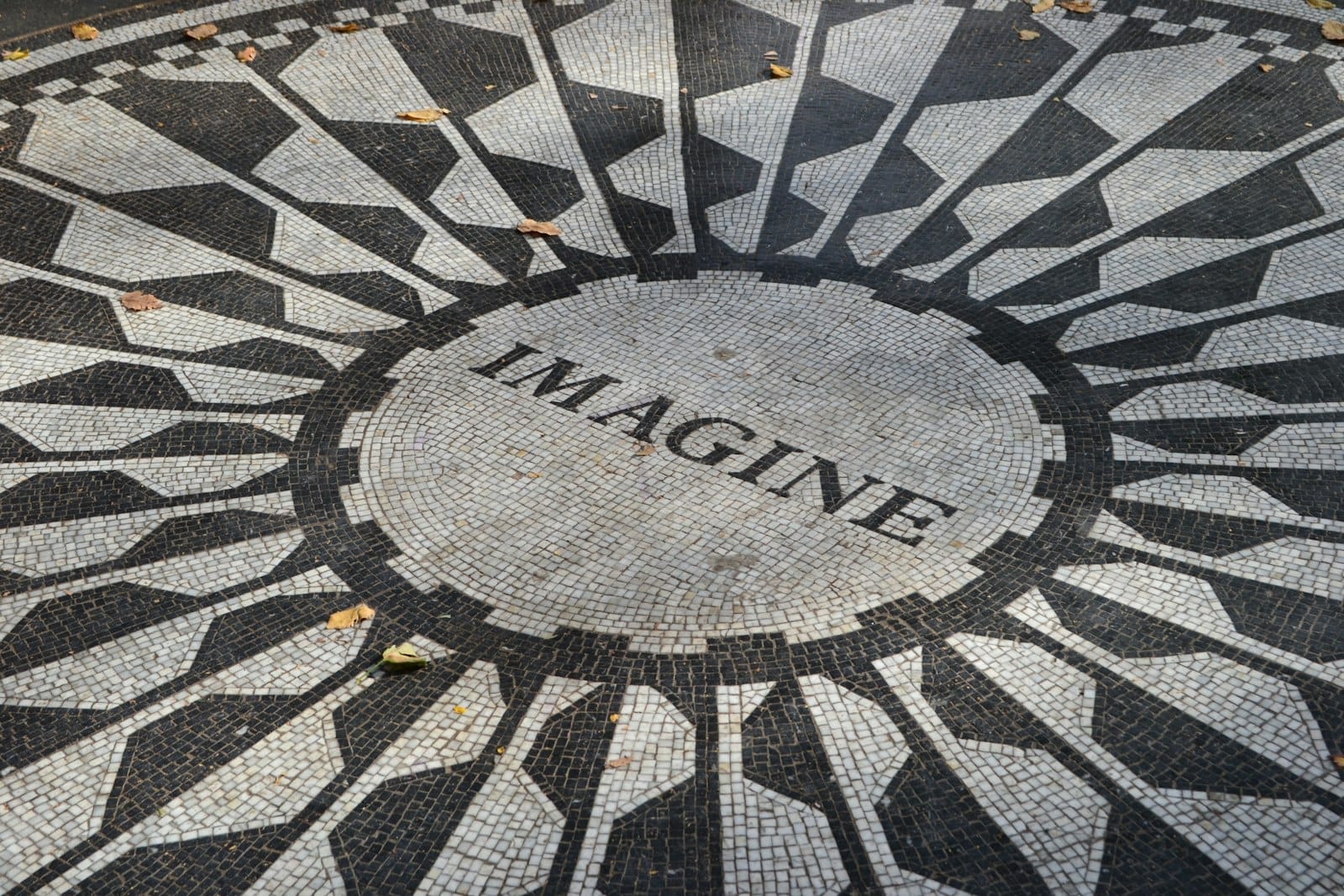
The physical centerpiece is the 'Imagine' mosaic, a circular black-and-white pavement inlay set flush into the main pathway. The mosaic was created by artists from the Italian city of Naples and bears a single word at its center. Around it, the landscaping consists of elms, flowering plants, and naturalistic paths typical of Frederick Law Olmsted's original park design. There are no fences, no ticket booths, and no barriers of any kind. You simply walk in.
ℹ️ Good to know
Strawberry Fields is open daily during standard Central Park hours, currently 6:00 a.m. to 1:00 a.m. Admission is free. The easiest approach is from the Central Park West & 72nd Street entrance, which puts you on the primary paved path to the mosaic within about two minutes of walking.
The Imagine Mosaic Up Close
The mosaic is smaller than most visitors expect from photographs. It measures roughly 12 feet in diameter and sits in the center of a slightly widened path. On almost any day, you will find flowers arranged on it: roses, tulips, or loose petals placed by fans who stop specifically to leave something. On Lennon's birthday (October 9) and the anniversary of his death (December 8), the flower arrangements grow considerably larger, sometimes covering nearly the entire surface.
The design is a circular radiating pattern in black, white, and grey stone, with 'IMAGINE' set in capital letters at the center. It reads clearly from standing height. Photographing it well requires patience because other visitors are almost always present, either crouching for photos themselves or standing nearby. Early mornings on weekdays are your best window for a clear shot.
The mosaic is surrounded by a semicircular bench area and several large elm trees that provide shade from roughly mid-spring through late autumn. In full leaf, the canopy creates a genuinely enclosed, sheltered atmosphere that feels distinct from the rest of the park. If you want to understand how the site fits into the broader landscape of the Upper West Side, the Central Park neighborhood guide covers the park's layout and surrounding streets in detail.
Tickets & tours
Hand-picked options from our booking partner. Prices are indicative; availability and final rates are confirmed when you complete your booking.
New York Mets Baseball Game Tickets at Citi Field
From 42 €Instant confirmationStatue of Liberty, Ellis Island, and Brooklyn Bridge Happy Hour Cruise
From 49 €Instant confirmationFree cancellationSpirit of New York Dinner Cruise
From 161 €Instant confirmationFree cancellationNew York City Highlights bike tour
From 70 €Instant confirmationFree cancellation
How the Experience Changes by Time of Day
Visiting at 8:00 a.m. on a weekday is about as close to solitude as this spot gets. The morning light comes through the elm canopy at a low angle, the air smells of damp soil and cut grass, and the path is largely empty except for joggers passing through without stopping. The flowers on the mosaic from the previous day are still fresh, and the quiet zone designation is actually enforced by atmosphere rather than signage: people lower their voices here.
By midday, particularly on weekends and in summer, the area draws consistent crowds. Tour groups, solo fans, and park visitors converge on the mosaic. Someone is nearly always playing guitar nearby, usually a Beatles song, and occasionally a small audience forms. This is not unpleasant, but it is a fundamentally different experience from the early morning. The acoustic element adds something genuine; the informal performances are spontaneous rather than organized.
Late afternoon in autumn may be the most photogenic window. The light filters through turning leaves, the crowds thin slightly after the midday peak, and the temperature drops enough to make lingering comfortable. Winter visits are quieter still. On grey December days, the site takes on a more austere quality, which some visitors find more appropriate to its commemorative function than the brightness of summer.
💡 Local tip
If you visit on December 8 (the anniversary of Lennon's death), expect a significant gathering by late afternoon and evening. Candles, flowers, and impromptu music performances make it an unusually affecting experience, but the site becomes genuinely crowded after dark.
Historical and Cultural Context
The name comes directly from the Beatles song "Strawberry Fields Forever" (1967), which Lennon wrote drawing on memories of a Salvation Army children's home in Liverpool. New York City designated this section of Central Park in his honor in 1981, less than four months after his death, with a council resolution adopted on March 26 of that year. Yoko Ono, Lennon's widow, donated $1 million to fund the restoration and landscaping of the area, and she continued to live at The Dakota across the street for decades afterward.
The decision to dedicate a section of Central Park rather than erect a statue was consistent with Lennon's own stated preferences. The 'Imagine' mosaic, created by artists from Naples and installed for the 1985 dedication, is the only explicitly commemorative element in the landscape. Everything else, the plantings, the paths, the elm trees, is designed to function as a living space rather than a monument.
The Dakota building is visible from the park entrance at Central Park West and 72nd Street, though not directly from the mosaic itself. Its dark Gothic Revival facade is unmistakable. The broader Upper West Side, covered in the Upper West Side neighborhood guide, is worth exploring before or after a visit: the area has a strong concentration of cultural institutions, independent bookshops, and restaurants.
Getting There and Practical Walkthrough
The most direct approach is via the 72nd Street subway station, served by the 1, 2, and 3 trains. Exit toward Central Park West, cross the street, and enter the park through the Strawberry Fields entrance. The mosaic is roughly a two-minute walk along the main path heading northeast into the park. You will see it before you reach it, partly because of the people gathered around it.
The paved path from the Central Park West entrance is flat and wide enough for wheelchairs and strollers without difficulty. If you want to explore the surrounding landscape rather than just the mosaic, some of the adjacent paths slope and include natural rock outcroppings, which are less accessible but not extreme. The quiet zone designation means amplified music and loud noise are officially discouraged in the immediate area.
Strawberry Fields pairs naturally with other nearby Central Park attractions. The Bethesda Terrace and Fountain is about a 10-minute walk east through the park. The broader Central Park offers hours of additional walking if you want to extend your visit.
💡 Local tip
Wear comfortable, flat shoes. The paved approach is easy, but if you wander the surrounding paths or head toward the Ramble (just east of Strawberry Fields), the terrain becomes more uneven. There are no cafes or food vendors at Strawberry Fields specifically, though vendors operate elsewhere in the park.
Photography Tips and Honest Limitations
The mosaic photographs best from directly above, which requires crouching or lying flat on the ground. A wide-angle lens or phone camera in portrait mode captures the full design. If you want the mosaic in frame without other visitors' feet in the shot, 7:00 to 8:30 a.m. on a weekday is the reliable window. Dappled light from the elm canopy can create high-contrast shadows in midday summer conditions that are difficult to expose correctly.
It is worth being honest about what Strawberry Fields is and is not. The site is small. On a typical afternoon, you will spend ten minutes at the mosaic and another ten walking the immediate surrounding paths before you have seen everything. The emotional weight of the place comes from what you bring to it, your relationship to Lennon's music and legacy, rather than from any grand architectural or natural spectacle. Visitors who arrive expecting a large monument often leave mildly surprised by its scale.
If your primary interest is sweeping views rather than contemplative spaces, the Belvedere Castle offers elevated panoramas over the park's Turtle Pond and the midpark landscape. For a wider overview of Central Park's standout spots, the best views in New York City guide covers options across the city.
Who Should Skip This
Travelers with no particular connection to John Lennon or the Beatles who are working through a tight itinerary may find the time-to-reward ratio modest compared with other Central Park destinations. The mosaic is genuinely striking, but the surrounding 2.5 acres do not compete visually with, say, Bethesda Terrace or the Conservatory Garden. If you are traveling with young children and looking for interactive or expansive spaces, the Central Park Zoo or the wider park lawns will hold attention better.
Visitors primarily interested in New York's cultural and historical institutions should note that Strawberry Fields is more experiential than informational. There are no interpretive panels, no museum-style displays, and no audio guides. For deep context on the city's cultural landscape, the NYC art and culture guide points to institutions that offer curated, narrative-driven experiences.
Insider Tips
- The flowers on the Imagine mosaic are replaced regularly by a small community of fans and local volunteers. If you want to leave flowers, single-stem roses are the most common offering and do not clutter the mosaic design.
- The Dakota building is visible from the 72nd Street entrance before you enter the park. Stand on the park side of Central Park West and look northwest for the unobstructed view of its facade.
- On October 9 (Lennon's birthday) and December 8 (the anniversary of his death), informal gatherings draw larger crowds with candles and music from early afternoon. Arrive before 3:00 p.m. if you want a contemplative rather than a crowd experience.
- The quiet zone designation is genuine: park staff do occasionally ask guitar players and groups to reduce volume or move. If you are hoping to hear impromptu music, weekend midday visits are more reliable for encountering it.
- One of the nearest restrooms is at the 72nd Street and Strawberry Fields area comfort station, a short walk toward the park interior. Check the Central Park Conservancy website for current facility information before visiting.
Who Is Strawberry Fields For?
- Beatles fans and anyone with a personal connection to John Lennon's music
- Solo travelers seeking a quiet, reflective pause within Central Park
- Photographers looking for an iconic pavement mosaic shot in a natural park setting
- Visitors combining the Upper West Side neighborhood with a Central Park walk
- Travelers who want a free, low-effort stop that carries genuine cultural weight
Nearby Attractions
Other things to see while in Central Park:
- Belvedere Castle
Perched atop Vista Rock at the heart of Central Park, Belvedere Castle is a 19th-century Gothic-Romanesque folly offering some of the most rewarding panoramas in New York City — all free of charge. Designed by Calvert Vaux and completed in 1872, the castle now serves as a visitor center operated by the Central Park Conservancy, and remains one of the park's most photogenic and historically layered landmarks.
- Bethesda Terrace and Fountain
Bethesda Terrace and Fountain sits at the heart of Central Park, framing the iconic Angel of the Waters sculpture against the backdrop of the Lake. Free to visit any day of the week, it rewards those who arrive at the right hour with light, space, and genuine New York atmosphere.
- Central Park
Central Park is a 843-acre public park stretching from 59th to 110th Street in Manhattan. Entry is free, the park is open daily until 1:00 a.m., and it contains dozens of distinct landscapes, landmarks, and activities within walking distance of each other.
- Central Park Zoo
One of the oldest zoos in the United States, the Central Park Zoo occupies about 6.5 acres near the southeast corner of Central Park. Small by design, it rewards visitors who take it slowly — especially families with young children and anyone wanting wildlife between museum stops.