Bavaria Statue and Ruhmeshalle: Munich's Bronze Giant Worth the Climb
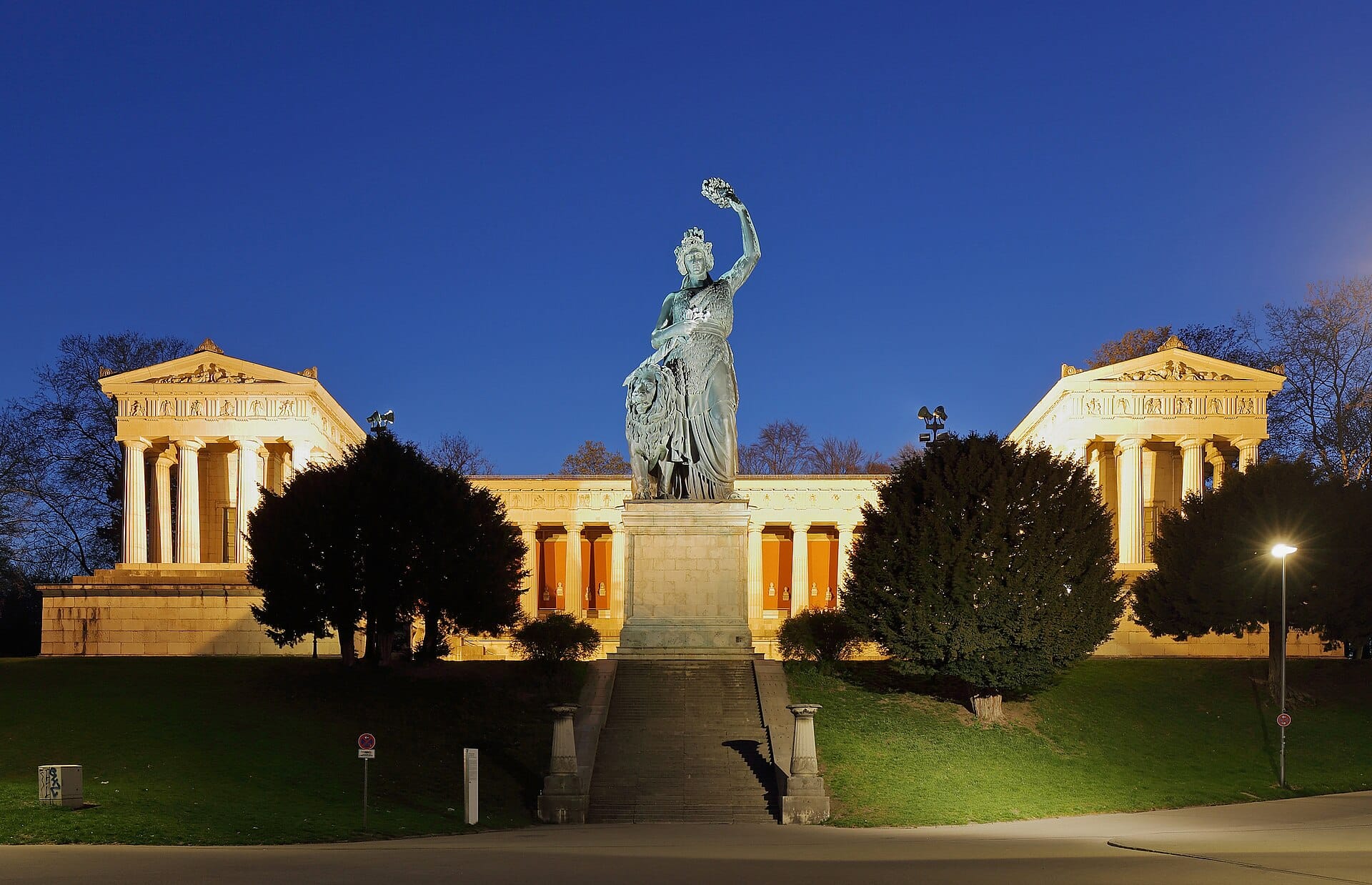
Standing 18.52 metres tall above Theresienwiese, the Bavaria Statue is one of the largest bronze figures in the world, and you can climb inside it. Behind her rises the Ruhmeshalle, a sweeping Doric colonnade commissioned by King Ludwig I to honour distinguished Bavarians. Together they form one of Munich's most undervisited monumental sites.
Quick Facts
- Location
- Theresienhöhe 16, 80339 München (Theresienwiese)
- Getting There
- U-Bahn: Theresienwiese, short uphill walk; Bus 134 to Theresienhöhe
- Time Needed
- 1 to 1.5 hours for statue climb and Ruhmeshalle
- Cost
- Regular €5, Reduced €4, Under-18s free
- Best for
- History lovers, architecture fans, panoramic city views, curious travellers
- Official website
- www.schloesser.bayern.de/englisch/palace/objects/mu_ruhm.htm
What You're Actually Looking At
The Bavaria Statue and Ruhmeshalle sit at the western edge of Theresienwiese, the same meadow that fills each autumn with Oktoberfest tents. For most of the year, though, the site belongs to a trickle of visitors who make the climb up from the U-Bahn and find something genuinely surprising: a 18.52-metre bronze woman, cast between 1844 and 1850, with a lion at her feet and enough hollow space inside her head to fit several people at once.
Bavaria, the allegorical personification of the Free State, holds an oak wreath in one raised hand. She faces east, looking out over the city she was built to symbolise. Her scale only becomes clear when you stand at her base: the head alone is about 3.7 metres tall. The casting process, using a technique supervised by Ferdinand von Miller at the Munich foundry, was considered a major industrial and artistic achievement of 19th-century Europe.
Directly behind her stands the Ruhmeshalle, a three-winged Doric colonnade approximately 68 metres long and 38 metres deep, built between 1843 and 1853 by architect Leo von Klenze. It was commissioned by King Ludwig I of Bavaria, who wanted a permanent hall to honour distinguished Bavarians in art, science, and military service. The busts of honoured figures line the interior walls, and the open-air colonnades create a calm, shaded walkthrough that most visitors spend less time in than the statue itself.
The Climb: What the Interior is Like
⚠️ What to skip
The only way to reach the viewing platform inside Bavaria's head is via a narrow internal spiral staircase. There is no lift. Anyone with claustrophobia, limited mobility, or difficulty on stairs should factor this in before purchasing a ticket.
Entry to the interior is through a door at the statue's base. A spiral staircase winds up through the hollow bronze figure, tight enough that two adults passing each other requires some coordination. The steps number around 130 in total, and the climb takes about five to eight minutes depending on the pace of the group ahead of you. The sound inside changes as you ascend: footsteps and voices echo against the metal shell in a way that feels unexpectedly industrial.
At the top, a small viewing platform inside Bavaria's head offers narrow slit windows looking out over Munich. The view is not the widest panoramic you'll find in the city, but the context is hard to replicate: you're looking out from inside a 19th-century bronze head, at a skyline that includes the Alps on clear days. The space accommodates only a handful of people at once, so expect to queue briefly on busy weekend mornings.
For broader city panoramas without the staircase challenge, the tower of St. Peter's Church in the Altstadt offers more expansive 360-degree views. Bavaria's viewpoint is more about the experience than the vista.
Tickets & tours
Live prices and dates from our booking partner. If you book, we may earn a commission at no extra cost to you.
Bavarian food tour at Viktualienmarkt Munich
From 43 €Instant confirmationFree cancellationBavarian castles self-guided audio tour of Neuschwanstein and Alps
From 30 €Instant confirmationMunich tour with Bavarian beer, food and Oktoberfest Museum
From 62 €Instant confirmationFree cancellationAudio walking tour of Munich, the capital of Bavaria and beer
From 25 €Instant confirmation
How the Site Changes Through the Day
Early morning, around opening at 9:00, the site is genuinely quiet. The Theresienwiese below is often empty except for joggers cutting across the meadow, and the low morning light falls on the bronze at an angle that emphasises the surface texture: the patina is deep greenish-brown in places, darker in the recesses of the drapery folds. This is the best time to photograph the statue without other visitors in the frame and to explore the Ruhmeshalle without competition for space.
By midday, particularly on summer weekends, a modest queue forms at the statue's base. The site never reaches the overcrowding you'd see at Marienplatz or the Deutsches Museum, but the interior climb can feel more rushed when a school group is moving through. The Ruhmeshalle becomes pleasantly shaded and cooler than the surrounding open ground in summer heat, which makes it a practical rest stop as much as a cultural one.
Late afternoon brings softer light and a gradual thinning of visitors. The statue's bronze takes on a warmer tone in evening light, and the view from the top windows looking west catches the sun descending toward the horizon. On clear autumn days, before the October closing, the Alps are visible to the south with particular sharpness.
Historical and Cultural Context
Ludwig I's ambition for this site was explicitly nationalistic in the 19th-century Romantic sense: he wanted Bavaria to have monuments that could stand alongside the great civic symbols of ancient Greece and Rome. Leo von Klenze, the same architect responsible for the Glyptothek and the Propyläen on Königsplatz, designed the Ruhmeshalle in a severe Doric style that consciously referenced Athenian civic architecture. The result is a building that looks less like anything else in Munich and more like something transported from the Athenian Agora.
The broader Königsplatz complex, a short distance away in Maxvorstadt, reflects the same Neoclassical vision Ludwig I pursued across the city. But where Königsplatz was later repurposed during the National Socialist period, the Ruhmeshalle remained more peripheral to that history, functioning primarily as a monument to pre-industrial Bavarian achievement.
The Bavaria statue herself was a technical landmark. At the time of completion, she was one of the largest bronze castings in the world, produced by the Munich Erzgießerei (royal bronze foundry) using a method that cast the figure in sections before assembly. The sculptor was Ludwig Schwanthaler, who designed the figure, though he died in 1848 before the casting was finished. Ferdinand von Miller oversaw the foundry work, and the project's success established Munich as a centre for monumental bronze casting in Europe.
Practical Walkthrough: Getting There and What to Expect
The U-Bahn station Theresienwiese on lines U4 and U5 is the easiest approach. From the station exit, you walk uphill along the western side of Theresienwiese for roughly five minutes. The statue becomes visible ahead of you as you clear the crest of the rise. Bus line 134 stops at Theresienhöhe, which is marginally closer to the entrance. A car park at Theresienwiese is available outside Oktoberfest, but public transport is straightforwardly convenient.
The site is open approximately late March to 19 October, daily from 09:00 to 18:00 (last entry 17:30). During Oktoberfest the statue remains open until 20:00, but the Ruhmeshalle closes for safety reasons during the festival period. Both the statue and the Ruhmeshalle close from around 20 October through late March. Always check the Bayerische Schlösserverwaltung's official page before visiting, as seasonal dates can shift slightly year to year.
Admission is €5 regular, €4 reduced, and free for visitors under 18. Tickets are purchased at the site. There are no timed-entry slots, so arrival at opening time on busy summer weekends is the simplest way to avoid any queue at the statue base. Wear comfortable shoes: the surrounding grounds are on a slope, and the spiral staircase requires some agility.
💡 Local tip
Combine this visit with the Viktualienmarkt for lunch before, or head to the Glyptothek on Königsplatz afterward. Both are within 15 minutes by U-Bahn and continue the Neoclassical Munich thread started here.
Photography Notes
The best full-figure photographs of the Bavaria statue are taken from the lower meadow, roughly 80 to 100 metres back, where the full height and the Ruhmeshalle behind her are both in frame. A wide-angle lens helps. The morning light (between 9:00 and 11:00) falls on the statue's face; afternoon light wraps around from the west and illuminates the colonnade.
Inside the head, the slit windows limit what you can shoot from the viewing platform, and the interior light is dim. A phone camera handles it adequately in good weather, but the shots are more documentary than scenic. The real photographic value of the climb is the unusual angle: looking down at the Theresienwiese from inside a bronze head is an image you can't get elsewhere in Munich.
Who Should Skip This
Travellers with very limited time who are prioritising Munich's heaviest-hitting sights should know that the Bavaria Statue is a meaningful secondary attraction rather than a top-tier priority alongside the Deutsches Museum or the Munich Residenz. The experience is rewarding, but the viewing platform inside the head is genuinely small, and if the physical climb is off the table due to mobility limitations, there is less reason to make a special trip.
Visitors who come specifically to see the Ruhmeshalle and are not interested in climbing the statue will find entry is still charged. The Ruhmeshalle as a standalone experience is architecturally interesting but modest in scale. Anyone expecting interior museum rooms with extensive historical exhibits will find the site sparse: this is a monument, not a museum, and should be approached as such.
Insider Tips
- Visit on a weekday morning in September before Oktoberfest begins: the meadow is quiet, the air is often clear enough to see the Alps, and there is no queue at the statue base.
- The Ruhmeshalle colonnades are open-sided and unheated. On cooler mornings in early spring or late September, bring a light layer: the shade inside the colonnades drops the temperature noticeably.
- If you are visiting Munich during Oktoberfest itself, note that the Ruhmeshalle is closed but the statue stays open until 20:00.
- The site is managed by the Bayerische Schlösserverwaltung. If you are visiting multiple state-managed properties (such as Nymphenburg Palace or the Residenz), check whether a combination ticket or the Bayern Pass offers savings.
- Stand at the far south end of the Ruhmeshalle colonnade and look back at the statue: this angle, with the Doric columns framing the figure against the sky, is more dramatic than the straight-on frontal view most visitors take from the meadow.
Who Is Bavaria Statue & Ruhmeshalle For?
- Architecture and history enthusiasts interested in 19th-century Bavarian Neoclassicism
- Travellers who want a panoramic viewpoint with an unusual, tangible physical experience
- Families with older children who can manage the spiral staircase independently
- Visitors with a half-day on the Oktoberfest grounds outside festival season
- Anyone building an itinerary around Munich's Neoclassical monuments and Leo von Klenze's legacy
Nearby Attractions
Combine your visit with:
- Allianz Arena & FC Bayern Museum
The Allianz Arena is one of Europe's most recognizable stadiums, home to FC Bayern München and capable of holding over 75,000 spectators. Paired with the FC Bayern Museum, it offers a full day of football history, architectural spectacle, and behind-the-scenes access for fans and curious visitors alike.
- Dachau Concentration Camp Memorial
The Dachau Concentration Camp Memorial Site, located 25 minutes from Munich by train, preserves the grounds of the first Nazi concentration camp, opened in 1933. With free admission, a comprehensive documentary exhibition, and guided tours in English, it draws many visitors each year who come to understand one of history's darkest chapters. Plan for at least three to four hours, and go prepared — emotionally as much as practically.
- Tierpark Hellabrunn (Munich Zoo)
Tierpark Hellabrunn has organized its animals by geographic region since 1928, making it the world's first geozoo. Spread across 40 hectares along the Isar River in southern Munich, it is one of Bavaria's most popular family destinations and a serious conservation institution. This guide covers everything you need to plan a rewarding visit.
- Neuschwanstein Castle
Schloss Neuschwanstein is the 19th-century Romanesque Revival palace that defined the world's image of a fairy-tale castle. Built for King Ludwig II starting in 1869 and never finished, it draws about 1.5 million visitors a year. This guide covers what the experience actually looks like, when to go, and how to get there without wasting a day.
Planning a trip? Discover personalized activities with the Nomado app.