Theresienwiese: Munich's Oktoberfest Grounds, Year-Round
Theresienwiese is the 42-hectare open meadow in Munich's Ludwigsvorstadt-Isarvorstadt district that has hosted Oktoberfest since 1810. Free to enter at any time of year, it tells a different story depending on when you show up — from a calm, windswept plaza framed by the Bavaria Statue to the world's largest folk festival drawing millions of visitors each autumn.
Quick Facts
- Location
- Bavariaring 5, 80336 München, Ludwigsvorstadt
- Getting There
- U4 / U5 to Theresienwiese station (direct); U3 / U6 to Poccistraße or Goetheplatz
- Time Needed
- 30–60 min outside festival; full day during Oktoberfest
- Cost
- Free entry year-round; Oide Wiesn section charges around €4 admission during Oktoberfest (verify current price)
- Best for
- History seekers, Oktoberfest visitors, photography, family walks
- Official website
- www.muenchen.de/en/sights/attractions/theresienwiese
What Is Theresienwiese?
Theresienwiese is a large public meadow and fairground in the Ludwigsvorstadt district, roughly a 20-minute walk southwest of Marienplatz. Covering approximately 42 hectares, the site is best known internationally as the home of Oktoberfest, but it functions as an ordinary open public space for the other ten or eleven months of the year. The name translates literally as 'Therese's Meadow,' named after Princess Therese von Sachsen-Hildburghausen, who married Crown Prince Ludwig (later King Ludwig I of Bavaria) here in October 1810. The horse race held to celebrate that wedding became the template for Oktoberfest, which has returned to the same site almost every year since.
Outside the festival window, the grounds are quiet in a way that surprises many visitors. What you find is an enormous flat expanse of concrete and compacted earth, ringed by residential streets and overlooked from the western edge by the monumental Bavaria Statue, a 18.5-metre bronze figure standing atop a stone hall of fame called the Ruhmeshalle. It is an odd and strangely compelling sight: classical grandeur at the edge of what is, for most of the year, an empty lot.
ℹ️ Good to know
Theresienwiese is accessible at all times as an open public space. No ticket is needed to walk the grounds. During Oktoberfest, the fairground and beer tents remain free to enter; rides and the Oide Wiesn historic section have their own costs.
The Ground Itself: What You See Outside Oktoberfest
Visit on a weekday morning in spring or summer and you may find dog walkers crossing the flat open surface, a handful of tourists locating the Bavaria Statue, and the occasional jogger. The scale of the place only becomes apparent when it is empty: 42 hectares is large enough that the far end disappears into a slight haze on overcast days. The surface underfoot is hard and unremarkable, with little greenery during festival preparation periods, though grass does recover in the off-season stretches.
The Ruhmeshalle — the neoclassical hall built between 1843 and 1853, designed by Leo von Klenze — is open to visitors at certain times and provides a sheltered, colonnaded walk with busts of notable Bavarians set into its curved walls. Above it, the Bavaria Statue can be climbed from inside via a narrow staircase, offering a view from the figure's head across Munich and, on clear days, toward the Alps. Confirm opening times for the statue interior before visiting, as these change seasonally.
Photographers find the early morning the most rewarding window outside festival season. The flat terrain allows low-angle shots of the Bavaria Statue against sky, and the lack of crowds means you can set up without obstruction. The light is softest in the hour after sunrise, and the surrounding streets are quiet enough that you hear only distant trams.
Tickets & tours
Live prices and dates from our booking partner. If you book, we may earn a commission at no extra cost to you.
Luggage Storage in Munich
From 6 €Instant confirmationFree cancellationOne hour city sightseeing bus tour in Munich
From 21 €Instant confirmationFree cancellationMunich Third Reich walking tour
From 32 €Instant confirmationFree cancellationRomantic Road Day Trip to Rothenburg and Harburg
From 74 €Instant confirmationFree cancellation
Oktoberfest: What the Grounds Actually Look Like in Use
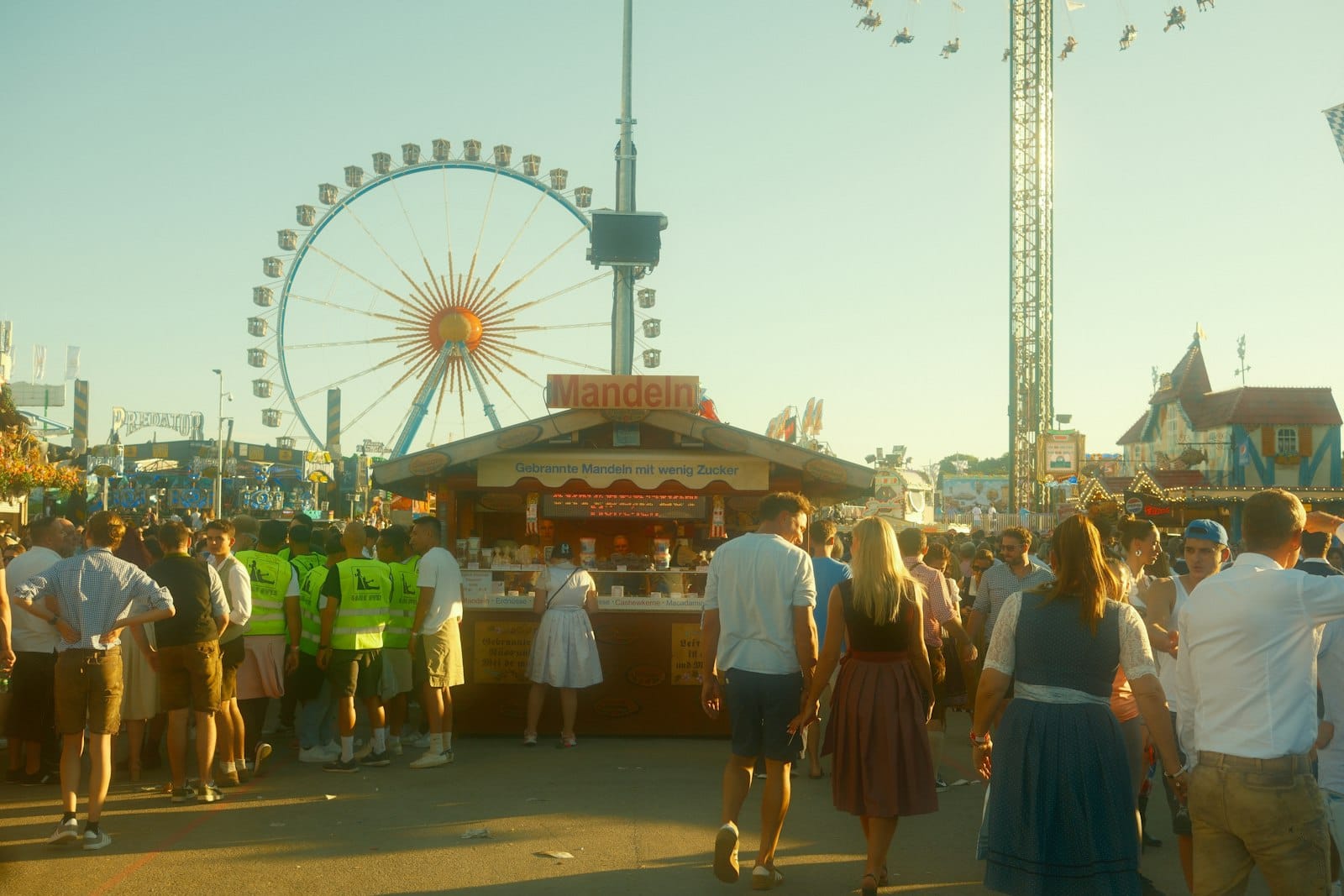
During Oktoberfest, usually running from mid-September to the first Sunday in October (verify the exact dates for your year of travel at the Oktoberfest planning guide), Theresienwiese is transformed beyond recognition. The empty expanse fills with around 40 large and small beer tents, fairground rides, food stalls, souvenir vendors, and roasting spits. The infrastructure involved is staggering: the tents are permanent wooden structures assembled each year, with the largest holding several thousand people.
The smell hits you before you arrive: roast chicken, pretzels, frying doughnuts, and underneath it all, a faint yeasty note from the beer. Brass band music from competing tents overlaps at the entrances, creating a wall of competing sound. Inside the tents, wooden benches seat strangers next to each other; conversation at high volume becomes normal. The floor vibrates when several thousand people stand to sing.
The outer ring of the festival grounds has an older, calmer character. The Oide Wiesn ('Old Oktoberfest') section, when offered, recreates historical festival elements with vintage rides and traditional Bavarian folk performances. It charges an admission fee of around €4 separate from the main grounds — check current pricing before your visit. Families with young children often prefer this section to the main beer tent area, which becomes very loud and very crowded by early afternoon on weekends.
⚠️ What to skip
Weekend afternoons during Oktoberfest are the most crowded hours by a significant margin. Beer tents fill by midday on Saturdays, and entry is refused once capacity is reached. If you want a seat in one of the major tents, arrive before 10:00 or book a table reservation through the tent's official operator well in advance.
Historical Context: Over 200 Years on the Same Meadow
The first Oktoberfest in 1810 was a public horse race organized as part of the royal wedding celebrations. The event was popular enough that Munich's citizens petitioned for it to repeat the following year. From those origins, the festival expanded incrementally: agricultural shows were added, then amusements, then permanent large beer halls replaced temporary structures. The name Oktoberfest became attached to a celebration that, ironically, now runs mostly through September, moved earlier in the 20th century to take advantage of warmer weather.
The meadow itself has witnessed events beyond the festival calendar. In the early 20th century, political rallies were held on the site. The Bavaria Statue, completed in 1850, predates unified Germany and was conceived as a monument to Bavarian identity at a time when Bavaria was a kingdom. The statue's interior mechanics — the hollow bronze cast and the staircase within — reflect the engineering ambition of the period.
Munich's history intersects here with the wider arc of Bavarian and German national identity. The site sits within a city that carries considerable 20th-century historical weight, explored in depth at the NS-Dokumentationszentrum, about 15 minutes north on foot.
Getting There and Moving Around
The most direct public transport connection is the U-Bahn. Lines U4 and U5 stop at Theresienwiese station, which exits directly onto the southwestern edge of the grounds. During Oktoberfest, additional train frequency is deployed and the station handles enormous passenger volumes; expect crowding at the exits after 11:00 on festival days. The nearby stations Poccistraße and Goetheplatz on lines U3 and U6 are worth knowing as overflow options if Theresienwiese station becomes congested.
Walking from the city centre is straightforward. From Marienplatz, the route takes roughly 20 to 25 minutes on foot, heading southwest through Sendlinger Tor and then along Goethestrasse. The walk passes through ordinary residential streets with no particular detours required. During Oktoberfest, this pedestrian route becomes extremely busy from mid-morning.
The grounds are flat and fully accessible for wheelchairs and pushchairs under normal conditions. During Oktoberfest, the city and festival organizers publish specific barrier-free access information and designated service points — consult the official Oktoberfest site before visiting if you have specific access requirements.
💡 Local tip
If you are cycling to Theresienwiese, note that bicycles must be left at designated parking areas outside the festival perimeter during Oktoberfest. Munich has an extensive cycling network, but the grounds themselves do not permit cycling during the festival.
Time of Day and Season: When to Come
Outside Oktoberfest, early morning is the best time to visit for photography and atmosphere. By mid-morning on weekends, school groups and tourists arrive to see the Bavaria Statue, and the open space loses its quiet quality. In summer, the site gets direct sun with limited shade — bring water. In winter, the grounds are largely deserted and slightly austere, but the low sun creates interesting light on the Ruhmeshalle columns. For broader Munich context, the best time to visit Munich guide covers seasonal trade-offs across the city.
During Oktoberfest, morning visits (between 10:00 and noon on weekdays) give you the best chance of walking the grounds without extreme crowds, seeing the tents before they reach capacity, and actually hearing the band. By 14:00 on any given day, and from around 11:00 on Saturdays, the atmosphere shifts from festive to compressed. The last two weekends of the festival tend to be the most crowded of all.
Who Might Not Enjoy This
If you are visiting outside Oktoberfest and expecting a visually rich or architecturally detailed site, Theresienwiese is likely to disappoint. The open concrete expanse is functional rather than beautiful, and the Bavaria Statue, while impressive in scale, is the only significant permanent landmark. Visitors accustomed to compact European old-town sightseeing may find the scale and emptiness disorienting.
During Oktoberfest, the experience is specifically not suited to those sensitive to noise, strong smells, or very large, dense crowds. Children under ten generally find the main beer tent areas overwhelming, though the Oide Wiesn section is a better fit. Travelers who prefer quiet cultural immersion should plan their Munich visit for a different week entirely.
Insider Tips
- The Bavaria Statue can be climbed internally via a narrow spiral staircase for a rooftop-level view across Munich. Confirm seasonal opening hours via muenchen.de or the official Oktoberfest/theresienwiese pages before going, as the interior is not always accessible.
- If you want to eat at Oktoberfest without the tent scrum, the outdoor food stalls along the inner perimeter serve roast chicken, pretzels, and grilled fish with far shorter queues than the seated tent restaurants.
- On the first Saturday of Oktoberfest, a formal costume and riflemen's procession (Trachten- und Schützenzug) passes through Munich's streets before reaching the grounds — watching it from the parade route costs nothing and gives you a visual spectacle without the beer-tent crush.
- The Ruhmeshalle colonnade is one of Munich's most overlooked free spaces for a slow walk. The busts represent Bavarian figures from science, arts, and politics spanning centuries — it reads as a quiet counterpoint to the festival chaos that surrounds it for two weeks a year.
- During non-festival periods, Google Maps sometimes misplaces Theresienwiese pins. Navigate to Bavariaring 5, or use the U-Bahn station exit as your landmark — you will see the Bavaria Statue immediately from street level.
Who Is Theresienwiese (Oktoberfest Grounds) For?
- Oktoberfest attendees looking to understand the grounds before arrival
- History and architecture enthusiasts interested in 19th-century Bavarian monuments
- Families visiting during Oide Wiesn for a lower-intensity festival experience
- Photographers seeking large-scale urban compositions, especially at dawn
- Budget travelers, as the grounds themselves are free and the surrounding streets have affordable food options
Nearby Attractions
Combine your visit with:
- Allianz Arena & FC Bayern Museum
The Allianz Arena is one of Europe's most recognizable stadiums, home to FC Bayern München and capable of holding over 75,000 spectators. Paired with the FC Bayern Museum, it offers a full day of football history, architectural spectacle, and behind-the-scenes access for fans and curious visitors alike.
- Bavaria Statue & Ruhmeshalle
Standing 18.52 metres tall above Theresienwiese, the Bavaria Statue is one of the largest bronze figures in the world, and you can climb inside it. Behind her rises the Ruhmeshalle, a sweeping Doric colonnade commissioned by King Ludwig I to honour distinguished Bavarians. Together they form one of Munich's most undervisited monumental sites.
- Dachau Concentration Camp Memorial
The Dachau Concentration Camp Memorial Site, located 25 minutes from Munich by train, preserves the grounds of the first Nazi concentration camp, opened in 1933. With free admission, a comprehensive documentary exhibition, and guided tours in English, it draws many visitors each year who come to understand one of history's darkest chapters. Plan for at least three to four hours, and go prepared — emotionally as much as practically.
- Tierpark Hellabrunn (Munich Zoo)
Tierpark Hellabrunn has organized its animals by geographic region since 1928, making it the world's first geozoo. Spread across 40 hectares along the Isar River in southern Munich, it is one of Bavaria's most popular family destinations and a serious conservation institution. This guide covers everything you need to plan a rewarding visit.
Planning a trip? Discover personalized activities with the Nomado app.