The Alhambra: Granada's Nasrid Palace Complex
The Alhambra is one of the most visited monuments in the world for good reason: it is an extraordinarily complete surviving example of Nasrid Islamic palatial architecture, set above Granada on the hill of Sabika. This guide covers what to expect at each section of the complex, how to secure tickets, and how to make the most of your visit.
Quick Facts
- Location
- Calle Real de la Alhambra, s/n, 18009 Granada — on the Sabika hill above the city centre
- Getting There
- City buses from central Granada (verify current routes with Transportes Rober); on foot via the steep Cuesta de Gomérez; or taxi from the centre
- Time Needed
- 3–5 hours for the full complex; plan a full morning or afternoon
- Cost
- General Day ticket €22.27; Gardens, Generalife and Alcazaba ticket €12.73; verify current prices at tickets.alhambra-patronato.es before visiting
- Best for
- History lovers, architecture enthusiasts, first-time visitors to Granada, photographers
- Official website
- www.alhambra-patronato.es
What the Alhambra Actually Is
The Alhambra, officially the Conjunto Monumental de la Alhambra y el Generalife, is a medieval palace and fortress complex built primarily by the Nasrid emirs of the Emirate of Granada during the 13th and 14th centuries. It occupies a flat-topped ridge on the Sabika hill — an elevated plateau roughly 14 hectares in extent — looking directly across at the whitewashed slopes of the Albaicín and, on clear days, framing the snow-capped Sierra Nevada to the south-east.
The complex is not a single building. It is a walled city-within-a-city: military fortifications (the Alcazaba), royal palaces (the Nasrid Palaces), a Renaissance palace added under Charles V in the 16th century, craft workshops, a mosque converted into a church, and the Generalife summer gardens connected by a covered walkway. Understanding this layered structure before you arrive makes the visit considerably less disorienting.
The site was granted UNESCO World Heritage status in 1984 (extended to include the Albaicín in 1994), recognized for its outstanding universal value as the last great monument of Moorish Spain. If you want deeper context on Granada's Islamic heritage before your visit, the Granada Moorish heritage guide covers the broader historical arc from the 8th century to the fall of the emirate in 1492.
Tickets: The Single Most Important Thing to Get Right
The Alhambra sells a fixed daily quota of tickets, and the Nasrid Palaces section carries a specific timed entry slot printed on your ticket. Miss that window by more than a few minutes and you will be turned away from the palaces regardless of what you paid. This is not an exaggeration: it happens regularly to visitors who underestimate the walking time between sections.
⚠️ What to skip
Book tickets through the official portal at tickets.alhambra-patronato.es well in advance — months ahead during spring and early autumn. Third-party resellers often charge significantly more. Check current prices directly on the official site before purchasing, as admission rates are updated periodically.
Tickets specify a timed entry for the Nasrid Palaces. When planning your day, choose a palace entry time that gives you at least 45–60 minutes to walk from the main Access Pavilion through the Alcazaba first, or alternatively visit the Generalife gardens before heading to the palaces. The Palacio de Carlos V and the Alcazaba have more flexible entry. Night visits, which cover only the Nasrid Palaces or the Generalife gardens depending on the season, require entirely separate tickets and operate on Friday and Saturday evenings in winter, with expanded summer schedules (verify exact dates on the official site, as programs change).
For a full breakdown of how the ticketing system works, slot types, and where to buy, see the dedicated Alhambra tickets guide.
Tickets & tours
Live prices and dates from our booking partner. If you book, we may earn a commission at no extra cost to you.
Alhambra guided tour in Italian
From 49 €Instant confirmationFree cancellationAlhambra guided group tour with Nasrid Palaces and Generalife Palace
From 40 €Alhambra guided tour with Carlos V Palace, Generalife and Alcazaba
From 35 €Alhambra and Generalife skip-the-line private tour
From 65 €Instant confirmation
Moving Through the Complex: A Practical Walkthrough
Most visitors enter through the Access Pavilion on the eastern side of the hill. From there, the three main zones radiate outward: the Alcazaba fortress to the west, the Nasrid Palaces in the central-northern section, and the Generalife gardens up the slope to the north-east.
The Alcazaba
The Alcazaba is the oldest part of the complex, a military citadel with watchtowers whose origins predate the Nasrid period. The Torre de la Vela (Bell Tower) at its western tip offers the clearest panoramic view over Granada's rooftops toward the Sierra Nevada — this is the photograph most people associate with the Alhambra experience. The interior of the Alcazaba is largely bare foundations and rampart walkways; it rewards those interested in fortification history but may feel sparse to visitors expecting the decorative richness of the palaces.
The Nasrid Palaces
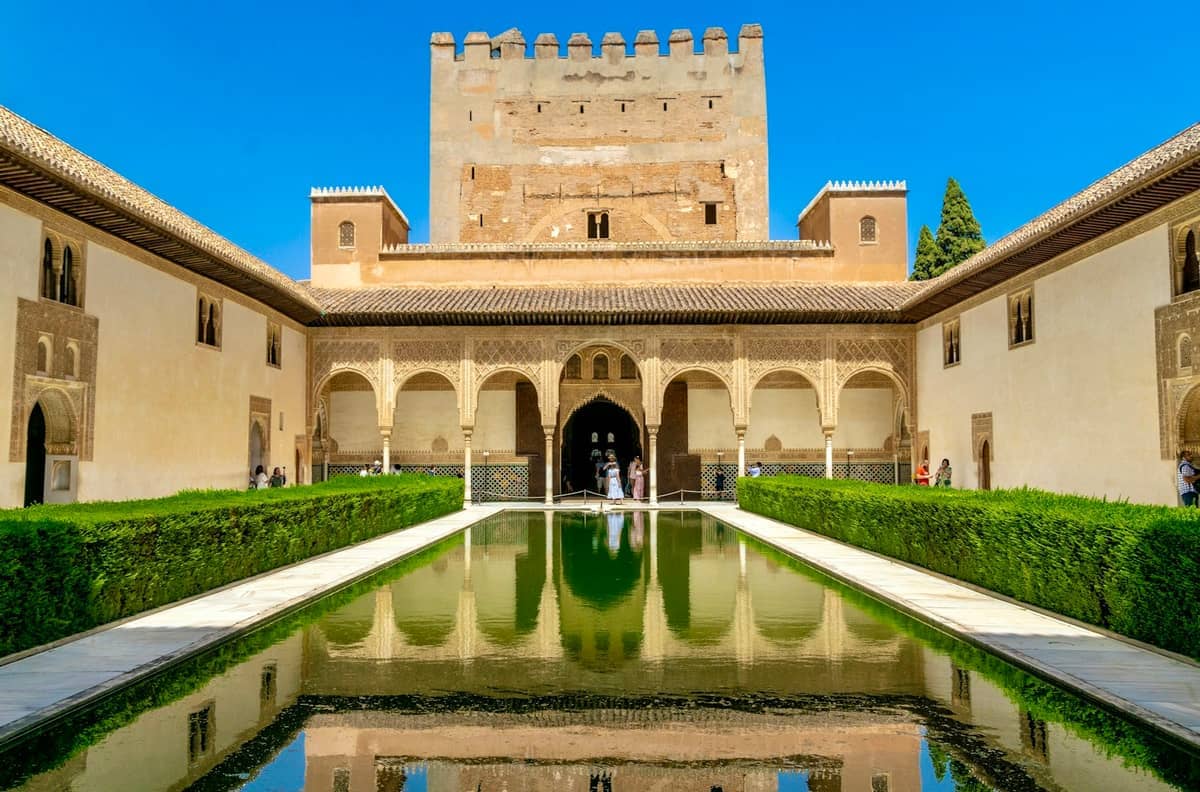
The Nasrid Palaces are the heart of any Alhambra visit and the reason the timed entry slot matters. Three interconnected palaces make up this section: the Mexuar (a council chamber now partly converted), the Comares Palace, and the Palace of the Lions. The Comares Palace is centered on the Court of the Myrtles, a long reflecting pool flanked by trimmed myrtle hedges whose surface mirrors the Torre de Comares above — one of the most geometrically satisfying spaces in medieval architecture anywhere in the world.
The Palace of the Lions centers on its famous courtyard: 124 slender marble columns supporting a forest of honeycombed muqarnas vaulting, arranged around a fountain carried by 12 white marble lions. The stucco ceilings in the Hall of the Two Sisters and the Hall of the Abencerrajes are among the most technically complex decorative surfaces surviving from any medieval culture. The light inside these halls shifts dramatically depending on time of day — early morning light enters low and rakes across the carved plasterwork, picking out geometric patterns that disappear in flat midday illumination.
The Palacio de Carlos V
The Palacio de Carlos V is a jarring tonal shift: a massive circular Renaissance palace begun in 1527 under Holy Roman Emperor Charles I of Spain (Charles V), set directly adjacent to the Nasrid Palaces. The exterior is austere dressed stone; the interior circular courtyard has a kind of austere grandeur. The palace now houses the Alhambra Museum and the Museum of Fine Arts. Neither collection is large, but the building itself is architecturally significant as an early example of Italian Renaissance style in Spain.
The Generalife
The Generalife (from the Arabic Yannat al-Arif, loosely 'the architect's garden' or 'the most noble of gardens') is the royal summer estate connected to the main complex by a covered walkway. The gardens are organized around long water channels with upward-spraying jets — the sound of moving water is constant and deliberately cooling. The Acequia Court (Court of the Water Channel) is the centerpiece, with cypresses clipped into dark vertical columns above the jet-spray and reflecting water.
In summer, when the Alhambra's stone interiors can feel airless and crowded, the Generalife provides genuine relief: shade, the smell of jasmine and roses, and considerably lighter foot traffic than the palace rooms. Allow 45–60 minutes here rather than rushing through.
How the Experience Changes by Time of Day
Early morning entry (08:30) puts you in the Nasrid Palaces before midday heat and at a point when tour groups have not yet reached their peak density. The light at this hour enters the palace courtyards at a low angle, and the carved stucco on the walls catches it in ways that simply do not happen at noon. The myrtle hedges in the Court of the Myrtles still hold moisture from overnight, and the air smells of damp stone and vegetation.
By 11:00, visitor density inside the Nasrid Palaces is noticeably heavier. The palace rooms are narrow, and crowding around the Court of the Lions makes it difficult to stand still long enough to absorb the architecture. If your timed entry is in this window, move against the natural visitor flow where possible: linger in the Hall of the Two Sisters when others push toward the Lions, then double back.
Afternoon visits (from 14:00 onward) benefit from slightly reduced crowds as day-trippers depart and the heat begins to ease. In summer, however, afternoon temperatures on the exposed Alcazaba ramparts can be brutal above 35°C — carry water and wear sun protection. The gardens and shaded palace interiors become particularly appealing as the day cools.
💡 Local tip
For photographs of the Court of the Lions without people in the frame, position yourself immediately after the doors open for your timed slot and move directly there before the crowd catches up. You may have 3–5 minutes of near-solitude.
Opening Hours and Seasonal Considerations
The complex opens daily. Winter hours (15 October to 31 March) run 08:30 to 18:00. Summer hours (1 April to 14 October) extend to 20:00. These hours apply to day visits; night visit schedules are separate and vary by season, typically covering Friday and Saturday evenings in winter (around 20:00–21:30) and expanding to Tuesday through Saturday in summer (around 22:00–23:30). Verify exact night visit availability and dates on the official site before booking, as programming changes annually.
Spring, particularly April and May, is widely considered the best time to visit: daytime temperatures sit around 22–27°C, the Generalife gardens are in bloom, and the light is clear without summer haze. Autumn (September–October) offers similar benefits. For a broader view of when to visit Granada based on weather, crowds, and local events, see the best time to visit Granada guide.
ℹ️ Good to know
In high summer (July–August), maximum temperatures in Granada regularly exceed 35°C. The Alhambra's stone surfaces and open ramparts amplify the heat. Bring at least one litre of water per person, wear a hat, and consider scheduling the Alcazaba for early morning or late afternoon rather than midday.
Getting There and Accessibility
On foot from the city centre, the most direct route climbs the Cuesta de Gomérez, a steep pedestrian lane that ascends from the Plaza Nueva. The walk takes approximately 20–25 minutes at a moderate pace and involves sustained uphill gradient — manageable for most visitors but tiring in summer heat. City buses serve the hill from central Granada; check current routes and stops with Transportes Rober before your visit, as service details change.
Taxis drop off at or near the Access Pavilion. If driving, paid car parks are available near the complex, though spaces fill early in peak season. The Alhambra hill is not served by Granada's Metro system.
Accessibility is partial. Roughly 50% of the complex is independently wheelchair accessible, rising to around 70% with assistance. The Generalife gardens and sections of the Palacio de Carlos V are the most accessible areas; parts of the Alcazaba and some Nasrid Palace rooms involve steps that cannot be bypassed. Free wheelchair loan is available at the Access Pavilion on a first-come, first-served basis with ID. Baby strollers are not permitted inside the monument — a free baby carrier loan (for children up to 12 kg) is available, and a free cloakroom handles bags and pushchairs.
Is It Worth It?
The Alhambra is not overhyped. The Nasrid Palaces in particular are among the most remarkable interior spaces in Europe, and nothing in photographs quite prepares visitors for the scale and density of the decorative programme covering every surface. That said, the experience is heavily shaped by crowd management and whether you have done the advance planning required.
Who may find it disappointing: visitors expecting a 'romantic ruin' atmosphere will find a very managed heritage site with signage, roped barriers, and queues. Those with severe mobility limitations will be excluded from significant sections. Anyone arriving without a pre-booked ticket on a busy day will simply not get in. The entrance fee plus transport costs and the planning overhead mean this is not a casual stop.
For those visiting Granada for two days or fewer, the Alhambra should anchor the itinerary. A suggested framework for organizing the rest of your time appears in the 2 days in Granada itinerary.
Insider Tips
- Your Nasrid Palace timed entry slot is strict: aim to be at the palace entrance 10 minutes before your slot, not at the Access Pavilion. Build that walking time into your plan from whichever section you visit first.
- The ceiling of the Hall of the Abencerrajes is best observed by stepping back against the far wall and looking straight up — the muqarnas stalactite dome is one of the densest examples of this craft in existence and easy to miss if you are following the crowd flow without pausing.
- Night visits cover a more limited area than daytime tickets but the experience of the Nasrid Palaces or Generalife after dark, with artificial lighting that mimics candle illumination, is distinctly different from daytime — quieter, more theatrical. Book separately and as far in advance as daytime slots.
- The Parador de Granada, a state-run luxury hotel physically inside the Alhambra complex, allows non-guests into its café and terrace. Having a coffee or early evening drink there gives you legitimate access to the complex atmosphere without the full visitor circuit — and the garden views are exceptional.
- Photography: the Court of the Myrtles reflection pool is best photographed in the first 30 minutes after opening when the surface is still and the crowd has not yet disturbed it. By mid-morning the water is rarely calm enough for the classic mirror reflection shot.
Who Is Alhambra For?
- First-time visitors to Granada — the Alhambra is the essential reference point for understanding the city's history and its place in European and Islamic cultural heritage
- Architecture and design enthusiasts interested in medieval Islamic geometric ornament, muqarnas vaulting, and the integration of water features into palatial design
- Photographers who plan carefully around timing and light conditions
- History-focused travelers wanting to understand the final chapter of Moorish Spain before 1492
- Couples visiting Granada — the Generalife gardens in spring, with roses and the sound of water jets, are among the most atmospheric spaces in Andalusia
Nearby Attractions
Other things to see while in Alhambra Hill (La Sabika):
- Alcazaba
The Alcazaba is the oldest surviving section of the Alhambra complex, a Nasrid military fortress perched at the western tip of the hill. Its towers offer some of the most commanding views in Granada, looking out over the Albaicín, the Darro valley, and on clear days, the snow-capped Sierra Nevada.
- Carmen de los Mártires
Tucked just minutes from the Alhambra entrance, Carmen de los Mártires is a sprawling 19th-century romantic garden on Alhambra Hill that most visitors walk straight past. Shaded paths, ornamental lakes, Moorish-influenced terraces, and resident peacocks reward those who take the detour.
- Casa-Museo Manuel de Falla
Tucked into the hillside near the Alhambra, the Casa Museo Manuel de Falla preserves the modest carmen where Spain's greatest 20th-century composer worked for nearly two decades. Original furnishings, a working piano, and handwritten manuscripts make this one of Granada's most intimate cultural visits.
- Fundación Rodríguez-Acosta (Carmen Rodríguez-Acosta)
Perched on the slopes of Alhambra Hill, the Fundación Rodríguez-Acosta is a layered surprise: a modernist villa-garden complex built by a Granadan painter in the early 20th century, now housing an eclectic art collection and the scholarly Museo Gómez-Moreno. Guided visits run in set morning passes; admission is 5 euros, with various reductions and free entry for children under 12.
Planning a trip? Discover personalized activities with the Nomado app.