Fundación Rodríguez-Acosta: Granada's Overlooked Modernist Carmen
Perched on the slopes of Alhambra Hill, the Fundación Rodríguez-Acosta is a layered surprise: a modernist villa-garden complex built by a Granadan painter in the early 20th century, now housing an eclectic art collection and the scholarly Museo Gómez-Moreno. Guided visits run in set morning passes; admission is 5 euros, with various reductions and free entry for children under 12.
Quick Facts
- Location
- Callejón Niño del Rollo 8, 18009 Granada
- Getting There
- 10–15 min walk from Plaza Nueva or central Realejo; local buses toward Alhambra stop nearby
- Time Needed
- 1.5–2 hours (guided visit runs approx. 1 hour)
- Cost
- 5 € general; 3 € ages 12–15; free under 12; reductions for seniors, students, and other eligible visitors
- Best for
- Art lovers, architecture enthusiasts, and visitors wanting an alternative to the Alhambra crowds
- Official website
- http://www.fundacionrodriguezacosta.com
What Is the Fundación Rodríguez-Acosta?
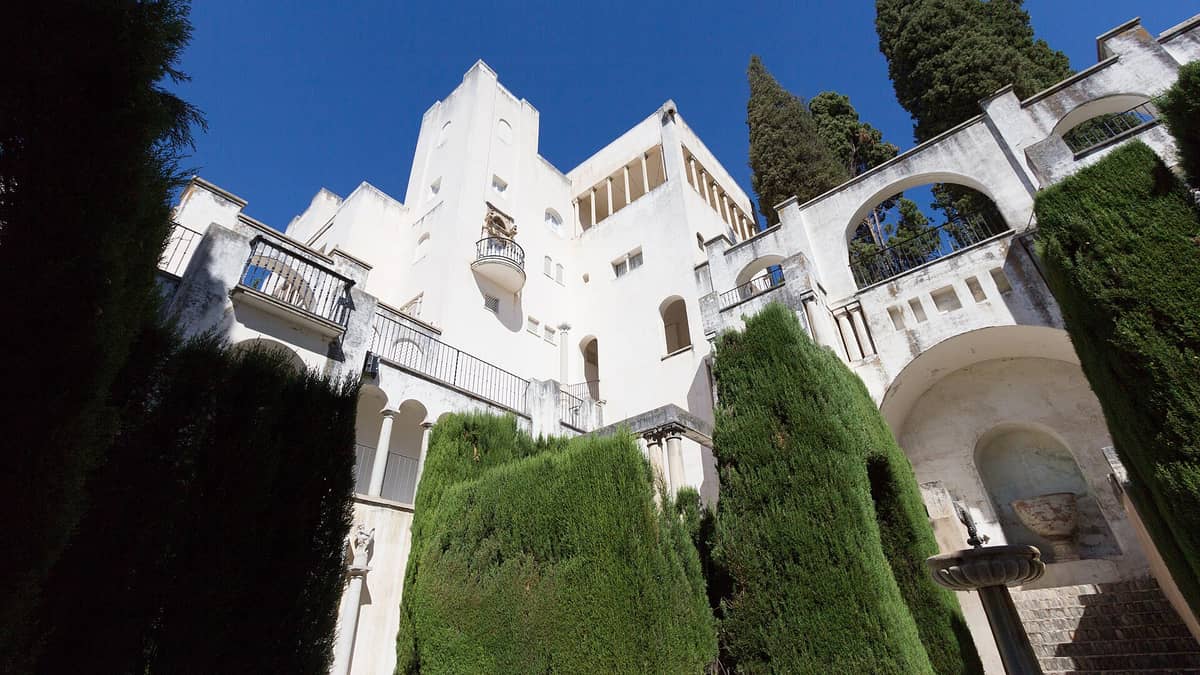
The Fundación Rodríguez-Acosta, officially the Fundación Pública Andaluza Rodríguez-Acosta, occupies a modernist carmen on the southern slope of Alhambra Hill, a few minutes' walk above the Realejo district. A carmen is a distinctly Granadan building type: a walled house with its own private garden, usually terraced into the hillside. This one is exceptional in scale and ambition.
It was built in the early 20th century as the residence and studio of José María Rodríguez-Acosta, a wealthy Granadan painter influenced by Symbolism and the Modernist currents of his time. He was not an artist who needed the money: he was an artist who could design his own world, and this carmen is the physical result of that freedom. After his death, the estate was converted into a cultural foundation and opened to the public, preserving both the architectural fabric and a broad collection of paintings, sculpture, decorative arts, and archaeological objects.
The complex also contains the Museo Gómez-Moreno, a separate scholarly collection assembled by art historian Manuel Gómez-Moreno and accessible on the foundation’s special visit that extends the standard route. For most visitors, the standard guided tour of the carmen, studios, galleries, and gardens is more than enough for one session.
ℹ️ Good to know
All visits are guided and run in scheduled morning passes between 10:00 and 14:00 daily. Capacity per group is limited. Book in advance on the foundation's website, especially for weekend visits and special passes.
The Architecture: A Modernist Stage Set on the Hillside
From the street, the entrance is easy to miss: a modest door set into a whitewashed wall on the Callejón Niño del Rollo. That modesty is deliberate. What opens up inside is a sequence of spaces that feel designed for revelation rather than welcome, each terrace and gallery framing a new view or placing a sculpture in unexpected relation to the landscape beyond.
The building draws on several strands of early 20th-century taste simultaneously: Renaissance and Baroque planning ideas, Moorish decorative vocabulary, classical statuary, and the Symbolist preference for total environments. Rodríguez-Acosta did not adopt a single style so much as orchestrate references the way a painter assembles a composition. The result is coherent without being predictable.
The gardens are terraced across multiple levels, connected by stone stairways and punctuated by cypress trees, clipped hedges, fountains, and figurative sculpture. The textures shift as you move through them: smooth rendered walls beside rough stone, polished marble against weathered brick. In spring the planting adds scent and color that photographs only partially capture.
From the upper terraces, the views toward the Vega de Granada and the city below are genuinely striking. The physical relationship to the Alhambra is also interesting: the two complexes sit on the same hill but operate on very different scales. For architectural context, the Palacio de Carlos V inside the Alhambra complex represents the imperial strand of Renaissance ambition in Granada; the Fundación Rodríguez-Acosta represents a private, early modern counter-tradition rooted in the same landscape.
Tickets & tours
Live prices and dates from our booking partner. If you book, we may earn a commission at no extra cost to you.
Alhambra guided tour in Italian
From 49 €Instant confirmationFree cancellationAlhambra guided group tour with Nasrid Palaces and Generalife Palace
From 40 €Alhambra guided tour with Carlos V Palace, Generalife and Alcazaba
From 35 €Alhambra and Generalife skip-the-line private tour
From 65 €Instant confirmation
How the Visit Works in Practice
The standard guided visit runs approximately one hour and follows a fixed route through the reception rooms, painter's studio, galleries, and garden terraces. Groups are small by design, which means the experience rarely feels crowded and the guide has room to pause and answer questions. The visit is conducted in Spanish by default; confirm in advance if you need English.
The studio is one of the most atmospheric spaces in the complex. It is a tall, north-lit room that still feels like a working space rather than a preserved relic. Canvases, easels, and furnishings remain arranged as though the painter stepped out for lunch. The quality of the light in the morning hours, when the sun has not yet moved to the west, is noticeably good for viewing both the paintings and the room itself.
The Saturday 16:00 special visit extends the standard route to include the library, the underground galleries, and additional house‑museum spaces, and runs for about two hours; this visit currently costs 10 €—check the foundation's booking page for any updates.
💡 Local tip
Some reduced or free admissions are capped per reservation. Check the booking system at the start of the week; the most advantageous ticket options fill quickly with locals and budget-conscious travelers who have figured out the system.
Time of Day and Seasonal Considerations
Because the current standard visit hours are 10:00–14:00 (check for any seasonal extensions), the question is not really when to go during the day but which day to choose. Weekday mornings tend to attract smaller groups. Weekends draw more visitors, partly because of the wider availability of tickets and partly because visitors with Alhambra reservations often pair the two sites.
Spring visits, roughly April to May, offer the best garden experience: the planting is active, temperatures are moderate (daytime highs around 22–27 °C), and the light is clear without the bleaching intensity of high summer. Summer visits work but the walk up the hill from central Granada can be uncomfortable in July and August, when afternoon highs regularly exceed 35 °C. Arriving for the 10:00 opening slot avoids the worst of the heat. For broader seasonal context around Granada, see the best time to visit Granada guide.
Winter visits have their own appeal: the cypress-framed terraces read more starkly and the contrast between the cold air outside and the warm interior galleries is pleasant. Rainfall is highest in November and December, and some garden areas can be slippery; wear shoes with grip.
The Collection: What You Are Actually Looking At
Rodríguez-Acosta's own paintings are well represented and worth more than a passing glance. He worked in a style influenced by post-Impressionist and Symbolist trends current in Spain and France around 1900–1930: loose but controlled brushwork, strong light effects, and a recurring interest in the nude in landscape. The work is of genuine quality and is underexhibited nationally, which gives this visit an element of discovery that more famous collections rarely deliver.
The decorative arts and sculpture scattered through the carmen are more eclectic, ranging from antique pieces to works collected during his lifetime. Some of it reads as a wealthy man's accumulation rather than a curated argument. The garden sculpture, however, is consistently well-placed: the relationship between stone figures and the surrounding planting and architecture has clearly been considered carefully.
For visitors with a specific interest in Granada's artistic heritage, the Fundación Rodríguez-Acosta pairs naturally with the Capilla Real, which houses the greatest concentration of Flemish and early Renaissance painting in the city, and with the Huerta de San Vicente, the García Lorca family house museum that offers a comparable insight into early 20th-century Granadan cultural life.
Getting There and Practical Notes
The address is Callejón Niño del Rollo 8, in the Realejo district on the lower slopes of Alhambra Hill. On foot from the central Realejo area or from Plaza Nueva, the walk takes 10–15 minutes. The final stretch involves climbing along narrow pedestrian lanes; follow signs toward the Alhambra and watch for the foundation's entrance on your left as the lane narrows.
Local buses that serve the Alhambra approach also bring you reasonably close; a taxi from the city center is a short and inexpensive ride. There is no dedicated parking at the foundation, and driving into the Realejo lanes is not practical for most visitors.
Accessibility is genuinely limited here. The foundation's own visitor guidelines state clearly that some areas of the carmen are not accessible to visitors with reduced mobility, due to the terraced structure, multiple staircases, and uneven historic surfaces. If you have mobility concerns, contact the foundation directly before booking to understand which sections you can realistically visit.
⚠️ What to skip
Photography policies inside the galleries should be confirmed with your guide at the start of the visit. Garden photography is generally permitted. The terraced paths include steep steps and uneven stone; suitable footwear is important, especially after rain.
If you are combining this visit with the Alhambra complex the same day, note that Alhambra tickets require advance booking and specific timed entry. The Fundación Rodríguez-Acosta's morning-only hours work well with an afternoon Alhambra slot, or as a standalone morning visit when Alhambra tickets are unavailable.
Who Will Get the Most from This Visit
This is not a large or immediately spectacular attraction in the way the Alhambra or Granada Cathedral are. Visitors looking for a quick visual payoff, or those with limited time who need to prioritize, should be honest with themselves about whether a one-hour guided walk through a Modernist villa is a good use of their afternoon.
That said, for visitors who appreciate early 20th-century architecture, garden design, or Spanish painting outside the usual Madrid-Seville axis, this is a quietly rewarding stop. It also suits those who have already seen the major monuments and are looking for Granada's less-visited cultural sites. The small group size and guided format mean you leave with genuine understanding of the place rather than just photographs of it.
Insider Tips
- The 10:00 opening slot on weekdays is consistently the quietest. Groups are smallest then, the morning light in the studio is at its best, and you have the garden terraces almost to yourself before the mid-morning arrivals.
- The most advantageous reduced or free ticket options tend to be limited to a small number of tickets per online reservation. Book them Monday or Tuesday of the same week; they are usually gone by Thursday.
- The Saturday 16:00 special visit, which includes the library and Museo Gómez-Moreno, is significantly more content-dense than the standard tour. If you have an interest in medieval art, Islamic decorative objects, or Spanish Renaissance painting, this is the visit to book.
- The garden terraces reward slow movement. The guided route sets a pace, but linger at the upper terrace viewpoints: the sight line toward the Vega de Granada, framed by cypresses, is one of the most considered views in the city.
- Combine this visit with the Carmen de los Mártires, another walled garden complex a short walk away on the same hillside, for a morning devoted entirely to Granada's carmen tradition.
Who Is Fundación Rodríguez-Acosta (Carmen Rodríguez-Acosta) For?
- Architecture and design enthusiasts interested in early 20th-century Modernism in southern Spain
- Art lovers seeking Spanish painting outside the major national collections
- Repeat visitors to Granada who have already covered the main monuments
- Travelers who prefer small-group guided experiences over self-paced museum wandering
- Garden lovers visiting in spring, when the terraced planting is at its most photogenic
Nearby Attractions
Other things to see while in Alhambra Hill (La Sabika):
- Alcazaba
The Alcazaba is the oldest surviving section of the Alhambra complex, a Nasrid military fortress perched at the western tip of the hill. Its towers offer some of the most commanding views in Granada, looking out over the Albaicín, the Darro valley, and on clear days, the snow-capped Sierra Nevada.
- Alhambra
The Alhambra is one of the most visited monuments in the world for good reason: it is an extraordinarily complete surviving example of Nasrid Islamic palatial architecture, set above Granada on the hill of Sabika. This guide covers what to expect at each section of the complex, how to secure tickets, and how to make the most of your visit.
- Carmen de los Mártires
Tucked just minutes from the Alhambra entrance, Carmen de los Mártires is a sprawling 19th-century romantic garden on Alhambra Hill that most visitors walk straight past. Shaded paths, ornamental lakes, Moorish-influenced terraces, and resident peacocks reward those who take the detour.
- Casa-Museo Manuel de Falla
Tucked into the hillside near the Alhambra, the Casa Museo Manuel de Falla preserves the modest carmen where Spain's greatest 20th-century composer worked for nearly two decades. Original furnishings, a working piano, and handwritten manuscripts make this one of Granada's most intimate cultural visits.
Planning a trip? Discover personalized activities with the Nomado app.