Capilla Real de Granada: The Royal Chapel Where Spain's History Is Buried
The Capilla Real de Granada is the funerary chapel commissioned by the Catholic Monarchs to house their remains in the city where they completed the Reconquista. Inside, behind an extraordinary wrought-iron screen, lie the tombs of Isabella I, Ferdinand II, Juana la Loca, and Felipe el Hermoso, alongside a small but remarkable collection of royal art and personal relics.
Quick Facts
- Location
- Calle Oficios s/n, 18001 Granada — attached to Granada Cathedral, historic centre
- Getting There
- Walk from Plaza Nueva (5 min); buses stop on Gran Vía and Calle Reyes Católicos
- Time Needed
- 45–90 minutes
- Cost
- Adults 7 €; reduced 5 €; under-12s free; Wednesday afternoon free entry with booking. Verify at ticketsgranadacristiana.com.
- Best for
- History enthusiasts, fans of Spanish Renaissance art, and anyone serious about understanding the end of the Reconquista
- Official website
- capillarealgranada.com
Why the Capilla Real Matters
The Capilla Real de Granada is not simply a royal mausoleum. It is the place where Queen Isabella I of Castile chose to be buried after her death in 1504, a deliberate statement about Granada's significance as the final conquest of the Reconquista in 1492. The city was, for her, the culmination of a unified Christian Spain. That weight of historical intention still hangs in the air inside the chapel, even now, in a way that few monuments in Andalusia quite manage.
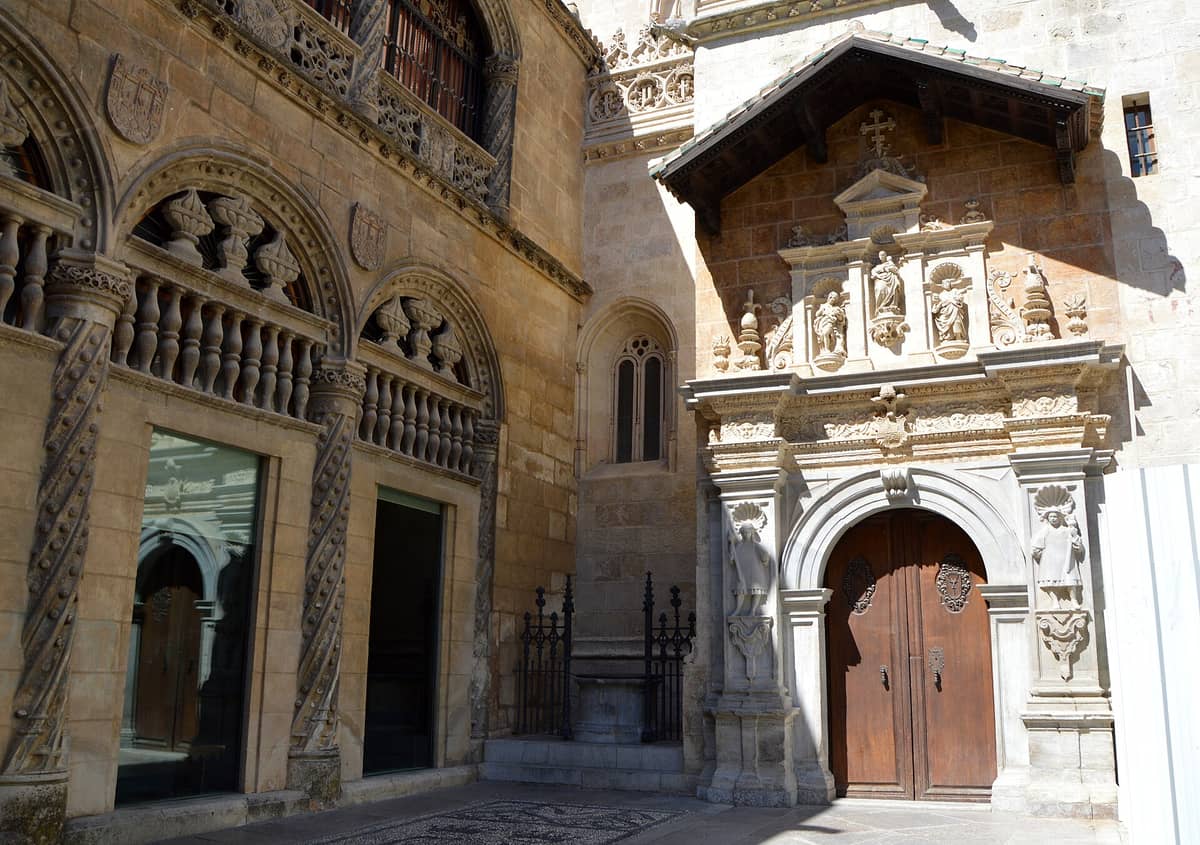
Construction began in 1505 under the direction of architect Enrique Egas and continued until around 1517, making it a relatively pure example of the Isabelline Gothic style, a Spanish architectural idiom that applies dense ornamental detail to Gothic structural forms. The contrast with the austere power of the Alhambra a short walk away could not be more deliberate. Where the Nasrid palace turns inward and celebrates geometric abstraction, the chapel turns outward with sculpted Christian iconography covering nearly every surface.
💡 Local tip
An audio guide is included with the standard 7 € ticket or can be downloaded for free to your phone. Use it. The sacristy's paintings and relics are poorly labelled in English, and the audio guide provides context that transforms an otherwise confusing display into something genuinely moving.
What You Actually See Inside
The chapel's interior is compact, which surprises most visitors who expect something cathedral-sized. The main nave is dominated by the central reja, a wrought-iron screen forged by Maestro Bartolomé de Jaén around 1520 and widely considered one of the finest pieces of Renaissance metalwork in Spain. It is gilded in parts, with figures of saints and royal heraldry worked into the grillework in extraordinary detail. Standing in front of it, you notice the weight of the thing before you notice its beauty.
Beyond the reja, the royal tombs are arranged in pairs on the floor of the chancel. The effigies of Ferdinand and Isabella recline in white Carrara marble, carved by the Florentine sculptor Domenico Fancelli in 1517. Their faces are individualized and serene. Beside them, the effigies of Juana la Loca and Felipe el Hermoso, carved by Bartolomé Ordóñez, are stylistically more elaborate but somehow less commanding. The actual lead coffins are housed in a crypt below, accessible by a small staircase to one side of the altar, where the remains lie in plain, undecorated boxes, a stark contrast to everything above.
The sacristy, off to one side, holds the chapel's most surprising treasures. Isabella's personal art collection includes Flemish and early Italian paintings she gathered during her lifetime, works by Rogier van der Weyden, Hans Memling, and Sandro Botticelli among others, displayed in a small room with minimal fanfare. Her personal crown and scepter are also here, behind glass, modest objects that feel oddly intimate given their historical significance. Ferdinand's sword is displayed alongside them.
Tickets & tours
Live prices and dates from our booking partner. If you book, we may earn a commission at no extra cost to you.
Visiting by Time of Day
Morning entry, particularly between 10:00 and 11:00, offers the calmest experience. Tour groups tend to arrive after 11:00, and by midday the nave can feel crowded enough that the audio guide competes with ambient noise. The lighting inside does not change dramatically with outside conditions since the chapel relies largely on artificial light, but early mornings are quieter and the sacristy feels less rushed.
The post-lunch slot, around 15:00–16:00, sees another wave of visitors. Late afternoon, approaching closing time at 18:30 (doors close at 19:00), tends to thin out again, and the slightly lower visitor numbers allow more time in front of the reja and the sacristy paintings without jostling. On Sundays, the chapel opens at 11:00, though on certain holidays the morning visiting hours are suspended.
ℹ️ Good to know
Free entry is available every Wednesday from 14:30 to 18:30, but it requires advance booking through the Archdiocese of Granada (archidiocesisgranada.es). Check the official site for the booking process, which changes periodically. This is worth planning around if your budget is tight.
Historical and Cultural Context
Isabella and Ferdinand are known collectively as the Reyes Católicos, the Catholic Monarchs, a title granted by Pope Alexander VI in 1496. Their reign unified the crowns of Castile and Aragon, sponsored Christopher Columbus's voyages to the Americas, and issued the Alhambra Decree of 1492 expelling Jews from Spain. Muslims in Granada remained under the Treaty of Granada until later forced conversions and the 17th-century Morisco expulsion. Granada was the last Nasrid emirate to fall. Understanding this context changes what you feel standing over their tombs. For a deeper understanding of the city's layered Moorish and Christian heritage, the Granada Moorish heritage guide provides useful background before or after your visit.
The chapel was built adjacent to what was then the site of a mosque, in the heart of the city's historic fabric. Granada Cathedral, which now stands directly alongside the chapel, was begun later, in 1523, and the two buildings share a physical boundary but were designed separately. The chapel predates the cathedral and was conceived as a standalone royal funerary monument, not as a cathedral adjunct. Many visitors confuse the two or assume the chapel is simply part of the cathedral complex, but they require separate tickets and have different opening hours.
Practical Details: Getting In and Getting Around
The entrance to the Capilla Real is on Calle Oficios, a pedestrian street that runs alongside Granada Cathedral. It is not on the cathedral's Renaissance façade, which faces Plaza de las Pasiegas, and it is not the cathedral's ticketed visitor entrance at Gran Vía de Colón 5. If you are walking from Plaza Nueva, follow Calle Reyes Católicos west for about five minutes, then turn left onto Calle Oficios. The entrance is clearly marked. From the main bus stops on Gran Vía, it is a two-minute walk south.
Tickets can be purchased at the door. There are rarely queues as long as those at the Alhambra, so advance booking is not essential, though it is available online. The chapel does not sell combined tickets with Granada Cathedral, so if you plan to visit both on the same day, budget time and entry fees separately. For more on planning your time across Granada's main monuments, see the two-day Granada itinerary.
Photography inside the chapel is not permitted in most areas, including near the tombs and in the sacristy, and is generally prohibited in the nave as well. This is strictly enforced. Bags must be kept with you as there is no luggage storage. The interior is dimly lit in parts, especially the crypt, so eyes need a moment to adjust. Dress codes apply as in any active religious site: covered shoulders are appropriate, though this is not always enforced at the entrance.
⚠️ What to skip
The chapel is closed on 25 December, 1 January, and Good Friday. On 2 January and 12 October, tourist visits are suspended in the morning and the chapel opens only in the afternoon (from 15:00 or 16:00 depending on season). Always check the official site before visiting on public holidays.
Who Should Visit and Who Can Skip It
The Capilla Real rewards visitors who come with some prior knowledge of Spanish history or at least curiosity about it. The space is small, the exhibits are sparse by museum standards, and without context the tombstones and sacristy paintings can feel underwhelming. Travelers who prioritize outdoor spaces, viewpoints, or Moorish architecture may find 45 minutes here less satisfying than time spent in the Albaicín or the Generalife gardens.
That said, for anyone interested in the pivotal moment when medieval Spain transitioned into the early modern period, this chapel is one of the most direct encounters with that history available anywhere. It is more intimate than a national museum and more personal than a cathedral. If you are combining it with a visit to Granada Cathedral next door, budget a full half-day for the historic centre and have lunch at one of the restaurants along Calle Pescadería before or after.
Young children may find the visit difficult to engage with. There are no interactive elements, the space is quiet and expected to remain that way, and the displays in the sacristy are oriented toward adults with historical interest. Families with children under eight would likely find their time better spent elsewhere.
Insider Tips
- Visit on a Wednesday afternoon and use the free entry slot (14:30–18:30) by booking ahead through the Archdiocese of Granada. Most visitors do not know this exists and the crowds are correspondingly lighter.
- The crypt staircase, where the actual lead coffins rest, is easy to miss. It is to the right of the main altar, marked by a small sign. Do not leave without going down, as the contrast between the ornate marble effigies above and the plain boxes below is one of the most quietly powerful moments in the building.
- Give the Flemish paintings in the sacristy serious time. Isabella's personal collection, which includes works attributed to Rogier van der Weyden and Hans Memling, is often glossed over by visitors rushing through. These are not reproductions.
- The wrought-iron reja is best appreciated from the nave side in the direction of the tombs. The light from the chancel backlights the gilded details. Photography is officially restricted or prohibited inside, including near the tombs and often in the nave, so do not plan on photographing it; confirm current rules at the entrance.
- If visiting in summer, the interior stays noticeably cooler than outside. Granada's July and August temperatures regularly exceed 35 °C, and the thick stone walls of the chapel provide genuine relief. Plan it as a midday escape rather than a morning rush.
Who Is Capilla Real de Granada (Royal Chapel) For?
- History enthusiasts with an interest in the Reconquista, the Catholic Monarchs, or the unification of Spain
- Art lovers drawn to Flemish and early Renaissance painting in an unexpected setting
- Travelers combining the historic centre with a visit to Granada Cathedral or the Alcaicería market nearby
- Visitors wanting a meaningful, manageable monument that takes under 90 minutes and does not require advance booking
- Anyone interested in the physical, human scale of royal history rather than grand ceremonial spectacle
Nearby Attractions
Other things to see while in Centro-Sagrario (City Centre):
- Alcaicería (Arab Bazaar)
The Alcaicería is Granada's reconstructed Arab silk market, a tight labyrinth of narrow lanes packed with craft and souvenir shops steps from the cathedral. Free to enter and open most days, it offers one of the most atmospheric walking experiences in the city centre, though visitors should know its history before they arrive.
- Basílica de San Juan de Dios
The Basílica de San Juan de Dios is Granada's most extravagantly decorated Baroque church, a 18th-century pilgrimage site housing the relics of the saint who founded the Brothers Hospitallers. Most visitors walk past its understated facade without a second glance — which makes the gold-drenched interior all the more astonishing when you step inside.
- Corral del Carbón
The Corral del Carbón is a 14th-century Nasrid alhóndiga — a combined grain warehouse and merchant inn — standing in Granada's historic centre. It is the last surviving Nasrid alhóndiga in the city, admission is free, and most visitors spend around 30 minutes exploring its layered courtyard architecture before continuing to the nearby Alcaicería or Cathedral.
- Cuarto Real de Santo Domingo
Built during the reign of Muhammad II in the late 13th century, the Cuarto Real de Santo Domingo is one of the oldest surviving Nasrid structures in Granada. Tucked behind Plaza de los Campos in the Realejo district, it receives a fraction of the crowds that descend on the Alhambra — yet its carved stucco and coffered ceilings belong to the same artistic tradition. Entry costs €2 (with €1 reduced tickets available), and admission is free on Sundays.
Planning a trip? Discover personalized activities with the Nomado app.