Corral del Carbón: Granada's Oldest Arab Monument, Free to Enter
The Corral del Carbón is a 14th-century Nasrid alhóndiga — a combined grain warehouse and merchant inn — standing in Granada's historic centre. It is the last surviving Nasrid alhóndiga in the city, admission is free, and most visitors spend around 30 minutes exploring its layered courtyard architecture before continuing to the nearby Alcaicería or Cathedral.
Quick Facts
- Location
- Calle Mariana Pineda, s/n, 18009 Granada (historic centre, near Granada City Hall)
- Getting There
- City buses 4, 8, 11, 21, 33, C30–C35 stop on Gran Vía / Catedral or Plaza Isabel la Católica, 2–5 min walk
- Time Needed
- 20–40 minutes
- Cost
- Free — no tickets, no timed entry
- Best for
- History lovers, architecture enthusiasts, first-time Granada visitors on foot
What Is the Corral del Carbón?
The Corral del Carbón is widely documented as the last surviving Nasrid alhóndiga in Granada and one of the best-preserved examples of the type in Spain. The word alhóndiga — from the Arabic al-funduq — refers to a building type that combined storage for grain and goods with lodging for travelling merchants. This one dates to the 14th century, built during the Nasrid sultanate that also produced the Alhambra.
What makes this building unusual in Granada's cityscape is its sheer survival. The historic centre has been rebuilt and repurposed many times over the centuries, but the Corral del Carbón has kept its structural bones largely intact. Its name — literally 'Charcoal Inn' — comes from a later period when it was used for charcoal trading under Spanish rule, centuries after its Nasrid origins.
The building sits a few steps from the Alcaicería silk market and is managed today under the Patronato de la Alhambra y Generalife, the same authority responsible for Granada's most famous monument complex.
💡 Local tip
Entrance is completely free. There are no tickets, no booking system, and no timed entry slots. Simply walk in during opening hours (currently 09:00–20:00 daily, though verify current hours before visiting as schedules can change).
The Architecture: What You Are Actually Looking At
The entrance portal is the first thing that stops visitors in their tracks. It is a recessed Nasrid arch decorated with carved plasterwork — honeycomb muqarnas filling the upper half of the recess in a style that immediately connects this building to the Alhambra's decorative tradition. The proportions are large enough to have admitted loaded pack animals, which was the practical reality of a 14th-century merchant warehouse.
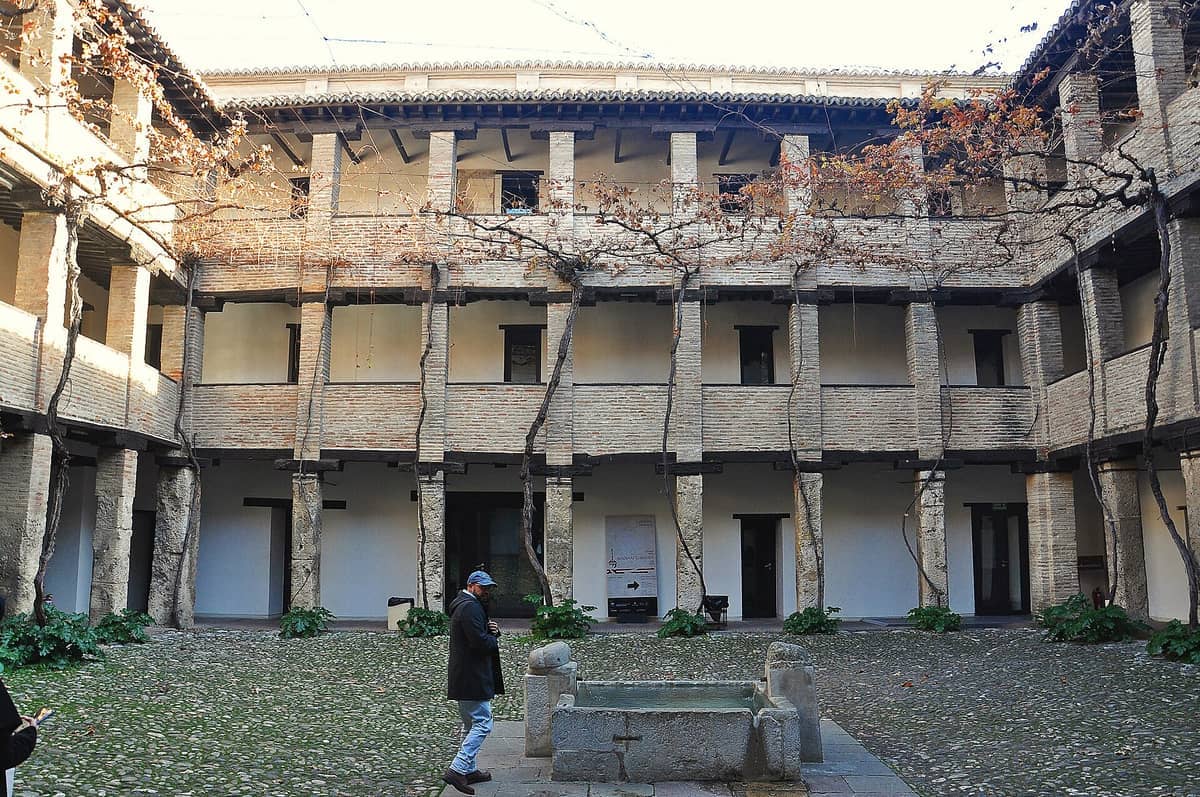
Beyond the entrance, the building opens into a rectangular central courtyard. Three tiers of galleries run around all four sides: a ground-floor arcade of stone arches, a first-floor wooden gallery with turned balusters, and a second-floor gallery of the same type above it. The galleries are narrower than they look from below, and the courtyard floor is laid with stone paving. In the centre, a fountain basin sits at ground level — a Nasrid architectural staple, though its current form reflects later restorations.
The structure was designed so that merchants could store goods in the arcade bays at ground level, conduct transactions in the courtyard, and sleep in the gallery rooms above. This stacking of functions — warehouse, market hall, and inn — into one courtyard building is a specifically Islamic urban building type, and the Corral del Carbón is its clearest surviving example in the city.
ℹ️ Good to know
Upper galleries are reached by stairs and are not wheelchair accessible. The ground-floor patio, which contains the main architectural interest, is accessible to visitors with reduced mobility.
Tickets & tours
Live prices and dates from our booking partner. If you book, we may earn a commission at no extra cost to you.
Guided tour of the Caminito del Rey from Granada
From 135 €Free cancellationAlhambra guided tour in Italian
From 49 €Instant confirmationFree cancellationAlhambra guided group tour with Nasrid Palaces and Generalife Palace
From 40 €Alhambra guided tour with Carlos V Palace, Generalife and Alcazaba
From 35 €
How the Space Changes Through the Day
In the early morning, shortly after opening, the courtyard is quiet and the stone stays cool from the night. The light comes in from above at a shallow angle and catches the carved plasterwork on the entrance arch in a way that makes the detail readable. This is the best time for photography if you want sharp, shadow-defined shots of the muqarnas without competing with tour groups.
By mid-morning, particularly in spring and autumn when Granada draws its largest visitor numbers, the courtyard starts to fill with people passing through on foot circuits of the historic centre. The acoustics of the space amplify conversation noticeably — the stone galleries create a resonance that you feel as much as hear. This same acoustic quality has made the courtyard a venue for occasional concerts and cultural events.
In summer, between roughly 13:00 and 16:00, the courtyard becomes one of the few places in the city centre where you can stand in shade without paying for it. The tall gallery walls block direct sun from the patio floor for most of the afternoon, making it a legitimate rest stop when temperatures regularly exceed 35°C. Late afternoon brings slanted golden light back into the upper galleries, which is worth timing if you plan to look up at the carved woodwork on the eaves.
Historical Context: From Nasrid Warehouse to Charcoal Yard
When the Catholic Monarchs took Granada in 1492, the city's economic geography changed substantially. The Alcaicería silk market next door remained commercially active, but the alhóndiga's role shifted. By the 16th century the building was being used by charcoal merchants — hence the name Corral del Carbón that has stuck for 500 years. It later passed through phases as residential accommodation and was significantly deteriorated by the 19th century.
Serious restoration work began in the 20th century and the building was declared a national monument, bringing it under heritage protection. What visitors see today is a careful consolidation of Nasrid original fabric with later interventions made legible rather than concealed. The wooden gallery elements are largely replacement work, but the stone arcade and the entrance arch are widely considered authentic 14th-century Nasrid construction.
For context on the broader Nasrid heritage that produced the Corral del Carbón, the Granada Moorish heritage guide covers the architectural period in more depth.
Practical Walkthrough: What to See and In What Order
Approach from Calle Mariana Pineda. The entrance arch is set back from the street behind a short vestibule passageway, so the building does not announce itself dramatically from the outside. Once through the passage, pause and look up at the muqarnas ceiling of the entrance portal before stepping into the courtyard.
In the courtyard, the standard visitor circuit covers the ground-floor arcade on all four sides. Look at the stone column capitals, the transition from the stone arches to the wooden gallery above, and the proportions of the courtyard as a whole. An information room on the lower level provides historical context in Spanish with some English-language materials.
If the staircase to the upper galleries is accessible, the view down into the courtyard from the first floor changes the reading of the space considerably — you understand the merchant accommodation function more clearly from up there. The galleries themselves are narrow, roughly a single person's width in places.
💡 Local tip
The Corral del Carbón takes 20 to 40 minutes for most visitors. It pairs well with the Alcaicería immediately adjacent and the Granada Cathedral a short walk north. Build it into a morning foot circuit rather than treating it as a standalone destination.
If you are planning a broader walking route through the historic centre, the things to do in Granada guide lays out how to connect the main sites efficiently.
Practical Intelligence: Getting There, What to Bring, Limitations
The Corral del Carbón sits on Calle Mariana Pineda, immediately behind Granada City Hall in the historic centre. It is within roughly a 5-minute walk of Plaza Nueva and about the same distance from the Cathedral. The surrounding streets are pedestrianised or low-traffic, so approaching on foot from any direction in the centre is straightforward.
City bus lines serving the Gran Vía de Colón corridor — including routes 4, 8, 11, 21, 33, C30, C31, C32, C34, and C35 — have stops within a 2 to 5-minute walk. If you are arriving from the Alhambra hill, the walk down through the Realejo neighbourhood takes around 15 minutes. Taxis and ride-hailing services (Uber and Cabify operate in Granada) can drop at City Hall with minimal routing complexity.
There is no on-site shop, café, or luggage storage. The building is free and open to the public, but it is not a museum in the conventional sense — there are no permanent display cases or audio guides available at the door. Some temporary exhibition and cultural programming occurs in the space, particularly in summer evenings, so checking the Granada tourism calendar before visiting is useful if you want to catch an event.
Granada's free tapa culture means you can eat and drink for the price of a drink at any bar. The free tapas guide covers which streets near the historic centre are best for this.
⚠️ What to skip
Opening hours and seasonal schedules can change. The most commonly cited hours are 09:00–20:00 daily, but verify with the Patronato de la Alhambra or Granada tourism before planning your visit around a specific time.
Worth Your Time?
The Corral del Carbón is not a spectacle. Visitors who arrive expecting something comparable in visual impact to the Nasrid Palaces or the Alhambra will be underwhelmed — the scale is domestic and the decorative complexity is concentrated in the entrance arch rather than distributed across the whole building. What it offers instead is legibility: you can understand exactly what this building was, how it worked, and why it mattered, in about 30 minutes, without crowds competing for your attention.
For travellers with a genuine interest in Islamic architecture or Nasrid Granada, it is one of the more quietly rewarding things in the city precisely because it is not on the standard itinerary. For travellers primarily interested in the Alhambra, it provides useful architectural context that sharpens how you read the plasterwork and courtyard organisation on the hill above.
Visitors who are time-pressed and have already committed their limited Granada hours to the Alhambra, the Albaicín, and the Cathedral can reasonably skip the Corral del Carbón without missing an essential experience. Its case for inclusion is strongest when you have a free morning in the centre and want to add genuine depth rather than just check boxes.
If you are still deciding how to allocate your Granada days, the 2 days in Granada itinerary shows where the Corral del Carbón fits relative to higher-priority sites.
Insider Tips
- Visit in the first hour after opening (09:00–10:00) for the best photography conditions. The entrance arch muqarnas read most clearly in the low-angle morning light, and the courtyard is typically empty of other visitors.
- Check the Granada cultural events calendar before you go. The courtyard hosts outdoor concerts and theatre performances in summer, and the acoustic quality of the space makes these genuinely worth attending if the timing works.
- The information room on the ground level contains a small architectural model of the building that clarifies the three-tier gallery system better than looking at it in person. Spend a minute with it before circling the courtyard.
- The Alcaicería market is immediately adjacent and best visited in the same pass. The covered market lanes are atmospheric in the early morning before the souvenir stalls open fully, when the architecture is easier to see.
- If you are visiting in summer and need a mid-afternoon break from the heat, the Corral del Carbón courtyard stays shaded from direct sun for much of the afternoon. It is a legitimately cooler environment than the surrounding streets with no entry cost.
Who Is Corral del Carbón For?
- Architecture and Islamic history enthusiasts looking for Nasrid context beyond the Alhambra
- First-time Granada visitors doing a morning walk through the historic centre
- Travellers who want to experience a significant monument without crowds or ticketing friction
- Photographers working in the early morning when the carved plasterwork catches directional light
- Visitors planning a combined circuit with the Alcaicería, Cathedral, and Royal Chapel
Nearby Attractions
Other things to see while in Centro-Sagrario (City Centre):
- Alcaicería (Arab Bazaar)
The Alcaicería is Granada's reconstructed Arab silk market, a tight labyrinth of narrow lanes packed with craft and souvenir shops steps from the cathedral. Free to enter and open most days, it offers one of the most atmospheric walking experiences in the city centre, though visitors should know its history before they arrive.
- Basílica de San Juan de Dios
The Basílica de San Juan de Dios is Granada's most extravagantly decorated Baroque church, a 18th-century pilgrimage site housing the relics of the saint who founded the Brothers Hospitallers. Most visitors walk past its understated facade without a second glance — which makes the gold-drenched interior all the more astonishing when you step inside.
- Capilla Real de Granada (Royal Chapel)
The Capilla Real de Granada is the funerary chapel commissioned by the Catholic Monarchs to house their remains in the city where they completed the Reconquista. Inside, behind an extraordinary wrought-iron screen, lie the tombs of Isabella I, Ferdinand II, Juana la Loca, and Felipe el Hermoso, alongside a small but remarkable collection of royal art and personal relics.
- Cuarto Real de Santo Domingo
Built during the reign of Muhammad II in the late 13th century, the Cuarto Real de Santo Domingo is one of the oldest surviving Nasrid structures in Granada. Tucked behind Plaza de los Campos in the Realejo district, it receives a fraction of the crowds that descend on the Alhambra — yet its carved stucco and coffered ceilings belong to the same artistic tradition. Entry costs €2 (with €1 reduced tickets available), and admission is free on Sundays.
Planning a trip? Discover personalized activities with the Nomado app.