Cuarto Real de Santo Domingo: Granada's Overlooked Nasrid Palace
Built during the reign of Muhammad II in the late 13th century, the Cuarto Real de Santo Domingo is one of the oldest surviving Nasrid structures in Granada. Tucked behind Plaza de los Campos in the Realejo district, it receives a fraction of the crowds that descend on the Alhambra — yet its carved stucco and coffered ceilings belong to the same artistic tradition. Entry costs €2 (with €1 reduced tickets available), and admission is free on Sundays.
Quick Facts
- Location
- Pl. de los Campos 6, 18009 Granada
- Getting There
- Walkable from Granada city centre; roughly 10 minutes on foot from Gran Vía de Colón. No direct metro stop — several urban bus lines serve nearby stops along Acera del Darro.
- Time Needed
- 45–75 minutes
- Cost
- €2 general; €1 reduced (students, pensioners, unemployed, ages 6–16); free on Sundays. Verify current hours at turismo.granada.org before visiting.
- Best for
- History enthusiasts, architecture lovers, budget travellers, and anyone who wants Islamic-era Granada without the Alhambra queues
- Official website
- turismo.granada.org/es/sitio-turistico/cuarto-real-santo-domingo
What the Cuarto Real de Santo Domingo Actually Is
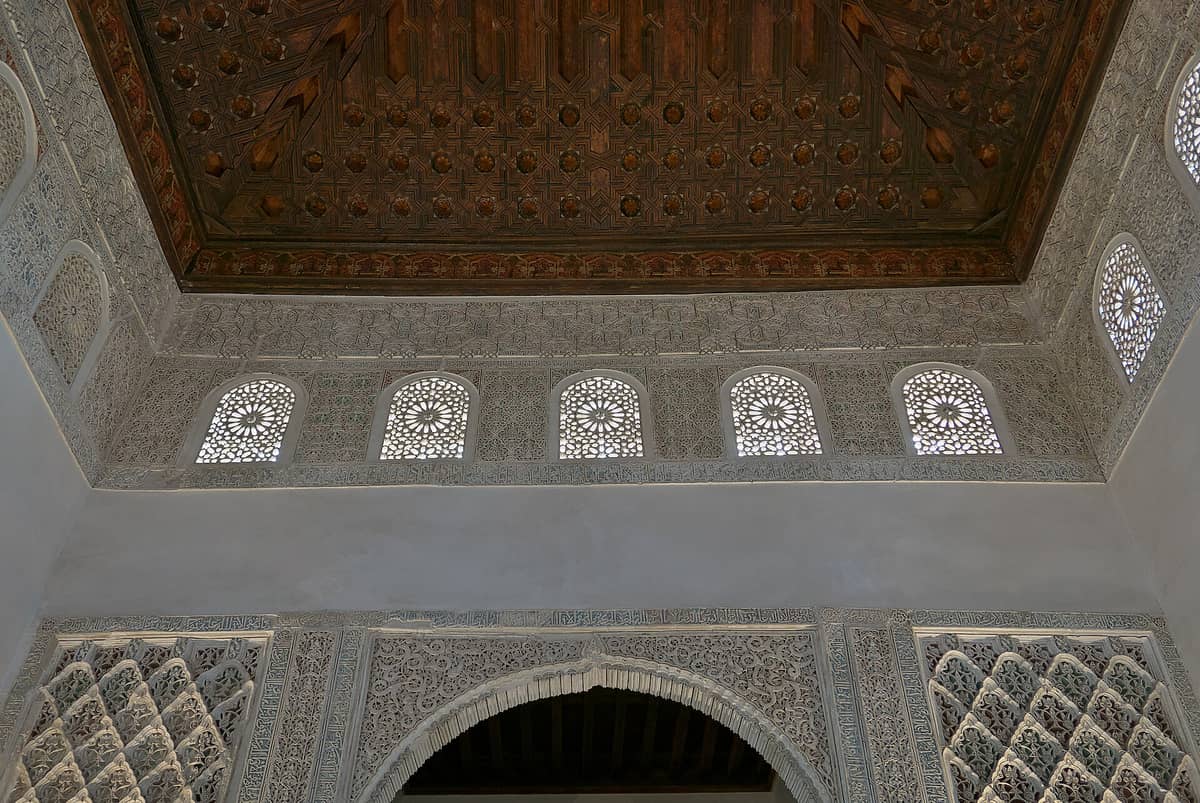
The Cuarto Real de Santo Domingo is a 13th-century Nasrid royal chamber that has survived, remarkably intact, within the city's historic centre. It was built during the reign of Muhammad II, the second Nasrid sultan of Granada, dating the structure to somewhere between 1273 and 1302, and dendrochronological studies date its wooden ceiling to after 1283. That makes it one of the oldest surviving Nasrid palatial structures in Granada — and historically significant for precisely that reason. This was not a private house. It was a royal residence, likely used by the sultan himself, positioned at what was then the edge of the city's most important garden estate.
After the Christian conquest of Granada in 1492, the surrounding estate was given to the Dominican order, which eventually constructed a monastery around the surviving Nasrid structure. The palace chamber became absorbed into the convent complex, which is how it avoided demolition. Today the Cuarto Real has been separated from the convent and passed to municipal ownership, allowing public access as a monument.
For context on how this site fits into Granada's broader Islamic heritage, the Granada Moorish heritage guide traces the surviving architecture across the city — from the Albaicín to less-visited monuments like this one.
The Architecture: What You're Looking At and Why It Matters
The centrepiece of the visit is the main hall, a rectangular throne room crowned by a remarkable wooden ceiling. The artesonado ceiling — a type of interlocking geometric coffered woodwork that was a hallmark of Hispano-Moorish craftsmanship — is one of the finest preserved examples from this early Nasrid period in Granada. Unlike much of the Alhambra's decoration, which was executed over multiple sultans across nearly two centuries, what you see here reflects a single coherent moment of construction.
The walls carry carved stucco panels with interlaced geometric and epigraphic motifs. The Arabic inscriptions are a standard feature of Nasrid palatial architecture, typically invoking divine blessing and sometimes referencing the patron. Stand close to the lower panels and you can feel the depth of the relief work with your eyes — shallow in some zones, almost sculptural in others. The craftsmanship is comparable in ambition to what you find in the Nasrid Palaces of the Alhambra, simply on a smaller scale and in a less famous address.
Visitors who want to understand how this style evolved should also look at the Bañuelo Arab baths, one of the oldest surviving Islamic structures in Granada, and then contrast both with the developed Nasrid aesthetic at the Nasrid Palaces in the Alhambra complex.
💡 Local tip
Bring a pocket torch or use your phone flashlight. The interior lighting is atmospheric but dim in certain corners, and some of the stucco detail in the lower wall panels is easier to appreciate with supplemental light.
Tickets & tours
Live prices and dates from our booking partner. If you book, we may earn a commission at no extra cost to you.
Granada cathedral and Capilla real guided tour
From 33 €Instant confirmationFree cancellationAlhambra guided tour in Italian
From 49 €Instant confirmationFree cancellationAlhambra guided group tour with Nasrid Palaces and Generalife Palace
From 40 €Alhambra guided tour with Carlos V Palace, Generalife and Alcazaba
From 35 €
The Visit: Arrival, Layout, and What to Expect Room by Room
The entrance on Plaza de los Campos is modest — a door set into a wall with signage that many people walk past without registering. Inside, you pass through a small reception and introductory display area before reaching the garden space that leads to the main palace chamber. The garden is planted with orange trees and aromatic plants in a style that references the original character of the Nasrid estate. On a cool morning, the smell of damp earth and citrus blossom is genuinely pleasant.
The main hall is compact but commands attention. The ceiling draws your eyes upward immediately, and the quality of conservation is good enough that the original pigments in parts of the stucco are still faintly visible. The room is interpreted with information panels that explain the historical context without overwhelming you with text. The exhibit is small — this is not a multi-room museum. Most visitors spend 45 to 75 minutes on-site, with focused readers taking slightly longer.
There is no café on site. The plaza outside has benches and a couple of nearby bars, which are serviceable for a coffee before or after. The immediate neighbourhood, Realejo, is quiet by Granada's standards and worth a short walk in its own right.
When to Go: Time of Day and Season
The site opens Tuesday to Sunday with fixed visiting hours and is closed on Mondays, so check the current timetable on the Granada tourism website before you go — hours may shift between summer and winter. Midweek morning visits are the quietest. By midday, especially on Sundays when entry is free, the small space can feel noticeably cramped with even a modest number of groups.
Because the main hall is interior, the experience does not change dramatically with weather. However, the garden approach is more pleasant in spring and autumn when temperatures sit between 18 and 26 degrees Celsius. In July and August, Granada's midday heat exceeds 35 degrees regularly, and the short walk from the city centre can be punishing. The interior is cool in summer and slightly chilly in winter — bring a light layer in December and January.
For a broader look at when to time your Granada trip around both climate and crowds, the best time to visit Granada guide covers the trade-offs month by month.
⚠️ What to skip
The Cuarto Real is closed on Mondays. Opening hours can change over time, so always confirm current schedules at turismo.granada.org before visiting — this is especially important if you are planning a combined itinerary with other monuments.
Photography
Photography is permitted without flash. The artesonado ceiling is the obvious target and is best shot from directly below, ideally with a wide-angle lens or your phone's ultra-wide mode. The natural light entering from the garden side of the hall gives a warm, slightly directional quality in the morning hours. By early afternoon, this changes as the sun shifts and the interior darkens somewhat. If you want the ceiling in good natural light, visit before noon.
The carved stucco panels on the walls are genuinely difficult to photograph well without supplemental lighting. The depth of the relief creates shadows that flatten in auto-exposure mode. A manual exposure or a gentle fill light from your phone helps reveal the geometric complexity.
Is It Worth Your Time?
The Cuarto Real de Santo Domingo is not for everyone. If you are short on time and making your way through Granada's major sites, the Alhambra, the Cathedral, and the Albaicín will offer more breadth. The Cuarto Real is a single chamber and a garden. It lacks the layered complexity of the Alhambra or the grandeur of the Cathedral. There is no gift shop of note, no audioguide, and the interpretive material is limited.
That said, for visitors who care about Islamic architecture specifically — or who want to understand the origins of the Nasrid aesthetic before it reached its peak expression — this is one of the most important surviving structures in the city. At €2, the price-to-experience ratio for the right visitor is exceptional. On free Sundays, it is one of the most worthwhile things you can do in Granada for nothing.
For those planning a full day in the historic centre, the free things to do in Granada guide includes this and other low-cost or no-cost sites in the city.
Insider Tips
- Visit on a Sunday morning: entry is free and crowds are manageable if you arrive when the site opens rather than mid-afternoon.
- Combine this with the nearby Realejo neighbourhood — the streets around Campo del Príncipe are pleasant for walking and have good tapas bars for lunch after your visit.
- Look at the exterior wall of the structure from the garden before entering the main hall. The proportions of the original Nasrid tower are clearly legible from outside, which helps you understand the building's original footprint.
- If you have a pair of reading glasses or a magnifying app on your phone, use it on the Arabic epigraphic bands in the stucco. The calligraphy is genuinely intricate and easy to rush past.
- The site is small enough that you can do it in 30 minutes if you move quickly — but if you sit in the garden for 10 minutes before leaving, the whole visit feels more complete.
Who Is Cuarto Real de Santo Domingo For?
- Architecture and Islamic heritage enthusiasts who want depth beyond the Alhambra
- Budget travellers: one of the cheapest ticketed monuments in Granada, free on Sundays
- Repeat visitors to Granada looking for sites they missed the first time
- Slow travellers who prefer a quiet, contemplative monument over a crowded major attraction
- Photographers interested in geometric and ornamental detail in controlled interior conditions
Nearby Attractions
Other things to see while in Centro-Sagrario (City Centre):
- Alcaicería (Arab Bazaar)
The Alcaicería is Granada's reconstructed Arab silk market, a tight labyrinth of narrow lanes packed with craft and souvenir shops steps from the cathedral. Free to enter and open most days, it offers one of the most atmospheric walking experiences in the city centre, though visitors should know its history before they arrive.
- Basílica de San Juan de Dios
The Basílica de San Juan de Dios is Granada's most extravagantly decorated Baroque church, a 18th-century pilgrimage site housing the relics of the saint who founded the Brothers Hospitallers. Most visitors walk past its understated facade without a second glance — which makes the gold-drenched interior all the more astonishing when you step inside.
- Capilla Real de Granada (Royal Chapel)
The Capilla Real de Granada is the funerary chapel commissioned by the Catholic Monarchs to house their remains in the city where they completed the Reconquista. Inside, behind an extraordinary wrought-iron screen, lie the tombs of Isabella I, Ferdinand II, Juana la Loca, and Felipe el Hermoso, alongside a small but remarkable collection of royal art and personal relics.
- Corral del Carbón
The Corral del Carbón is a 14th-century Nasrid alhóndiga — a combined grain warehouse and merchant inn — standing in Granada's historic centre. It is the last surviving Nasrid alhóndiga in the city, admission is free, and most visitors spend around 30 minutes exploring its layered courtyard architecture before continuing to the nearby Alcaicería or Cathedral.
Planning a trip? Discover personalized activities with the Nomado app.