Nasrid Palaces (Palacios Nazaríes): The Complete Guide to Granada's Greatest Interior
The Palacios Nazaríes are the reason most people come to Granada. Built as the royal residence of the Nasrid sultans from the 14th century onward, these interlocking palace rooms represent the peak of Andalusian Islamic architecture. Entry is strictly timed and capped at 300 visitors every half hour, so planning matters as much as the visit itself.
Quick Facts
- Location
- Calle Real de la Alhambra, s/n, 18009 Granada — inside the Alhambra complex on the hill above the city centre
- Getting There
- City bus lines C30 and C32 from Plaza Nueva / Plaza Isabel la Católica to the Alhambra entrance; 15-minute uphill walk from Plaza Nueva is also common. No metro connection.
- Time Needed
- 1.5–2 hours for the Nasrid Palaces alone; allow a full day if combining with the Alcazaba, Generalife, and gardens
- Cost
- Included in the Alhambra General ticket (verify current price at tickets.alhambra-patronato.es — €22.27 for adults, under-12s free). Night visit is a separate product.
- Best for
- Architecture enthusiasts, history travellers, photography, couples, first-time visitors to Granada
- Official website
- www.alhambra-patronato.es/en
What the Nasrid Palaces Actually Are
The Palacios Nazaríes are not a single palace. They are three interconnected royal structures built and expanded over roughly two centuries: the Mexuar (the oldest administrative section, used for council and justice), the Comares Palace (the sultan's formal reception complex, containing the Throne Room), and the Palace of the Lions (the private royal residence, built primarily under Muhammad V in the late 14th century). Together they form the most sophisticated example of Nasrid court architecture in existence.
Construction began at the start of the 14th century, during the reign of the Nasrid dynasty, which ruled the last Islamic emirate on the Iberian Peninsula. The palaces served as the habitual residence of the kings of Granada until the Christian Reconquista brought the dynasty to an end in 1492, when Sultan Muhammad XII surrendered the keys of the Alhambra to Ferdinand and Isabella. What makes the Nasrid Palaces unusual in the landscape of medieval European royal architecture is how thoroughly the interiors survived. The ceilings, stucco panels, tile dados, and inscriptions you see today are substantially original.
ℹ️ Good to know
Entry to the Nasrid Palaces is strictly timed and capped at 300 visitors every half hour. Your ticket specifies a 30-minute entry window. Arriving late means you may be refused entry at the gate — this is enforced very strictly.
Moving Through the Palaces: Room by Room
The Mexuar
You enter from the Mexuar, the oldest and most altered of the three sections. Originally an audience hall and later converted to a Christian chapel, it feels rougher and more improvised than what follows. The gilded wooden ceiling is 16th-century Christian in style, sitting on top of Nasrid walls. Some visitors rush through this room to get to the famous courtyards — that is a mistake. The Mexuar's oratory, a small prayer niche off the original hall facing Mecca, gives you a sense of the functional, layered nature of the entire complex.
The Comares Palace and the Court of the Myrtles
The transition from the Mexuar into the Cuarto Dorado courtyard, and then through the Comares facade into the Court of the Myrtles (Patio de los Arrayanes), is one of the most carefully orchestrated architectural sequences in the medieval world. The facade between the two courtyards is covered in stucco carving of almost microscopic intricacy. Then you step through and the world opens: a long rectangular pool, flanked by trimmed myrtle hedges, reflects the Torre de Comares on still days.
The Throne Room (Salón de los Embajadores) inside the Comares Tower is the single largest room in the Alhambra. Its domed ceiling is made of more than 8,000 interlocking cedar wood pieces arranged in a geometric pattern representing the seven heavens of the Islamic cosmos. On clear mornings, shafts of light cross the room from the latticed windows, and the effect of those shadows moving across the stucco walls is worth planning your timed entry around. If you have any flexibility with your entry slot, request or book an early morning window.
The Palace of the Lions
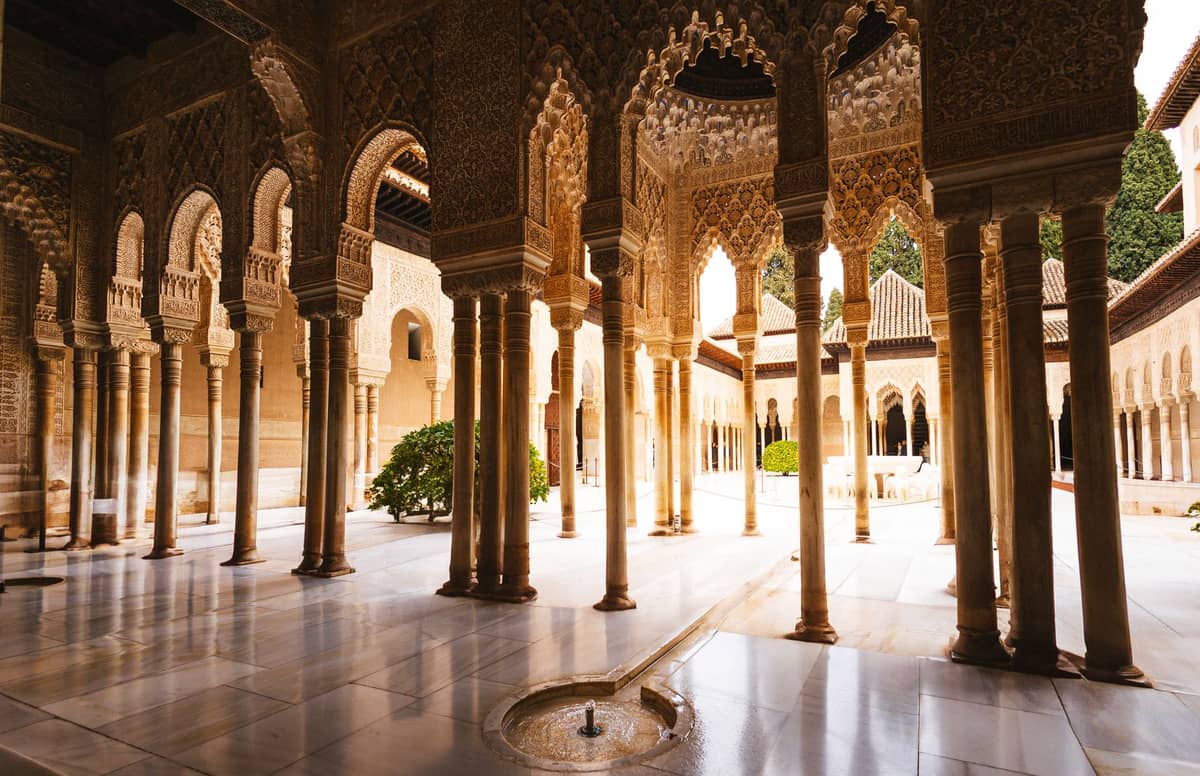
The Court of the Lions (Patio de los Leones) is the most photographed space in Granada, and it earns that attention. Twelve marble lions support a central alabaster fountain; 124 slender marble columns surround the courtyard, their capitals and the stucco arches above them covered in Arabic poetry and geometric ornament. The poetry, composed by the court poet Ibn Zamrak, is literally inscribed into the architecture — the building is, in part, a text.
The surrounding halls — the Hall of the Abencerrages (Sala de los Abencerrajes) and the Hall of the Two Sisters (Sala de las Dos Hermanas) — each contain a muqarnas dome, a ceiling composed of hundreds of stalactite-like plaster cells. The muqarnas in the Hall of the Two Sisters has been estimated at approximately 5,000 individual cells. Looking up into it produces a vertiginous sense of depth, as though the ceiling is dissolving upward into geometry.
In mid-morning, when the courtyard receives direct light, the reflections on the marble floor are extraordinary and the detail of the columns is fully legible. By early afternoon in summer, the space fills with visitors and the heat becomes a factor — the shade of the surrounding halls offers relief but the central courtyard can feel crowded. Late-afternoon light in autumn is particularly warm and raking, which brings out the texture of the carved stucco in a way that flat noon light does not.
Tickets & tours
Live prices and dates from our booking partner. If you book, we may earn a commission at no extra cost to you.
Day Visit vs. Night Visit: Which to Choose
The Patronato offers a separate night visit to the Nasrid Palaces on selected evenings throughout the year. From 1 April to 14 October, sessions run Tuesday to Saturday, 22:00–23:30. From 15 October to 31 March, sessions are on Fridays and Saturdays, 20:00–21:30. The night visit covers the main Nasrid Palace rooms, illuminated by artificial light, without access to the Alcazaba, Generalife, or gardens.
The honest assessment: the night visit is atmospheric but not superior to a daytime visit for understanding the architecture. The muqarnas ceilings and the stucco detail depend on light to read properly, and artificial lighting renders them theatrically but not always clearly. What the night visit delivers is a near-empty courtyard, relative silence, and the contrast of lamplight on marble — which for certain travellers (couples, photographers working with low light, those who have already seen the palaces by day) makes it worth seeking out. For first-time visitors with only one chance, a daytime slot with an early entry time is the better choice.
💡 Local tip
Book night visit tickets directly through the official Patronato portal (tickets.alhambra-patronato.es). Third-party sellers exist but the official site is the only guaranteed source. Night tickets sell out weeks in advance in high season.
Practical Walkthrough: Getting There and Getting In
The Nasrid Palaces are inside the Alhambra complex. City buses C30 and C32 depart from Plaza Nueva and stop at the Alhambra entrance area. The uphill walk from Plaza Nueva takes about 15 minutes along the Cuesta de Gomérez and through the forest path — shaded, pleasant in cool weather, tiring in summer heat. Taxis and ride-hailing apps can drop you at the Access Pavilion. For full context on navigating the city to reach the hill, the getting around Granada guide has current transport details worth checking before you go.
At the Access Pavilion, you will pass through security (bags scanned, no tripods, no selfie sticks). From there, signposted paths lead through the grounds to the Nasrid Palace entrance. The walk from the pavilion to the palace entrance gate takes about 10 minutes at a moderate pace. Factor this into your timing: if your entry window is 10:00, you need to be through security and walking by 09:45 at the latest.
Inside the palaces, the route is one-directional and well-signed. You cannot backtrack through previous rooms. The entire circuit — Mexuar, Comares complex, Court of the Lions, exit via the Partal gardens — takes most visitors between 1.5 and 2 hours when moving at a comfortable pace with stops for photography. Moving faster is possible but rarely worthwhile.
⚠️ What to skip
Baby strollers and pushchairs are not permitted inside the Nasrid Palaces. A designated drop-off area is available near the entrance, and baby carriers can be borrowed free of charge via the cloakroom service. Wheelchairs can be borrowed at the Access Pavilion on a first-come, first-served basis. The Patio de los Leones is mostly flat; some transitional areas within the older sections have uneven paving.
Photography, Crowds, and Realistic Expectations
The Nasrid Palaces are photographed millions of times a year, and the reality on busy days is that achieving an empty-courtyard image of the Patio de los Leones requires either a night visit or an opening-slot daytime ticket. By 10:00 on a summer morning, the Court of the Lions already has enough visitors to fill the frame. Early morning slots (08:30 entry) in shoulder season — April, May, October — offer the most manageable crowds and the best natural light in the Comares Tower.
For the surrounding context of the Alhambra hill and how the Nasrid Palaces fit within the broader complex, see the full Alhambra attraction page. For detailed ticket strategy including how to secure the entry slot you want and what to do if tickets are sold out, the Alhambra tickets guide covers the process step by step.
The palaces are not suitable for visitors who struggle with slow, concentrated looking. If ornamental detail and architectural history do not hold your attention for sustained periods, the circuit can feel long and repetitive after the first two courtyards. This is not a criticism — it is useful information. The Nasrid Palaces reward visitors who arrive prepared to read the space rather than simply pass through it.
Placing the Palaces in Context: Heritage and History
The Alhambra complex, including the Nasrid Palaces, was inscribed as a UNESCO World Heritage Site in 1984, extended in 1994 to include the Albaicín quarter across the valley. The inscription recognized the palaces as the outstanding surviving example of Nasrid art and architecture, with no comparable ensemble existing elsewhere. From the Mirador de San Nicolás in the Albaicín, you can see the exterior of the Nasrid Palaces from across the Darro gorge — the red-tinged towers of the Comares complex visible above the fortress walls. That distant view is impressive; what lies inside is on a different order entirely.
The Nasrid dynasty ruled the Emirate of Granada from 1232 until 1492, making it the longest-surviving Islamic state on the Iberian Peninsula after the broader Christian Reconquista dismantled earlier Muslim kingdoms to the north and west. The palaces were built during a period of intense cultural and diplomatic activity, with the court maintaining connections to the Marinid dynasty in Morocco and the wider Islamic world. Understanding this context changes how you read the Arabic inscriptions covering the walls — they are not merely decorative. They include verses from the Quran, panegyric poetry, and philosophical texts, woven into the architecture as a statement of legitimacy and cosmological order. For a deeper grounding in the Moorish heritage of Granada, the Granada Moorish heritage guide provides useful background before your visit.
What to Wear and Bring
- Comfortable, flat-soled shoes: the marble and tile floors are smooth and can be slippery, especially if you visit after rain
- A light layer for the interior rooms, which stay cool even in summer due to the thick walls and water features
- Water: there is limited opportunity to buy drinks once you are inside the palace circuit
- A charged phone or camera: tripods and monopods are not permitted
- Your ticket confirmation, digital or printed, ready to scan at the palace entrance gate (not just the Access Pavilion)
Insider Tips
- Your timed entry window applies specifically to the Nasrid Palace gate, not to the general Alhambra grounds. You can enter the wider complex (Alcazaba, gardens, Generalife) before your palace slot opens — use that time to see the fortress first so you are already on site and relaxed when your window arrives.
- The Sala de los Abencerrajes is almost always less crowded than the Court of the Lions because visitors linger in the central courtyard. Step quickly into the hall and look up at the muqarnas dome before the next group arrives — you may have it nearly to yourself for a minute or two.
- On overcast days, the reflections in the Court of the Myrtles pool are sharper and more symmetrical than on bright sunny days, when the light creates glare. Cloudy weather is not the worst condition for visiting.
- The exit from the Nasrid Palaces leads through the Partal gardens, a quieter area with a small palace portico and a reflecting pool that most visitors walk past quickly. It is worth slowing down here — the view back toward the Torre de las Damas from the garden path is one of the least-photographed but most composed views in the entire complex.
- If you are visiting in summer and have a late morning entry slot, the Comares Tower rooms (west-facing) are at their best in afternoon light — but your timed entry window dictates when you go through. There is no way to linger selectively and return to a room. Move slowly through the Mexuar and Court of the Myrtles, and by the time you reach the Throne Room, the light in the windows will have shifted.
Who Is Nasrid Palaces (Palacios Nazaríes) For?
- First-time visitors to Granada who want to understand the city's defining monument
- Architecture and design enthusiasts interested in Islamic geometric ornament, muqarnas, and Andalusian court architecture
- History travellers tracing the end of Moorish Spain and the period of the Reconquista
- Photographers willing to plan their entry slot around light conditions
- Couples — particularly for a night visit in shoulder season when the courtyards are quiet
Nearby Attractions
Other things to see while in Alhambra Hill (La Sabika):
- Alcazaba
The Alcazaba is the oldest surviving section of the Alhambra complex, a Nasrid military fortress perched at the western tip of the hill. Its towers offer some of the most commanding views in Granada, looking out over the Albaicín, the Darro valley, and on clear days, the snow-capped Sierra Nevada.
- Alhambra
The Alhambra is one of the most visited monuments in the world for good reason: it is an extraordinarily complete surviving example of Nasrid Islamic palatial architecture, set above Granada on the hill of Sabika. This guide covers what to expect at each section of the complex, how to secure tickets, and how to make the most of your visit.
- Carmen de los Mártires
Tucked just minutes from the Alhambra entrance, Carmen de los Mártires is a sprawling 19th-century romantic garden on Alhambra Hill that most visitors walk straight past. Shaded paths, ornamental lakes, Moorish-influenced terraces, and resident peacocks reward those who take the detour.
- Casa-Museo Manuel de Falla
Tucked into the hillside near the Alhambra, the Casa Museo Manuel de Falla preserves the modest carmen where Spain's greatest 20th-century composer worked for nearly two decades. Original furnishings, a working piano, and handwritten manuscripts make this one of Granada's most intimate cultural visits.
Planning a trip? Discover personalized activities with the Nomado app.