Alcazaba: Inside the Alhambra's Ancient Military Citadel
The Alcazaba is the oldest surviving section of the Alhambra complex, a Nasrid military fortress perched at the western tip of the hill. Its towers offer some of the most commanding views in Granada, looking out over the Albaicín, the Darro valley, and on clear days, the snow-capped Sierra Nevada.
Quick Facts
- Location
- Real de la Alhambra, 18009 Granada, Alhambra Hill
- Getting There
- City bus lines C30 and C32 from Plaza Isabel la Católica (near Plaza Nueva) to the Alhambra entrance; also walkable uphill via Cuesta de Gomérez (about 20 minutes)
- Time Needed
- 45–90 minutes for the Alcazaba alone; budget a full day for the wider Alhambra complex
- Cost
- Included in the general Alhambra ticket (approx. €22.27 for the full complex; verify current price before visiting)
- Best for
- History lovers, photographers, panoramic views, military architecture
- Official website
- www.alhambra-patronato.es
What the Alcazaba Actually Is
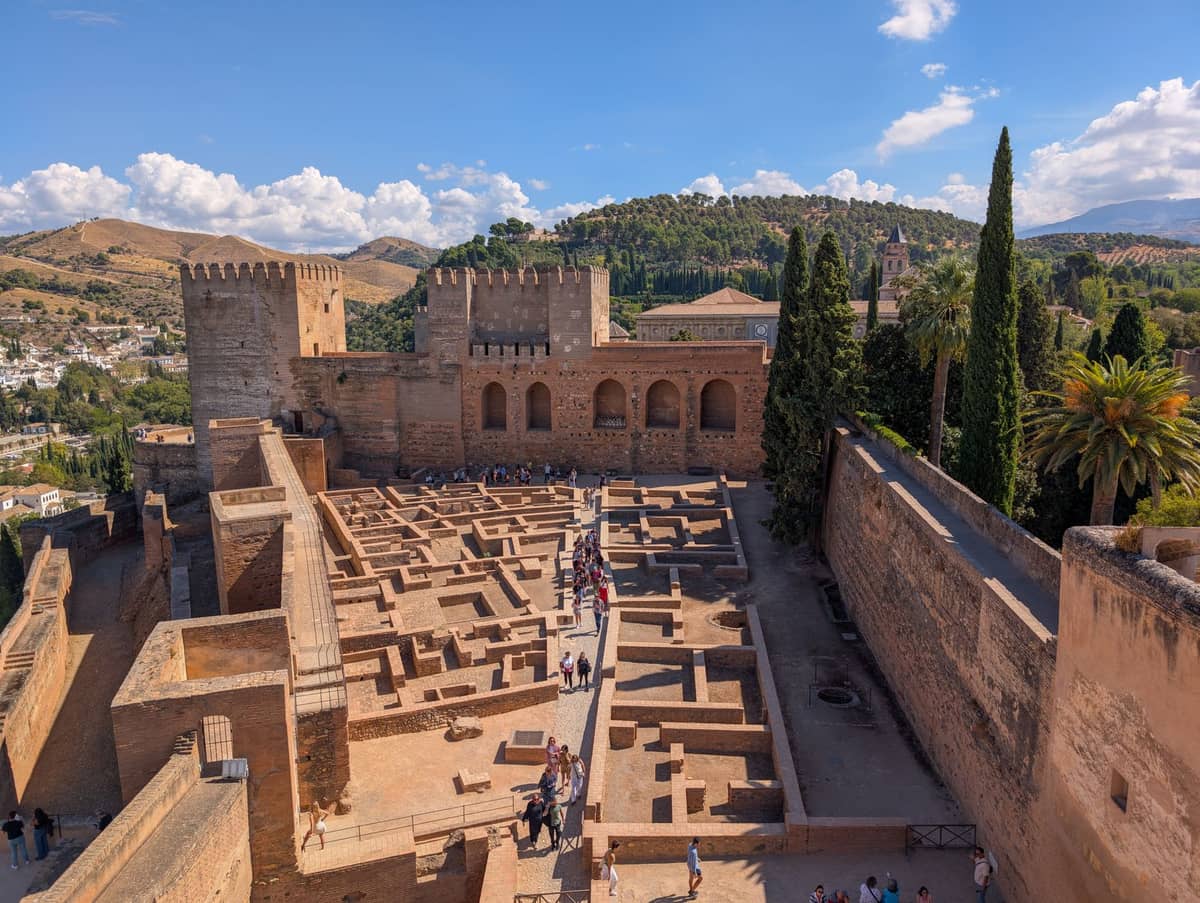
The Alcazaba de la Alhambra is the fortified military citadel that forms the westernmost tip of the Alhambra complex. While most visitors associate the Alhambra with the ornate Nasrid Palaces, the Alcazaba predates them significantly. This is where the story of the hill begins: a compact, defensible fortress of reddish towers, troop quarters, cisterns, and rampart walks, all with fortifications documented from the 9th century and substantially rebuilt into the current Alcazaba under the Nasrid dynasty from the 13th century onward.
The name itself comes from the Arabic al-qasba, meaning citadel or inner fortification. Unlike the palaces, which were spaces of courtly ceremony and private luxury, the Alcazaba was purely functional. It housed soldiers, stored weapons, and served as the last line of defense if the hill were breached. The contrast between its stark military pragmatism and the decorative intensity of the Nasrid Palaces just a few hundred meters away is part of what makes the Alhambra such a layered place to explore.
ℹ️ Good to know
The Alcazaba is included in the standard Alhambra day-visit ticket, which covers the Nasrid Palaces, Generalife, Gardens, and other core areas of the Monumental Complex. Tickets sell out weeks in advance; book through the official Patronato de la Alhambra platform before your trip.
The Experience: Walking the Fortress
Entering the Alcazaba from the Alhambra's main route, you pass through a series of gateways designed to slow and disorient any attacker. The walls are thick enough to muffle the sound of wind outside, and the air carries the particular coolness of old stone even in summer. The ground underfoot is uneven: compacted earth and worn brick, nothing like the smooth paths through the garden areas. Bring footwear with decent grip.
The interior of the citadel opens onto a sunken plaza once surrounded by troop barracks. The foundations and lower walls of these structures are still clearly visible, giving the space an archaeological quality. Information panels explain the original layout, but the footprint speaks for itself: the soldiers' quarters were narrow and stacked, arranged around shared cisterns. It is not a romantic space. It is an efficient one, and that efficiency is historically honest.
The highlight for most visitors is the climb to the Torre de la Vela, the tallest tower in the Alcazaba. The staircase inside is steep and narrow, a single-file climb with low headroom in places. At the top, a broad terrace opens with 360-degree views: the Albaicín quarter rolling across the opposite hill, the Darro river valley below, the modern city spreading south, and on days without haze, the Sierra Nevada ridge clearly visible above the treeline. In winter and spring, those peaks carry snow, and the color contrast between white mountains and red-ochre ramparts is striking.
💡 Local tip
The Torre de la Vela is not wheelchair accessible. Visitors with mobility limitations can still explore much of the Alcazaba's lower areas and the rampart walks at ground level, where views over the Albaicín remain excellent.
Tickets & tours
Live prices and dates from our booking partner. If you book, we may earn a commission at no extra cost to you.
Alhambra guided tour with Carlos V Palace, Generalife and Alcazaba
From 35 €Flamenco show in a Sacromonte cave in Granada with drink
From 26 €Instant confirmationFree cancellation1-hour Flamenco Show at Palacio Flamenco in Granada
From 25 €Instant confirmationFree cancellationAlpujarras tour from Granada
From 57 €Instant confirmationFree cancellation
How the Light and Crowds Change Through the Day
Opening time (08:30) brings the best conditions. The early morning light in Granada is soft and slightly golden, especially from April through October, and the ramparts face east and south in ways that catch that light well. The towers cast long shadows across the interior plazas, and you will likely have significant stretches of the Alcazaba to yourself before the main tour groups arrive after 10:00.
By mid-morning, particularly in summer, the tour groups consolidate and the narrow stairways inside the towers become bottlenecked. The Torre de la Vela queue can develop quickly. If you are visiting in July or August, the afternoon heat on the exposed ramparts is significant: temperatures frequently exceed 35°C and there is almost no shade on the upper walkways. A refillable water bottle and sun protection are not optional in summer.
Late afternoon visits in spring and autumn have their own reward. The Alhambra hill faces west-northwest from the Torre de la Vela, and the late sun catches the white walls of the Albaicín directly opposite. Photographers working in that golden window between 17:00 and 19:00 in summer will find the light warmer and the crowds noticeably thinner than at midday. Winter closing time (18:00) cuts this option slightly, but the lower angle of winter sun means good light arrives earlier in the day.
Historical and Architectural Context
The origins of the Alcazaba are debated, but most historians trace the earliest fortification on the site to the 9th century, when local Muslim authorities began consolidating control over Granada. The Nasrid rulers who came to power in 1238 transformed the hill into the complex that survives today, and the Alcazaba was substantially reinforced and expanded during the 13th and 14th centuries as the Nasrid Kingdom of Granada faced increasing pressure from Christian kingdoms to the north.
The fortress communicates military logic in stone. The outer walls are studded with towers at irregular intervals, each positioned to provide covering fire for the adjacent stretch of wall. The gatehouse sequence at the main entrance uses bent entrances and blind turns to prevent direct assault. The Torre de la Vela takes its name from the large bell that was installed after the Christian Reconquista of Granada in 1492; the bell was rung to signal water distribution to irrigated fields below and, later, to mark significant dates in the city's calendar.
The Alcazaba sits within the broader UNESCO World Heritage designation that covers the Alhambra, Generalife, and Albayzín. Understanding it in isolation misses something important. For the full picture of how the Nasrid rulers shaped this hill, the Nasrid Palaces and the Generalife gardens are the natural complements, each representing a different register of Nasrid ambition: military, ceremonial, and domestic.
Practical Walkthrough: Getting There and Getting In
The Alcazaba is accessed through the Alhambra complex. The main visitor entrance is via the Access Pavilion on the eastern approach to the hill. From Granada's city center, the most straightforward option on foot is the Cuesta de Gomérez, a pedestrianized lane rising steeply from Plaza Nueva that takes about 20 minutes at a moderate walking pace. City bus lines C30 and C32 run from Plaza Nueva to the Alhambra entrance and take roughly 10 minutes.
Once through the Access Pavilion and into the complex, follow signage toward the western end of the hill. The Alcazaba is the first major area you reach walking from the main gate, before the Nasrid Palaces. If you have booked a timed entry for the Nasrid Palaces, note that slot carefully: missing it forfeits that portion of your ticket. The Alcazaba has no separate timed entry and can be visited at any point during your allocated day. For full guidance on navigating ticket types, see the Alhambra tickets guide.
Opening hours follow the Alhambra's seasonal schedule. From approximately 1 April to 14 October the complex is open 08:30–20:00 daily. From approximately 15 October to 31 March hours are 08:30–18:00. The complex closes on 25 December and 1 January. Specific one-off closures do occur; verify the current schedule on the official Patronato de la Alhambra website before your visit.
⚠️ What to skip
The Alcazaba is partially accessible but has significant limitations. The Torre de la Vela is not accessible to wheelchair users. Free wheelchair loans are available at the Access Pavilion ticket office. Surfaces throughout the Alcazaba include uneven stone, compacted earth, and steep stairs.
Photography Tips
The Alcazaba's best photographic opportunities are from the ramparts rather than within the interior plazas. From the Torre de la Vela's upper terrace, a wide-angle lens captures the Albaicín quarter to the north and the Sierra Nevada to the southeast in a single frame. A standard zoom (24–70mm equivalent) works well for isolating individual towers against the sky.
The Alcazaba also appears prominently in photographs taken from the opposite hill. The Mirador de San Nicolás in the Albaicín provides the classic full-length view of the Alhambra complex, with the Alcazaba's towers visible at the western end. If you want external shots of the Alcazaba itself rather than views from it, the Albaicín viewpoints are where those images are made.
Who Should Manage Their Expectations
The Alcazaba rewards visitors who engage with military history, panoramic geography, and the raw structural logic of medieval fortification. Visitors primarily interested in decorative Islamic art and tilework should know that virtually none of that remains here: the Alcazaba's aesthetic is austere by design. The ornamental intensity of the Alhambra belongs to the palaces, not this citadel.
Visitors with mobility difficulties will find the experience significantly curtailed. The lower plazas and some rampart sections are accessible, but the tower climbs and much of the upper circuit are not. Families with very young children in pushchairs should plan for the same limitations: the terrain is rough and the stairways narrow.
Insider Tips
- Book your Alhambra ticket the moment your travel dates are confirmed. The Nasrid Palaces timed-entry slots sell out weeks, sometimes months, in advance. The Alcazaba itself has no separate timed slot, but it is bundled with the same ticket.
- The Torre de la Vela is frequently photographed from inside the Alcazaba looking up, but the better composition is from the rampart walk to its south: from there you get the tower framed against the Sierra Nevada rather than against sky alone.
- If you arrive at opening time (08:30), the interior barracks area of the Alcazaba is usually quiet for the first 45 minutes. Use that window to explore the lower archaeological sections before the tour groups arrive and concentrate near the tower.
- In winter (November to March), the Sierra Nevada often carries heavy snow and is clearly visible from the Torre de la Vela. The combination of snow-covered peaks and the red-ochre ramparts in the same frame is one of the more distinctive views in Andalusia.
- The small café and water point near the Alhambra's main axis is some distance from the Alcazaba. Bring a full water bottle, particularly in summer when the exposed ramparts offer no shade and temperatures regularly exceed 35°C.
Who Is Alcazaba For?
- History and military architecture enthusiasts who want to understand the Alhambra before the Nasrid Palaces were built
- Photographers seeking panoramic views over Granada, the Albaicín, and the Sierra Nevada from an elevated fortress platform
- Travelers combining the Alcazaba with a full Alhambra day visit who want meaningful context for the wider complex
- Early-morning visitors who arrive at 08:30 and want to have an iconic monument largely to themselves
- Visitors interested in Andalusia's Moorish and medieval heritage beyond decorative surfaces
Nearby Attractions
Other things to see while in Alhambra Hill (La Sabika):
- Alhambra
The Alhambra is one of the most visited monuments in the world for good reason: it is an extraordinarily complete surviving example of Nasrid Islamic palatial architecture, set above Granada on the hill of Sabika. This guide covers what to expect at each section of the complex, how to secure tickets, and how to make the most of your visit.
- Carmen de los Mártires
Tucked just minutes from the Alhambra entrance, Carmen de los Mártires is a sprawling 19th-century romantic garden on Alhambra Hill that most visitors walk straight past. Shaded paths, ornamental lakes, Moorish-influenced terraces, and resident peacocks reward those who take the detour.
- Casa-Museo Manuel de Falla
Tucked into the hillside near the Alhambra, the Casa Museo Manuel de Falla preserves the modest carmen where Spain's greatest 20th-century composer worked for nearly two decades. Original furnishings, a working piano, and handwritten manuscripts make this one of Granada's most intimate cultural visits.
- Fundación Rodríguez-Acosta (Carmen Rodríguez-Acosta)
Perched on the slopes of Alhambra Hill, the Fundación Rodríguez-Acosta is a layered surprise: a modernist villa-garden complex built by a Granadan painter in the early 20th century, now housing an eclectic art collection and the scholarly Museo Gómez-Moreno. Guided visits run in set morning passes; admission is 5 euros, with various reductions and free entry for children under 12.
Planning a trip? Discover personalized activities with the Nomado app.