Mirador de San Nicolás: Granada's Most Iconic Alhambra Panorama
Perched in the Albaicín, the Mirador de San Nicolás is a free public square that frames the Alhambra against the snow-dusted ridgeline of the Sierra Nevada. The view is real, the crowds are real, and knowing when to go makes all the difference.
Quick Facts
- Location
- Plaza Mirador de San Nicolás, Albaicín, 18010 Granada, Spain
- Getting There
- Minibus C31 from Plaza Nueva stops close to Plaza de San Nicolás (C32 service currently suspended due to works)
- Time Needed
- 30–90 minutes, depending on how long you linger
- Cost
- Free — open public square, no ticket required
- Best for
- Sunset views of the Alhambra, Albaicín walks, photography
- Official website
- turismo.granada.org/es/monumento/mirador/mirador-san-nicolas
What the Mirador de San Nicolás Actually Delivers
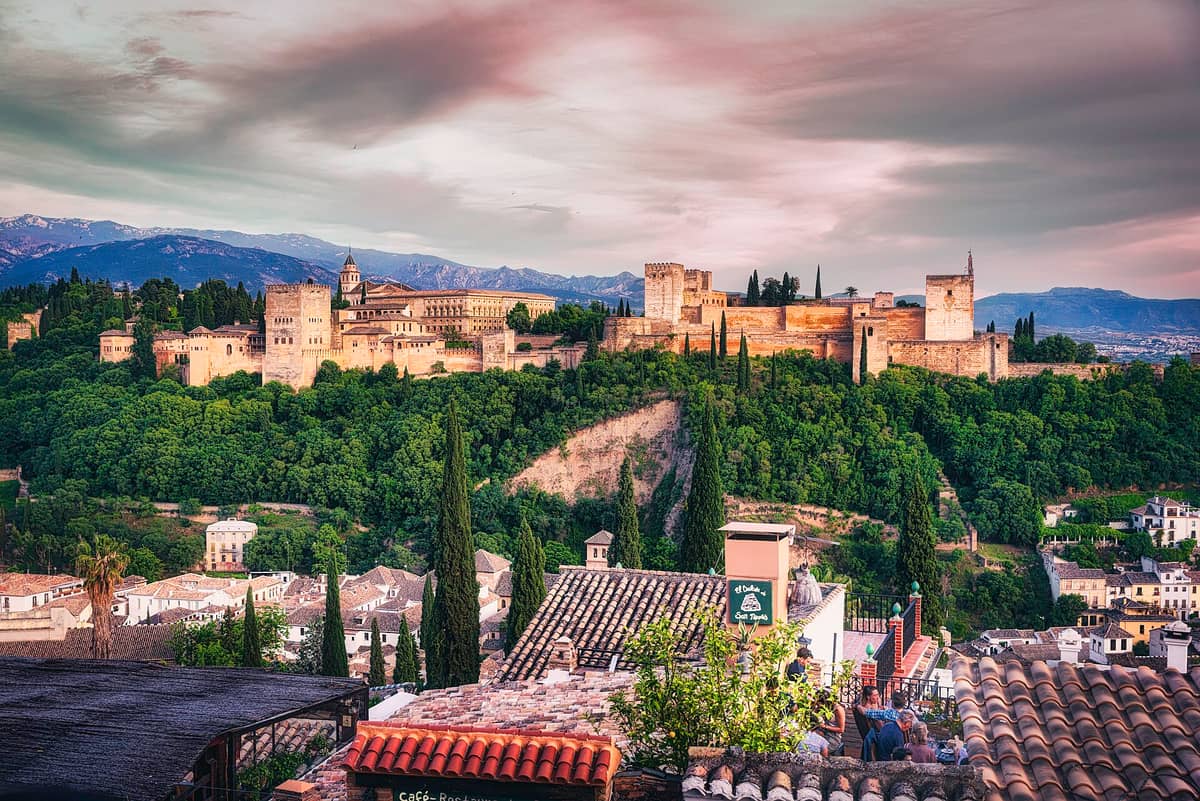
There is a reason the Mirador de San Nicolás appears on almost every photograph of Granada. From this wide, stone-paved square in the Albaicín, the entire south face of the Alhambra sits directly across the Darro valley at eye level, close enough to make out the crenellated towers of the Alcazaba, the bulk of the Palacio de Carlos V, and the cypress-lined terraces of the Generalife climbing the hill behind. Beyond it, when conditions allow, the permanent snowfields of the Sierra Nevada form a backdrop that photographers spend whole afternoons chasing.
The viewpoint is a public square, completely free, open at all hours. It requires no booking, no ticket, and no guided tour. What it does require is some effort to reach through the medieval lanes of the Albaicín neighbourhood, and a willingness to share the space with other visitors who have made the same calculation. Come at the right time and the atmosphere is genuinely moving. Come at the wrong time and it resembles a busy outdoor waiting room.
💡 Local tip
The single most effective strategy at this viewpoint: arrive 45 minutes before sunset, claim a spot along the low stone wall facing the Alhambra, and stay through the first 20 minutes of dusk. The light sequence during this window — gold on the towers, then amber, then the first floodlights switching on — is the one that earns the photographs.
How the Experience Changes Through the Day
Early Morning
Before 9 a.m., the mirador belongs almost entirely to the neighbourhood. Local residents cross the square on their way to the bakery or the lower streets. The light arrives from the east and side-lights the Alhambra's walls in a warm, raking glow that is less photographed than the sunset but arguably more beautiful. The air in Granada at this elevation carries a noticeable freshness in spring and autumn mornings, sometimes carrying the scent of orange blossom from the gardens below. In summer, early morning is also when the temperature is bearable: July and August afternoons here can hit 35°C or above.
Midday and Afternoon
From around 11 a.m. through mid-afternoon, the square fills steadily. Tour groups arrive via the C31 and C32 minibuses, and the surrounding cafés and souvenir stalls open fully. The light at this hour is flat and high, which is the least flattering for photographs of the Alhambra. Vendors circulate through the crowd selling cold drinks and small crafts. If you have a time-limited visit and midday is your only option, the view itself remains impressive, but do not expect a quiet contemplative moment.
Sunset and Evening
Sunset is the acknowledged peak experience, and the crowd reflects that. In summer months, the square can fill to the point where latecomers stand three or four rows back from the wall. The compensation is the quality of the light: the Alhambra's ochre walls seem to intensify as the sun drops, and the Sierra Nevada turns from white to pink to a muted grey as the sky darkens. Once the floodlights activate on the Alhambra, the view shifts into an entirely different register: the illuminated fortress against a deep blue sky is the image that travels. Street musicians sometimes play near the church steps during this hour, and the air fills with the low hum of voices from every direction.
Tickets & tours
Live prices and dates from our booking partner. If you book, we may earn a commission at no extra cost to you.
Alhambra guided tour in Italian
From 49 €Instant confirmationFree cancellationAlhambra guided group tour with Nasrid Palaces and Generalife Palace
From 40 €Alhambra guided tour with Carlos V Palace, Generalife and Alcazaba
From 35 €Alhambra and Generalife skip-the-line private tour
From 65 €Instant confirmation
The Albaicín Context: Why This Spot Exists Here
The Albaicín is Granada's oldest residential district, a hillside neighbourhood whose street layout preserves the medieval Islamic urban fabric almost intact. The area was designated a UNESCO World Heritage Site, extending the protection that already covered the Alhambra and Generalife across the valley. The quarter developed as the main residential zone for Granada's Muslim population during the Nasrid period, when the Alhambra was the seat of the last independent Islamic kingdom on the Iberian Peninsula.
The Mirador de San Nicolás sits adjacent to the Iglesia de San Nicolás, a church built on the site of a former mosque after the Christian conquest of Granada in 1492. The building itself is relatively modest, but its position at the high edge of the Albaicín hill commands the exact sightline across to the Alhambra that Nasrid-era residents would have looked out upon from their carmen gardens. Standing here, the geography of the city's history becomes legible in a way that no museum exhibit replicates.
For deeper historical context on the Albaicín's Moorish heritage and what to look for as you walk up through its lanes, the Granada Moorish heritage guide covers the neighbourhood's architectural layers and the best-preserved streets to explore on the way to the viewpoint.
Getting There: The Walk, the Bus, and the Taxi
The most common approach on foot starts from Plaza Nueva, the main square at the foot of the Albaicín. From there, the climb through Cuesta de San Gregorio and the narrower lanes above takes roughly 20 to 30 minutes at a steady pace. The streets are cobbled and steep in places, shaded in the upper sections by whitewashed walls and occasional overhanging vegetation. Comfortable, non-slip footwear is not optional: smooth-soled shoes on wet cobblestones are a genuine hazard, especially after autumn or winter rain.
The Transportes Rober minibus C31 provides the alternative for those who prefer not to climb. This line departs from Plaza Nueva, passes through Paseo de los Tristes, and winds up through the Albaicín to stops close to Plaza de San Nicolás. The ride is short and inexpensive, though the minibus runs on a fixed schedule and can fill quickly in peak season. Fares and timetables are subject to change, so check with Transportes Rober directly before travelling.
ℹ️ Good to know
Accessibility note: The viewpoint square itself is level and open, which makes it manageable once you arrive. The challenge is the approach. Visitors with limited mobility are best served by taking a taxi or the C31/C32 minibus to the closest stop, rather than attempting the steep cobbled ascent from the city centre on foot.
If you are planning to combine the viewpoint visit with a structured walk through the neighbourhood, the Albaicín walking tour guide maps out a logical route that incorporates the mirador without doubling back unnecessarily.
Photography at the Mirador: Practical Realities
The Alhambra sits roughly to the south-southeast from the viewpoint, which means the sun tracks behind and to the right of the photographer during morning hours and comes from the left during sunset. For the classic front-lit fortress shot, the window is actually the hour after sunrise in summer, when the low eastern sun catches the Alhambra's walls directly. The sunset view is more dramatic in terms of sky colour, but the Alhambra itself is often in partial shadow before the floodlights come on.
A standard 24-70mm lens covers the full panorama comfortably from the wall. A longer focal length compresses the snow on the Sierra Nevada closer to the fortress, which is a compelling composition but requires stepping back in the square to gain distance. A tripod is useful for the dusk-to-dark transition, though the square gets crowded enough that setting one up at peak hours requires patience and awareness of the people around you.
⚠️ What to skip
The snow on the Sierra Nevada behind the Alhambra is not guaranteed. Snowfall reaches the highest peaks from late autumn and can persist into spring, but by June through September the visible snow is typically limited or absent. If the Sierra Nevada backdrop matters to you, plan a visit between November and May and check conditions before you go.
Who Should Manage Their Expectations
The view from Mirador de San Nicolás is genuine and impressive, and it earns its reputation. But visitors who arrive expecting a serene, uncrowded encounter will be caught off guard by the reality of peak hours. In summer, from around 6 p.m. onwards, the square holds what feels like several hundred people simultaneously. The atmosphere is convivial rather than contemplative, and it is worth knowing that in advance.
Visitors who want to see the Alhambra itself, rather than look at it from across the valley, need to plan that visit separately and well in advance. Tickets for the Nasrid Palaces sell out days or weeks ahead. The Alhambra tickets guide explains the booking process, the different entry options, and how far in advance to reserve.
Visitors with significant mobility challenges should be aware that the Albaicín's terrain is genuinely difficult. A taxi to the square is a practical solution and costs very little relative to the alternative. Anyone who is not comfortable with steep, uneven cobblestones should factor this in before committing to the walk.
Insider Tips
- The 30 minutes immediately after sunset, once the sky moves from orange to deep blue and the Alhambra floodlights are fully on, is less crowded than the sunset itself because many visitors leave once the sun drops. This window often produces the most atmospheric photographs and the most relaxed atmosphere on the square.
- The C31 and C32 minibuses from Plaza Nueva are the fastest way up, but the walk down through Calle Calderería Nueva takes you past the tea houses and spice stalls of the Moorish-influenced commercial street, which is worth doing slowly in the early evening.
- In winter, the square at dawn can be almost empty, the air is cold and clear, and the Sierra Nevada snow is at its fullest. The combination of an unobstructed view, low-angle light, and near-total quiet makes January and February mornings one of the genuinely underused windows to visit.
- If you hear guitar playing near the church steps in the late afternoon, move closer but do not block the path for others. The informal musicians who set up here are often skilled, and listening for ten minutes costs nothing while the light slowly changes behind you.
- There are cafés and restaurants on and immediately around the square. None are particularly special gastronomically, but a drink at one of the terrace tables gives you a seated view of the Alhambra without competing for wall space, which is a reasonable trade on a busy evening.
Who Is Mirador de San Nicolás For?
- Travellers visiting Granada for the first time who want to understand the Alhambra's position in the landscape before entering it
- Photographers seeking the classic Granada sunset shot with the Alhambra and Sierra Nevada in the same frame
- Visitors combining the viewpoint with a longer walk through the Albaicín's medieval street network
- Couples looking for a scenic early-evening stop before dinner in the neighbourhood
- Travellers on a tight budget who want a high-impact Granada experience without a ticket price
Nearby Attractions
Other things to see while in Albaicín:
- Baños Árabes El Bañuelo
Tucked along the Darro riverbank in the Albaicín, El Bañuelo is an 11th-century Arab bath complex that has survived nearly a thousand years in remarkable condition. With its star-shaped skylights, horseshoe arches, and three-room hammam layout, it offers one of the clearest windows into medieval Islamic daily life in Spain.
- Casa de Zafra
Tucked into the narrow lanes of Granada's Albaicín quarter, Casa de Zafra is a rare surviving example of a 14th-century Nasrid urban palace. Now operating as the Albaicín Interpretation Centre, it pairs authentic medieval architecture with exhibits on the neighbourhood's layered history, and rewards visitors with a rooftop view of the Alhambra that most people walk right past.
- Mirador de San Cristóbal
Perched on the northern edge of the Albaicín, the Mirador de San Cristóbal is a free, open-air viewpoint beside the Iglesia de San Cristóbal that offers broad panoramas over Granada and toward the Alhambra. Less crowded than the famous Mirador de San Nicolás, it rewards visitors who are willing to climb a little further into the old Moorish quarter.
Planning a trip? Discover personalized activities with the Nomado app.