Mirador de San Cristóbal: Granada's Quieter Hilltop View
Perched on the northern edge of the Albaicín, the Mirador de San Cristóbal is a free, open-air viewpoint beside the Iglesia de San Cristóbal that offers broad panoramas over Granada and toward the Alhambra. Less crowded than the famous Mirador de San Nicolás, it rewards visitors who are willing to climb a little further into the old Moorish quarter.
Quick Facts
- Location
- Plaza de San Cristóbal, Albaicín, Granada
- Getting There
- On foot via Cuesta de la Alhacaba from Puerta de Elvira; taxi from central Granada approx. €5–10 (verify current fares)
- Time Needed
- 20–40 minutes at the viewpoint; allow 1–2 hrs if walking up through the Albaicín
- Cost
- Free – no ticket, no gate, no booking required
- Best for
- Sunrise walkers, photographers, visitors wanting Alhambra views without the San Nicolás crowd
- Official website
- turismo.granada.org/es/monumento/mirador/mirador-san-cristobal
What the Mirador de San Cristóbal Actually Is
The Mirador de San Cristóbal is a pedestrian terrace set into the upper slopes of the Albaicín, Granada's UNESCO-listed medieval quarter. It sits directly beside the Iglesia de San Cristóbal, a 16th-century parish church built on what was once a defensive hillside above Puerta de Elvira, the old northern gate of the Moorish city. The terrace is publicly owned, completely free to enter, and is generally accessible at all hours.
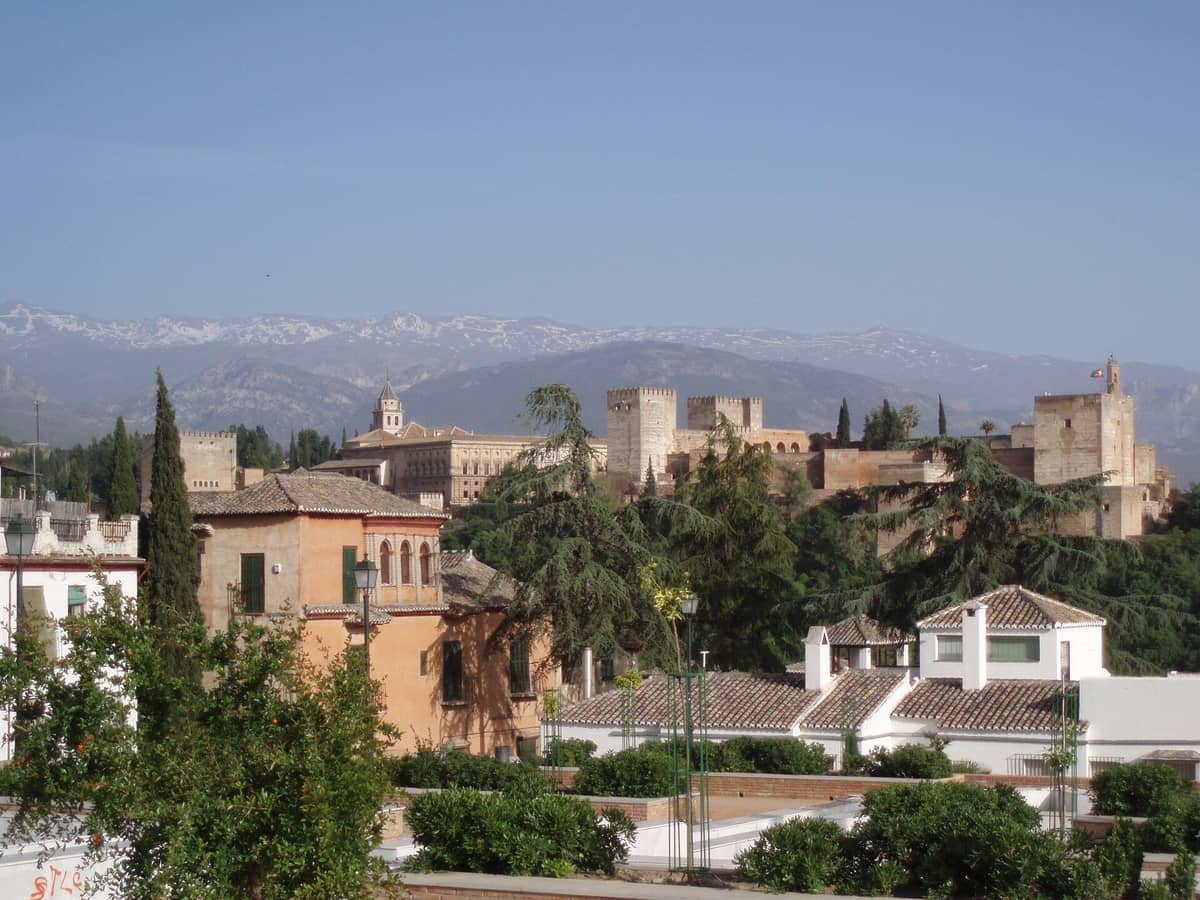
The view from here sweeps across the lower city to the south and east, with the Alhambra visible on its own hill across the valley. It is a broader, more horizontal panorama than the tighter, Nasrid-palace-focused view you get from the Mirador de San Nicolás further south in the Albaicín. Neither is objectively better; they show different faces of the city.
ℹ️ Good to know
San Cristóbal sits on the northern end of the Albaicín hill, above Puerta de Elvira. If you approach from the city centre, you gain about 60–80 metres of elevation on foot. The climb is real; wear shoes with grip, especially on wet cobblestones.
The View: What You Are Actually Looking At
From the terrace, the entire lower bowl of Granada opens up to the south. On a clear day, the snow-capped ridgeline of the Sierra Nevada frames the horizon behind the city, often visible from October through May. The Alhambra sits to your right on its own forested hill, with the red-ochre walls of the Alcazaba tower and the roofline of the Nasrid Palaces identifiable to anyone who has already visited. The Generalife gardens are less distinct from this angle.
The foreground is the Albaicín itself: white-rendered houses with terracotta tiles spilling down the slope, punctuated by the bell towers of churches built over old mosques after the Christian reconquest of 1492. The urban texture from this elevated position makes the density and age of the Albaicín neighbourhood concrete in a way no street-level walk can.
On a clear winter morning after rain, the air is sharp and the Sierra Nevada looks close enough to touch. In summer, heat haze can soften distant detail by midday. The single biggest factor affecting your experience here is atmospheric clarity, not cloud cover.
Tickets & tours
Live prices and dates from our booking partner. If you book, we may earn a commission at no extra cost to you.
Alhambra guided tour in Italian
From 49 €Instant confirmationFree cancellationAlhambra guided group tour with Nasrid Palaces and Generalife Palace
From 40 €Alhambra guided tour with Carlos V Palace, Generalife and Alcazaba
From 35 €Alhambra and Generalife skip-the-line private tour
From 65 €Instant confirmation
How the Experience Changes by Time of Day
Early morning, roughly 7:00 to 9:00, the terrace is quiet. Residents from the upper Albaicín pass through on their way down to the city; you may share the space with a dog-walker or a jogger but rarely with other tourists. The light at this hour strikes the Alhambra's western walls at a low angle, lending the stone a deep amber tone that disappears once the sun climbs higher.
By late morning and early afternoon, particularly between 11:00 and 14:00 in summer, the terrace receives direct sun with almost no shade. In July and August, daytime temperatures in Granada regularly exceed 35°C. There are no refreshment kiosks at the viewpoint itself, so come with water if you plan to linger.
The hour before sunset draws the most visitors, but San Cristóbal still sees considerably fewer people than San Nicolás at the same time. Sunset light on the Alhambra from this angle is warm and direct. After dark, the Alhambra's floodlighting is visible and the city spread below shows its full extent. The terrace is accessible at night, though the steep streets leading up are poorly lit in places; carry a torch if you plan a late visit.
💡 Local tip
For photography: come at golden hour (roughly 40 minutes before sunset) for warm light on the Alhambra. For solitude and the sharpest views, come at sunrise. A standard zoom lens (24–70mm equivalent) covers the full panorama comfortably.
Historical and Cultural Context
The Albaicín quarter was the principal residential district of Moorish Granada from the 11th century, when Granada rose to prominence under the Zirids, through to 1492 when the city surrendered to Ferdinand and Isabella. The hillside above Puerta de Elvira formed part of the northern defensive perimeter, and the church of San Cristóbal was erected in the 16th century as part of the systematic Christianisation of the neighbourhood, a process that replaced mosques with churches while leaving the basic urban layout largely intact.
The Albaicín as a whole received UNESCO World Heritage status in 1994, an extension of the original 1984 inscription that covered the Alhambra complex. The viewpoint at San Cristóbal is part of that protected urban fabric, which is why the surrounding buildings retain their traditional whitewashed appearance and why no commercial structures have been built to obstruct the terrace.
The name 'San Cristóbal' (Saint Christopher, patron of travellers) is fitting for a spot that, for centuries, marked the point where travellers arriving from the north along the old Camino Real first looked down into Granada.
How to Get There: Routes and Practical Notes
The most direct walking route from the lower city starts at Puerta de Elvira, the surviving Moorish gate on Calle Elvira at the northern edge of the historic centre. From there, take the Cuesta de la Alhacaba uphill, then climb the steps of Cuesta de San Cristóbal following signs toward San Cristóbal. The ascent is moderate-to-steep, with mixed paving and stairways: some stretches of smooth stone (slippery when wet) and others of rougher cobbles. Allow 20 to 30 minutes on foot from Puerta de Elvira.
You can also approach from within the Albaicín itself, combining this viewpoint with a walk through the quarter's lanes. This works well if you are already visiting the Mirador de San Nicolás and want to continue north through the neighbourhood rather than retracing your steps.
For visitors who prefer not to climb, taxis can be directed to 'Mirador de San Cristóbal' or 'Ctra. de Murcia, 47'. Indicative taxi fares from the city centre or lower Albaicín are roughly €5–10, but fares are meter-regulated and subject to change; verify current rates before travel. There is limited space for cars near the terrace.
⚠️ What to skip
Accessibility: The terrace itself is reported to have step-free access from certain approach routes, making it more manageable than some upper Albaicín spots. However, the steep Cuesta de la Alhacaba and Cuesta de San Cristóbal routes involve significant gradients and uneven paving that will be difficult for visitors with mobility impairments. If this is a concern, a taxi drop-off directly at the viewpoint is the most practical option.
San Cristóbal vs. San Nicolás: Which Should You Visit?
The Mirador de San Nicolás is the most photographed viewpoint in Granada, with a tightly framed view of the Nasrid Palaces and the Sierra Nevada behind them. It is genuinely excellent and worth the visit, but it is also genuinely crowded, with tour groups, street musicians, and vendors occupying the terrace for most of the day.
San Cristóbal gives a wider, more contextual panorama that includes more of the city itself. It suits visitors who want to understand Granada's geography rather than frame the perfect Alhambra postcard. For anyone spending more than a day in the city, visiting both makes sense: San Nicolás for the classic Alhambra close-up, San Cristóbal for the broader picture. You can read more about planning your time across the city's viewpoints in our Granada viewpoints guide.
Who should skip San Cristóbal: if your time is very limited and you have already committed to visiting the Alhambra and San Nicolás, San Cristóbal adds relatively marginal visual value for the effort of the climb. It is also less rewarding in overcast or hazy conditions, when the Sierra Nevada disappears and the Alhambra loses definition at distance.
Weather, Seasons, and When to Visit
Granada sits at roughly 738 metres above sea level with a Mediterranean-continental climate. Spring (April to May) and autumn (September to October) offer the most reliable combination of comfortable temperatures, around 18 to 24°C during the day, and clear air. These are the best months for long-distance views from any elevated point in the city.
Winter visits are underrated. Between December and February, daytime highs average around 14–15°C, and the Sierra Nevada’s higher peaks are typically snow-covered. The combination of a snow-capped mountain backdrop, a clear blue sky, and near-empty terraces makes for a compelling case for an off-season visit. Bring a warm layer; wind on the hilltop can drop the perceived temperature significantly.
Summer is the busiest period for Granada tourism overall. The views are not at their best due to heat haze, and the climb in July or August midday heat is genuinely uncomfortable. If you are visiting in summer, aim for early morning or the evening hour before sunset. For a fuller picture of seasonal trade-offs, see the best time to visit Granada guide.
Insider Tips
- The terrace faces roughly south and southwest, which means it catches direct afternoon and evening sun. In winter, this makes it a genuinely warm spot to sit even on cool days, as long as the wind is calm.
- The streets immediately below the viewpoint, particularly around Calle de la Umbría, have some of the quietest and best-preserved sections of the upper Albaicín. Budget an extra 20 minutes to explore rather than rushing straight back down.
- Unlike San Nicolás, there are no permanent vendors or market stalls at San Cristóbal. If you want coffee or water before the climb, pick up supplies on Calle Elvira before heading up the Cuesta de la Alhacaba.
- For the clearest Sierra Nevada views, visit in the 24 to 48 hours after a rainy day. Rain clears the atmospheric dust that normally softens long-distance sightlines in this part of Andalusia.
- The church of San Cristóbal beside the terrace has a modest exterior but is worth a glance for its early-16th-century construction details. It is not regularly open to casual visitors, but the facade and bell tower are visible from the terrace and provide useful historical context for the site.
Who Is Mirador de San Cristóbal For?
- Photographers wanting the Alhambra in a wider urban context, particularly at golden hour
- Early risers who want sunrise views without sharing a terrace with tour groups
- Walkers doing a full Albaicín circuit who want to extend north beyond San Nicolás
- Winter visitors who want Sierra Nevada snow views combined with a relatively warm, sunny terrace
- Travellers with more than one day in Granada who have already done the San Nicolás visit
Nearby Attractions
Other things to see while in Albaicín:
- Baños Árabes El Bañuelo
Tucked along the Darro riverbank in the Albaicín, El Bañuelo is an 11th-century Arab bath complex that has survived nearly a thousand years in remarkable condition. With its star-shaped skylights, horseshoe arches, and three-room hammam layout, it offers one of the clearest windows into medieval Islamic daily life in Spain.
- Casa de Zafra
Tucked into the narrow lanes of Granada's Albaicín quarter, Casa de Zafra is a rare surviving example of a 14th-century Nasrid urban palace. Now operating as the Albaicín Interpretation Centre, it pairs authentic medieval architecture with exhibits on the neighbourhood's layered history, and rewards visitors with a rooftop view of the Alhambra that most people walk right past.
- Mirador de San Nicolás
Perched in the Albaicín, the Mirador de San Nicolás is a free public square that frames the Alhambra against the snow-dusted ridgeline of the Sierra Nevada. The view is real, the crowds are real, and knowing when to go makes all the difference.
Planning a trip? Discover personalized activities with the Nomado app.