Casa de Zafra: Inside Granada's Best-Preserved Nasrid House
Tucked into the narrow lanes of Granada's Albaicín quarter, Casa de Zafra is a rare surviving example of a 14th-century Nasrid urban palace. Now operating as the Albaicín Interpretation Centre, it pairs authentic medieval architecture with exhibits on the neighbourhood's layered history, and rewards visitors with a rooftop view of the Alhambra that most people walk right past.
Quick Facts
- Location
- Calle Portería Concepción 8, Albaicín, Granada
- Getting There
- Walk uphill from Plaza Nueva (~15 min), or take city bus C31 or C32 to Albaicín stops
- Time Needed
- 45–75 minutes
- Cost
- €3 general / €1 reduced / Free on Sundays.
- Best for
- History enthusiasts, architecture lovers, Albaicín walkers
- Official website
- turismo.granada.org/en/house-zafra
What Is Casa de Zafra?
Casa de Zafra, officially the Centro de Interpretación del Albaicín, is one of the few surviving Nasrid-period domestic buildings in Granada that visitors can actually enter. While the Alhambra draws enormous crowds across the valley, this 14th-to-15th-century urban palace sits quietly in the Albaicín, overlooked by most itineraries and all the better for it.
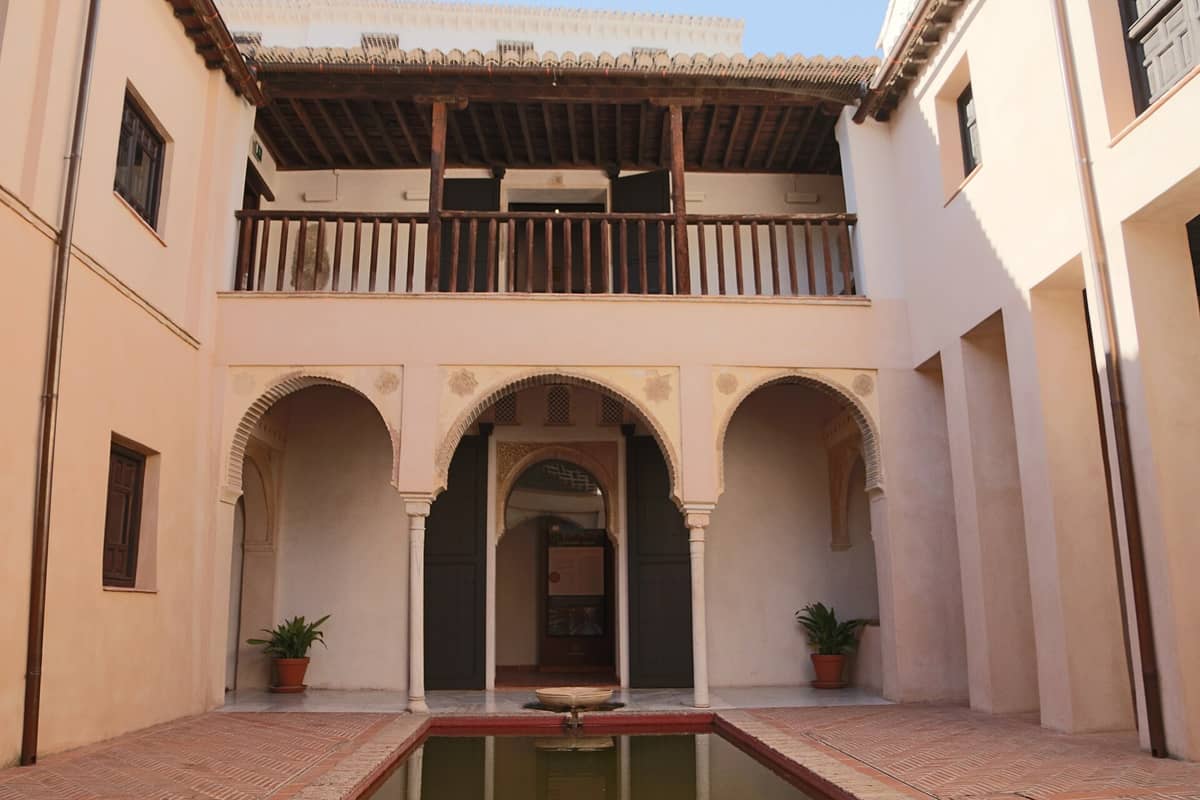
The building is not a museum in the traditional sense. It is a space where the structure itself is the exhibit. The thick whitewashed walls, the central courtyard with its marble-edged pool, the carved plasterwork, and the wooden ceilings all speak to the domestic life of a prosperous Nasrid household from the era when Granada was the last major Islamic kingdom on the Iberian Peninsula. Visitors who have already seen the Nasrid Palaces at the Alhambra will find this a grounding counterpoint: this is what that same architectural tradition looked like when applied to private urban life rather than royal ceremony.
ℹ️ Good to know
Admission is free every Sunday. If your schedule allows, this is the easiest way to visit without spending anything, and Sunday crowds at this site remain light compared to the Alhambra.
The Architecture: What You Are Actually Looking At
The house follows the classic Nasrid courtyard typology: a rectangular patio at the centre, galleries on the short ends, and service rooms arranged around the perimeter. The courtyard pool, though modest compared to the Alhambra's famous reflecting pools, serves the same function: to bring sky and light into the interior and to create a microclimate that keeps the rooms cooler in summer. In the heat of a Granada July, when the city regularly reaches 36°C, you can feel that logic working.
The plasterwork retains traces of the geometric and vegetal patterns typical of the Nasrid period, though some sections have faded or been restored over the centuries. The upper gallery offers a different perspective on the courtyard below and leads toward the terrace level with views toward the Alhambra hill. The building shows clear evidence of its post-Reconquista modifications too: after 1492, successive Christian owners adapted the structure in ways that are still legible in the layering of materials and wall openings.
Understanding this architectural context makes the broader Moorish heritage of Granada considerably more tangible. Casa de Zafra is the kind of place that retroactively deepens what you saw at larger sites.
Tickets & tours
Live prices and dates from our booking partner. If you book, we may earn a commission at no extra cost to you.
Traditional Flamenco Show at Tablao Casa Ana in Granada
From 20 €Instant confirmationFree cancellationAlhambra guided tour in Italian
From 49 €Instant confirmationFree cancellationAlhambra guided group tour with Nasrid Palaces and Generalife Palace
From 40 €Alhambra guided tour with Carlos V Palace, Generalife and Alcazaba
From 35 €
The Interpretation Centre: Exhibits and Context
The Centro de Interpretación function means the house also carries interpretive panels and display cases covering the urban history of the Albaicín: its origins as a densely settled Nasrid city, the upheavals of the Reconquista, the expulsion of the Morisco population in the late 16th century, and the neighbourhood's gradual transformation into what it is today. The panels are available in Spanish and English, and the level of detail is appropriate for an engaged general visitor rather than a specialist.
The exhibits are not extensive. This is a small building with limited exhibition space, and you should not arrive expecting room after room of artefacts. What the centre does well is situate the house within its neighbourhood, giving you a framework for reading the Albaicín's narrow streets, its Carmen gardens, and its surviving medieval structures as a coherent urban landscape rather than a collection of isolated curiosities.
💡 Local tip
Spend a few minutes with the district maps and historical plans near the entrance before moving through the courtyard. The spatial overview helps you orient what you will see when you continue walking the Albaicín afterward.
Visiting by Time of Day: How the Experience Changes
Morning visits, particularly on weekdays, are the quietest. The courtyard in early light has a calm that is hard to replicate later in the day. The marble and plaster surfaces pick up a warm, diffuse quality in the first hours after opening, and the sound of the city outside barely penetrates the thick walls. This is when the spatial logic of the Nasrid courtyard house makes the most sense: the building is genuinely quiet and cool, designed to be a retreat.
By late morning on weekends, small tour groups occasionally pass through, but the house is compact enough that it never feels congested. Afternoon visits in summer (the centre reopens at 17:00 in summer season) can be pleasant once the day's peak heat has passed, and the lower angle of light creates different shadows across the courtyard. Winter afternoon sessions, reopening at 16:00, offer a softer, grayer light that suits the architecture in a different way.
What you will not get at any hour is a dramatic, cinematic experience. Casa de Zafra rewards a quiet, attentive visit. Visitors who rush through in ten minutes will find it underwhelming. Those who sit for a moment in the courtyard, look up at the carved gallery, and follow the exhibits properly will leave with something useful.
Getting There and Practical Logistics
The house sits on Calle Portería Concepción 8, within the UNESCO-listed Albaicín neighbourhood. The most straightforward approach from the city centre is on foot from Plaza Nueva, heading uphill through the Carrera del Darro and then into the lower Albaicín lanes. The walk takes roughly 15 minutes and is itself worthwhile, passing the Bañuelo Arab Baths and several medieval towers along the river edge.
City buses C31 and C32 run a circuit through the Albaicín and stop closer to the upper quarter, reducing the uphill climb. The Albaicín streets are cobbled, steep in places, and often narrow enough that two people walking side by side fill the lane. Comfortable, flat-soled shoes are not optional. The approach and the building itself are not fully accessible for wheelchair users or those with significant mobility limitations: this is an honest constraint of the medieval urban fabric.
Payment at the entrance is card only. There is no cash option. General admission is €3, with a reduced rate of €1 for students, pensioners, unemployed visitors, and children aged 6 to 16. Children under 6 enter free. Entry on Sundays is free for all visitors. The seasonal hours split into two schedules: winter (15 October to 14 March) runs Tuesday to Saturday 10:00 to 14:00 and 16:00 to 19:00, with Sunday 10:00 to 14:00; summer (15 March to 14 October) shifts to 9:30 to 13:30 and 17:00 to 20:00 on Tuesday to Saturday, with Sunday 9:30 to 13:30. The centre is closed all day on Mondays, on 25 December, 1 January, and 6 January, and closes early on the afternoons of 24 and 31 December.
⚠️ What to skip
Always verify current hours and prices on the official Ayuntamiento de Granada tourism page before visiting, as seasonal schedules and fees are subject to change.
Photography and What to Look For
The courtyard is the main photographic subject, and it photographs best when the light is indirect. Direct overhead sun in summer creates harsh contrasts on the white walls. The geometric tilework at the base of the courtyard walls, the carved plaster friezes above, and the wooden ceiling beams in the upper gallery all reward close attention. A phone camera handles the interior light reasonably well; a wide-angle lens helps with the courtyard given the limited space.
If you are walking the Albaicín as part of a structured route, Casa de Zafra fits naturally into a broader morning circuit that might also include the Bañuelo Arab Baths along the Darro river and a stop at the Mirador de San Nicolás for the Alhambra panorama. The three together make a coherent half-day in the upper city without overlapping each other.
For a fuller understanding of Albaicín walking routes, the Albaicín walking tour guide provides sequenced itineraries that include Casa de Zafra as a logical stop.
Who Will Get the Most From This Visit
Casa de Zafra is a genuinely interesting site for anyone with curiosity about medieval Islamic domestic architecture, the history of the Albaicín, or the Nasrid period more broadly. At €3, it is also low-risk. The physical space is intimate and atmospheric, and the interpretation centre adds useful context without overwhelming the experience with information.
It is not the right stop for visitors with very limited time who need to choose between this and the Alhambra, or for anyone expecting a large, well-resourced museum experience. The space is small. If you have already absorbed a great deal of history from larger sites and feel saturated, this will add to that saturation rather than resolve it. But for a visitor who has seen the Alhambra and wants to understand what daily Nasrid-period life looked like on the other side of the valley, or for someone building a walking day through the Albaicín who wants a quiet anchor point with genuine historical substance, this is an excellent choice.
Families with young children can visit, though there is limited interactive content aimed at children. For more family-oriented planning in Granada, the Granada with kids guide suggests how to balance heritage sites with more hands-on attractions.
Insider Tips
- The Sunday free entry window is consistent and reliable. If you are budget-conscious and in Granada over a weekend, this is worth planning around.
- The upper terrace level, accessed via the interior stair, offers a contained but clear view toward the Alhambra hill. It is a better photography angle than most visitors expect from a domestic building of this scale.
- Because the site is card-only, do not arrive with cash and expect to sort it out at the door. There is no ATM immediately outside in these narrow lanes.
- The Albaicín's streets can disorient first-time visitors quickly. Download an offline map before heading uphill: phone signal and data can be inconsistent in the tightest lanes.
- Combine the visit with the Bañuelo Arab Baths on Carrera del Darro, which have similarly early opening hours and form a natural pair for understanding pre-Reconquista Granada in a single morning.
Who Is Casa de Zafra For?
- Architecture and history enthusiasts who want to move beyond the Alhambra into its residential context
- Travellers building a half-day Albaicín walking itinerary and looking for a substantive indoor stop
- Budget visitors: free on Sundays, and €3 represents genuine value for the quality of the experience
- Photographers seeking interior courtyard shots of authentic Nasrid domestic architecture without crowds
- Anyone who has already visited the Nasrid Palaces and wants grounding context for what daily life in Nasrid Granada actually looked like
Nearby Attractions
Other things to see while in Albaicín:
- Baños Árabes El Bañuelo
Tucked along the Darro riverbank in the Albaicín, El Bañuelo is an 11th-century Arab bath complex that has survived nearly a thousand years in remarkable condition. With its star-shaped skylights, horseshoe arches, and three-room hammam layout, it offers one of the clearest windows into medieval Islamic daily life in Spain.
- Mirador de San Cristóbal
Perched on the northern edge of the Albaicín, the Mirador de San Cristóbal is a free, open-air viewpoint beside the Iglesia de San Cristóbal that offers broad panoramas over Granada and toward the Alhambra. Less crowded than the famous Mirador de San Nicolás, it rewards visitors who are willing to climb a little further into the old Moorish quarter.
- Mirador de San Nicolás
Perched in the Albaicín, the Mirador de San Nicolás is a free public square that frames the Alhambra against the snow-dusted ridgeline of the Sierra Nevada. The view is real, the crowds are real, and knowing when to go makes all the difference.
Planning a trip? Discover personalized activities with the Nomado app.