Baños Árabes El Bañuelo: Granada's Most Intact Moorish Bathhouse
Tucked along the Darro riverbank in the Albaicín, El Bañuelo is an 11th-century Arab bath complex that has survived nearly a thousand years in remarkable condition. With its star-shaped skylights, horseshoe arches, and three-room hammam layout, it offers one of the clearest windows into medieval Islamic daily life in Spain.
Quick Facts
- Location
- Carrera del Darro 31, Albaicín, Granada, Spain
- Getting There
- City microbuses C31, C32, C34 – stop 'Carrera del Darro 33 - Bañuelo'; or 10-min walk from Plaza Nueva along Carrera del Darro
- Time Needed
- 30–45 minutes
- Cost
- Around €8 on the Monumentos Andalusíes ticket; may be included in the Granada Card — verify current prices before visiting
- Best for
- History enthusiasts, architecture lovers, Moorish heritage seekers
- Official website
- turismo.granada.org/en/banuelo
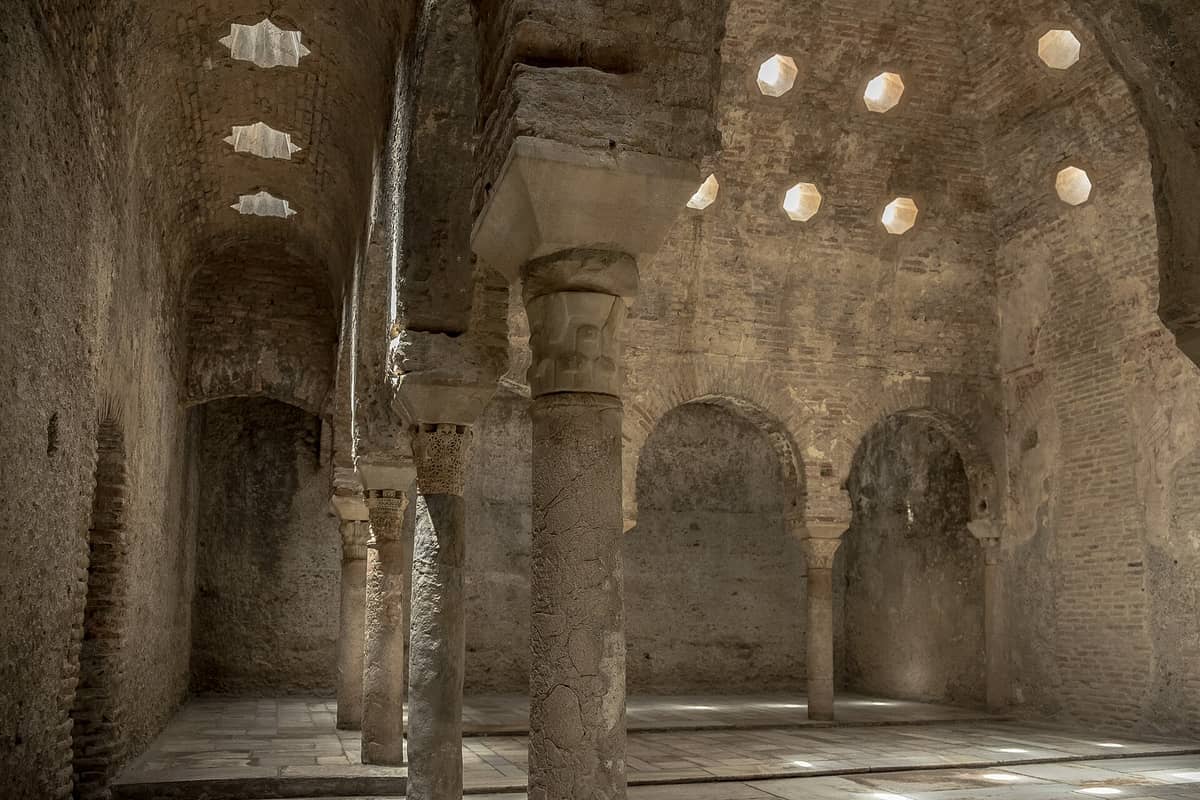
What El Bañuelo Actually Is
Baños Árabes El Bañuelo is a hammam, an Islamic public bathhouse, built in the 11th century during the Zirid dynasty's rule over Granada. It sits on Carrera del Darro, the scenic riverside street that edges the lower Albaicín, just a short walk upstream from Plaza Nueva. Among all the Moorish-era structures that once filled this city, El Bañuelo is exceptional for a simple reason: it is still standing, and much of it is intact.
Most medieval hammams in Spain were demolished after the Reconquista, repurposed beyond recognition, or left to collapse. El Bañuelo survived, largely because it was converted into a private dwelling and storage space for centuries, which paradoxically protected its core architecture. The horseshoe arches, the vaulted ceilings pierced by octagonal and star-shaped skylights, and the three-room bathing sequence from cool to warm to hot remain structurally legible today.
ℹ️ Good to know
Opening hours are seasonal: 10:00–17:00 from 15 September to 30 April; 09:30–14:30 and 17:00–20:30 from 1 May to 14 September. Closed 25 December and 1 January. Always verify current hours before visiting, as schedules occasionally shift.
Inside the Baths: What You See and Feel
You enter from the street through a modest doorway — there is nothing about the exterior that signals what is inside. The transition from the bright Darro riverbank into the cool, dim interior is immediate and striking. The stone underfoot is original; the walls are thick and damp in the way that old masonry always is. Sound from the street drops away almost completely.
The layout follows the classical hammam sequence: a changing room (bayt al-maslakh), then the cold room (bayt al-barid), the warm room (bayt al-wastani), and the hot room (bayt al-sajun). Each room is defined by its arches and its ceiling. The warm and hot rooms have the most memorable architecture: columns with carved capitals support horseshoe arches, and above them the vaults are punctuated by star-shaped and octagonal apertures. In daylight, these openings project shifting patterns of light onto the stone floor and walls — a detail that photographs rarely capture accurately, because the effect depends on the angle of sunlight and the hour of day.
Morning visits, when the summer session opens at 09:30, offer the best light for this. In late afternoon during summer hours (17:00–20:30), the light enters at a lower angle and the shadows lengthen across the vaults. Both are worth seeing; they are genuinely different experiences in the same space.
💡 Local tip
Photography tip: bring a camera with good low-light performance, or use your phone's night mode. Interior lighting is minimal, which preserves the atmosphere but makes auto-focus unreliable. The star-shaped skylights are the signature shot — stand directly beneath one and look up.
Tickets & tours
Live prices and dates from our booking partner. If you book, we may earn a commission at no extra cost to you.
Alhambra Guided Tour with Entry to Arab Baths in Granada
From 149 €Instant confirmationAlhambra guided tour with Arabian baths tickets
From 149 €Instant confirmationFree cancellationAlhambra guided tour in Italian
From 49 €Instant confirmationFree cancellationAlhambra guided group tour with Nasrid Palaces and Generalife Palace
From 40 €
Historical Context: Why This Hammam Matters
The hammam was not a luxury space in medieval Islamic cities. It was infrastructure. Public baths served religious, social, and hygienic functions simultaneously: ritual purification before prayer, a place where news circulated, and the primary means of bathing in a society without domestic plumbing. Every neighborhood in al-Andalus had one. Granada's Albaicín alone once had dozens.
El Bañuelo dates from the 11th century, the Zirid period, when Granada was an independent taifa kingdom. This was a century before the Almohad and Almoravid dynasties, and considerably earlier than the Nasrid sultanate that built the Alhambra. The baths predate most of what tourists associate with Moorish Granada by 200 to 300 years. That age is part of what makes the structure significant, and part of what makes its survival remarkable.
The columns inside are a small architectural puzzle: they are not uniform. Some capitals are clearly Visigothic in origin, others Roman. This was standard practice in early medieval Iberian construction — builders reused materials from older structures. Looking closely at the column capitals, you can see the stylistic differences. It is an accidental record of Granada's layered pre-Islamic history built into the fabric of an Islamic monument.
El Bañuelo is classified as part of the Monumentos Andalusíes group of protected sites in Granada, alongside the Corral del Carbón. The nearby Casa de Zafra is a separate municipal interpretation centre and is not included on the Monumentos Andalusíes ticket. The combined ticket covers El Bañuelo together with the Corral del Carbón, Casa de Horno de Oro, Palacio de Dar-al-Horra, and related Andalusí monuments, which makes the entry price more reasonable than it might first appear.
Getting There and Navigating the Albaicín
Carrera del Darro is one of the more pleasant streets in Granada to approach on foot. Walking from Plaza Nueva takes roughly ten minutes along the left bank of the Darro River, with the Alhambra hill rising on the opposite bank and a series of small bridges crossing at intervals. The walk itself is worth doing slowly.
If you are coming from further into the Albaicín or from Sacromonte, the C31, C32, and C34 microbuses stop at Carrera del Darro 33 - Bañuelo. These microbuses navigate the narrow Albaicín streets and are useful if you have already spent time higher in the neighborhood at spots like the Mirador de San Nicolás and want to descend to the river level without the steep walk down.
The street itself is cobbled, and the approach to the entrance involves uneven stone surfaces. Inside, the floors are original stone, which can be slippery when damp. Visitors with mobility limitations should be aware that the 11th-century structure has not been adapted for wheelchair access, and interior doorways are low and narrow in places.
⚠️ What to skip
The Albaicín's cobbled streets, including Carrera del Darro, are genuinely uneven. Wear flat, closed shoes with grip. Sandals and heeled footwear are problematic on wet stone.
How Crowded Does It Get, and When to Visit
El Bañuelo is not on the same tourist circuit as the Alhambra, which works in its favor. Visitor numbers are modest by Granada standards. On weekend mornings in peak season (July and August), you may share the space with twenty or thirty people; on weekday mornings in spring or autumn, sometimes fewer than ten. The baths are small enough that even a modest crowd creates a sense of congestion, particularly in the central warm room where most people linger longest.
The best visiting windows are weekday mornings, either at opening time (10:00 in winter, 09:30 in summer) or during the mid-afternoon lull in summer's split schedule. Spring and autumn are the most comfortable seasons temperature-wise. For broader context on when crowds thin out across the city, the best time to visit Granada guide covers seasonal patterns in detail.
The visit is self-guided and typically takes 30 to 45 minutes. There are information panels in Spanish and English. No audio guide is available at the site, but the spatial logic of the hammam is easy to follow: the temperature gradient from cool to warm to hot rooms tells its own story. You do not need a guide to understand what you are seeing.
Fitting El Bañuelo Into a Broader Albaicín Visit
El Bañuelo works naturally as the starting point or end point of a walk through the Albaicín. Carrera del Darro connects directly to Plaza Nueva on one end and curves toward Paseo de los Tristes on the other. From there, the climb into the upper Albaicín begins. If you are planning an extended exploration of the neighborhood, the Albaicín walking tour covers a logical route that can incorporate the baths at the riverbank level.
The baths are also close to the Casa de Zafra, a 14th-century Nasrid house a few minutes' walk away. It is a separate visit and is not included on the Monumentos Andalusíes ticket. If you want to see both, plan about 90 minutes total.
Be honest with yourself about expectations. El Bañuelo is a small monument, not a sprawling complex. People who come expecting something on the scale of the Alhambra leave puzzled. People who come understanding that they are looking at a 1,000-year-old working bathhouse in a state of near-original preservation leave genuinely impressed. The physical space is compact; the historical weight is considerable.
Who Will Not Enjoy This Visit
Travelers with very limited time who are prioritizing the Alhambra, Generalife, and Cathedral may find El Bañuelo competes uncomfortably with those larger sites for a half-day slot. If you have only one full day in Granada, the baths are worth a quick visit but should not displace Alhambra tickets, which require advance booking and are significantly harder to reschedule. Children under about ten may find the visit too static, as there is no interactive element and the rooms are small and dim.
Those with significant mobility limitations will find the experience difficult: the stone floors are uneven, the entrance is not ramped, and some interior passages are narrow. It is worth contacting the site directly before visiting to confirm current accessibility conditions.
Insider Tips
- The combined Monumentos Andalusíes ticket also covers the Casa del Horno de Oro, the Palace of Dar al-Horra, and the Maristán. If you are already planning to see any of those sites, buy the combined ticket at the first one you visit — it saves money and avoids separate queues.
- Summer split hours (09:30–14:30 and 17:00–20:30) mean there is a mid-afternoon gap when the site is closed. Plan your Darro riverside walk for the morning session, then use the closure window for lunch before heading back for an evening visit with lower-angle light through the skylights.
- The Darro riverbank in front of the baths faces the Alhambra hill directly. Before or after your visit, walk a hundred meters further upstream to Paseo de los Tristes for a clear view of the Nasrid towers above the tree line — one of the better vantage points in the lower city.
- The column capitals inside are a mix of Roman and Visigothic pieces reused by Zirid-era builders. Look for the stylistic differences between individual columns in the warm room. Most visitors walk past them without noticing.
- If you want a deeper read on the neighborhood context before you visit, the Granada Moorish heritage guide covers the Zirid period, the hammam's place in urban al-Andalus, and the broader Albaicín story in more detail than the on-site panels provide.
Who Is Baños Árabes El Bañuelo For?
- History and archaeology enthusiasts who appreciate early medieval Islamic architecture
- Architecture lovers interested in the structural logic of the hammam: horseshoe arches, vaulted ceilings, star skylights
- Travelers combining the Albaicín walk with a structured cultural stop at river level
- Photographers seeking interior architectural details with natural overhead light
- Anyone on a combined Monumentos Andalusíes ticket who wants to use it fully
Nearby Attractions
Other things to see while in Albaicín:
- Casa de Zafra
Tucked into the narrow lanes of Granada's Albaicín quarter, Casa de Zafra is a rare surviving example of a 14th-century Nasrid urban palace. Now operating as the Albaicín Interpretation Centre, it pairs authentic medieval architecture with exhibits on the neighbourhood's layered history, and rewards visitors with a rooftop view of the Alhambra that most people walk right past.
- Mirador de San Cristóbal
Perched on the northern edge of the Albaicín, the Mirador de San Cristóbal is a free, open-air viewpoint beside the Iglesia de San Cristóbal that offers broad panoramas over Granada and toward the Alhambra. Less crowded than the famous Mirador de San Nicolás, it rewards visitors who are willing to climb a little further into the old Moorish quarter.
- Mirador de San Nicolás
Perched in the Albaicín, the Mirador de San Nicolás is a free public square that frames the Alhambra against the snow-dusted ridgeline of the Sierra Nevada. The view is real, the crowds are real, and knowing when to go makes all the difference.
Planning a trip? Discover personalized activities with the Nomado app.