Basílica de San Juan de Dios: Granada's Most Gilded Baroque Interior
The Basílica de San Juan de Dios is Granada's most extravagantly decorated Baroque church, a 18th-century pilgrimage site housing the relics of the saint who founded the Brothers Hospitallers. Most visitors walk past its understated facade without a second glance — which makes the gold-drenched interior all the more astonishing when you step inside.
Quick Facts
- Location
- Calle San Juan de Dios 17–23, 18001 Granada (Centro-Sagrario)
- Getting There
- 10-minute walk from Granada Cathedral; several city buses stop on Gran Vía de Colón, a 3-minute walk away
- Time Needed
- 45–75 minutes
- Cost
- €10 general; €9.50 seniors (65+); €9 students (12–25); free under 12 (verify before visiting)
- Best for
- Architecture lovers, religious heritage, photography, quiet mid-morning visits
- Official website
- basilicasanjuandedios.es/english
First Impressions: The Facade That Gives Nothing Away
Standing on Calle San Juan de Dios, the basilica's exterior is restrained by Granada standards: a broad stone facade with twin towers, dignified but not particularly dramatic. Pilgrims and architecture enthusiasts tend to arrive knowing what awaits them; everyone else walks past. That contrast between the calm street front and the interior spectacle is, in its own way, one of the most effective moments the building has to offer.
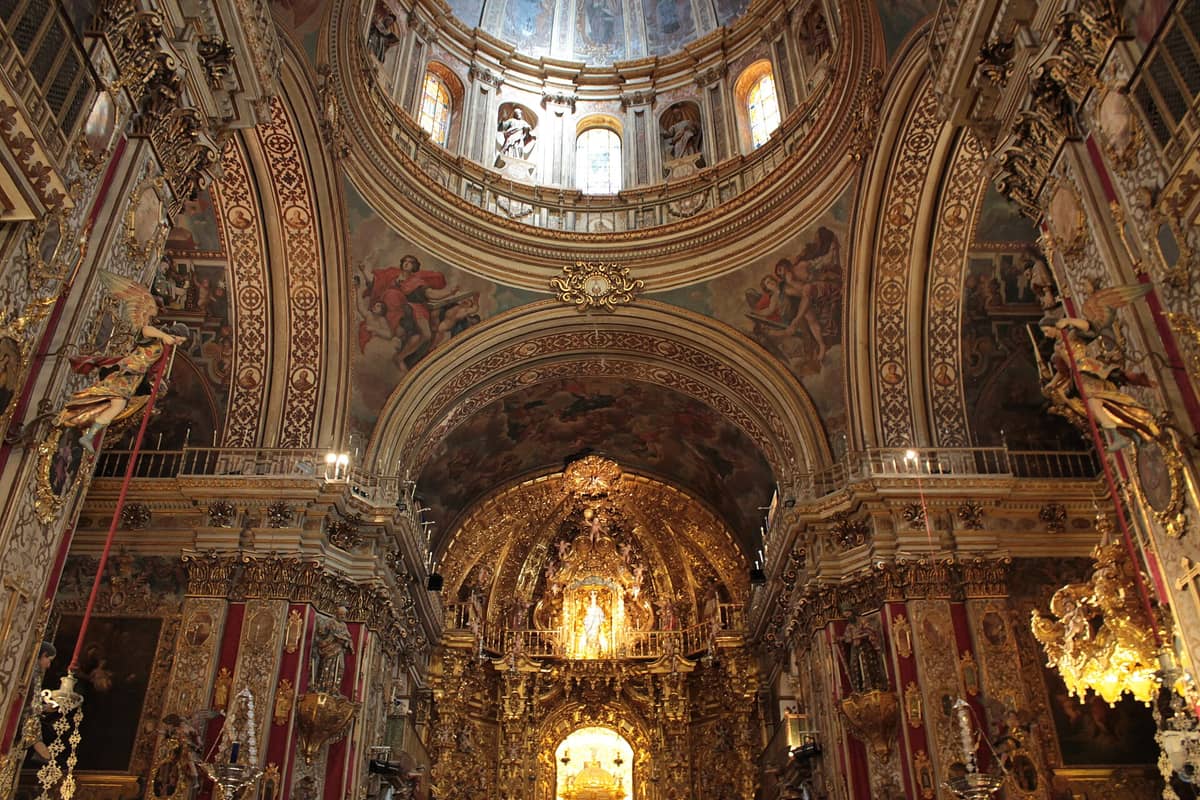
The entrance door is modest in scale. Once through it, your eyes need a few seconds to adjust, not just to the lower light but to the sheer density of what fills the space: gilded retablos rising toward the ceiling, polychrome saints in carved niches, a nave whose proportions feel both grand and intimate. The smell is the familiar blend of old stone, incense residue, and candle wax that clings to functioning churches. This is not a museum preserved behind barriers. Masses are celebrated here, and the building feels lived-in because it is.
💡 Local tip
Arrive between 10:00 and 11:30 on a weekday. Morning light enters from the upper windows at an angle that catches the gilded surfaces without the flat midday wash. Crowds at this hour are minimal.
History and Significance: The Saint Who Stayed in Granada
The Basílica de San Juan de Dios is the spiritual headquarters of the Order of Saint John of God, the Brothers Hospitallers, a religious order founded in Granada in the 16th century. Juan de Dios (John of God) was a Portuguese-born labourer and soldier who, after a conversion experience in Granada in 1539, dedicated his life to caring for the sick and destitute. He established a hospital in the city, begged in its streets for resources, and died here in 1550. He was canonised in 1690.
The current basilica was built during the 18th century, replacing an earlier structure. Its construction stretched over decades, and the interior decoration reflects the full exuberance of Andalusian late Baroque: nothing was left plain if it could be gilded, carved, or painted. The building serves simultaneously as a parish church, a pilgrimage destination, and the custodian of the saint's relics, which are housed in the Camarín de San Juan de Dios, an elevated shrine chamber behind the high altar.
Granada has no shortage of historic churches, but this one occupies a specific role in the city's religious identity that makes it distinct from the more widely visited Granada Cathedral or the Capilla Real. The saint's connection to the city is genuinely local: Juan de Dios lived, worked, and died within walking distance of this building. For visitors interested in Granada's Moorish heritage, this site offers a complementary Christian narrative that shaped the post-Reconquista city.
Tickets & tours
Live prices and dates from our booking partner. If you book, we may earn a commission at no extra cost to you.
Alhambra guided tour in Italian
From 49 €Instant confirmationFree cancellationAlhambra guided group tour with Nasrid Palaces and Generalife Palace
From 40 €Alhambra guided tour with Carlos V Palace, Generalife and Alcazaba
From 35 €Alhambra and Generalife skip-the-line private tour
From 65 €Instant confirmation
The Interior: What You Are Actually Looking At
The nave is single-aisled and flanked by side chapels, each containing its own retablo. The high altar is the dominant visual event: a gold retablo that fills the entire rear wall of the apse, packed with sculptural figures and framed by twisted Solomonic columns. The density of ornament is genuinely unusual even by Andalusian Baroque standards. Visitors who find this aesthetic excessive will find the basilica too much; visitors who respond to it will find the level of craft remarkable.
The Camarín de San Juan de Dios, the shrine room containing the saint's relics, is reached by a staircase behind the high altar. This chamber is smaller and more intimate than the nave, decorated with precious materials and votive offerings accumulated over centuries. Access to the Camarín is via stairs only, with no ramp or lift, so visitors with significant mobility limitations should be aware they may not be able to reach this part of the visit. The main nave is accessible via a portable ramp at the entrance.
Look up at the ceiling vaults as you move through the nave. The painted decoration and gilded framing of the vault ribs continues the same visual language as the retablos below. Side chapels dedicated to various saints are worth pausing at individually rather than rushing past. Some contain sculpture of genuinely high quality.
ℹ️ Good to know
Photography is permitted inside, but flash photography and tripods may be restricted during Mass or services. Check posted notices at the entrance. Exterior light is generally better in the morning; interior shots benefit from a camera capable of handling low light without flash.
Opening Hours, Tickets, and Getting There
The basilica is open Monday through Saturday from 09:30 to 18:50, and on Sundays from 09:00 to 11:50 and again from 13:30 to 18:50. The Sunday morning closure corresponds to Mass, so if you plan a Sunday visit, either arrive before 11:50 or return after 13:30. Seasonal adjustments are possible, so confirm current hours on the official website or with official ticketing partners before visiting.
Admission is €10 for general visitors, €9.50 for seniors aged 65 and over, and €9 for students between 12 and 25 with valid identification. Children under 12 enter free. Prices listed here were verified from official and tourism sources in 2024 and should be checked against the official site before your visit, as tariffs are updated periodically.
The basilica is on Calle San Juan de Dios 17–23, in the Centro-Sagrario district. From the Granada Cathedral and the nearby Alcaicería market area, it is a straightforward 10 to 15-minute walk: head northwest along Gran Vía de Colón and turn onto Calle San Juan de Dios. Several urban bus lines serve Gran Vía de Colón. If you are arriving from the Alhambra hill area, budget around 20 to 25 minutes on foot or take a city bus toward the centre.
How the Experience Changes by Time of Day
Morning visits, particularly on weekdays between 10:00 and noon, offer the best combination of good interior light and low visitor numbers. The church is genuinely quiet at these hours. You can stand in the nave without the visual interference of other tourists in your sightlines, and the building's acoustics, which amplify even quiet footsteps into resonant echoes, feel appropriate to the space.
By early afternoon, particularly after 14:00, tourist traffic increases as visitors who have spent the morning at the Alhambra work their way back through the city centre. The experience remains manageable but is noticeably busier. Late afternoon light, roughly from 16:00 to 17:30, creates a different atmospheric quality inside, warmer and lower, that can be appealing for photography but offers less visibility of the upper altar details.
Avoid arriving in the final 30 minutes before closing. Staff begin to manage visitors toward the exit, and the atmosphere becomes hurried rather than contemplative. If you want to spend time in the Camarín, factor in the staircase approach and at least 20 minutes in the shrine itself.
⚠️ What to skip
Sunday mornings between approximately 11:50 and 13:30 the basilica is closed to visitors due to religious services. The surrounding street can be crowded on Sunday mornings as worshippers arrive and depart. Plan accordingly.
Practical Details and Who Should Skip It
Dress modestly for this visit: covered shoulders and avoiding very short clothing is appropriate and may be required at the entrance. The interior temperature is relatively stable year-round due to the thick stone walls, running a few degrees cooler than the street in summer and warmer in winter. In July and August, when Granada's daytime temperatures regularly exceed 35°C, the interior offers genuine relief, making the mid-morning visit even more appealing during the hottest months.
Visitors who are primarily interested in Granada's Islamic heritage and the Nasrid palace tradition may find this basilica less immediately relevant than the Alhambra or the Albaicín neighbourhood. That said, the building is close to the city centre and adds less than 90 minutes to any itinerary, making it easy to combine with other stops in the historic core. Travellers who are already fatigued from a full day at the Alhambra complex may prefer to schedule this visit on a separate half-day.
Visitors who are indifferent to Baroque religious art, or who find heavily gilded interiors aesthetically overwhelming rather than impressive, may find the admission price hard to justify. The building's exterior and the surrounding street are accessible without a ticket and give a reasonable sense of the church's scale and architectural style. The interior, however, is the reason to come.
For broader context on what else the city's historic centre offers, see the complete guide to things to do in Granada, or for a tighter focus on heritage buildings, the Moorish heritage guide covers the wider architectural story of the city.
Insider Tips
- The basilica is significantly less crowded than the Cathedral or the Capilla Real. If you arrive without queuing on a weekday morning, you may have the nave almost to yourself, which is genuinely rare for a major Granada monument.
- The Camarín chamber behind the high altar is the emotional core of the visit for many pilgrims. Even non-religious visitors often find it striking, partly because the scale is intimate and the accumulated votive offerings give a sense of the saint's enduring significance to visitors across centuries.
- Bring a small pair of binoculars if you have them. The upper sections of the main retablo and the ceiling vaults contain details that are difficult to read from floor level with the naked eye, particularly in lower light conditions.
- The street outside, Calle San Juan de Dios, has several cafes and a small square atmosphere that makes for a natural rest stop before or after the visit. Prices are lower here than on Gran Vía de Colón one block away.
- If you are visiting during Semana Santa, the basilica and its surroundings take on added significance as part of Granada's procession routes. The experience of the building during Holy Week is quite different from a standard visit, though the interior may be partially closed for specific ceremonies.
Who Is Basílica de San Juan de Dios For?
- Architecture enthusiasts interested in the full range of Andalusian Baroque, beyond the better-known Cathedral
- Travellers on a multi-day Granada itinerary who want depth over breadth in the historic centre
- Visitors interested in religious heritage and the history of the Brothers Hospitallers
- Photographers looking for a dramatically lit interior with relatively few other visitors in the frame
- Anyone visiting in summer who wants a cool, unhurried mid-morning stop between hotter outdoor sites
Nearby Attractions
Other things to see while in Centro-Sagrario (City Centre):
- Alcaicería (Arab Bazaar)
The Alcaicería is Granada's reconstructed Arab silk market, a tight labyrinth of narrow lanes packed with craft and souvenir shops steps from the cathedral. Free to enter and open most days, it offers one of the most atmospheric walking experiences in the city centre, though visitors should know its history before they arrive.
- Capilla Real de Granada (Royal Chapel)
The Capilla Real de Granada is the funerary chapel commissioned by the Catholic Monarchs to house their remains in the city where they completed the Reconquista. Inside, behind an extraordinary wrought-iron screen, lie the tombs of Isabella I, Ferdinand II, Juana la Loca, and Felipe el Hermoso, alongside a small but remarkable collection of royal art and personal relics.
- Corral del Carbón
The Corral del Carbón is a 14th-century Nasrid alhóndiga — a combined grain warehouse and merchant inn — standing in Granada's historic centre. It is the last surviving Nasrid alhóndiga in the city, admission is free, and most visitors spend around 30 minutes exploring its layered courtyard architecture before continuing to the nearby Alcaicería or Cathedral.
- Cuarto Real de Santo Domingo
Built during the reign of Muhammad II in the late 13th century, the Cuarto Real de Santo Domingo is one of the oldest surviving Nasrid structures in Granada. Tucked behind Plaza de los Campos in the Realejo district, it receives a fraction of the crowds that descend on the Alhambra — yet its carved stucco and coffered ceilings belong to the same artistic tradition. Entry costs €2 (with €1 reduced tickets available), and admission is free on Sundays.
Planning a trip? Discover personalized activities with the Nomado app.