Granada Cathedral (Catedral de Granada): The Complete Visitor Guide
Granada Cathedral, officially the Santa Iglesia Catedral Metropolitana de la Encarnación de Granada, is one of the finest Renaissance buildings in Spain. Construction began in 1523 on the site of the city's former Great Mosque, and the result is a monument that rewards patience and context. This guide covers what to expect inside, when to go, and how to make the most of your visit.
Quick Facts
- Location
- Renaissance façade on Plaza de las Pasiegas; ticketed visitor entry at Gran Vía de Colón 5, Centro, 18001 Granada
- Getting There
- Walk from Plaza Nueva along Gran Vía de Colón; city buses (lines 8 and 11) stop nearby
- Time Needed
- 45–90 minutes for a thorough visit
- Cost
- From €7 (adults). Tuesday free entry is for residents of Granada province only. Wednesday afternoon free entry is commonly offered; confirm current hours on the cathedral site.
- Best for
- Architecture enthusiasts, history travelers, and anyone exploring Granada's historic centre
- Official website
- catedraldegranada.com
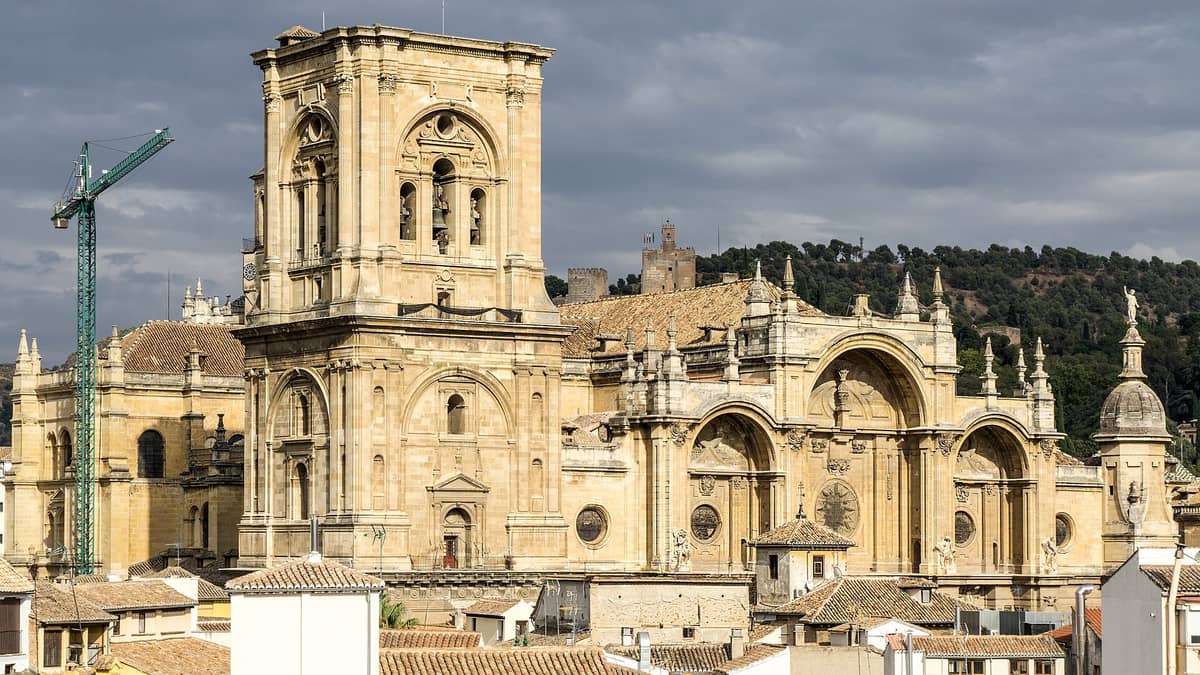
What Granada Cathedral Actually Is
The Catedral de Granada, formally the Santa Iglesia Catedral Metropolitana de la Encarnación de Granada, is the seat of the Archbishop of Granada and one of the largest churches in Spain. It occupies a central block of the historic city, bordered by Gran Vía de Colón to the north and the narrow lanes of the old town to the south and east. The Capilla Real (Royal Chapel) is physically attached to the cathedral's southern flank, though the two have separate entrances and tickets.
What makes this cathedral architecturally unusual is its style. Unlike the Gothic cathedrals that dominate most of Spain, Granada's was designed in the Spanish Renaissance manner, a deliberate choice that reflected the ambitions of the Catholic Monarchs and their successors to project a new, humanist Christian order over a city recently reconquered from the Nasrid sultanate. The scale is imposing without being oppressive: the main Renaissance façade faces Plaza de las Pasiegas and is one of the most photographed church frontages in Andalusia. Ticketed visitor entry is around the north side at Gran Vía de Colón 5.
ℹ️ Good to know
Opening hours (verify before visiting): Monday–Saturday 10:00–18:15, Sunday and public holidays 15:00–18:15. Closed 24–25 December and 31 December–1 January. Check catedraldegranada.com for the current schedule, as liturgical events sometimes affect tourist access.
History in Context: Why This Building Exists Where It Does
Construction of Granada Cathedral began in 1523, just over three decades after the Christian conquest of Granada in 1492. The site was not chosen at random. The Great Mosque of Granada, which had stood at the centre of the Nasrid city for centuries, was demolished to make way for the cathedral, a practice common across reconquered Andalusia. Walking the streets around the building today, you can still read the logic of the old Islamic city in the irregular lane pattern that surrounds this enormous rectangular block.
The original design was Gothic, but the project shifted toward Renaissance under the architect Diego de Siloé, who took over in 1528 and transformed both the floor plan and the ambition of the building. Siloé introduced a rotunda-style main chapel, an unusual feature in Spanish cathedral design, modelled loosely on ancient circular temples. Construction stretched across nearly two centuries, which explains why the building contains layers of architectural decision-making from different periods. The Baroque façade by Alonso Cano, completed in 1667, was added long after the interior was largely finished.
The cathedral should be understood alongside the adjacent Capilla Real, where Ferdinand and Isabella are buried. The two buildings share a wall and a history, but the Royal Chapel predates the cathedral and was constructed with more urgency, as the Catholic Monarchs needed a mausoleum quickly. The cathedral came later, grander in scale but slower to complete.
Tickets & tours
Live prices and dates from our booking partner. If you book, we may earn a commission at no extra cost to you.
Inside the Cathedral: What You Will Actually See
The interior is dominated by the nave, which rises to around 30 metres and floods with light from the clerestory windows above the main chapel. This brightness is the first thing most visitors notice. Where many old Spanish churches feel deliberately dim, Granada Cathedral is luminous, its stone columns painted in cream and gold tones that reflect the light rather than absorb it. The effect is less solemn than you might expect.
The circular Capilla Mayor (main chapel) at the east end is the architectural centrepiece. It is surrounded by tall windows filled with 16th-century stained glass depicting biblical scenes. The painted figures of the Catholic Monarchs kneel in gilded niches on either side of the altar, positioning them in perpetual devotion. The organ, which occupies a prominent position in the nave, is still used for concerts and occasional liturgical services.
Along the ambulatory and side chapels, you will find paintings, carved wooden choir stalls, and Baroque altarpieces of varying quality. A small museum section near the entrance displays vestments, silver processional items, and manuscripts. The audioguide, often included in the ticket price, is worth using: the building's layers of construction are not self-explanatory, and the commentary helps connect what you are seeing to the historical sequence.
💡 Local tip
Bring or wear an extra layer even in summer. The thick stone walls keep the interior noticeably cool, which is welcome in July and August when temperatures outside regularly exceed 35°C, but can feel cold on winter mornings.
How the Experience Changes by Time of Day
Opening time (10:00 on weekdays) is the least crowded window for visits. The main nave is often empty enough in the first hour that you can stand in the centre of the Capilla Mayor and hear nothing but footsteps on stone. The light at this hour comes in low through the eastern windows, casting coloured patterns on the floor that disappear as the sun climbs.
By midday, tour groups arrive in waves, particularly in spring and autumn. The ambulatory around the main chapel becomes congested, and the acoustic qualities of the space amplify the noise considerably. If your priority is atmosphere over time efficiency, a second visit in the early afternoon on a weekday will often feel calmer than a Saturday morning.
Sunday access is from 15:00 onward. This means Sunday visitors have less time before closing and encounter a cathedral that has been in active liturgical use throughout the day, which some find adds to the atmosphere and others find limiting. The streets around the cathedral on Sunday mornings fill with locals, which makes for good city observation even if you cannot enter until the afternoon.
Getting There and Practical Logistics
The cathedral is at the geographical centre of Granada's historic city. From Plaza Nueva, the main square used as a navigation hub by most visitors, it is a five-minute walk north along Gran Vía de Colón. The route is flat and straightforward. City buses (lines 8 and 11) stop on Gran Vía de Colón within a short walk of the ticketed visitor entrance at number 5, which is useful if you are coming from further out in the city. For a full orientation to getting around Granada by bus and on foot, the city's compact historic core means that most central attractions are walkable from each other.
Tourist ticketed entry is at Gran Vía de Colón 5, on the north side of the cathedral. The Renaissance façade — the photographed landmark frontage — faces Plaza de las Pasiegas on the opposite side. First-time visitors sometimes queue at the plaza looking for a ticket door that is not there. Signs for the Gran Vía entrance are present but easy to miss.
Tickets are purchased at the Gran Vía de Colón 5 entrance. As of recent information, adult admission is approximately 7 euros. Tuesday free entry is for residents of Granada province, not general tourists. Wednesday afternoon free entry is commonly offered; confirm current hours on the cathedral site. Prices change periodically, so confirm the current rate at catedraldegranada.com before your visit.
⚠️ What to skip
Dress code: shoulders and knees must be covered to enter. This is enforced consistently. Light scarves or a layer in your bag solve the problem on warm days. The cathedral is an active place of worship, not only a tourist attraction.
Photography Inside
Photography for personal use is generally permitted in the public areas of the cathedral, though this should be confirmed at the entrance as policies can change. The Capilla Mayor, with its stained glass and the gilded niches of the Catholic Monarchs, is the most rewarding subject. A wide-angle lens is useful given the scale of the interior. Flash is often restricted and is also unnecessary, as the interior is well-lit naturally during daylight hours.
The Renaissance façade on Plaza de las Pasiegas is best photographed in the morning when the light falls directly on it. By midday the square is busy enough that getting a clean shot without pedestrians requires patience. The view of the cathedral from the corner of Calle Oficios, looking toward the plaza, gives a sense of the building's mass relative to the surrounding streets.
Is It Worth Your Time?
Compared to the Alhambra, Granada Cathedral will not overwhelm you. It is not the most spectacular cathedral in Spain, and travelers who have already seen Seville or Córdoba may find it somewhat familiar in format. Its value lies in context: the building makes most sense when you understand what it replaced, why it was designed the way it was, and how it relates to the Royal Chapel next door. Visitors who read a little about the history in advance consistently report a richer experience than those who walk in cold. If you are already doing the Moorish heritage circuit in Granada, the cathedral is an essential counterpoint, representing the Christian response to the Nasrid city that preceded it.
Those with very limited time in Granada and a single day to see the city should note that the Alhambra will consume most of that day, and the Royal Chapel next door tells the dynastic story of Ferdinand and Isabella more intimately than the cathedral does. If you need to prioritise, the Royal Chapel is the more focused experience. The cathedral rewards the extra hour if you have it.
For travelers staying multiple days, the cathedral fits naturally into a morning walk through the centro-sagrario neighborhood, combined with a stop at the nearby Alcaicería silk market and the Corral del Carbón, Granada's 14th-century Nasrid caravanserai. All three are within five minutes' walk of each other.
Insider Tips
- Tuesday free entry is for residents of Granada province, not general tourists. Wednesday afternoon free entry is commonly offered; confirm current hours on the cathedral site.
- The Renaissance façade faces Plaza de las Pasiegas, the photographed landmark square. Tourist ticketed entry is at Gran Vía de Colón 5 — do not invert the two.
- The interior temperature is noticeably lower than outside. A light layer in your bag is useful even in July.
- If you are combining the cathedral with the Royal Chapel, buy the tickets separately at each entrance. The Royal Chapel has its own separate hours and entrance and is worth at least 30 additional minutes.
- Wednesday and Thursday mornings between 10:00 and 11:30 tend to be the quietest windows for a visit, avoiding the weekend crowds and the midday tour group rush.
Who Is Granada Cathedral (Catedral de Granada) For?
- Architecture and history travelers who want to understand Granada's Christian heritage alongside its Islamic past
- Visitors with more than one day in Granada who have time beyond the Alhambra
- Travelers interested in Spanish Renaissance architecture as distinct from Gothic or Baroque
- Anyone visiting the Royal Chapel who wants to understand the broader monumental complex it belongs to
- Budget-conscious visitors who can plan around Wednesday afternoon free entry (confirm current hours on the cathedral site)
Nearby Attractions
Other things to see while in Centro-Sagrario (City Centre):
- Alcaicería (Arab Bazaar)
The Alcaicería is Granada's reconstructed Arab silk market, a tight labyrinth of narrow lanes packed with craft and souvenir shops steps from the cathedral. Free to enter and open most days, it offers one of the most atmospheric walking experiences in the city centre, though visitors should know its history before they arrive.
- Basílica de San Juan de Dios
The Basílica de San Juan de Dios is Granada's most extravagantly decorated Baroque church, a 18th-century pilgrimage site housing the relics of the saint who founded the Brothers Hospitallers. Most visitors walk past its understated facade without a second glance — which makes the gold-drenched interior all the more astonishing when you step inside.
- Capilla Real de Granada (Royal Chapel)
The Capilla Real de Granada is the funerary chapel commissioned by the Catholic Monarchs to house their remains in the city where they completed the Reconquista. Inside, behind an extraordinary wrought-iron screen, lie the tombs of Isabella I, Ferdinand II, Juana la Loca, and Felipe el Hermoso, alongside a small but remarkable collection of royal art and personal relics.
- Corral del Carbón
The Corral del Carbón is a 14th-century Nasrid alhóndiga — a combined grain warehouse and merchant inn — standing in Granada's historic centre. It is the last surviving Nasrid alhóndiga in the city, admission is free, and most visitors spend around 30 minutes exploring its layered courtyard architecture before continuing to the nearby Alcaicería or Cathedral.
Planning a trip? Discover personalized activities with the Nomado app.