Alcaicería Granada: Inside the City's Historic Arab Bazaar
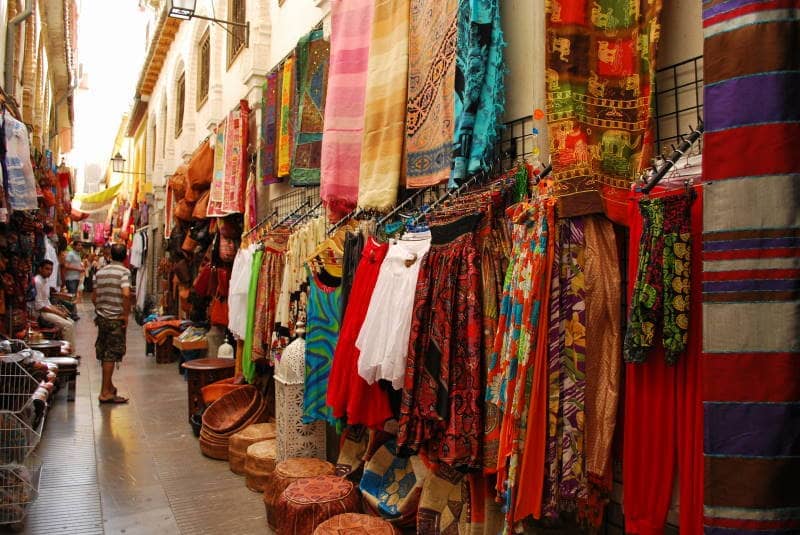
The Alcaicería is Granada's reconstructed Arab silk market, a tight labyrinth of narrow lanes packed with craft and souvenir shops steps from the cathedral. Free to enter and open most days, it offers one of the most atmospheric walking experiences in the city centre, though visitors should know its history before they arrive.
Quick Facts
- Location
- Calle Alcaicería, Centro, 18001 Granada
- Getting There
- A short walk from the cathedral area; most visitors arrive on foot from Plaza de las Pasiegas or Calle Reyes Católicos
- Time Needed
- 30–60 minutes to walk through; longer if you browse shops
- Cost
- Free to enter; shop prices vary
- Best for
- Souvenir shopping, architectural curiosity, Moorish heritage context
- Official website
- http://www.alcaiceria.com
What the Alcaicería Actually Is
The Alcaicería is Granada's historic Arab silk market, a compact network of narrow pedestrian lanes running beside and behind the cathedral. In its original form, the market functioned as a tightly controlled silk souk under the Nasrid sultans, where merchants could trade in silk and other luxury goods. A fire in the nineteenth century destroyed most of the original structure, and the market was rebuilt in a neo-Moorish style that borrows from Nasrid decorative vocabulary: horseshoe arches, geometric tilework, carved stucco ornament, and lantern-lit passages.
This is an important distinction for any visitor who arrives expecting medieval authenticity. The bones of the street layout are old; the architecture as it stands today is a romantic nineteenth-century reconstruction. That does not make it uninteresting, but it does change what you are looking at. Treat it as a working market that happens to be dressed in Moorish costume, and you will enjoy it on its own terms.
ℹ️ Good to know
Entry is completely free. There are no gates, no tickets, and no timed entry. The lanes are public streets, open to anyone.
The Alcaicería sits in the Centro–Sagrario neighborhood, directly adjacent to Granada Cathedral and just a short walk from the Corral del Carbón, one of the few surviving Nasrid commercial inns in the city. This central position makes it an easy addition to any walking itinerary through the historic core.
The Experience: Walking the Lanes
The lanes are narrow enough that two people with bags can barely pass each other comfortably. In the morning, before around 11:00, the market has a quieter rhythm. Shopkeepers are arranging displays, rolling out leather goods, and hanging strings of ceramic pomegranates in doorways. The light is cool and slanted, filtering through the arched entrances. It is the best time to appreciate the architecture without bodies in the way.
By midday the lanes fill up. The smell of leather competes with incense sticks, cedar wood boxes, and the occasional cloud of spray from a nearby ceramics display being dampened. Vendors call out in several languages. The tile-and-plaster walls press close. If you have any tendency toward sensory overload, a brief visit is enough; the market is compact and you can cover all its lanes in under twenty minutes at a comfortable pace.
In summer, the narrow passages provide some shade, though temperatures in Granada regularly exceed 35°C in July and August. The stone paving absorbs heat and the lanes become uncomfortable by early afternoon. In winter, the same narrowness traps cold air and the ceramic wares feel cold to the touch. Spring and autumn are when the Alcaicería is most pleasant: mild air, moderate crowds, and enough light to see the detail in the carved archways.
💡 Local tip
Arrive before 11:00 or after 18:00 on weekdays for noticeably thinner crowds and better photographs without strangers filling the frame.
Tickets & tours
Live prices and dates from our booking partner. If you book, we may earn a commission at no extra cost to you.
Alhambra guided tour in Italian
From 49 €Instant confirmationFree cancellationAlhambra guided group tour with Nasrid Palaces and Generalife Palace
From 40 €Alhambra guided tour with Carlos V Palace, Generalife and Alcazaba
From 35 €Alhambra and Generalife skip-the-line private tour
From 65 €Instant confirmation
What You Will Find in the Shops
The product range has shifted considerably from silk. Most shops today sell tourist goods: ceramic plates and tiles with Moorish geometric patterns, leather bags and pouches, silver jewellery, inlaid wooden boxes (marquetry work from the Granada tradition), embroidered textiles, Alhambra-themed prints, and the ubiquitous ceramic pomegranate in every size and colour. The pomegranate, symbol of Granada itself, appears often in the market.
Quality varies significantly from shop to shop. Factory-produced ceramics from outside the region are common, but some vendors sell genuinely hand-painted pieces from workshops in the province. The marquetry boxes are a craft with real historical roots in Granada: inlaid woodwork using contrasting veneers of olive, orange, and ebony was practiced here for centuries. If you are looking for something more considered than a mass-produced fridge magnet, ask the shopkeeper directly whether the piece is made locally; the answer, and the way it is delivered, will tell you what you need to know.
Prices are not fixed. Bargaining is not standard in Spanish markets the way it might be in a Moroccan medina, but polite negotiation, especially on higher-value items like leather goods or larger ceramic pieces, is generally accepted. Paying in cash gives you slightly more leverage.
If the craft market format appeals and you want a broader selection of local produce, Corral del CarbónIf the craft market format appeals and you want a broader selection of local produce, Plaza Bib-Rambla is less than a minute's walk away and often hosts artisan markets on weekends.
Historical and Cultural Context
Under Nasrid rule, the alcaicería was a regulated commercial district with locked gates that closed at night. It specialized in silk, the most valuable commodity of medieval Granada, which controlled significant silk-weaving production across the surrounding Vega and the Alpujarras mountain villages. The market was effectively a sealed trading zone: outsiders could enter to buy but not to lodge or store goods overnight without permission. Taxes collected from the alcaicería represented a substantial portion of the Nasrid treasury's commercial income.
After the Christian Reconquest in 1492, the market continued operating under Spanish royal authority. The fire in the nineteenth century was a significant loss, not just economically but architecturally: the original medieval structures have largely vanished. The rebuilding used neo-Moorish decorative elements that were fashionable at the time and resonant with romantic ideas about Andalusia's Islamic past. The result is a Victorian-era interpretation of a Nasrid market, not the market itself.
For richer historical grounding in Granada's Moorish heritage, the Granada Moorish heritage guide covers the major sites and their connections in depth.
Practical Information
Getting There
The Alcaicería is centrally located and reachable on foot from virtually any point in the historic centre. From the cathedral square (Plaza de las Pasiegas), the market entrance is a very short walk away. From Calle Reyes Católicos, the main commercial artery through the centre, you turn toward the cathedral and the entrance is immediately visible.
Opening Hours
Individual shops set their own schedules, so there is no single guaranteed opening time. The general pattern: most shops open around 10:00 and close between 20:30 and 21:00, Monday through Saturday. On Sundays, many shops close or operate shorter hours (roughly 10:00 to 14:30–15:00). In August and September, some shops extend to 21:00. Verify with individual shopkeepers during holiday periods.
⚠️ What to skip
Hours are shop-by-shop and not centrally enforced. Sunday visits outside peak season may find many shutters down. If you want full market activity, visit on a weekday morning.
Accessibility
The lanes are paved with uneven stone and include occasional shallow steps at lane intersections. No dedicated accessibility infrastructure exists. Wheelchair users may find passage difficult both because of the surface and because of crowd density at busy times. The best window for anyone with limited mobility is a weekday morning in shoulder season, when the lanes are least congested.
Photography Tips
The Alcaicería is photogenic in the right conditions and frustrating in the wrong ones. The morning light, arriving early from the east, catches the carved archways and throws geometric shadows across the lane floors. A wide-angle lens works better than a telephoto in these tight spaces. At midday, the high contrast between shaded lanes and bright sky creates harsh lighting that flattens the decorative detail.
If you want shop displays without the distraction of strangers mid-transaction, early morning on a weekday is the window. The lanterns in the arches are electric and rarely photogenic during daylight; at dusk, when they are lit against a darkening sky, the entrances look considerably more atmospheric. Shopkeepers are generally comfortable with photography of their storefronts but may object to close-up shots of display items without purchase intent.
Is It Worth Your Time?
The Alcaicería is not one of Granada's essential experiences in the way that the Alhambra or the Albaicín neighbourhood are. It is a souvenir market in a historically interesting shell, and visitors who arrive expecting a genuine medieval Arab bazaar will find the reality more modest. The reconstruction is handsome without being remarkable, and the commercial atmosphere does not encourage slow contemplation.
What it does offer is a genuinely atmospheric five-minute walk, a concentrated selection of Granada's craft output, and a sense of the street layout that once defined this part of the city. For anyone staying in the centre, the Alcaicería will cross your path naturally. Passing through is worth it. Building your afternoon around it probably is not.
Travelers who want to do justice to their time in Granada should read the complete Granada attractions guide to prioritize correctly.
Who should skip it: visitors on very tight schedules who have not yet seen the Alhambra, the Albaicín, or the cathedral; anyone with no interest in craft shopping; and travelers sensitive to narrow, crowded spaces during peak hours.
Insider Tips
- The lane near the cathedral's south side, rather than the main arched entrance, sees a fraction of the foot traffic and gives you a clearer look at the architectural details without navigating around tour groups.
- Marquetry wooden boxes are one of the few craft items with genuine historical roots in Granada. Look for pieces where the inlaid pattern continues consistently around corners and edges — a sign of more careful workmanship rather than mass production.
- If you are buying ceramics, compare the same design across two or three shops before committing. Prices for identical pieces can vary significantly within the same row of stalls.
- The lanes connect at several points to the street behind the cathedral. Knowing this exit means you can cut through rather than doubling back, which is useful when the main entrance is jammed with a tour group.
- Early January through mid-March sees the fewest tourists in Granada overall, and the Alcaicería on weekday mornings at that time of year is almost empty. You can examine the carved plasterwork and tilework without distraction.
Who Is Alcaicería (Arab Bazaar) For?
- Souvenir and craft shoppers looking for Granada-specific gifts
- Travelers interested in the city's Moorish commercial history
- Visitors combining it with the cathedral or Corral del Carbón in a single city-centre loop
- Photography enthusiasts working the early-morning or dusk light
- First-time visitors to Granada who want a quick atmospheric walk in the historic core
Nearby Attractions
Other things to see while in Centro-Sagrario (City Centre):
- Basílica de San Juan de Dios
The Basílica de San Juan de Dios is Granada's most extravagantly decorated Baroque church, a 18th-century pilgrimage site housing the relics of the saint who founded the Brothers Hospitallers. Most visitors walk past its understated facade without a second glance — which makes the gold-drenched interior all the more astonishing when you step inside.
- Capilla Real de Granada (Royal Chapel)
The Capilla Real de Granada is the funerary chapel commissioned by the Catholic Monarchs to house their remains in the city where they completed the Reconquista. Inside, behind an extraordinary wrought-iron screen, lie the tombs of Isabella I, Ferdinand II, Juana la Loca, and Felipe el Hermoso, alongside a small but remarkable collection of royal art and personal relics.
- Corral del Carbón
The Corral del Carbón is a 14th-century Nasrid alhóndiga — a combined grain warehouse and merchant inn — standing in Granada's historic centre. It is the last surviving Nasrid alhóndiga in the city, admission is free, and most visitors spend around 30 minutes exploring its layered courtyard architecture before continuing to the nearby Alcaicería or Cathedral.
- Cuarto Real de Santo Domingo
Built during the reign of Muhammad II in the late 13th century, the Cuarto Real de Santo Domingo is one of the oldest surviving Nasrid structures in Granada. Tucked behind Plaza de los Campos in the Realejo district, it receives a fraction of the crowds that descend on the Alhambra — yet its carved stucco and coffered ceilings belong to the same artistic tradition. Entry costs €2 (with €1 reduced tickets available), and admission is free on Sundays.
Planning a trip? Discover personalized activities with the Nomado app.