Granada's Free Tapas Culture: The Complete Guide
Granada is one of the few places left in Spain where ordering a drink automatically earns you a free plate of food. This guide explains the rules, the best neighborhoods, drink prices, timing, and the common myths that catch tourists off guard.
Tickets & tours
Live prices and dates from our booking partner. If you book, we may earn a commission at no extra cost to you.
TL;DR
- In Granada, a free tapa comes with every drink — beer, wine, vermouth, soft drinks, even water at many bars. No asking required.
- The bar chooses the tapa, not you. More rounds sometimes unlock limited choice, but don't count on it.
- A caña or glass of house wine with tapa typically costs €2–€3.50. Some student bars pitch around €3–€4 all-in.
- The best tapas neighborhoods are Realejo, Calle Elvira, Plaza Nueva, and the student zone around Gran Vía. See our guide to where to eat in Granada for full restaurant coverage.
- Peak hours are 13:00–16:00 and 20:00 until late. Go early in the evening to avoid crowds at the most popular spots.
Why Granada Still Has Free Tapas
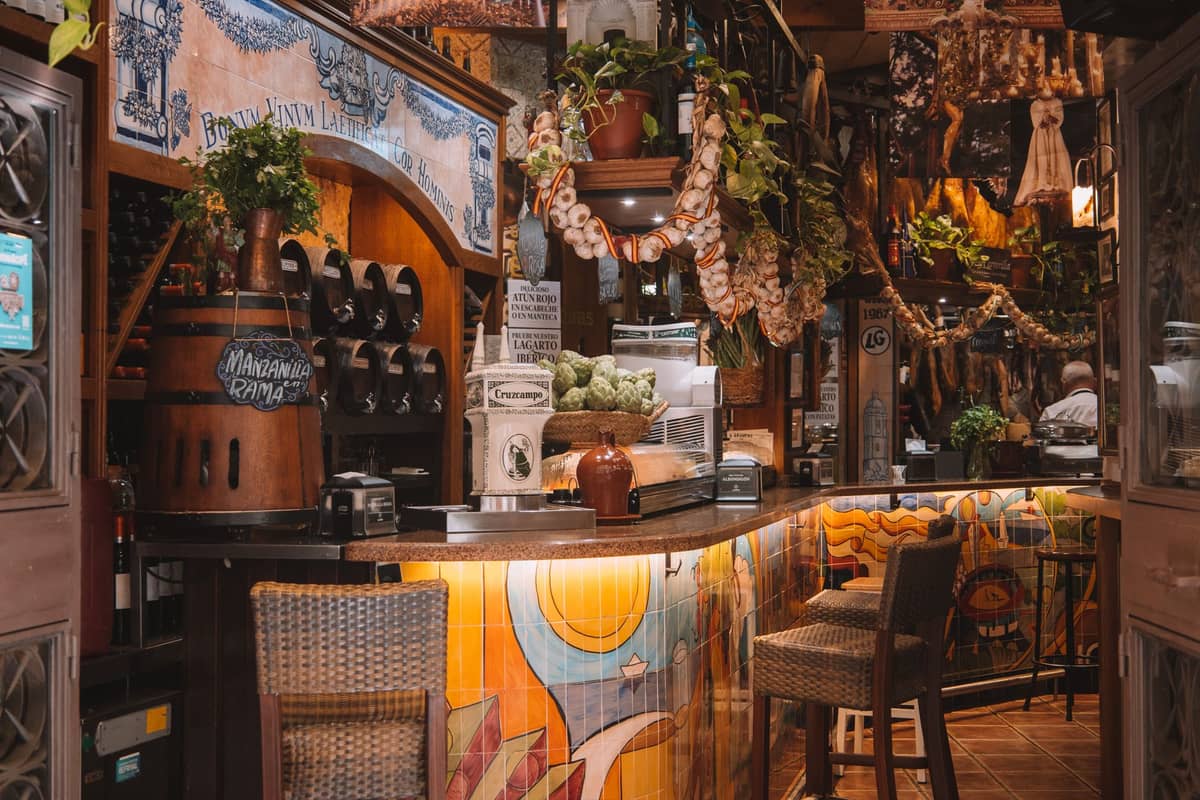
Granada is genuinely unusual in the context of modern Spain. In Madrid, Barcelona, and most of coastal Andalusia, tapas are a paid affair — small dishes you order separately, priced at €3–€6 each. In Granada, the tradition that once existed across much of the country has survived intact: every drink in traditional tapas bars comes with a free bite of food, automatically, without negotiation. This is not a marketing gimmick limited to a few tourist bars. It is a living local custom practiced across hundreds of traditional establishments in the city.
The origin is debated. One popular story credits a Castilian king who ordered drinks to be served with a small cover (tapa means 'lid' in Spanish) to prevent flies from entering the glass. A more practical explanation is that Andalusian bar culture historically treated food and drink as inseparable: you drank, you ate something. What makes Granada distinct is that this inseparability never broke down under commercial pressure. The University of Granada, which gives the city a large permanent student population, has also helped sustain it — affordable drinks with included food remain central to student social life.
ℹ️ Good to know
Granada's free tapa system is confirmed by the city's official tourism office: 'In most places, a free tapa is served with each drink.' The key tapas zones highlighted officially include Plaza del Campillo, Mariana Pineda, San Matías, and the Realejo–Campo del Príncipe–Alhambra area.
How the System Actually Works
The mechanics are simple but worth understanding before you walk into your first bar. You order a drink — a caña (small draft beer, roughly 200ml), a glass of house wine, a tinto de verano (red wine with lemon soda), a vermouth, or even a soft drink or orange juice at many places. The bartender brings your drink and, shortly after or simultaneously, brings a small plate of food. You did not order this plate. You do not pay extra for it. That is the tapa.
For the first round, the bar always chooses what you get. There is no menu for the free tapa, and asking to swap it out is generally not how it works. You might get a slice of tortilla española, a small portion of fried fish, a bit of stewed meat, a few slices of jamón with bread, or a modest plate of salmorejo. At some bars, particularly once you are on your second or third round, staff may offer a small degree of choice — but treat that as a bonus, not a right. The practical approach is to order what you want to drink, be curious about what arrives, and treat each round as a mini-lottery of Andalusian cooking.
- What triggers a free tapa Any drink order at a traditional Granada bar — beer, wine, vermouth, soft drink, or in many places even water and coffee.
- Who chooses the tapa The bar, always for the first round. Limited choice sometimes appears from the second round onward, never guaranteed.
- Do you need to ask No. If the tapa does not appear within a few minutes of your drink, a polite 'nos trae la tapa?' ('could you bring us the tapa?') is enough.
- Group dynamics Each person who orders a drink gets a tapa, so a table of four ordering four drinks will receive four tapas — sometimes four of the same dish, sometimes a variety.
- Non-alcoholic drinks Many bars include tapas with soft drinks, orange juice, and even sparkling water. A few tourist-facing bars on the most central streets are less consistent about this.
⚠️ What to skip
Not every bar in Granada participates. Places directly on the main tourist drag around the Alhambra ticket offices, or restaurants billing themselves as 'international cuisine,' may charge for food separately. Step one block off the main route and you will almost always find the real system operating normally.
What to Expect to Pay
Drink prices at traditional tapas bars in Granada are consistently lower than in most comparable Spanish cities, partly because the pricing model bundles food and drink together. As of 2025, a caña or glass of house wine at a typical neighborhood bar runs roughly €2–€3, with the tapa included at no additional cost. Student-oriented bars, particularly in the university areas and along streets like Calle Elvira, often price drinks at €3–€4 all-in. Some of the older, no-frills local bars still hold at around €2–€2.50 per drink.
This makes tapas-hopping in Granada one of the most cost-effective ways to eat well in any Spanish city. A group of two people can cover lunch or an early dinner — four rounds of drinks, four tapas each — for around €20–€28 total, with no tipping obligation (service is not customary to tip in Spain, though rounding up small amounts is common). For a full picture of eating on a budget here, see our Granada on a budget guide.
✨ Pro tip
If you want more food than the free tapas provide, you can order raciones (larger shared plates) or medias raciones (half-portions) on top of your drinks. These are paid dishes and are where you can typically choose what you get. A media ración usually costs €6–€12 depending on the dish.
The Best Neighborhoods for Tapas in Granada
Granada's tapas scene is geographically spread out, and different neighborhoods have distinct characters. The Realejo district, the former Jewish quarter south of the cathedral, is considered one of the best areas for serious tapas bars. Streets like Calle Santiago and Calle Molinos hold a mix of long-standing local bars and newer places that have kept the free tapa tradition while upgrading the quality of what they serve.
Calle Elvira and the streets around Plaza Nueva are the classic starting point for most visitors — genuinely good tapas bars operate here, though the most obvious spots on the main pedestrian stretch can get extremely crowded on weekend evenings. The Albaicín has fewer dedicated tapas bars but compensates with terraces and views — expect the tapa tradition to be slightly less consistent here than in the lower city. The area around Plaza del Campillo and Mariana Pineda, officially flagged by Granada's tourism office, is a reliable middle ground: central enough to walk to, local enough that prices stay reasonable.
- Realejo Best overall quality-to-price ratio. Less tourist traffic than Plaza Nueva, stronger local crowd, consistent free tapas at nearly every bar.
- Calle Elvira and Plaza Nueva Classic route, high density of bars. Go on a weekday evening or before 21:00 on weekends to avoid the worst of the crowd.
- Plaza del Campillo and Mariana Pineda Officially recognized tapas zone. Mix of traditional and slightly more modern bars. Good for families as the square has space.
- Around Gran Vía and university area Student-dominated, lowest prices, highest volume. Tapas tend to be simpler but portions are sometimes larger. Best midweek.
- Sacromonte and upper Albaicín Not the primary tapas route — treat it as an add-on to an evening in the lower city.
Timing: When to Go and What to Expect
Granada follows Spanish eating hours, which run later than most northern European or North American visitors expect. The lunchtime tapas window is roughly 13:00 to 16:00 — this is when bars fill with locals taking a drink before or instead of a sit-down meal. The evening session starts slowly around 20:00 and builds through 21:30 and 22:00, which is when the scene is most animated. Many bars stay open until midnight or later on weekends.
Seasonality matters. During the university term (October through May), the student areas are reliably busy any day of the week. In peak tourist season (Easter week and summer), the central streets become genuinely packed on weekend evenings, and standing room at the bar is the norm rather than the exception. September and October see a pleasant combination of warm weather, returned student population, and slightly fewer international tourists — arguably the best conditions for tapas-hopping without fighting for space.
Winter is underrated for tapas. Granada sits at 738 meters elevation and gets genuinely cold between December and February — daytime highs typically reach around 12–14°C in January. But this drives locals indoors to exactly the kind of warm, low-ceilinged tapas bars where the culture feels most authentic. For more on visiting outside peak season, see our guide to Granada in December.
Common Myths and Misunderstandings
A few misconceptions circulate about Granada's tapas culture, and believing them can lead to frustration or awkward bar interactions. The most persistent is the idea that you get to choose your free tapa. You do not. The bar determines what you receive, at least for the first round. Some bars post a blackboard with two or three options and let you pick after the first drink, but this varies enormously by venue. Arriving expecting a menu of free options will set you up for disappointment.
A second misconception is that only beer or wine triggers a tapa. In practice, most traditional Granada bars extend the custom to soft drinks, juices, sparkling water, and sometimes even coffee. A third myth is that the free tapa is a 'starter' and that a proper meal must follow. A tapa is specifically a small dish intended to accompany a drink — it is not a portion of a meal. If you want to eat more substantially, the local approach is to bar-hop: one or two drinks at each place, rotating through three or four bars over the course of two hours, so that the accumulated tapas form something close to a full meal.
Finally, some visitors assume the free tapa system is dying out. It is not — at least not in Granada's traditional bars. The custom has contracted across most of Spain, but Granada has maintained it as both a cultural identity marker and a practical draw. That said, the system does not apply in restaurants, in tourist-oriented 'tapas restaurants' with English menus posted outside, or in most rooftop bars. Stick to traditional bares de tapas and you will find it operating exactly as described. For everything else worth doing in the city, our guide to things to do in Granada covers the full picture.
Practical Tips Before You Go
A few logistical notes that make the difference between a good tapas session and a frustrating one. First, cash is still widely accepted and sometimes preferred at older bars — bring some euros. Second, standing at the bar (en la barra) is completely normal and often the faster way to get served. Third, if you are visiting Granada primarily for the Alhambra, plan tapas for the evening after your visit — the tapas scene does not get going until well after noon, and serious bar-hopping works best from around 20:30 onward.
Language is rarely a barrier. Most bartenders in traditional bars understand a basic order in English, but knowing a few Spanish phrases helps: 'una caña, por favor' for a small beer, 'un vino tinto/blanco' for red/white wine, and 'nos trae la tapa?' if yours seems to have been forgotten. For broader context on navigating the city, the getting around Granada guide covers transport between neighborhoods. And if you are building a full itinerary, the 2 days in Granada itinerary integrates tapas into a logical sightseeing route.
💡 Local tip
Pace yourself. The tapas-hopping rhythm that works best is two drinks maximum per bar, then move on. This lets you sample more food variety, avoid getting too full at one place, and experience the social shift in atmosphere between different neighborhoods as the evening progresses.
FAQ
Do you really get a free tapa with every drink in Granada?
Yes, in traditional tapas bars across the city. The custom applies to beer, wine, vermouth, and most soft drinks. The bar chooses what you receive — you do not select it. Restaurants and tourist-facing venues may not follow this system.
How much does a drink with tapa cost in Granada?
Most traditional bars price drinks at €2–€3.50 with the tapa included. Student-area bars sometimes charge slightly more, around €3–€4, but the portions can be larger. Prices as of 2026 — verify locally as costs can shift.
Can you choose what tapa you get?
Generally no, especially for the first round. The bar decides. Some bars offer limited choice from the second round onward, and a few post options on a chalkboard, but this is the exception rather than the rule.
Which area of Granada has the best tapas bars?
Realejo is consistently rated the best neighborhood for quality and authenticity, with less tourist pressure than the immediate center. Calle Elvira and the streets around Plaza Nueva are also good, particularly on weeknights. The official tourism office highlights Plaza del Campillo and the Mariana Pineda area as key zones.
What time do tapas bars open in Granada?
The lunchtime session runs roughly 13:00–16:00. Evening service typically begins around 20:00 and continues until midnight or later on weekends. The peak hours for atmosphere and variety are between 21:00 and 23:00.
Tickets & tours
Live prices and dates from our booking partner. If you book, we may earn a commission at no extra cost to you.
Planning a trip? Discover personalized activities with the Nomado app.