Palacio de Carlos V: Granada's Renaissance Palace Inside the Alhambra
The Palacio de Carlos V is a bold Renaissance palace built inside the Alhambra complex in Granada, Andalusia. Its circular courtyard is one of the most architecturally unusual spaces in Spain, and entry to the courtyard and the ground-floor museum is free for all visitors. Most visitors walk past it quickly, which is a mistake.
Quick Facts
- Location
- Calle Real de la Alhambra, s/n, 18009 Granada, Spain (inside the Alhambra complex)
- Getting There
- Bus C30 or C32 from Plaza Nueva to Alhambra; or 20-minute uphill walk from the Albaicín
- Time Needed
- 30–60 minutes for the palace alone; 1–2 hours if visiting both museums
- Cost
- Courtyard and Museum of the Alhambra: free. Museum of Fine Arts: check current rates before visiting
- Best for
- Architecture enthusiasts, museum visitors, travellers wanting Alhambra depth beyond the Nasrid Palaces
- Official website
- www.alhambra-patronato.es
What the Palacio de Carlos V Actually Is
The Palacio de Carlos V is a 16th-century Renaissance palace sitting inside one of the world's most celebrated Islamic complexes. Emperor Charles V commissioned it after the Reconquista, intending it as a royal residence worthy of his status. Construction began in 1527 under architect Pedro Machuca, who is said to have trained in Italy under Michelangelo's influence. The building was never completed in Charles V's lifetime, and the monarch never actually lived in it. Work dragged on for over a century, halted repeatedly by funding shortfalls and changing priorities. The palace was finally roofed only in the 20th century.
The result is a peculiar object: a square, two-storey Renaissance palace, roughly 63 metres on each side, rising unexpectedly between the Nasrid Palaces and the Alcazaba. From the outside, the ochre stone facade is dignified and severe, with carved medallions and pilasters arranged in classical order. Nothing about it prepares you for the interior.
ℹ️ Good to know
Access to the circular courtyard and the Museum of the Alhambra (ground floor) is free for all visitors. A separate ticket may be required for the Museum of Fine Arts on the upper floor. Confirm current pricing at the entrance or via the Patronato de la Alhambra before your visit.
The Circular Courtyard: The Architectural Shock
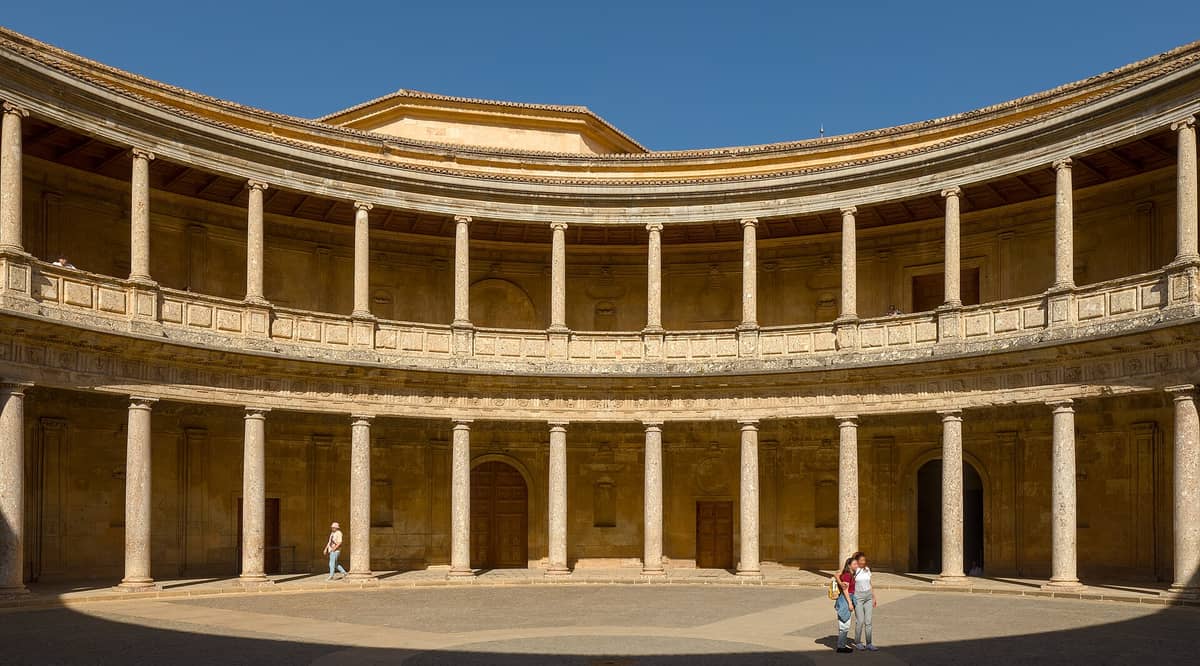
Step through any of the four doorways and the square exterior dissolves into something entirely different: a perfect circular courtyard, roughly 30 metres in diameter, ringed by two levels of colonnade. The ground level uses Doric columns; the upper level, Ionic. The geometry is mathematically precise, the stone cool to the touch even in summer, and the acoustics unusually resonant. Drop a coin or clap once and the sound curls around the circle and returns to you.
This is the architectural feature that architecture historians actually travel to see. A circle inscribed within a square was a Renaissance humanist ideal, linking the form of the human body to ideal architectural proportion, a direct echo of Vitruvius via Leonardo. Machuca executed it here with a rigour that had almost no parallel in 16th-century Spain.
In the early morning, before the main Alhambra crowds press in around 10:00, the courtyard is relatively quiet. Light enters from above in a clean column, and the columns cast long, geometric shadows across the stone floor. By midday the space fills with visitors pausing briefly before moving on to the Nasrid Palaces, and the reflected heat from the pale stone becomes noticeable. Late afternoon, especially in spring and autumn, brings a warmer, amber light that makes the carved stonework read more crisply.
Tickets & tours
Live prices and dates from our booking partner. If you book, we may earn a commission at no extra cost to you.
Alhambra guided tour with Carlos V Palace, Generalife and Alcazaba
From 35 €1-hour Flamenco Show at Palacio Flamenco in Granada
From 25 €Instant confirmationFree cancellationAlhambra tour of the Palacios, with audio guide
From 39 €Guided tour of the Palacio de Viana and its courtyards
From 30 €Instant confirmationFree cancellation
The Museum of the Alhambra: More Than a Footnote
The ground floor of the Palacio de Carlos V houses the Museum of the Alhambra, which most visitors overlook entirely. That is a genuine loss. The collection holds original Nasrid-era artifacts recovered from the Alhambra complex itself: ceramic pieces with geometric and calligraphic decoration, carved plasterwork panels, architectural fragments, metalwork, and wooden elements removed during restoration. The most significant object is the Jarrón de las Gacelas, a large 14th-century Nasrid ceramic vase decorated with gazelles in gold and cobalt, considered one of the finest examples of Hispano-Moresque ceramics in existence. It provides tangible context for what you have just walked through in the Nasrid Palaces.
The museum is small enough to cover in 30 to 45 minutes without feeling rushed, and the labelling includes English translations. Lighting is controlled and cool, making it a genuinely welcome pause on a hot summer afternoon. Entry is free for all visitors. If you skip it, you are leaving the most concentrated collection of original Alhambra objects without seeing it.
The Museum of Fine Arts: A Different Conversation
The upper floor holds the Museum of Fine Arts, the oldest public fine arts museum in Andalusia, established in 1839. Its permanent collection covers painting and sculpture from the 15th through the early 20th century, with particular depth in works by artists from Granada and Andalusia. Diego de Siloé, who designed Granada Cathedral, has connections to the period represented here. Alonso Cano, one of Granada's most celebrated baroque painters and sculptors, is well represented.
The museum occupies the upper colonnade level, and several rooms open onto windows that look out over the Alhambra grounds. The collection is serious and sometimes overlooked by visitors who have used up their attention on the Nasrid decoration below. A separate admission fee may apply; check current pricing before visiting as it can change seasonally. The upper floor is accessible via lift for visitors with reduced mobility.
Practical Information for Visiting
The Palacio de Carlos V is located inside the Alhambra complex and is reached through the Alhambra's main access points. The most used route from the city is bus C30 or C32 from Plaza Nueva, which drops you near the Puerta de la Justicia. The uphill walk from the Albaicín takes roughly 20 minutes and passes through pleasant pine-shaded paths, though it is steep in sections. For more on navigating the full complex, see the Alhambra tickets guide.
Seasonal opening hours align with the broader Alhambra complex: approximately 08:30 to 20:00 from April 1 through October 14, and 08:30 to 18:00 from October 15 through March 31. The complex is closed on 25 December and 1 January. These hours are indicative and subject to change; always confirm current hours via the Patronato de la Alhambra website before your visit.
The courtyard and exterior are on level, paved ground and are wheelchair accessible. Both museums inside the building have lift access. Wheelchairs are available on-site through Alhambra visitor services, and modified itineraries can be arranged for visitors with reduced mobility. It is worth contacting the Patronato in advance if you have specific accessibility needs.
💡 Local tip
Photography tip: the circular courtyard photographs best at a low angle from the centre, pointing upward to capture both levels of colonnade against the sky. A wide-angle lens helps. In summer, the contrast between the bright sky and shadowed columns is extreme midday; overcast conditions or early morning light give more even results.
How the Palace Fits Into a Broader Alhambra Visit
Most visitors to the Alhambra arrive with their attention fixed on the Nasrid Palaces and the Generalife gardens. The Palacio de Carlos V sits between the two and is often treated as a corridor between destinations rather than a destination itself. That impulse is understandable, but it means most visitors leave without understanding the full conversation happening on this hilltop: a Renaissance emperor inserting his own architectural language directly into the heart of a Moorish palace complex.
That conversation is worth pausing over. The palace does not destroy its surroundings but it does assert itself. Walking from the intimate, intricately decorated rooms of the Nasrid Palaces into the austere classical geometry of Carlos V's courtyard is a concrete encounter with the architectural values of two very different civilisations occupying the same ground. For more context on the broader significance of this hilltop, see the Alcazaba guide and the overview of Granada's Moorish heritage.
Who Should Manage Their Expectations
The Palacio de Carlos V is not a warm or intimate space. Visitors expecting the sensory richness of the Nasrid Palaces, the carved stucco, the tiled dados, the sound of water, will find the palace cool and austere by comparison. The exterior can seem plain to eyes already accustomed to the Alhambra's decorative vocabulary. Children who have already navigated a full Alhambra visit are unlikely to find the Renaissance architecture engaging. Visitors with very limited time and a single Alhambra ticket should prioritise the Nasrid Palaces and Generalife, then fit in the Carlos V courtyard and museum as time allows.
In peak summer months, July and August, temperatures on the Alhambra hill regularly exceed 35°C. The palace courtyard offers no shade and reflects heat from its pale stone surfaces. Plan visits to open-air spaces for early morning, and use the interior museum rooms as a natural midday refuge.
Insider Tips
- Enter the courtyard from the northern doorway rather than the main southern entrance: you get the full visual impact of the circle opening up in front of you, with better morning light on the columns.
- The Museum of the Alhambra occasionally displays pieces on a rotating basis. If the Jarron de las Gacelas vase is not in its usual position, ask at the desk: it is sometimes temporarily repositioned for conservation.
- The upper colonnade of the courtyard is not always open to general circulation. On days when it is accessible, the view down into the circular floor and across to the Nasrid Palace rooftops is the best architectural photograph available in the complex.
- If you have a late-afternoon Alhambra ticket (note that the gardens-only evening ticket does not automatically include access to the museums), the courtyard empties significantly after 17:00 in summer and offers the cleanest photographs and the quietest experience.
- The palace appears on the reverse of the former Spanish 500-peseta coin first issued in 1957. Mentioning this to a knowledgeable local guide often opens up a longer conversation about the building's contested legacy.
Who Is Palacio de Carlos V For?
- Architecture enthusiasts interested in Renaissance design principles and how they interact with Islamic precedents
- Visitors who want to engage with original Nasrid ceramic and decorative objects in the Museum of the Alhambra
- Travellers making a second or third visit to the Alhambra who want depth beyond the Nasrid Palaces
- Photography-focused visitors seeking geometric and classical subjects as a contrast to the ornate Moorish interiors
- Anyone needing a cool, shaded pause during a hot summer Alhambra visit
Nearby Attractions
Other things to see while in Alhambra Hill (La Sabika):
- Alcazaba
The Alcazaba is the oldest surviving section of the Alhambra complex, a Nasrid military fortress perched at the western tip of the hill. Its towers offer some of the most commanding views in Granada, looking out over the Albaicín, the Darro valley, and on clear days, the snow-capped Sierra Nevada.
- Alhambra
The Alhambra is one of the most visited monuments in the world for good reason: it is an extraordinarily complete surviving example of Nasrid Islamic palatial architecture, set above Granada on the hill of Sabika. This guide covers what to expect at each section of the complex, how to secure tickets, and how to make the most of your visit.
- Carmen de los Mártires
Tucked just minutes from the Alhambra entrance, Carmen de los Mártires is a sprawling 19th-century romantic garden on Alhambra Hill that most visitors walk straight past. Shaded paths, ornamental lakes, Moorish-influenced terraces, and resident peacocks reward those who take the detour.
- Casa-Museo Manuel de Falla
Tucked into the hillside near the Alhambra, the Casa Museo Manuel de Falla preserves the modest carmen where Spain's greatest 20th-century composer worked for nearly two decades. Original furnishings, a working piano, and handwritten manuscripts make this one of Granada's most intimate cultural visits.
Planning a trip? Discover personalized activities with the Nomado app.