Dusit is Bangkok's royal district, built in the early 20th century as a European-influenced counterpart to the old city at Rattanakosin. Wide avenues, palatial grounds, and government ministries give it a quieter, more formal character than any other part of Bangkok.
Dusit is Bangkok's royal and administrative heart, a district of broad tree-lined boulevards, white palace walls, and government ministries that feels conspicuously calm compared to the rest of the city. Built under King Rama V at the turn of the 20th century after he returned inspired from a tour of Europe, the neighborhood still carries the dignified air of a planned capital district. It rewards visitors who want to understand Bangkok beyond the temples and traffic.
Orientation
Dusit sits north of the old royal city of Rattanakosin, separated from it by the broad green expanse of the Royal Plaza and Sanam Luang. The district is roughly bounded by the Chao Phraya River to the west, the old Khlong Phadung Krung Kasem canal to the south, Phitsanulok Road to the east, and the old Dusit Park grounds to the north. It is not a compact neighborhood you can walk across in ten minutes: the palace grounds and government compound together cover considerable ground.
The central spine of Dusit is Ratchadamnoen Nok Avenue, a grand ceremonial boulevard modelled loosely on the Champs-Élysées. It runs north from the Royal Plaza, past the ornate Thai Royal Throne Hall and the parliament building, connecting the old city to the new administrative district Rama V envisioned. Ratchadamnoen Nok feeds into the circular Royal Plaza, which in turn connects to the older Ratchadamnoen Klang that leads back toward the Democracy Monument and the historic core. Understanding this axis helps you place everything else in Dusit.
Dusit shares borders with several key Bangkok areas. To the south lies Rattanakosin, the old royal city, with its cluster of grand temples and the Grand Palace. To the east, the neighborhood edges toward the government district around Phitsanulok Road before giving way to the quieter residential zones north of the old city. Dusit is not on the BTS Skytrain network, which is part of why it sees far fewer tourists than Sukhumvit or Silom.
Character & Atmosphere
Walking through Dusit feels different from almost anywhere else in Bangkok. The scale is larger, the tree cover is denser, and there is a deliberate formality in the layout that keeps the usual street-level commercial chaos at bay. Wide sidewalks run along the grand avenues, the buildings set back behind walls and gates rather than pressing up against the pavement. It is one of the few parts of central Bangkok where you can actually walk at a comfortable pace without navigating around vendor carts and motorbike parking.
In the early morning, civil servants and students move purposefully along the avenues on their way to government offices and the nearby universities. Street vendors set up near the palace gates and along Ratchawithi Road, selling coffee, rice porridge, and fresh fruit to the working crowd rather than to tourists. The light is still soft at this hour, filtering through the old rain trees that line Ratchadamnoen Nok, and the air is notably cooler than in the congested streets further south.
By midday the area quiets considerably. Government offices seal themselves behind air conditioning, the tourist groups at the Royal Plaza thin out after their morning visits, and the streets take on a sleepy, provincial quality unusual for a capital city. In the afternoon, the golden spires of the Ananta Samakhom Throne Hall catch the western light with remarkable effect, the white Italian marble glowing against the blue sky. Street photography here rewards patience more than speed.
After dark, Dusit is quiet by Bangkok standards. There are no major nightlife strips, and most of the commercial activity shuts down early. The Royal Plaza and the area around the Democracy Monument are sometimes used for ceremonial gatherings and national celebrations, but on ordinary evenings the wide boulevards are almost empty, lit by ornate lampposts that make walking feel slightly ceremonial in itself. It is not an area to come looking for nightlife, but an evening walk along Ratchadamnoen Nok when the avenues are nearly empty has a particular atmosphere you will not find anywhere else in the city.
ℹ️ Good to know
Dusit is Bangkok's most politically significant district. Major national ceremonies, royal processions, and political demonstrations all tend to use the Royal Plaza and Ratchadamnoen Nok as their stage. Check local news before visiting if there are any significant events scheduled, as sections of the avenue may be closed.
What to See & Do
Dusit's royal heritage is anchored by the Dusit Palace complex, the grand compound that Rama V constructed after his European travels. The grounds once contained Vimanmek Mansion, then the world's largest golden teak building, along with several throne halls and pavilions that gave vivid form to how the Thai monarchy adapted European architecture to local conditions. The complex has been closed to the public since 2016 and Vimanmek Mansion has since been dismantled, but the surrounding perimeter and the approach along Ratchadamnoen Nok still carry the weight of the original planning. Today, the highlights are the surrounding public spaces, the Royal Plaza and grand avenues, which can be appreciated freely on foot.
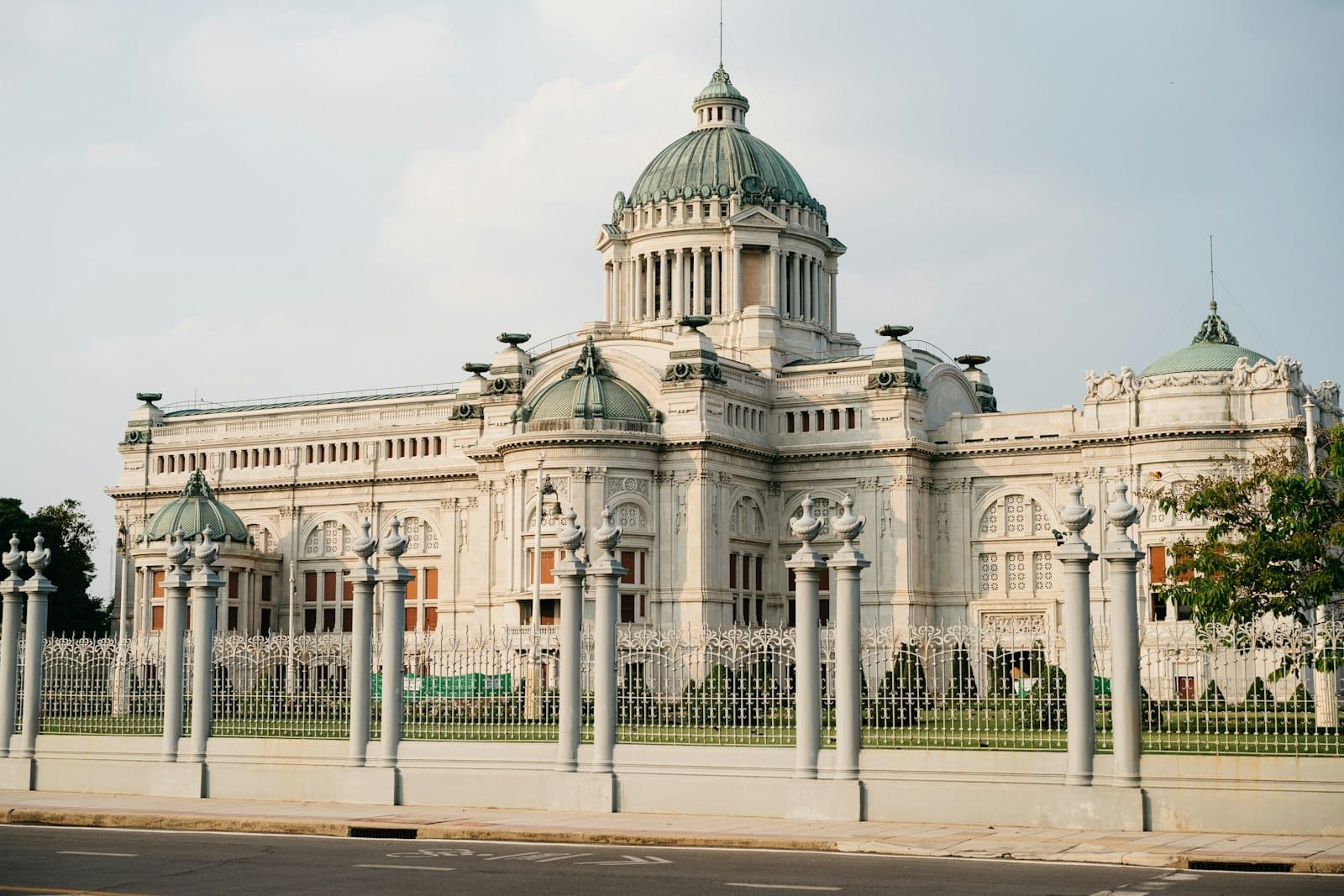
The Ananta Samakhom Throne Hall dominates the Royal Plaza end of Ratchadamnoen Nok. Built between 1908 and 1915, the hall is a striking example of Italian Renaissance architecture adapted to Bangkok's climate, topped by a large dome visible from some distance. It has served as a reception hall for foreign dignitaries and a parliament building, but the interior has been closed to visitors since 2017. Even if you do not go inside, approaching it along the avenue on foot is one of Bangkok's more impressive urban experiences.
The Royal Plaza itself is worth time as a destination rather than just a throughway. The wide ceremonial square at the intersection of Dusit and Rattanakosin gives a sense of the district's scale and its relationship to the city's ceremonial life. Walking the length of Ratchadamnoen Nok from the plaza southward, tree-lined, wide, and relatively uncrowded outside of major ceremonies, is one of the more underrated walks in Bangkok. The architecture along the avenue, a mix of government ministries and civic buildings, rewards unhurried attention.
A short distance south, the ceremonial axis connects to the Democracy Monument, the 1939 landmark that marks the shift from absolute to constitutional monarchy. It sits at the midpoint of Ratchadamnoen Klang and remains a powerful piece of civic architecture. From here you are also within easy walking distance of Wat Ratchanatdaram and the broader cluster of Rattanakosin-area temples.
Ananta Samakhom Throne Hall striking exterior and dome visible from Royal Plaza (interior closed since 2017)
Royal Plaza wide ceremonial square at the Dusit-Rattanakosin intersection, open and walkable
Ratchadamnoen Nok Avenue grand tree-lined boulevard worth walking end to end
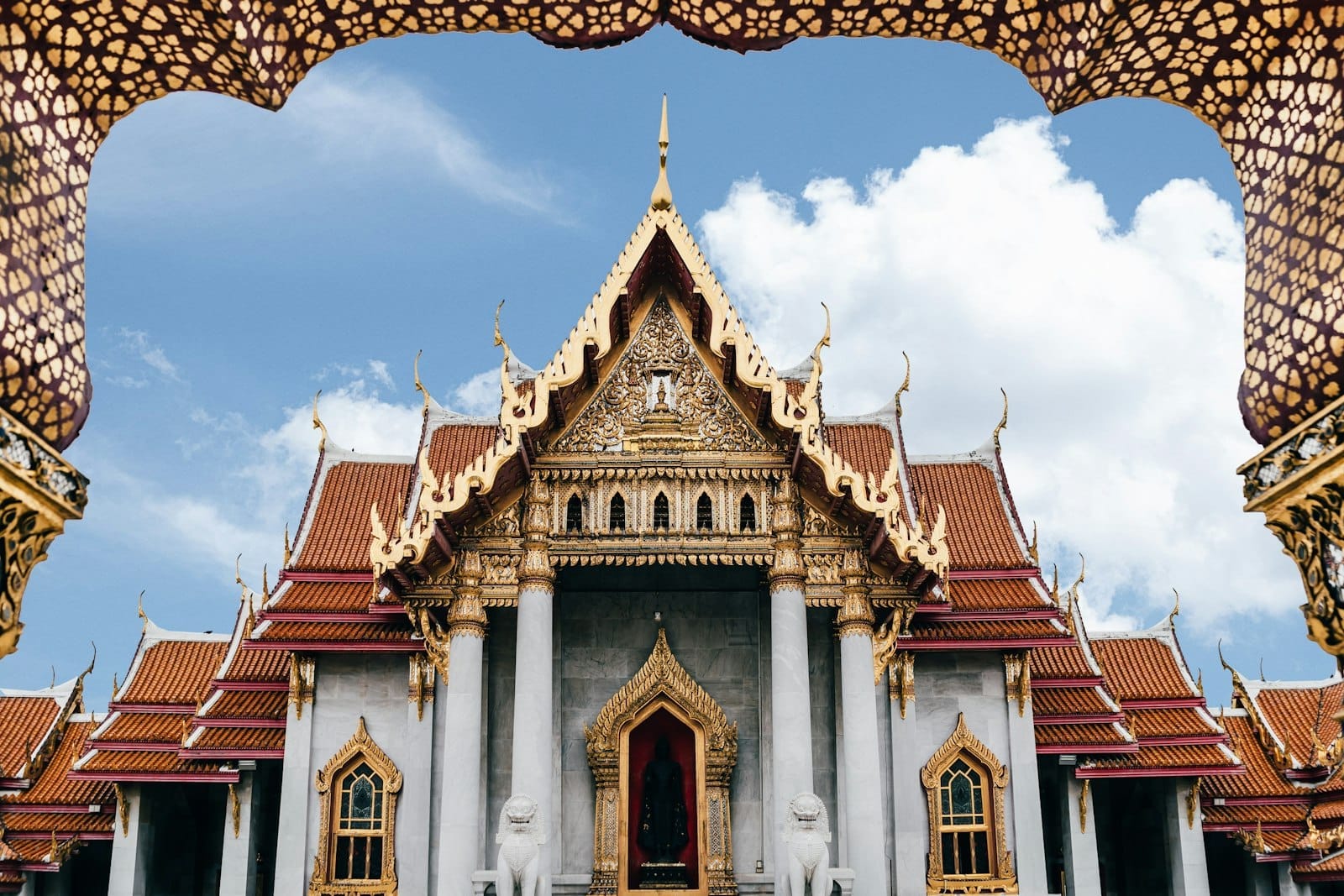
Wat Benchamabophit the Marble Temple — open, refined architecture, quieter than most Bangkok temples
Democracy Monument 1939 civic landmark on the southern ceremonial axis
One attraction that many visitors to the broader area overlook is Wat Benchamabophit, the Marble Temple, located on Si Ayutthaya Road at the southern edge of the Dusit district. Built in 1899 under Rama V, it uses Carrara marble imported from Italy and features a cloister containing 52 Buddha images in different styles. It is quieter than the more famous temples to the south and worth the short detour.
Eating & Drinking
Dusit is not a food destination in the way that Chinatown or the areas around Sukhumvit are, but it feeds its population of civil servants, students, and palace staff with efficient, unpretentious cooking. The food scene here is oriented toward working Bangkokians rather than tourists, which means cheaper prices and more straightforward Thai food: rice dishes, noodle soups, pad kra pao, papaya salad. You will not find much in the way of international cuisine or trendy cafes in the heart of the district.
The streets around Ratchawithi Road and the areas near Rajvithi Hospital have a reliable concentration of lunch spots and small noodle shops. In the morning, vendors near the palace entrance and along the approach to the Throne Hall sell coffee, Thai tea, and grilled bread with spreads that sustain the early crowds. These stalls pack up by mid-morning, so if you want to eat local here you need to be out early.
There are a handful of cafes and slightly more polished restaurants near the Dusit palace grounds and along the edges of the district closer to the Thewet area by the river, which has developed a quieter cafe culture over the past decade. Thewet flower market, just southwest of the main Dusit grounds, is surrounded by small eateries that do solid riverside food at reasonable prices. It is one of the more pleasant places to eat lunch in the area.
💡 Local tip
If you are planning a morning exploring the Royal Plaza and the surrounding royal district, eat before you arrive. Food options directly around the main attractions are limited, and the area around the Royal Plaza has very little commercial activity at street level. The Thewet area near the river, a 15-minute walk west, has better options.
Getting There & Around
Dusit has no BTS or MRT station within the district itself, which is the main logistical challenge for visitors. One of the nearest stations is Phaya Thai, which is at the southeastern edge of the extended area, and even that requires a taxi or tuk-tuk to reach the palace conveniently. The BTS network does not extend into this part of the city at all. This is one reason Dusit remains comparatively less visited by tourists.
The most practical options are taxis and ride-share apps (Grab is widely used and reliable in Bangkok). From the Silom, Siam, or Sukhumvit areas, a taxi to Dusit Palace typically takes 20 to 40 minutes depending on traffic and costs 60 to 100 baht under the meter. Traffic on Ratchadamnoen Nok is generally lighter than in the commercial districts, so the ride in from the south is often faster than you might expect.
Chao Phraya Express Boats stop at Thewet Pier (N15), which sits at the western edge of Dusit near the flower market. This is arguably the most pleasant way to arrive, particularly from the Rattanakosin area or from the piers further south. From Thewet Pier, the palace is a 15 to 20 minute walk east along Ratchawithi Road, or a short motorcycle taxi ride.
Bicycle rentals are occasionally available near the palace grounds, and the wide avenues make cycling less stressful here than in most parts of the city. Motorbike taxis cluster near the main intersections for shorter hops.
⚠️ What to skip
Dress code is strictly enforced at Wat Benchamabophit. Shoulders and knees must be covered. Sarongs are available for loan or rental at the entrance to some sites, but it is easier and more comfortable to dress appropriately before you arrive, especially in Bangkok's heat.
Where to Stay
Dusit is not a major hotel district, and most travelers stay elsewhere in Bangkok and visit as a day trip. There are a few guesthouses and smaller hotels scattered along the avenues and in the Thewet area near the river, many of them occupying older shophouse buildings. The Thewet guesthouse strip has been a budget traveler landmark for decades, offering basic but often characterful accommodation near the flower market and the pier, with easy boat access to the rest of the city.
Staying in Dusit suits travelers who want to focus on the royal and historic sites, who prefer quiet evenings and early mornings, and who do not need the BTS network on their doorstep. Those prioritizing nightlife, shopping, or the major commercial areas should look at Sukhumvit or Silom as bases. For a broader discussion of where to base yourself in Bangkok, the where to stay in Bangkok guide compares the main neighborhoods in detail.
Nearby Neighborhoods
Dusit connects naturally to a morning that starts in Rattanakosin and works north. From the Grand Palace and Wat Pho, you can walk or take a short taxi ride north along Ratchadamnoen Klang, passing the Democracy Monument, and continue into the Dusit district for Royal Plaza and Avenues. This north-south historical axis is one of the most rewarding walks in Bangkok for architecture and urban scale, covering roughly three kilometers end to end.
For those interested in Bangkok's broader temple landscape, the best temples in Bangkok guide includes Wat Benchamabophit alongside the larger sites further south, and gives useful context for planning a temple-focused day that takes in both Rattanakosin and Dusit without backtracking.
TL;DR
Dusit is Bangkok's royal and administrative district, built by Rama V in a European-influenced style at the turn of the 20th century, and it still carries that formal, unhurried character.
The main draw is Wat Benchamabophit (the Marble Temple), which is less crowded than the Rattanakosin sites to the south.
There is no BTS or MRT access within the district; reaching it requires a taxi, Grab, or the Chao Phraya Express Boat to Thewet Pier.
Food and nightlife are minimal compared to Bangkok's commercial districts. Dusit rewards visitors who want history, architecture, and a slower pace, not those seeking markets, malls, or nightlife.
Best visited as a half-day trip combined with the Rattanakosin temples to the south, following the ceremonial Ratchadamnoen avenue as your spine.
From the riverside spectacle of ICONSIAM to the bargain floors of MBK, this guide covers Bangkok's 10 best shopping malls by district with straightforward takes on what each one actually does best.
Bangkok's street food scene is one of the most rewarding in Southeast Asia, but knowing where to go and what to order separates a great meal from a mediocre one. This guide breaks down the best dishes, neighborhoods, and markets so you can eat confidently and affordably.
From the 15,000-stall maze of Chatuchak to the sizzling woks of Yaowarat after dark, this guide covers Bangkok's best markets with candid reviews, practical tips, and the best times to visit each one.
From the dazzling Grand Palace complex to quiet neighborhood temples with barely a tourist in sight, this guide covers Bangkok's 10 most rewarding temples with frank reviews and practical visiting tips.
Bangkok's tropical climate means timing your visit matters more than most cities. This guide breaks down every season, key festivals, crowd levels, and price shifts so you can pick the right window for your trip.
Songkran is Thailand's New Year and the world's largest water fight, and Bangkok does it on a scale unlike anywhere else. This guide covers the best spots to celebrate, practical logistics, cultural context, and practical advice on what to skip.
From glittering temple complexes and chaotic night markets to rooftop observation decks and hidden neighborhoods, this guide covers 20 of the best things to do in Bangkok with candid reviews and practical advice.
Bangkok spreads across a vast urban grid, and where you stay shapes your entire trip. This guide breaks down the city's top neighborhoods by location, vibe, transport access, and price range, so you can book with confidence.