The Wolfsonian–FIU: Where Design, Propaganda, and Art Deco History Collide
Tucked into a restored 1927 Mediterranean Revival building on Washington Avenue, the Wolfsonian–FIU is one of Miami Beach's most intellectually rewarding museums. Its collection of more than 200,000 objects explores how design shaped — and was shaped by — politics, industry, and ideology between 1850 and 1950.
Quick Facts
- Location
- 1001 Washington Ave, Miami Beach, FL 33139 (corner of 10th St & Washington Ave, South Beach Art Deco District)
- Getting There
- Miami Beach Trolley and Metrobus stops within one block; Citi Bike stations at 9th and 11th Streets off Washington Ave; city parking garages on 12th St and Collins Ave
- Time Needed
- 1.5–2.5 hours for a focused visit; longer if you use the library by appointment
- Cost
- Adults $12 | Seniors/Students/Ages 6–18 $8 | Free for Florida residents, members, military, under-6s, and every Friday 6–9 PM
- Best for
- Design and history enthusiasts, architecture lovers, Art Deco District visitors, budget travelers on Fridays
- Official website
- wolfsonian.org
What Is the Wolfsonian–FIU?
The Wolfsonian–FIU is a research museum and library operated by Florida International University, housed at 1001 Washington Avenue in the heart of South Beach. It holds more than 200,000 objects — books, posters, furniture, ceramics, industrial products, and decorative arts — all focused on the period from roughly 1850 to 1950. The collection's central question is deceptively sharp: how does design reflect and reinforce ideology? The museum answers that question with objects drawn from North America and Western Europe, spanning the rise of industrial mass production, the World Wars, the Great Depression, and the early Cold War era.
The Wolfsonian began as a private research collection assembled by Mitchell Wolfson Jr. It was organized as a research center in 1995, then gifted to Florida International University and the State of Florida in 1997. The result is a genuinely academic institution that still functions as a public museum — not a vanity gallery or a decorative arts showroom, but a place where the objects on display are intended to make you think about power, persuasion, and the designed world around you.
💡 Local tip
Free Fridays: Every Friday from 6:00 PM to 9:00 PM, admission is completely free — no strings attached. This is the single best-value window to visit, and it also coincides with a quieter, more contemplative atmosphere than weekend daytime hours.
The Building: A 1927 Mediterranean Revival Landmark
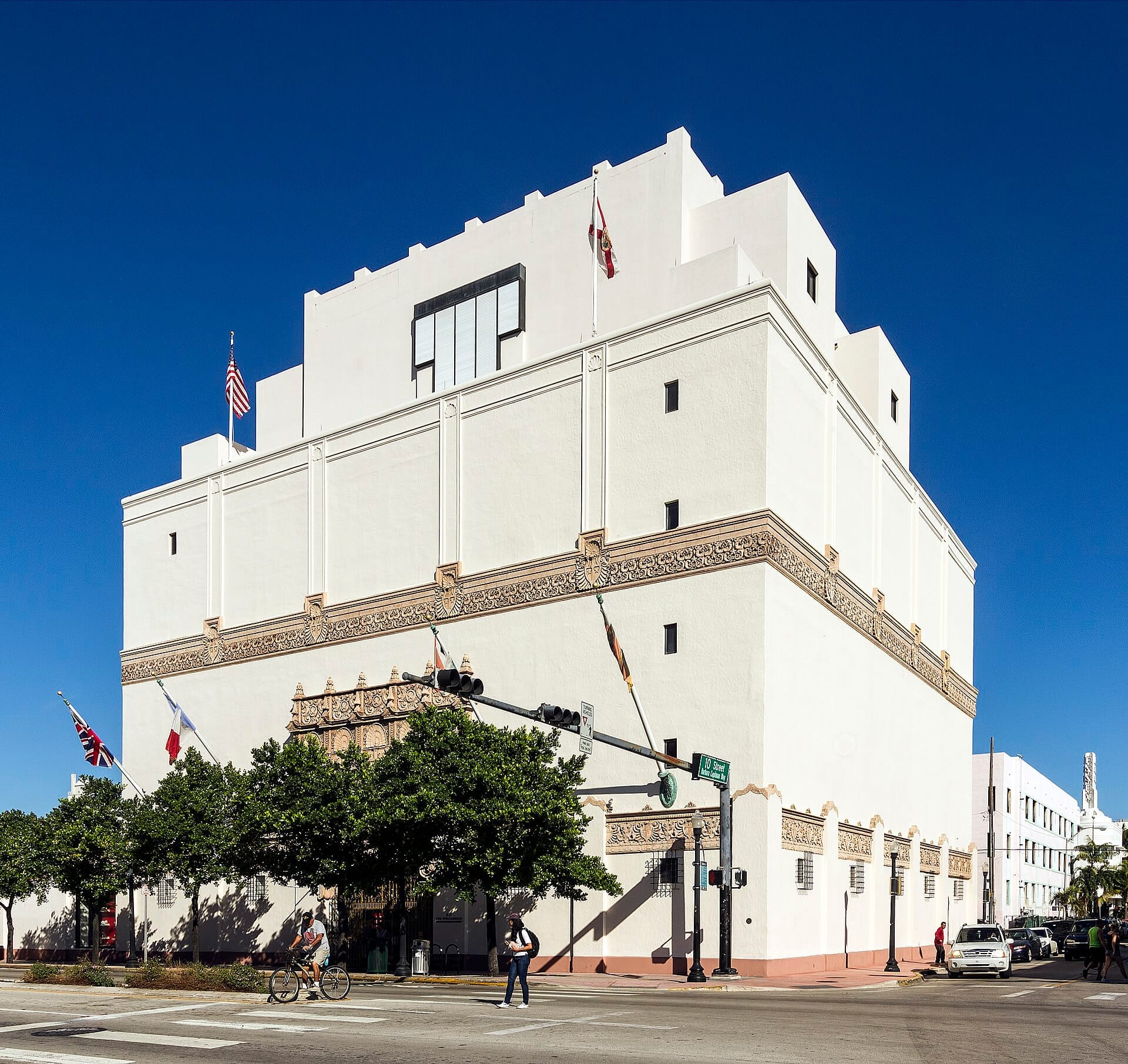
Before you step inside, the building itself rewards attention. The structure dates to 1927 and was originally built as the Washington Storage Company — a climate-controlled warehouse serving Miami Beach's wealthiest winter residents, who stored their valuables when they returned north. The Mediterranean Revival facade, with its ornamental ironwork, arched windows, and terracotta-toned exterior, sits confidently among the area's more celebrated Art Deco neighbors without trying to replicate them.
The 10th Street and Washington Avenue corner where the museum stands is worth a slow walk around before entering. South Beach's Art Deco Historic District extends in every direction from here, and the Wolfsonian's 1927 Mediterranean Revival fabric is a useful counterpoint to the more celebrated 1930s Deco strips a block away on Ocean Drive. The building's bones — thick masonry walls, deep-set windows, a lobby with original ironwork details — create a temperature that stays noticeably cool even during Miami Beach's intense summer months, which makes it a legitimately comfortable midday refuge.
Tickets & tours
Hand-picked options from our booking partner. Prices are indicative; availability and final rates are confirmed when you complete your booking.
Everglades admission ticket with airboat ride and wildlife show
From 24 €Instant confirmationFree cancellationKey West day trip with glass bottom boat ride
From 110 €Instant confirmationFree cancellationEverglades airboat ride with Biscayne Bay boat tour and transportation
From 67 €Instant confirmationFree cancellationGrand Bahama tour with optional Pig Beach visit
From 309 €Instant confirmationFree cancellation
The Collection: Design as Propaganda and Progress
The Wolfsonian's 200,000-object collection is not organized like a typical art museum. You will not move chronologically through painting styles or see objects grouped by nationality alone. Instead, the museum organizes its exhibitions around themes: how industrial design sold the idea of modernity, how governments used posters and decorative arts to shape public behavior, how architecture and graphic design expressed both utopian hope and authoritarian control during the first half of the twentieth century.
Expect to encounter WPA-era travel posters printed with almost aggressive optimism, Italian Futurist typography designed to evoke speed and national pride, German Expressionist woodcuts, early American industrial product design, and British Arts and Crafts movement furniture in the same building. These objects were made to persuade people of something — to buy, to believe, to work, to fight. Seeing them in close proximity, regardless of their country of origin, makes that persuasive intent viscerally clear in a way that reading about the period never quite achieves.
The permanent collection is rotated and recontextualized regularly, so repeat visits genuinely yield different experiences. Temporary exhibitions, often collaborations with FIU's academic departments, bring in objects on loan and introduce thematic angles that can reframe even familiar parts of the collection. Check the museum's website before visiting if a specific exhibition is your primary draw.
Visiting at Different Times of Day
The museum is closed Mondays and Tuesdays. Wednesday through Sunday it opens at 10:00 AM. On Fridays it stays open until 9:00 PM; all other days it closes at 6:00 PM. The weekday morning window — roughly 10:00 AM to noon on Wednesday or Thursday — is the quietest you will find it. Galleries are nearly empty, the lighting feels deliberate rather than crowded, and you can spend five uninterrupted minutes in front of a single poster without anyone nudging past you.
Weekend afternoons between noon and 4:00 PM bring the most foot traffic, partly because tourists walking Washington Avenue from the beach naturally drift inside. The building's thick walls mean noise levels inside remain manageable even when the museum is moderately full, but the small gallery rooms can feel cramped with more than a dozen people in them at once. If you are visiting on a weekend, arriving at opening time or in the last hour before closing gives you a noticeably better experience.
Friday evening free hours draw a different crowd: locals, FIU students, design professionals, and people who combine a museum visit with a broader South Beach evening. The tone is social but engaged. It is not a loud scene — the galleries are not large enough for that — but there is a conversational energy that daytime visits rarely have. For solo travelers or couples, Friday evenings combine genuine cultural substance with an easy, low-cost start to the night.
Practical Walkthrough: What to Expect on Arrival
The entrance is on Washington Avenue. The lobby is relatively modest — a reception desk, a small museum shop, and information about current exhibitions. Buy your ticket or show your ID for free admission categories before proceeding. The shop is legitimately good: it stocks design-focused books, prints, and objects that reflect the collection's themes rather than generic souvenir merchandise.
The galleries spread across multiple floors, connected by an elevator and stairwell. The building's original structure means some rooms are narrow and doorways low by modern standards, but the space is navigable with a standard wheelchair or stroller. Visitors with disabilities and one accompanying caregiver are admitted free. ADA parking spaces are designated on both 10th and 11th Streets between Washington and Collins Avenues.
Photography for personal use is generally permitted in the permanent collection galleries without flash. If you are also planning to visit The Bass Museum nearby on Collins Avenue, note that the two museums have genuinely different curatorial personalities: The Bass focuses on contemporary art, while the Wolfsonian's entire identity is anchored in the historical period before 1950. Together, they offer a compelling arc of twentieth-century visual culture without requiring a car.
ℹ️ Good to know
The Wolfsonian's research library holds archival materials related to the collection and is open by appointment only: Monday through Friday 9:00 AM to 5:00 PM and Saturday 11:00 AM to 5:30 PM. Researchers and serious students of design history should book well in advance via the museum's website.
Getting There and Around the Neighborhood
The Wolfsonian sits squarely in walkable South Beach. The Miami Beach Trolley, which is free to ride, stops within a block on Washington Avenue. Metrobus also serves the corridor. If you are cycling, Citi Bike docking stations are located at 9th and 11th Streets off Washington Avenue, and bike racks line the street outside. Driving is possible but parking in this part of South Beach requires patience: city garages are available at 12th Street (between Washington and Pennsylvania Avenues), Collins Avenue at 7th and 13th Streets, and Drexel Avenue at 12th Street. There is also a surface lot directly across the street at Washington Avenue and 10th Street, and metered street parking along Washington. Visitors with valid disabled person parking permits park free at all on-street meters and city garages. For more detail on navigating Miami Beach by transit, the getting around Miami guide covers all major options including trolley routes and Metrobus.
The Wolfsonian is an easy complement to other South Beach cultural stops. Ocean Drive is two blocks east — a five-minute walk — and the Art Deco Historic District's most photographed streetscape. If you are building a half-day cultural itinerary in South Beach, the Wolfsonian pairs well with a walk along the district's preserved facades and a stop at the Española Way pedestrian street two blocks north.
Who Will Get the Most Out of This Museum
The Wolfsonian rewards visitors who bring some curiosity about history, design, or visual culture. You do not need an art history background — the wall texts are well-written and genuinely explanatory rather than academic — but you do need patience to read them. This is not a museum you absorb by moving quickly. The objects are dense with context, and the most interesting moments come from slowing down: noticing the typography on a 1930s propaganda poster, reading the manufacturer's text on an early mass-produced household appliance, or comparing the furniture aesthetics of competing European political movements.
Families with children under about 10 are not the museum's natural audience. The collection has almost nothing pitched at young children, and the gallery spaces are quiet and text-heavy. Florida residents, active military, and veterans enter free with valid ID, making this a genuinely zero-cost option for local adults looking for a serious cultural afternoon. FIU students and State University System faculty also enter free.
Visitors primarily interested in contemporary art may find the pre-1950 scope limiting. For more recent work, the Pérez Art Museum Miami in Downtown focuses on modern and contemporary international art, and the Institute of Contemporary Art Miami in the Design District offers free admission to all visitors year-round.
Insider Tips
- Friday evenings from 6–9 PM are free for everyone — no need to be a Florida resident or student. This is also when the museum's atmosphere is most social, making it an unusually pleasant way to start a South Beach evening without spending anything on entry.
- The museum shop stocks a genuinely curated selection of design books and prints that are hard to find elsewhere in Miami Beach. Even if you are short on time, worth a browse on your way out — it reflects the collection rather than generic tourist merchandise.
- If the gallery walls feel overwhelming, focus on the poster collection first. WPA travel posters and politically charged European graphics from the 1930s are consistently the most immediately accessible and viscerally powerful objects in the building.
- The building's thick masonry walls keep the interior notably cool, which makes the Wolfsonian a practical afternoon stop during Miami Beach's hot and humid summer months, typically June through September, when outdoor time becomes physically uncomfortable by early afternoon.
- The library reading room operates by appointment only on weekdays and Saturdays. If you are researching design, advertising history, or material culture from 1850 to 1950, contacting the museum in advance to arrange access is worth the effort — the archival holdings are substantial and not widely publicized.
Who Is Wolfsonian–FIU Museum For?
- Design and graphic arts enthusiasts who want context beyond gallery aesthetics
- History travelers interested in how visual culture intersected with twentieth-century politics
- Architecture lovers using the Wolfsonian as an anchor for a broader Art Deco District walking tour
- Budget and free travelers, especially Florida residents and anyone visiting on a Friday evening
- Solo visitors or couples seeking a quiet, intellectually engaging afternoon away from South Beach's beach crowds
Nearby Attractions
Other things to see while in South Beach:
- Art Deco Historic District
The Miami Beach Art Deco Historic District preserves more than 800 historic buildings along Ocean Drive, Collins Avenue, and Washington Avenue, making it one of the world's largest concentrations of Art Deco architecture. Listed on the National Register of Historic Places in 1979, the district is free to explore on foot and rewards visitors at every hour of the day.
- Española Way
Conceived in the early 1920s as an artists' colony and largely completed by 1925, Española Way is a roughly two-block pedestrian stretch in South Beach where Spanish Revival architecture, open-air restaurants, and a quieter pace of life offer a genuine contrast to the Ocean Drive scene. Admission is free and the street is open around the clock.
- Jewish Museum of Florida–FIU
Occupying two landmark synagogue buildings from 1929 and 1936 at 301 and 311 Washington Avenue, the Jewish Museum of Florida–FIU tells the story of Jewish life in Florida across more than 250 years. The 1936 building alone, designed by Art Deco master Henry Hohauser, is worth the visit for its copper dome and 80 stained-glass windows.
- Lincoln Road Mall
Lincoln Road Mall is an eight-block pedestrian promenade running through the heart of Miami Beach, flanked by over 200 shops, restaurants, galleries, and cafés. Redesigned in the late 1950s by architect Morris Lapidus, it is often cited as one of the earliest open-air pedestrian malls in the United States. Free to enter and open around the clock, it offers a very different experience at 9 a.m. than it does at 10 p.m.