Española Way: South Beach's Mediterranean Street Worth Knowing
Conceived in the early 1920s as an artists' colony and largely completed by 1925, Española Way is a roughly two-block pedestrian stretch in South Beach where Spanish Revival architecture, open-air restaurants, and a quieter pace of life offer a genuine contrast to the Ocean Drive scene. Admission is free and the street is open around the clock.
Quick Facts
- Location
- Between Collins Ave & Jefferson Ave, South Beach, Miami Beach, FL 33139
- Getting There
- Drive via MacArthur Causeway (I-395) to Washington Ave; walkable from Lincoln Road and Ocean Drive
- Time Needed
- 45 minutes to 2 hours depending on dining and browsing
- Cost
- Free to enter; restaurant and bar prices vary
- Best for
- Architecture lovers, couples, photographers, slow-travel explorers
- Official website
- www.visitespanolaway.com
What Española Way Actually Is
Española Way is a short, pedestrian-only street in South Beach that most visitors walk past without slowing down, which is exactly why it rewards those who stop. Stretching roughly two blocks between Collins Avenue and Jefferson Avenue, this narrow corridor was built in 1925 and designed to evoke the feel of a Mediterranean village, complete with terracotta roof tiles, wrought-iron balconies, ochre and cream stucco facades, and arched doorways that frame glimpses of courtyard spaces beyond.
The street is commonly referred to as Española Way in Miami Beach, and that is the name used in official historic district documentation. The street is publicly accessible at all hours with no admission fee, making it one of the few genuinely low-cost experiences in an otherwise expensive part of the city. What you spend here depends entirely on whether you sit down for a meal or a drink, and the price range across the restaurants and bars covers most budgets.
💡 Local tip
Española Way runs between 14th Street and 15th Street in South Beach. If you are already walking between Lincoln Road and Ocean Drive, this street is a natural midpoint detour that adds less than 20 minutes to your route.
The History Behind the Architecture
The street was conceived in the early 1920s by developer N.B.T. Roney and collaborators, who envisioned a Mediterranean-style artists' colony that would attract painters, writers, and bohemian types to what was then the developing northern edge of Miami Beach. By 1925, the buildings were complete, featuring Spanish Revival and Moorish Revival elements that were fashionable across Florida at the time, a period when Coral Gables was also being built on similar aesthetic principles.
The original vision of an artists' enclave never fully materialized in the form Roney imagined, and the street cycled through various identities across the twentieth century, including a period as a hub for artists and entertainment in the 1930s. By the time Miami Beach's wider revival gathered momentum in the 1980s and 1990s, Española Way had weathered decades of mixed fortunes. A significant turning point came in 2017 when the city undertook a revitalization project that permanently pedestrianized the street, removing through traffic and creating the car-free environment that exists today. The architectural fabric from 1925 remains largely intact, which is what makes this street genuinely different from newer developments. For a broader understanding of how South Beach's architecture evolved across multiple eras, the Art Deco Historic District just a few blocks away provides essential context.
Tickets & tours
Hand-picked options from our booking partner. Prices are indicative; availability and final rates are confirmed when you complete your booking.
Everglades admission ticket with airboat ride and wildlife show
From 24 €Instant confirmationFree cancellationKey West day trip with glass bottom boat ride
From 110 €Instant confirmationFree cancellationEverglades airboat ride with Biscayne Bay boat tour and transportation
From 67 €Instant confirmationFree cancellationGrand Bahama tour with optional Pig Beach visit
From 309 €Instant confirmationFree cancellation
How the Street Feels at Different Times of Day
Morning is when Española Way shows its quietest, most photogenic face. Before 10am, the street is largely still. The terracotta tiles catch low-angle light from the east, the wrought-iron lanterns overhead look proportionally dramatic without crowds beneath them, and the smell of coffee drifts from the first cafes opening their doors. The textured plaster walls, in shades ranging from dusty rose to pale yellow, read best in the soft morning light before the midday sun flattens them out.
By early afternoon, foot traffic picks up as tourists connect the dots between Ocean Drive to the south and Lincoln Road to the north. This is a perfectly workable time to visit, but the charm is slightly diluted by louder groups moving through. The street's narrow width means even moderate crowds feel dense.
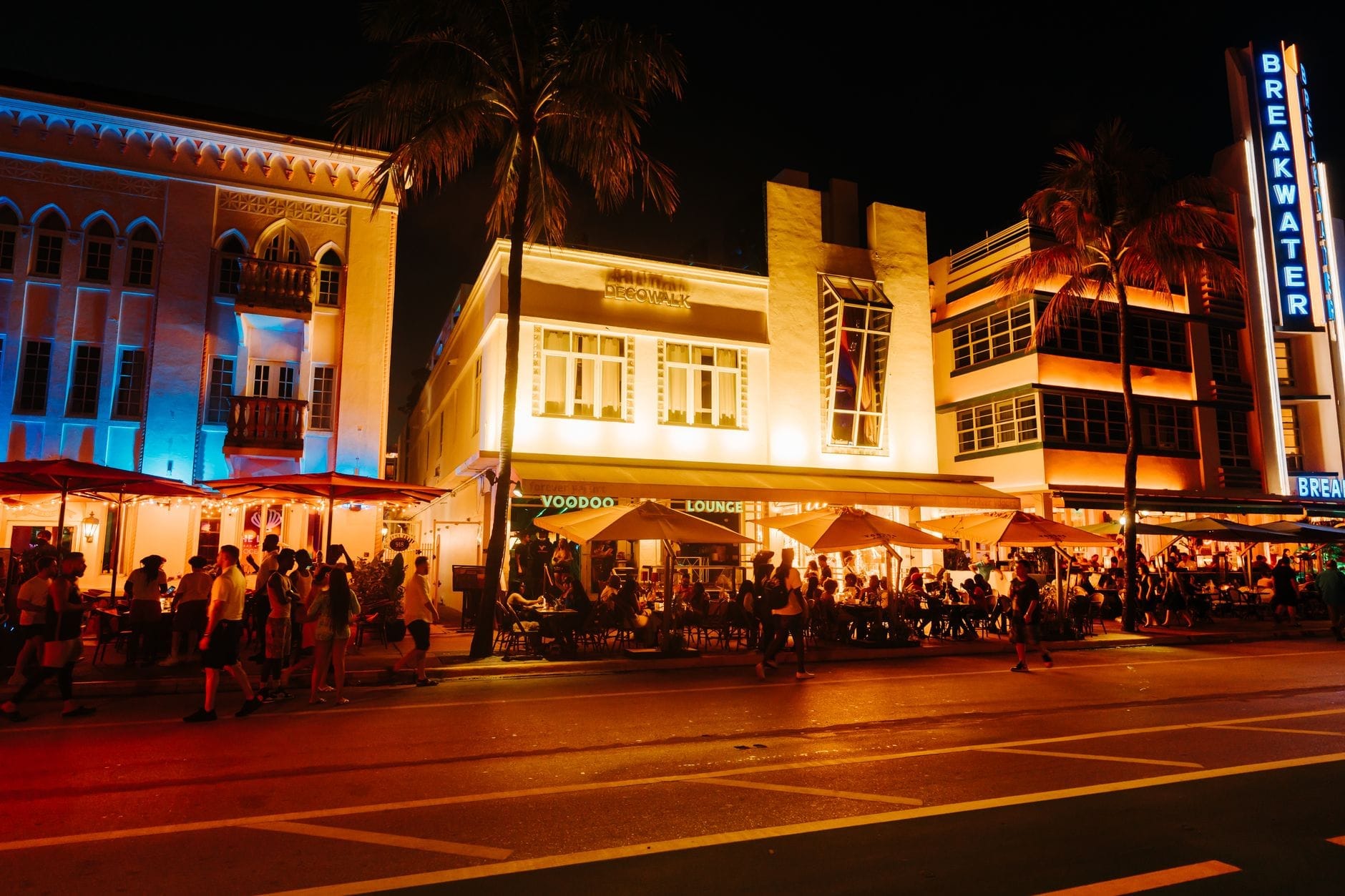
Evening is when Española Way comes into its own as an experience rather than just a visual. The overhead string lights that run the length of the street switch on as the sky darkens, casting warm light across the balconies and cobblestone-style pavers. Restaurant tables fill the pedestrian zone, and the ambient noise shifts from traffic hum to conversation and live music filtering from the bars. On weekend evenings, this becomes a genuinely atmospheric scene, closer in spirit to a European plaza than anything else in South Florida.
ℹ️ Good to know
The street hosts periodic outdoor events including art markets and live performances. Check the official Española Way website or local event listings before your visit to see what might be scheduled during your stay.
What to Do Here: Restaurants, Galleries, and Browsing
The ground-floor spaces along Española Way are occupied by a mix of restaurants, bars, small galleries, and boutique shops. The food options lean toward international and Latin-inflected menus, with outdoor seating that spills across the pedestrianized street. Because this is South Beach, prices at sit-down restaurants are higher than the Miami average, and the standard 18-20% tip on pre-tax totals applies as it does across U.S. dining. If you are on a budget, the street is equally enjoyable as a walking experience without spending anything.
Several small galleries and creative spaces operate along the corridor, carrying on a diluted version of the original artists' colony idea. These tend to keep irregular hours and some are appointment-only, so treat any gallery visit as an opportunistic discovery rather than a planned stop. If the intersection of art and urban space interests you more broadly, Wynwood Walls on the Miami mainland offers a far larger and more concentrated art experience, though its character is entirely different from Española Way's quiet, architectural atmosphere.
Practical Walkthrough: Getting There and Moving Around
Española Way sits in the geographic center of South Beach, making it accessible on foot from most hotels in the area. From Ocean Drive, walk west on 14th or 15th Street to reach Española Way between Collins Avenue and Jefferson Avenue. From Lincoln Road Mall, it is a five-minute walk south. Washington Avenue, which forms the western anchor of the street, is a major South Beach artery with bus service, so arrivals by public transit are straightforward.
By car, a common approach from the mainland is via the MacArthur Causeway (I-395), following signs into South Beach and heading toward Washington Avenue. Parking in this part of South Beach is metered and competitive, particularly on weekend evenings. Street parking and public garages exist on nearby blocks, but expect to walk a short distance. If you are combining this stop with broader South Beach exploration, the guide to getting around Miami covers transit options in detail, including the South Beach Local circulator bus that runs along Washington Avenue.
The street is fully pedestrianized following the 2017 revitalization, which makes it wheelchair accessible in terms of vehicle-free movement. The surface is uneven in places due to the historic paving treatment, so those with mobility considerations should expect some variation underfoot rather than a smooth continuous surface.
Photography: What Works and What Does Not
The architectural details on Española Way are genuinely photogenic, but the street's narrow width creates challenges for anyone trying to capture the full facade of a building. Wide-angle lenses help. The best compositions tend to be looking down the length of the street toward a vanishing point, capturing the receding archways and overhead lights, rather than shooting perpendicular to the buildings. Morning light from the east hits the south-facing facades well. By midday, harsh overhead sun creates unflattering shadows across the decorative ironwork.
After dark, the string lights create a warm, high-contrast scene that works well for atmosphere but requires either a steady hand, a tripod, or a phone with strong night mode capability. The wrought-iron lanterns on the building exteriors make natural focal points for close-up detail shots. Avoid shooting during peak dinner service on Friday and Saturday nights if you want any frame without crowds, because the street fills completely.
⚠️ What to skip
If your sole purpose is a quiet, photogenic visit, Friday and Saturday evenings are the wrong time to come. Midweek evenings offer the string-light atmosphere with significantly fewer people.
Honest Assessment: Is It Worth the Detour?
Española Way is not a landmark attraction in the sense that Vizcaya or the Wynwood Walls are. It does not take long, it does not require planning, and it works best as part of a broader South Beach walk rather than a standalone destination. For travelers whose entire Miami visit is built around beaches and nightlife, it may not register as memorable. But for anyone with an interest in architectural history, Mediterranean Revival design, or simply a slower pace than Ocean Drive offers, it rewards visitors who slow down far more than its two-block footprint suggests.
The street's real value is contrast. South Beach's most famous blocks are loud, high-stimulation environments. Española Way is quieter, older, and more textured in a literal sense. It fits naturally into a day that also includes the Lincoln Road Mall to the north and Ocean Drive to the south, giving that standard South Beach loop a moment of genuine historical depth.
Insider Tips
- Visit on a Tuesday or Wednesday evening for the best combination of atmosphere and manageable crowd levels. The restaurants are still animated but the street does not feel congested.
- The balconies on the upper floors of the 1925 buildings are used by some of the bars and restaurants above street level. If you want an elevated view looking down the street rather than along it, ask whether upstairs seating is available.
- Near the intersection of Española Way and Drexel Avenue, close to the midpoint of the corridor, the street widens slightly and gives you the clearest view of the Spanish Revival rooflines without being squeezed by the narrowest section. It is also the best spot for full-length architectural shots.
- Several of the ground-floor retail spaces change tenants more frequently than restaurants do. If you visited a few years ago and remember a specific shop, it may no longer be there. Treat the retail as discovery rather than destination.
- Morning coffee seekers should note that not all businesses on the street open early. Check hours before making a specific trip for breakfast; the surrounding blocks of South Beach have more reliable early-morning options.
Who Is Española Way For?
- Architecture and history enthusiasts who want something beyond the Art Deco strip
- Couples looking for a romantic evening atmosphere with outdoor dining options
- Photographers interested in Spanish Revival detail work and ambient-light night shots
- Travelers on a budget who want a free, walkable cultural stop in South Beach
- Anyone who finds Ocean Drive overwhelming and wants a quieter South Beach alternative
Nearby Attractions
Other things to see while in South Beach:
- Art Deco Historic District
The Miami Beach Art Deco Historic District preserves more than 800 historic buildings along Ocean Drive, Collins Avenue, and Washington Avenue, making it one of the world's largest concentrations of Art Deco architecture. Listed on the National Register of Historic Places in 1979, the district is free to explore on foot and rewards visitors at every hour of the day.
- Jewish Museum of Florida–FIU
Occupying two landmark synagogue buildings from 1929 and 1936 at 301 and 311 Washington Avenue, the Jewish Museum of Florida–FIU tells the story of Jewish life in Florida across more than 250 years. The 1936 building alone, designed by Art Deco master Henry Hohauser, is worth the visit for its copper dome and 80 stained-glass windows.
- Lincoln Road Mall
Lincoln Road Mall is an eight-block pedestrian promenade running through the heart of Miami Beach, flanked by over 200 shops, restaurants, galleries, and cafés. Redesigned in the late 1950s by architect Morris Lapidus, it is often cited as one of the earliest open-air pedestrian malls in the United States. Free to enter and open around the clock, it offers a very different experience at 9 a.m. than it does at 10 p.m.
- Lummus Park Beach
Lummus Park Beach runs along Ocean Drive between 5th Street and 14th Place in South Beach, Miami Beach. Free to enter and open daily from sunrise to midnight, it offers Atlantic swimming, a paved beachside path, and one of the most recognizable urban beach landscapes in the world.