Art Deco Historic District: South Beach's Architectural Crown
The Miami Beach Art Deco Historic District preserves more than 800 historic buildings along Ocean Drive, Collins Avenue, and Washington Avenue, making it one of the world's largest concentrations of Art Deco architecture. Listed on the National Register of Historic Places in 1979, the district is free to explore on foot and rewards visitors at every hour of the day.
Quick Facts
- Location
- 5th St to 23rd St, Ocean Drive / Collins Ave / Washington Ave, South Beach, Miami Beach, FL
- Getting There
- Miami Beach local buses and trolleys (South Beach routes); taxi or rideshare from Miami via MacArthur Causeway
- Time Needed
- 1–2 hours for a self-guided walk; 2.5 hours for a guided MDPL walking tour
- Cost
- Free to explore; MDPL guided tours approx. US$35 (adults), discounts for seniors, students, veterans — verify current rates with MDPL
- Best for
- Architecture lovers, photographers, history enthusiasts, first-time Miami visitors
What the Art Deco Historic District Actually Is
The Miami Beach Art Deco Historic District is not a museum with a ticket booth and a closing time. It is an entire neighborhood frozen in a specific architectural moment: the 1920s through 1940s, when South Beach was rebuilt in the streamlined, sun-drenched style that had swept through Europe and North America. Some 800 historic buildings line the blocks between 5th Street and 23rd Street, representing Art Deco, Mediterranean Revival, and MiMo (Miami Modern) styles. In 1979, this area became the first 20th-century neighborhood in the United States to be added to the National Register of Historic Places.
The concentration of intact, purpose-built Art Deco structures here is unmatched anywhere in the world. That is not promotional hyperbole: cities like New York, Chicago, and Paris each have iconic individual Art Deco landmarks, but South Beach has entire streetscapes where the scale, proportion, and ornamentation were designed to work together. Walking a single block of Ocean Drive or Collins Avenue puts you inside an aesthetic system, not just past a single impressive facade.
ℹ️ Good to know
The Art Deco Welcome Center at 1001 Ocean Drive is your best starting point. It is open daily 9:00–17:00, operated by the Miami Design Preservation League, and sells tickets for MDPL walking tours. Pick up a free district map here even if you are self-guiding.
The Architecture Up Close: What to Look For
Art Deco buildings in South Beach share a visual vocabulary once you know where to look. Eyebrows — horizontal concrete canopies projecting over windows — were designed to shade interiors from the Florida sun and double as decorative relief lines on otherwise flat facades. Porthole windows nod to the ocean-liner aesthetic fashionable in the 1930s. Corners are often rounded rather than square, creating that streamlined silhouette associated with speed and modernity. Terrazzo floors inside lobbies continue this language in swirling patterns of marble chips embedded in cement.
The pastel color palette that defines the district today — mint green, coral pink, pale yellow, soft turquoise — is not original. Most buildings were white or cream when first built. The candy-colored repaints date from Leonard Horowitz's influential work in the 1980s, carried out in collaboration with preservationist Barbara Baer Capitman, whose campaign in the 1970s saved much of the district from demolition. Whether you consider the pastel palette historically accurate or not, it has become inseparable from the district's identity.
Three streets define the district's experience: Ocean Drive is the most theatrical, with hotel facades facing Lummus Park and the ocean beyond. Collins Avenue runs parallel one block inland and carries more of the district's pure residential and hotel stock. Washington Avenue is the commercial spine, grittier and more local in feel, and home to the Wolfsonian-FIU museum at number 1001, which holds a definitive collection of design and propaganda art from the period that produced these buildings.
Tickets & tours
Hand-picked options from our booking partner. Prices are indicative; availability and final rates are confirmed when you complete your booking.
Wynwood Art District's history tour with sweets tasting
From 56 €Instant confirmationFree cancellationWynwood graffiti golf cart tour
From 38 €Instant confirmationFree cancellationWynwood walls and street art tour
From 25 €Instant confirmationFree cancellationBest of Wynwood street art walking tour
From 33 €Instant confirmationFree cancellation
How the Experience Changes by Time of Day
Early morning, roughly 7:00 to 9:30, is the single best time to walk the district if architecture is your priority. Ocean Drive at this hour smells of salt air and fresh coffee from the few cafes already open. The sidewalks are quiet enough that you can step back and study a facade without dodging foot traffic. The low eastern sun rakes across the relief details on building fronts — the zigzag friezes, the carved flamingos, the stylized foliage — and creates shadows that make the ornamentation pop in photographs. Pastel paint colors look most saturated in soft morning light.
By midday, Ocean Drive becomes a different proposition. Restaurant terraces fill the sidewalks, servers approach pedestrians, and the combination of tourist foot traffic and Florida heat makes leisurely architectural observation more demanding. This is not the end of the world — the energy is real and the people-watching is genuinely good — but it is not the time for quiet contemplation.
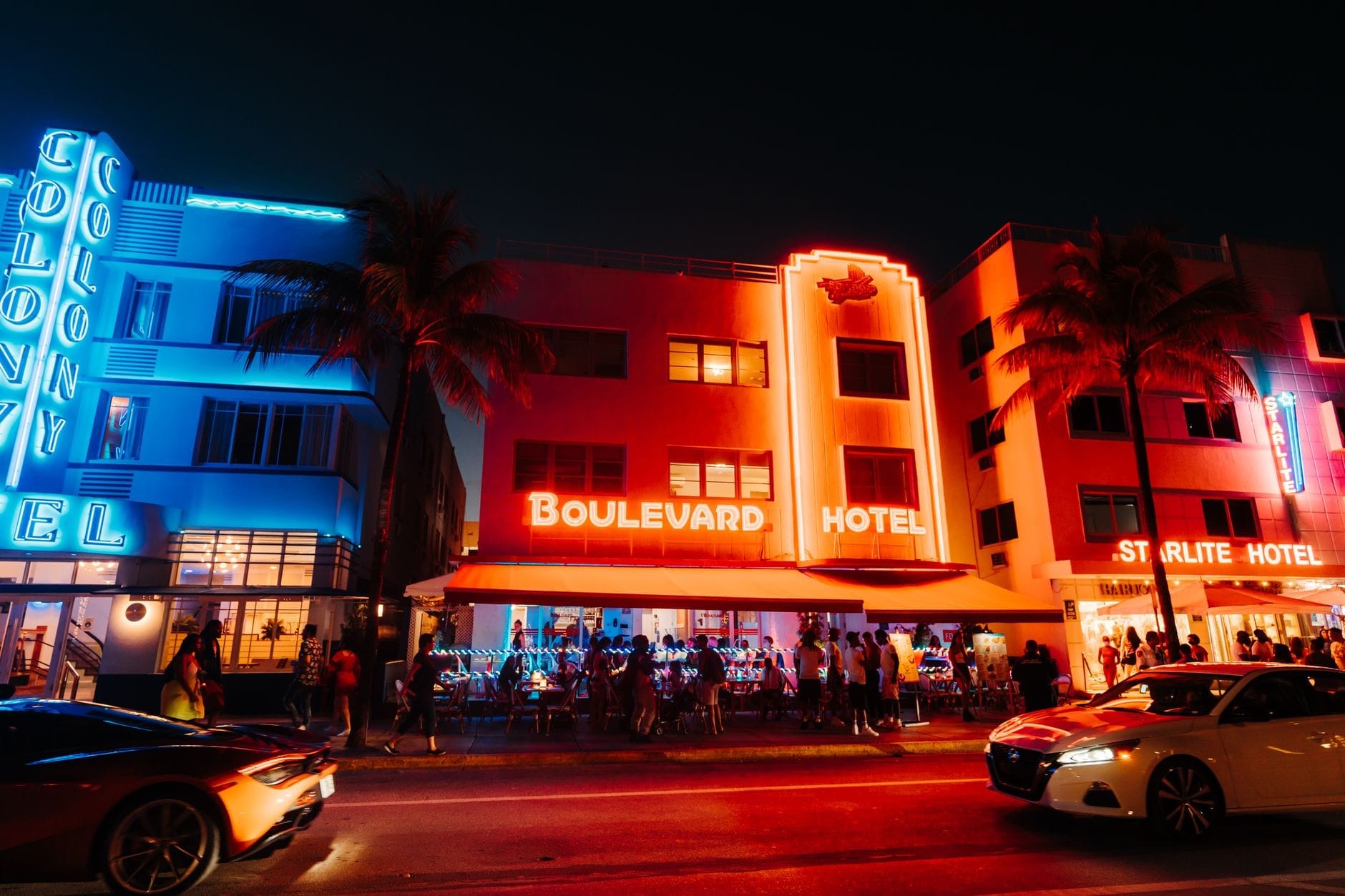
Dusk and the early evening bring another shift. Around 18:00 to 20:00, the buildings are backlit by the warm sky and the neon signs built into facade lettering begin to glow. The Colony Hotel's sign on Ocean Drive, the neon tubing along rooflines, the illuminated porthole windows: these details are invisible in daylight and fully alive after dark. If you can do two visits, one morning walk for architecture details and one evening stroll for atmosphere, you will see two genuinely different places.
💡 Local tip
For photography: arrive before 8:30 on a weekday morning. Stand on the Lummus Park side of Ocean Drive (the beach-facing sidewalk) and shoot west toward the building facades. You will have clean lines, warm light, and almost no people in frame.
Guided vs. Self-Guided: Which Makes Sense
The Miami Design Preservation League (MDPL) offers guided walking tours departing from the Art Deco Welcome Center at 1001 Ocean Drive. The standard tour runs up to two hours and covers the major streets of the district with an experienced guide who can explain construction dates, original owners, preservation battles, and architectural details that most visitors walk past without noticing. For first-time visitors or anyone with a serious interest in design history, this is money well spent. Recent adult pricing has been around US$35, with discounts for seniors, students, and veterans — verify current rates and tour schedules directly with MDPL before visiting, as these change.
Self-guided walks are entirely viable with the free map available at the Welcome Center. The map identifies key buildings by address and style, and even a slow two-hour walk covering Ocean Drive, a portion of Collins Avenue, and a return along Washington Avenue will give you a coherent picture of the district. Audio guides are also available through the Welcome Center for visitors who prefer a narrated experience at their own pace.
If you have more than a day in South Beach, consider pairing the Art Deco Historic District with the Wolfsonian-FIU Museum on Washington Avenue, which contextualizes the design period through its collection, and the nearby Jewish Museum of Florida in a pair of restored synagogue buildings that demonstrate a different facet of the neighborhood's 20th-century history.
Practical Walkthrough: Getting There and Getting Around
The district sits in South Beach on Miami Beach, a separate barrier island city east of Miami proper. From Downtown Miami, the most direct route is via the MacArthur Causeway (Route 395), which deposits you into Miami Beach near 5th Street, the southern edge of the district. Miami Beach local bus routes and trolleys serve the South Beach corridor along Collins and Washington avenues; the trolley is free and runs frequently during daytime hours. Taxi and rideshare drop-offs on Ocean Drive or Collins Avenue are straightforward.
Terrain throughout the district is flat, with standard sidewalks along all three main streets. Visitors with mobility considerations should be aware that some older building interiors (lobby tours, for example) may have steps and limited accessibility. If you need accommodation for an MDPL-organized tour or event, contact the Welcome Center at least 72 hours in advance.
Parking in South Beach is notoriously tight and expensive. Arriving by rideshare or using the free South Beach Trolley from further north on the island is consistently more convenient than driving. For context on getting around the broader Miami area, see the complete Miami transit guide.
⚠️ What to skip
Avoid driving on Ocean Drive during peak hours (late afternoon through evening). The strip is narrow, valet lines block lanes, and parking enforcement is active. Use the 7th Street or 12th Street municipal garages if you must drive.
Weather, Seasons, and When to Visit
The district is walkable year-round, but the experience varies significantly by season. November through April is Miami's dry season: temperatures average in the mid-70s°F (around 24–26°C), humidity drops compared to summer, and afternoon thunderstorms are rare. This is peak tourist season in South Beach, and the district will be busier, but the walking conditions are genuinely comfortable.
From June through September, heat and humidity are intense — highs regularly reach 89–91°F (32–33°C) with high moisture in the air. Walking the district in July midday is unpleasant, and afternoon thunderstorms can arrive quickly. The practical solution is to schedule architectural walks for early morning and shift beach or indoor activities to the hottest hours. For more on navigating the season, see the guide to visiting Miami in summer.
Art Basel Miami Beach, held annually in December, transforms South Beach including the Art Deco District into an art-world epicenter. Hotels fill up months in advance, Ocean Drive becomes impossibly crowded on weekend evenings, and prices spike. If your primary goal is the architecture itself, visiting in January or February offers nearly identical weather with significantly fewer crowds. For an overview of the December art season, the Miami Art Basel guide covers what to expect.
Honest Assessment: What the District Is and Is Not
Ocean Drive in particular has a reputation gap between how it photographs and how it feels on the ground during peak hours. Much of the ground-floor retail along the strip consists of tourist restaurants with aggressive sidewalk hosts, souvenir shops, and bars targeting a spring-break demographic. The architecture is genuinely spectacular; the commercial activity at street level on Ocean Drive is thoroughly average. This is not a reason to skip the district — it is a reason to manage expectations and to explore Collins and Washington avenues where the ratio of authentic neighborhood life to tourist theater is more balanced.
Visitors expecting a quiet European-style historic quarter with fine dining and boutique shopping woven between the buildings will find the reality more boisterous. Visitors who come specifically to absorb one of the world's great collections of 20th-century urban architecture, and who are willing to look up rather than just along the street, will leave genuinely satisfied.
The Art Deco Historic District is central to any meaningful visit to South Beach. It is also the foundation on which the neighborhood's later MiMo developments were built — the MiMo Biscayne Historic District north of Miami Beach takes this architectural story into the 1950s and 1960s for those who want to trace the full arc.
Insider Tips
- The Colony Hotel at 736 Ocean Drive has one of the most photogenic neon signs in the district. Position yourself on the park-side sidewalk at dusk for a shot that includes the lit sign, the facade, and a sliver of pink sky above.
- Collins Avenue between 10th and 16th Streets has a higher density of original lobby interiors than Ocean Drive. Walk in and look down: the terrazzo floors in many of these hotel lobbies are intricate and completely free to see.
- The MDPL Welcome Center at 1001 Ocean Drive sells a detailed self-guided walking map for a small fee that is more informative than the free version. If you are spending more than an hour in the district, it is worth picking up.
- Washington Avenue at the southern end of the district (below 10th Street) is calmer, more neighborhood-oriented, and gives a clearer picture of what the area looked like before the tourist economy dominated. The residential buildings here are in excellent preservation condition.
- If you are visiting in January or February, check the MDPL calendar for the annual Art Deco Weekend festival, which typically includes free outdoor concerts, vintage car displays on Ocean Drive, and walking tours at reduced or no cost.
Who Is Art Deco Historic District For?
- Architecture and design enthusiasts who want to study a coherent historic streetscape rather than isolated landmarks
- Photographers, particularly those who shoot early mornings or at dusk when light conditions are ideal and crowds are thin
- First-time Miami visitors who want to understand why South Beach has the cultural identity it does
- History-minded travelers interested in 20th-century American urban development and preservation movements
- Couples looking for an atmospheric evening walk before dinner in South Beach
Nearby Attractions
Other things to see while in South Beach:
- Española Way
Conceived in the early 1920s as an artists' colony and largely completed by 1925, Española Way is a roughly two-block pedestrian stretch in South Beach where Spanish Revival architecture, open-air restaurants, and a quieter pace of life offer a genuine contrast to the Ocean Drive scene. Admission is free and the street is open around the clock.
- Jewish Museum of Florida–FIU
Occupying two landmark synagogue buildings from 1929 and 1936 at 301 and 311 Washington Avenue, the Jewish Museum of Florida–FIU tells the story of Jewish life in Florida across more than 250 years. The 1936 building alone, designed by Art Deco master Henry Hohauser, is worth the visit for its copper dome and 80 stained-glass windows.
- Lincoln Road Mall
Lincoln Road Mall is an eight-block pedestrian promenade running through the heart of Miami Beach, flanked by over 200 shops, restaurants, galleries, and cafés. Redesigned in the late 1950s by architect Morris Lapidus, it is often cited as one of the earliest open-air pedestrian malls in the United States. Free to enter and open around the clock, it offers a very different experience at 9 a.m. than it does at 10 p.m.
- Lummus Park Beach
Lummus Park Beach runs along Ocean Drive between 5th Street and 14th Place in South Beach, Miami Beach. Free to enter and open daily from sunrise to midnight, it offers Atlantic swimming, a paved beachside path, and one of the most recognizable urban beach landscapes in the world.