Ocean Drive, South Beach: What It's Really Like (And When to Go)
Ocean Drive is South Beach's most photographed street, a 1.3-mile stretch of pastel Art Deco facades, open-air restaurants, and a beachfront promenade running from 1st to 15th Street. Free to walk, open around the clock, and best experienced on a weekday morning before the crowds arrive.
Quick Facts
- Location
- South Beach, Miami Beach, FL 33139 (runs from just south of 1st St to 15th St along the beachfront)
- Getting There
- Free Miami Beach Trolley stops within a few blocks; Metrobus connects from mainland Miami. Street parking and public garages available nearby.
- Time Needed
- 1–3 hours for a full walk; longer if dining or bar-hopping
- Cost
- Free to walk; individual restaurants, bars, and hotels charge their own rates
- Best for
- Architecture lovers, first-time Miami visitors, evening dining, people-watching
- Official website
- www.miamiandbeaches.com/ocean-drive
What Ocean Drive Actually Is
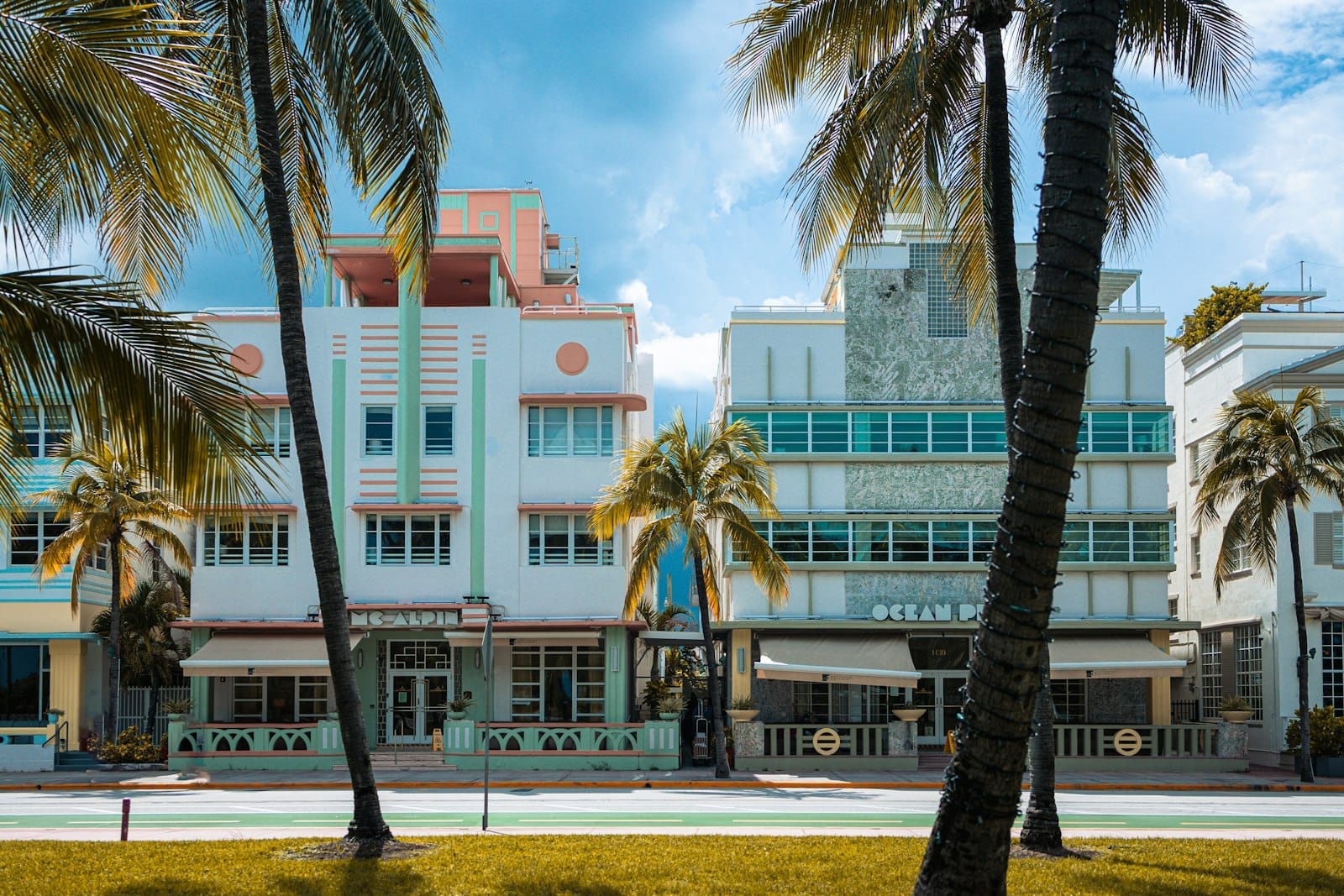
Ocean Drive is a public street and beachfront promenade running approximately 1.3 miles (about 2.1 km) along the eastern edge of South Beach, from just south of 1st Street in the south to 15th Street near Lummus Park. It is, without exaggeration, the most recognizable block of pavement in Miami, possibly in all of Florida. The street's fame comes from a single, photogenic fact: one side is lined with a nearly unbroken row of pastel-colored Art Deco hotels and restaurant terraces, while the other side opens onto Lummus Park and the Atlantic Ocean.
There is no ticket booth, no entry gate, and no formal hours. Ocean Drive is a functioning public road. Anyone can walk the length of it at any time of day or night. That accessibility is part of its appeal and part of its limitation: you share it with delivery trucks at dawn, photo tours at noon, and nightclub lines at midnight, all equally entitled to be there.
ℹ️ Good to know
Since mid-2020, a municipal resolution has restricted most vehicular traffic on Ocean Drive to create a pedestrian-priority zone, significantly reducing through traffic. The result is a calmer, more walkable strip than it was in earlier decades, though service vehicles and hotel drop-offs still use portions of the road.
The Architecture: Why This Street Matters
The buildings along Ocean Drive were constructed primarily in the 1930s, a period when Miami Beach was aggressively marketing itself as a resort destination. Architects working in the Streamline Moderne and Art Deco styles gave the street its defining visual character: rounded corners, eyebrow ledges designed to shade windows from the subtropical sun, racing stripes of horizontal molding, and facades painted in sherbet tones of coral, mint, and cream. The colors, incidentally, are largely a 1980s interpretation, introduced during restoration work, rather than the original palette.
The broader Miami Beach Art Deco Historic District, which includes Ocean Drive as its spine, contains roughly 800 contributing structures on the National Register of Historic Places. This makes it one of the largest concentrations of Art Deco architecture in the United States. The Cardozo, the Carlyle, and the Colony Hotel are among the most photographed facades on the strip, each representing slightly different expressions of the style.
For a deeper understanding of the architectural context, the Art Deco Historic District extends several blocks inland and is worth exploring on foot alongside Ocean Drive. The Miami Design Preservation League offers guided tours that depart from a location on Ocean Drive and provide architectural detail that a self-guided walk cannot replicate.
💡 Local tip
Walk the west side of the street (the building side) to examine facade details up close, then cross to the park side for full-length photographs. Late afternoon light hits the facades at a flattering angle for photography.
Tickets & tours
Hand-picked options from our booking partner. Prices are indicative; availability and final rates are confirmed when you complete your booking.
Guided tour of Oceanfront to discover the best donuts in Miami
From 46 €Instant confirmationFree cancellationSelf-guided driving tour from Miami to the Florida Keys
From 15 €Instant confirmationEverglades National Park Self-Guided Driving Audio Tour
From 15 €Instant confirmationFree cancellationUltimate Florida Self-Guided Driving Audio Tour
From 26 €Instant confirmationFree cancellation
How the Street Changes Throughout the Day
Early morning, roughly 6:30 to 9:00 a.m., is when Ocean Drive earns its quietest and most atmospheric hour. The restaurant terraces are empty or just setting up. The facades catch the low eastern light. A few joggers and cyclists move along the park-side path. The smell is salt air and coffee drifting from hotel lobbies. This is the version of Ocean Drive that most visitors never see, and it is genuinely worth the early alarm.
By mid-morning the street has transitioned into tourist territory. Walking tours gather at the southern end. Restaurant hosts begin their sidewalk pitches, which can feel persistent. By noon the outdoor terraces are full and the street is at its most photogenic and most crowded simultaneously. Heat is significant from late spring through September, with temperatures regularly reaching the high 80s to low 90s Fahrenheit (around 31-33°C). In summer, carry water.
Evening transforms the character entirely. From around 7:00 p.m. onward, the neon signs activate, the restaurants fill with diners, and the acoustic mix shifts to music spilling from bar entrances. The Deco facades look best under artificial light at dusk, when the colors deepen and the geometric details catch the glow. Weekend evenings from 9:00 p.m. onward bring significantly heavier foot traffic, club lines, and noise. If loud nightlife is not your preference, a Thursday evening or early Friday visit offers the lit-up atmosphere with fewer crowds.
⚠️ What to skip
Weekend nights on Ocean Drive can feel overwhelming if you are not prepared for dense crowds, persistent promoters, and high ambient noise. Budget travelers should also know that drinks and meals at Ocean Drive venues carry a premium, often significantly above typical Miami Beach prices.
Walking the Strip: A Practical Orientation
A comfortable walk from the 1st Street end to 15th Street takes about 20 to 30 minutes at a relaxed pace, not accounting for stops. The southern end near 1st Street is quieter and closer to South Pointe Park. The energy intensifies as you move north through the 5th to 12th Street corridor, which contains the highest concentration of hotels, outdoor dining terraces, and bars. The northern end near 13th and 14th Streets softens again into a more residential feel.
Immediately west of Ocean Drive is Collins Avenue and the broader grid of South Beach. Directly east, across Lummus Park's strip of grass and palm trees, is the beach itself. The Lummus Park Beach is publicly accessible without any fee and is one of the most central and well-maintained beach sections in South Beach. Transitioning between the street and the beach takes about three minutes on foot.
The promenade running parallel to the beach on the park side is paved, flat, and suitable for cycling and walking. It connects to a broader beachfront path. The surface is smooth and step-free, making it accessible for wheelchair users, though individual restaurant terraces and hotel entrances vary. Public restrooms are available within Lummus Park.
Getting There and Practical Logistics
The free Miami Beach Trolley runs every 30 minutes between approximately 8:00 a.m. and 11:00 p.m. on most routes, with some weekend and route-specific variations in hours and frequency, and stops within a few blocks of Ocean Drive along Washington Avenue and Collins Avenue. This is the most practical free transit option for visitors already on Miami Beach. Miami-Dade Metrobus connects the mainland to Miami Beach and serves stops on Washington Avenue, one block west of Ocean Drive.
Ride-hailing (Uber and Lyft) is the most convenient option from other parts of Miami. Drop-off on Ocean Drive itself depends on traffic restrictions, so drivers typically stop on Collins Avenue or Washington Avenue. For broader guidance on moving around the city, see the getting around Miami guide.
Driving and parking on Ocean Drive is complicated, particularly on weekends. Public garages exist nearby on Collins Avenue and on Washington Avenue. Street parking meters are in effect throughout the area. If arriving by car, plan to park and walk rather than circling for a spot.
What Ocean Drive Gets Wrong, and Who Should Know
Ocean Drive is not a secret, and it does not pretend to be. It is one of the most commercially developed stretches of street in Miami, and some of the outdoor restaurants along it are more focused on volume than quality. Menus are often priced for tourists with limited comparison points. If your priority is eating well in South Beach, Lincoln Road or Española Way offer better value and a more local atmosphere.
Visitors who find the Wynwood arts scene or the residential quiet of Coconut Grove more appealing may find Ocean Drive too performative. It is a spectacle, and it rewards people who enjoy spectacle. Architecture enthusiasts who want to go deeper will get more from a structured tour of the broader Art Deco district than from a restaurant terrace.
For families, the street is perfectly walkable and the beach access is excellent, but the nightlife noise and bar density from around 9:00 p.m. onward makes late evening visits unsuitable for young children. Morning visits with beach access are ideal for families.
Miami's climate matters here more than most people expect. From June through September, afternoon heat on a south-facing, open street with limited shade is genuinely uncomfortable. The dry season, roughly November through April, brings more manageable temperatures and is the period most visitors to Miami prefer. For timing your broader trip, the best time to visit Miami guide covers seasonal trade-offs in detail.
Insider Tips
- The Cardozo Hotel at 1300 Ocean Drive has a bar terrace that offers excellent views of the strip without requiring a reservation. It is one of the less aggressively marketed spots on the block.
- Walk the full length to 15th Street and then cut west one block to Collins Avenue for the return. The Collins side shows a different, slightly less tourist-dense face of the same Deco architecture.
- Photography is best from the Lummus Park side of the street, not from the building side. Standing in the park and shooting back across the road gives you full facades with the Art Deco details visible above the restaurant canopies.
- The Miami Design Preservation League runs guided walking tours that start on Ocean Drive. The architecture commentary they provide turns what is otherwise a street stroll into a genuinely informative experience.
- If you are visiting on a weekday, the outdoor restaurant terraces are noticeably more relaxed. Hosts are less aggressive, noise levels are lower, and you can actually hold a conversation while looking at the architecture.
Who Is Ocean Drive For?
- First-time visitors to Miami who want to see the postcard version of South Beach
- Architecture and design enthusiasts interested in American Art Deco
- Evening diners who want outdoor seating with atmosphere
- Morning joggers and cyclists wanting a flat beachfront route
- Photographers working in golden hour or dusk light
Nearby Attractions
Other things to see while in South Beach:
- Art Deco Historic District
The Miami Beach Art Deco Historic District preserves more than 800 historic buildings along Ocean Drive, Collins Avenue, and Washington Avenue, making it one of the world's largest concentrations of Art Deco architecture. Listed on the National Register of Historic Places in 1979, the district is free to explore on foot and rewards visitors at every hour of the day.
- Española Way
Conceived in the early 1920s as an artists' colony and largely completed by 1925, Española Way is a roughly two-block pedestrian stretch in South Beach where Spanish Revival architecture, open-air restaurants, and a quieter pace of life offer a genuine contrast to the Ocean Drive scene. Admission is free and the street is open around the clock.
- Jewish Museum of Florida–FIU
Occupying two landmark synagogue buildings from 1929 and 1936 at 301 and 311 Washington Avenue, the Jewish Museum of Florida–FIU tells the story of Jewish life in Florida across more than 250 years. The 1936 building alone, designed by Art Deco master Henry Hohauser, is worth the visit for its copper dome and 80 stained-glass windows.
- Lincoln Road Mall
Lincoln Road Mall is an eight-block pedestrian promenade running through the heart of Miami Beach, flanked by over 200 shops, restaurants, galleries, and cafés. Redesigned in the late 1950s by architect Morris Lapidus, it is often cited as one of the earliest open-air pedestrian malls in the United States. Free to enter and open around the clock, it offers a very different experience at 9 a.m. than it does at 10 p.m.