Waterfall Gully & First Falls: Adelaide's Most Rewarding Urban Escape
Waterfall Gully is a free natural reserve in the Adelaide Hills, about 8 km east of the city centre. The gorge shelters First Falls, a tiered waterfall feeding a clear pool, and connects to the popular trail up to Mount Lofty Summit. It draws everyone from early-morning joggers to families on weekend picnics — and rewards those who time their visit after winter rain.
Quick Facts
- Location
- Waterfall Gully Road, Waterfall Gully SA 5066 — approx. 8 km east of Adelaide CBD
- Getting There
- No direct public transit to the car park; drive via Glen Osmond Road, or take a taxi/rideshare. Verify current Adelaide Metro bus options before visiting.
- Time Needed
- 30–45 min for the falls and pool; 2.5–3.5 hrs return if continuing to Mount Lofty Summit
- Cost
- Free entry. Parking is free but limited on weekends.
- Best for
- Nature walks, photography, family outings, trail running, post-rain waterfall chasing
- Official website
- www.parks.sa.gov.au/parks/waterfall-gully
What Waterfall Gully Actually Is
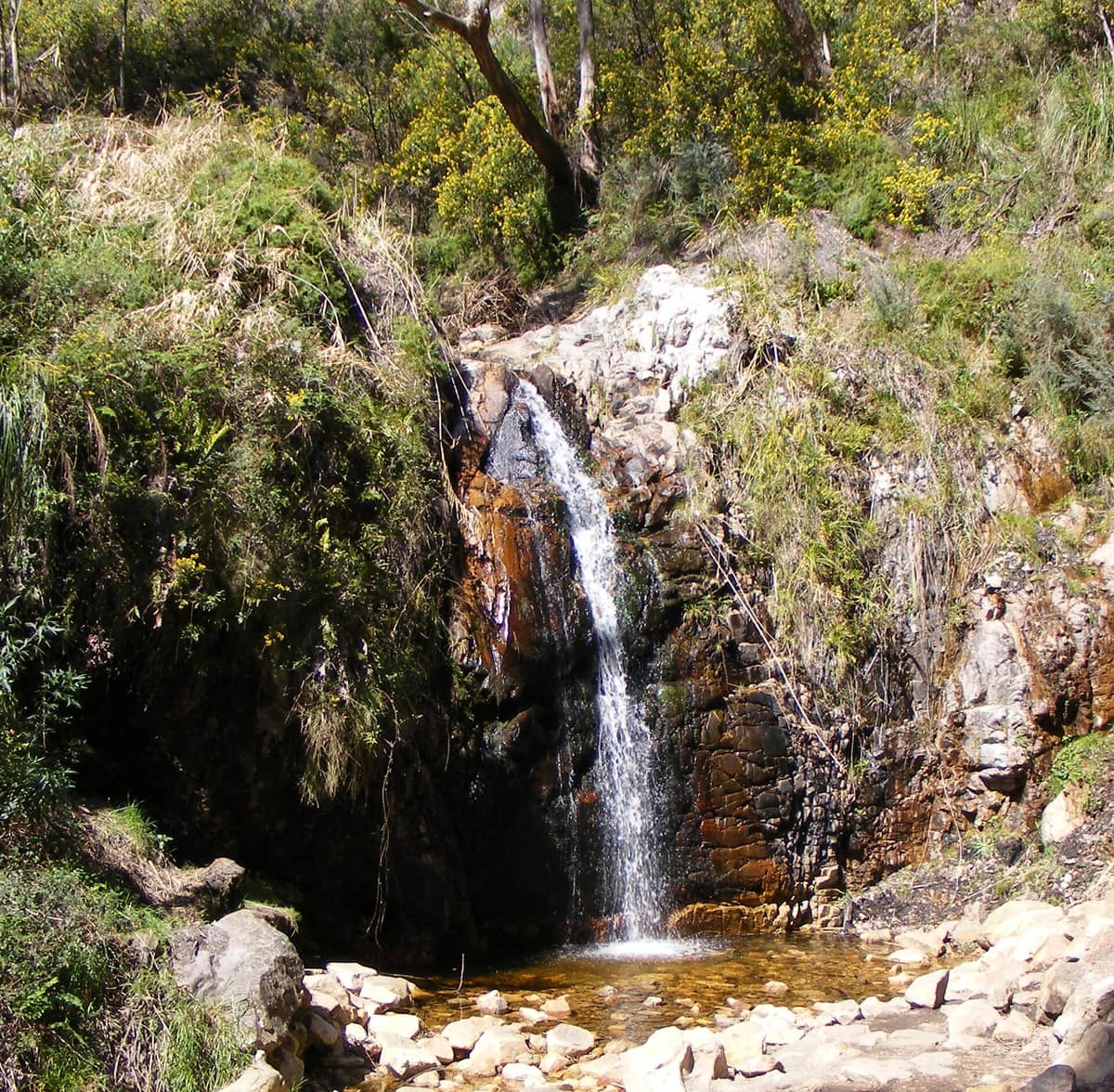
Waterfall Gully is a narrow sandstone gorge managed by the National Parks and Wildlife Service South Australia, sitting at the western edge of the Mount Lofty Ranges. Its centrepiece, First Falls, is a multi-tiered waterfall that drops into a broad, shallow pool surrounded by native vegetation. At its best, the falls flow strongly enough that you can hear the water before you see it; at their quietest, in late summer, the cascade shrinks to a trickle over dark, moss-covered rock.
The gorge itself is the start of the most popular walking route to Mount Lofty Summit, which means the car park and lower trail act as a funnel for a wide range of visitors: trail runners, families with prams on the short paved section, and serious hikers with trekking poles heading for the top. Understanding this layered use helps you plan the experience you actually want.
ℹ️ Good to know
The park may close on days of catastrophic fire danger and sometimes on days of extreme fire danger. Check the National Parks and Wildlife Service South Australia website or the SA Government fire danger app before visiting between December and March.
The Falls Themselves: What to Expect by Season
First Falls was recorded by surveyor John William Adams in January 1837 — he called it 'Adams' Waterfall' — making it one of the earliest European-documented natural features in the Adelaide Hills. The name 'First Falls' distinguishes it from Second Falls, which requires a steeper side trail further up the gully.
Adelaide's Mediterranean climate means the waterfall is most impressive between June and September, when winter rain drives water down through the Mount Lofty Ranges. After heavy rain, the falls can be genuinely dramatic: a white curtain dropping roughly 20 to 30 metres over layered sandstone ledges, with spray misting the ferns that line the pool's edge. The air smells of wet eucalyptus and cool stone. Visit in January or February and you may find the pool reduced to a shallow puddle and the rock face barely damp. That is simply the rhythm of a seasonal waterfall in a dry climate.
Spring visits, particularly September through November, often strike the best balance: water is still flowing from winter rainfall, temperatures are comfortable for walking (typically 11–22°C), and the surrounding bush is actively green rather than sun-bleached.
💡 Local tip
Photography tip: The pool sits in a gorge that receives direct sunlight only around midday. For even, shadow-free shots of the falls, aim for late morning on a lightly overcast day — flat light reveals the texture of the sandstone much better than harsh sun.
Tickets & tours
Live prices and dates from our booking partner. If you book, we may earn a commission at no extra cost to you.
Ultimate Adelaide and Hahndorf full-day tour
From 94 €Instant confirmationFree cancellationHalf-day Lofty Descents tour by bike
From 89 €Instant confirmationFree cancellationAdelaide kayak tour with expert instructors
From 51 €Instant confirmationFree cancellationTrue Crime Tour in Adelaide
From 21 €Instant confirmationFree cancellation
The Walk: From Car Park to Pool and Beyond
The car park on Waterfall Gully Road has two dedicated accessible parking spaces. From there, a 300-metre sealed bitumen path runs directly to the First Falls pool. The gradient is gentle but not entirely flat; the National Parks service notes that some sections may require assistance for wheelchair users. For most visitors with limited mobility or young children in prams, the path provides a workable route to the water's edge.
Beyond the sealed section, the trail becomes compacted gravel and then a mixture of rock and root as it climbs through the gully toward Second Falls and eventually Mount Lofty Summit, 7.5 km return from the car park. The trail climbs through steep hills; the official trail listing does not specify an elevation gain. It is not technical, but it is sustained: the middle section in particular is a consistent uphill push through dense native scrub, where you hear currawongs and rosellas far more than you see other walkers.
Walkers who complete the full route to the top emerge at Mount Lofty Summit, where a café and 360-degree views over Adelaide reward the effort. From the summit, the city grid and the Gulf St Vincent are visible on clear days. It is possible to arrange a pickup at the summit rather than walking back down — useful if the group energy runs out at the top.
How the Experience Changes Through the Day
Arrive before 8 am on a weekday and the gully feels like it belongs to the local trail-running community. The car park is quiet, the light is low and golden through the eucalypts, and the only sounds are footsteps on gravel and bird calls. Crimson rosellas are reliably present near the trail head in the morning; kookaburras are loudest at dawn and dusk.
By 9:30 to 10 am on weekends, the car park fills quickly. Families with children, weekend walkers, and groups of friends all converge in the same window, and the lower section of the trail near the pool gets genuinely crowded. The pool area can feel like a shared outdoor lounge room on a fine Saturday morning in spring — pleasant, but not solitary.
Midday brings the most direct sun into the gorge and the highest footfall. This is not the best time to visit either for photography or for quiet. By 2 pm, particularly on weekdays, the crowds thin considerably and the afternoon light catches the sandstone cliff in warm tones that the morning misses entirely.
⚠️ What to skip
Parking is the main friction point at Waterfall Gully. On fine weekend mornings, the small car park fills before 9 am and overflow parking along Waterfall Gully Road is limited. Arriving before 8:30 am or after 2 pm significantly reduces the chance of a frustrating search for a space.
Practical Details: Getting There, What to Bring, Accessibility
The reserve sits about 8 km east of the Adelaide CBD via Glen Osmond Road and Greenhill Road, turning onto Waterfall Gully Road. Driving is the most straightforward option. Rideshare services operate in Adelaide and can drop you directly at the car park entrance; this also sidesteps the parking problem entirely if you plan to continue to Mount Lofty Summit and arrange a separate pickup.
There is no direct public transport route to the Waterfall Gully car park at time of writing — verify current Adelaide Metro bus routes at the getting around Adelaide guide before planning a transit-only trip.
Wear closed-toe shoes with grip, even if you only plan to walk to the pool. The bitumen path can be slippery when wet from waterfall spray. If you intend to continue to the summit, proper trail shoes are worth it: the upper section has loose rock and exposed roots. Carry water regardless of how short your planned walk is; there are no water fountains in the gorge.
The reserve is free to enter and open every day, subject to fire danger closures. It connects naturally with a broader Adelaide Hills hiking circuit and is often combined with a visit to Mount Lofty Botanic Garden or a stop at one of the Adelaide Hills towns.
Who This Works For — and Who Should Think Twice
Waterfall Gully suits a wide range of visitors. The sealed path to First Falls pool offers a short route to the waterfall, though some visitors may need assistance because of the gradient. Families with children old enough to walk on uneven ground find the short loop to the pool a very manageable outing. The full trail to the summit appeals to anyone who wants a real physical workout without driving further into the hills.
Visitors chasing a dramatic wilderness experience may find the lower section of Waterfall Gully too social, particularly on weekends. If solitude is the priority, consider Morialta Conservation Park, a short drive further into the hills with multiple waterfall trails and far more trail space to spread out. Morialta's Third Falls are significantly more impressive in peak flow.
Visitors arriving in January or February expecting a roaring waterfall are frequently disappointed. The falls are seasonal, and this is worth stating clearly: summer visits to Waterfall Gully are still pleasant walks through native bush, but the 'waterfall' part of the experience may not materialise. If you are timing a trip around the falls specifically, May through August is the reliable window.
For those interested in pairing natural beauty with cultural context, the Adelaide Hills are part of Kaurna Country. The Living Kaurna Cultural Centre in the city provides background on the traditional custodians of this landscape before or after a visit to the hills.
Insider Tips
- The pool at First Falls is shallow and rock-bottomed — children wade in it on warm days, but it is not a swimming hole in any meaningful sense. Don't plan a swim.
- If you drive, leave a jacket in the car. The gorge is noticeably cooler than the city in summer and can feel cold in winter despite sunshine at the car park level.
- The trail to Mount Lofty Summit passes a small wooden shelter at roughly the halfway point — useful reference if you are tracking progress or need a rest point before committing to the upper section.
- Weekday mornings after winter rain are the single best time to visit: the falls flow strongly, the light is soft, the car park is half-empty, and the air in the gorge smells of wet fern and damp sandstone in a way that is worth experiencing at least once.
- The Adelaide Hills can receive afternoon thunderstorms in summer with little warning. If dark clouds are building to the east when you arrive, keep an eye on conditions and don't push for the summit if weather is uncertain.
Who Is Waterfall Gully & First Falls For?
- Walkers and trail runners looking for a quick, accessible escape from the city
- Families with children who want a manageable nature walk with a clear destination
- Photographers seeking seasonal waterfall shots in a sandstone gorge setting
- Visitors combining the walk with a summit café stop at Mount Lofty
- Anyone with limited mobility wanting to reach a natural waterfall on a sealed path
Nearby Attractions
Other things to see while in Adelaide Hills:
- Belair National Park
Proclaimed in 1891, Belair National Park covers 840 hectares of native bushland in the Adelaide Hills, just 11 kilometres from the city centre. It offers walking trails, open grass areas, wildlife watching, and a genuine sense of space without requiring a full-day commitment.
- Carrick Hill
Carrick Hill is a beautifully preserved 1930s Arts and Crafts estate in Springfield, about 8 kilometres from the Adelaide CBD. The property combines a fully furnished house museum, a heritage garden designed to complement the architecture, and a contemporary gallery space — all set within a 100-acre estate in the Adelaide foothills.
- Cleland Wildlife Park
Cleland Wildlife Park sits within a 1,036-hectare national park in the Adelaide Hills, offering one of Australia's most intimate native wildlife experiences. Walk among free-roaming kangaroos, hand-feed wallabies, and get close to koalas — all within 20 minutes of the city centre.
- Gorge Wildlife Park
Set on 14 acres of Adelaide Hills bushland near Cudlee Creek, Gorge Wildlife Park has been introducing visitors to Australian native animals since 1965. It is one of the few places near Adelaide where you can hold a koala, hand-feed kangaroos, and observe over 150 species of Australian and exotic animals, birds, and reptiles in an unhurried, genuinely personal atmosphere.
Planning a trip? Discover personalized activities with the Nomado app.