Belair National Park: Adelaide's Oldest National Park, Right on the City's Doorstep
Proclaimed in 1891, Belair National Park covers 840 hectares of native bushland in the Adelaide Hills, just 11 kilometres from the city centre. It offers walking trails, open grass areas, wildlife watching, and a genuine sense of space without requiring a full-day commitment.
Quick Facts
- Location
- Upper Sturt Road, Belair SA 5052 — Upper Sturt Road, Belair SA 5052 — approximately 11 km southeast of Adelaide CBD
- Getting There
- Belair train line to Belair Station, located at the park's north-west corner
- Time Needed
- 2–4 hours for a relaxed visit; a full day if you plan to walk multiple trails
- Cost
- A$14.40 per vehicle; pedestrian and train arrivals do not pay a vehicle fee
- Best for
- Families, trail walkers, wildlife spotters, and anyone needing green space near the city
- Official website
- www.parks.sa.gov.au/parks/belair-national-park
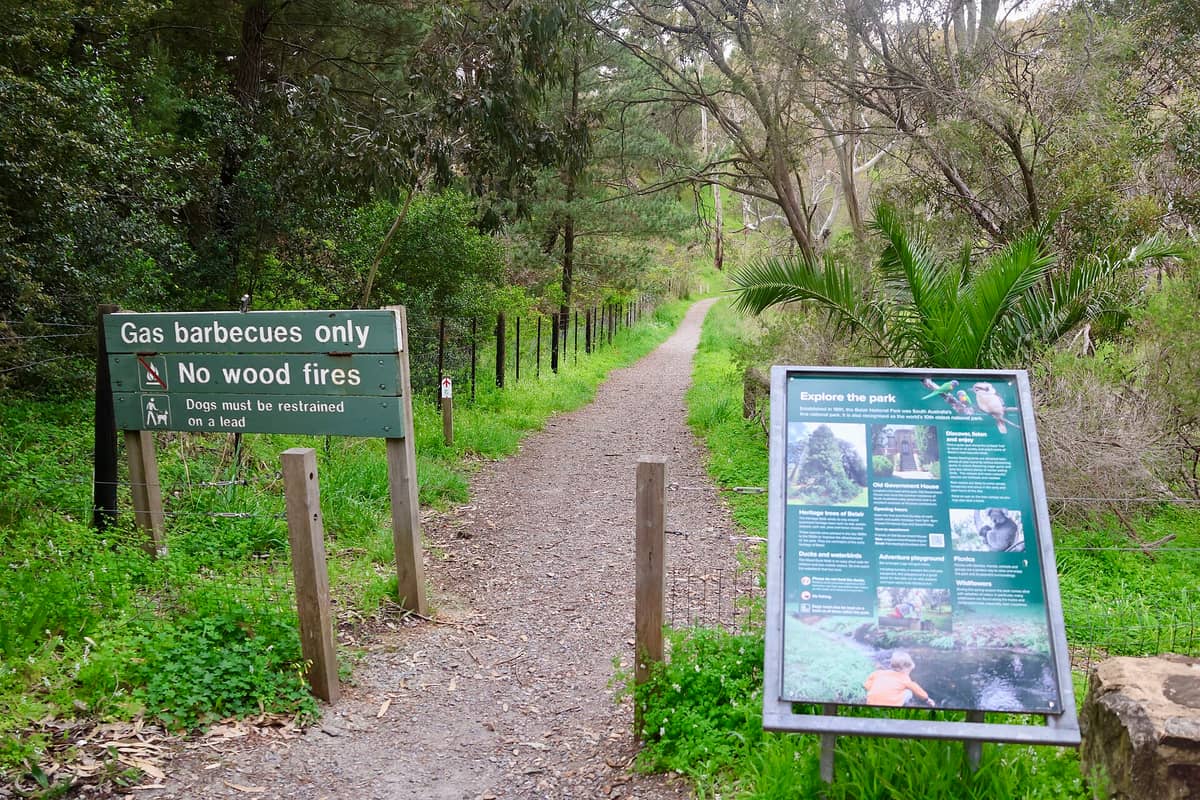
What Belair National Park Actually Is
Belair National Park holds a specific distinction in South Australian history: proclaimed in 1891, it is the state's first national park. That makes it older than most of Australia's conservation estate and older than many national parks worldwide. The Kaurna people, whose traditional lands encompass the Adelaide Plains and surrounding hills, have a deep connection to this area.
The park covers 840 hectares of native bushland in the Adelaide Hills, a short 11-kilometre drive southeast of the city. It functions as genuine bushland rather than a manicured park. The understorey is dense with native shrubs, the canopy is dominated by eucalypts, and the trails cross terrain that feels genuinely removed from suburban Adelaide despite the proximity.
For travellers comparing options in the hills, Belair is a solid choice for those who want accessible, well-maintained trails with picnic infrastructure. If you want more dramatic scenery and waterfalls, Waterfall Gully and Morialta Conservation Park are worth comparing. Belair's advantage is scale and variety: 840 hectares gives you room to spread out.
Arriving at the Park: What to Expect at the Gates
ℹ️ Good to know
Vehicle gates are open 8 am to 9 pm during daylight-saving months and 8 am to 7 pm during standard-time months. The park closes on days of catastrophic fire danger and may also close on days of extreme fire danger. Check the National Parks and Wildlife Service South Australia website before visiting in summer.
By car, you enter via Upper Sturt Road. The vehicle entry fee is A$14.40, paid at the gate. Arriving by train is a genuinely pleasant alternative: the Belair line runs from Adelaide city and deposits you at Belair Station, which sits directly at the park's north-west corner. You do not pay a vehicle entry fee on foot. The train journey takes roughly 30 minutes from the city and operates seven days, including public holidays; check current Adelaide Metro timetables before relying on specific weekend or public holiday services.
Getting around Adelaide and its surrounds by public transport is more practical than many visitors expect. For a broader overview of transit options, the getting-around Adelaide guide covers the full network including train fares and how to use the Metrocard.
Tickets & tours
Live prices and dates from our booking partner. If you book, we may earn a commission at no extra cost to you.
Ultimate Adelaide and Hahndorf full-day tour
From 94 €Instant confirmationFree cancellationHalf-day Lofty Descents tour by bike
From 89 €Instant confirmationFree cancellationAdelaide kayak tour with expert instructors
From 51 €Instant confirmationFree cancellationTrue Crime Tour in Adelaide
From 21 €Instant confirmationFree cancellation
The Trails: Variety Without Extreme Difficulty
Belair's trail network caters to a wide range of fitness levels. The terrain is hilly rather than flat, so expect some elevation change on most routes, but nothing that requires technical hiking experience. The trails are clearly signposted, and the park's size means you can choose a short 45-minute loop or extend your walk to cover several kilometres of ridge and gully country.
Morning light through the eucalypt canopy is one of the park's quiet pleasures. By 7 am in warmer months, the bush is already active: currawongs call across the ridge, crimson rosellas move through the mid-canopy, and the air carries the faint resinous scent of gum leaves warming up. The sounds change noticeably once the day heats up. Midday in summer is quiet in a different way, with cicadas and the occasional rustle of a lizard in the leaf litter.
Kangaroos are common in the open grassed areas, particularly in the early morning and around dusk. They tend to be unfazed by people at a reasonable distance. If you arrive via the train station and walk in through the northern sections of the park, you are likely to encounter them within the first 15 minutes. Keep noise low and avoid approaching closely, especially females with joeys.
💡 Local tip
Wear closed-toe shoes. The trails cross uneven ground, and some sections have loose rocks. In warmer months, carry at least one litre of water per person regardless of how short your planned walk is.
Picnic Areas and Family Infrastructure
Belair has a long tradition as a family day-use park, and that shows in its infrastructure. Picnic tables, barbecue facilities, and grassed open areas make up a significant part of the park's centre. On weekends and public holidays, these areas attract local families, and the atmosphere shifts from contemplative bushwalk to something more social. If you are after solitude, arrive early or take a trail away from the central picnic grounds.
For families with younger children, the grassed areas provide genuine value. The combination of open space, close-range wildlife encounters, and shade from mature trees keeps children engaged without the parents having to manage a difficult walk. There is also play equipment in some areas of the park.
If you are planning a family-focused Adelaide trip and want to combine Belair with other options, the Adelaide with kids guide gives a broader picture of what the region offers for younger visitors, including wildlife parks and beaches.
Accessibility and the All-Terrain Trike
Belair is one of the few national parks in South Australia that offers a free-to-hire all-terrain accessibility trike, allowing visitors with limited mobility to access parts of the park that would otherwise be difficult. Accessible parking is available at several locations within the park. That said, the terrain is naturally hilly and most trails are not fully accessible. If you are planning a visit with specific mobility needs, contact the National Parks and Wildlife Service South Australia in advance to confirm which areas and facilities are suitable.
When to Visit: Seasons and Fire Risk
Adelaide's Mediterranean climate gives Belair a clear seasonal rhythm. Spring, from September to November, is the most rewarding time to visit. Wildflowers appear across the understorey, the temperatures sit between roughly 11 and 22 degrees Celsius, and the light through the canopy is at its most photogenic. Autumn, March to May, offers similar mildness with less flower activity but good walking conditions.
Summer visits are viable but require planning. Temperatures can exceed 35 degrees Celsius, and the park closes on days of extreme or catastrophic fire danger. If you visit in summer, go early, carry ample water, and monitor the South Australian fire danger rating via the Country Fire Service or the Bureau of Meteorology before leaving home. The park can close with short notice on high-risk days.
Winter is cooler and quieter. Rainfall increases from May through August, which can make trails muddy and some creek crossings slippery. The upside is that the park is significantly less busy, and the cooler air makes longer walks more comfortable. The eucalypts look particularly good after rain, with the bark taking on deeper colour tones.
⚠️ What to skip
Belair National Park closes on Christmas Day and on days of catastrophic fire danger; it may also close on days of extreme fire danger. These closures can be declared with limited advance notice. Always check the National Parks and Wildlife Service SA website or the SA Fires app before visiting during hot weather.
Photography Notes and Honest Limitations
The park is not a dramatic photographic destination in the way that coastal cliff formations or mountain ranges can be. What it offers is quieter: dappled eucalypt light, close-range wildlife, native wildflowers in spring, and the texture of Australian bushland at different times of day. Early morning is the best time for both wildlife photography and softer light. The open grassed areas in the park centre are good for kangaroo shots if you are patient.
Travellers who arrive expecting Instagram-ready landscapes with panoramic views may find Belair underwhelming. The views are largely canopy-level. The attraction is immersion in working bushland, not spectacle. If dramatic views are your priority, the lookout options in the wider Adelaide Hills are a better fit.
For viewpoints with genuine panoramic payoff in the Adelaide Hills, Mount Lofty Summit sits nearby and gives a 360-degree view over the city and coast. It pairs well with a Belair morning if you have a full day in the hills.
Insider Tips
- Arriving by train rather than car saves you the A$14.40 vehicle entry fee and drops you directly at the park's north-west entrance. The walk from Belair Station into the park is straightforward and takes about five minutes.
- The park's central picnic areas fill quickly on warm weekends. If you want a table without competition, arrive before 10 am or target the less-central picnic spots shown on the park map available at the entrance.
- The free-to-hire all-terrain accessibility trike must be booked in advance. If you or someone in your group would benefit from it, contact the National Parks and Wildlife Service South Australia before your visit rather than assuming it will be available on the day.
- Spring wildflower season, roughly September to October, adds a layer of colour to the understorey that makes the same trails significantly more rewarding than in other months. If your travel dates overlap with spring, Belair is worth prioritising.
- The park closes on days of catastrophic fire danger and may close at short notice on days of extreme fire danger. Build flexibility into your itinerary if visiting between December and February, and always check fire ratings on the morning of your visit.
Who Is Belair National Park For?
- Families with children who want open green space, picnic facilities, and kangaroo encounters within easy reach of the city
- Walkers looking for a multi-hour trail experience without needing a car or a full-day mountain commitment
- Visitors travelling on a tighter budget who want genuine bushland without paying for a guided experience
- Spring travellers who want native wildflowers and mild temperatures in a well-maintained park setting
- Accessibility-focused visitors who want bushland access: the all-terrain trike hire is a rare and practical offering
Nearby Attractions
Other things to see while in Adelaide Hills:
- Carrick Hill
Carrick Hill is a beautifully preserved 1930s Arts and Crafts estate in Springfield, about 8 kilometres from the Adelaide CBD. The property combines a fully furnished house museum, a heritage garden designed to complement the architecture, and a contemporary gallery space — all set within a 100-acre estate in the Adelaide foothills.
- Cleland Wildlife Park
Cleland Wildlife Park sits within a 1,036-hectare national park in the Adelaide Hills, offering one of Australia's most intimate native wildlife experiences. Walk among free-roaming kangaroos, hand-feed wallabies, and get close to koalas — all within 20 minutes of the city centre.
- Gorge Wildlife Park
Set on 14 acres of Adelaide Hills bushland near Cudlee Creek, Gorge Wildlife Park has been introducing visitors to Australian native animals since 1965. It is one of the few places near Adelaide where you can hold a koala, hand-feed kangaroos, and observe over 150 species of Australian and exotic animals, birds, and reptiles in an unhurried, genuinely personal atmosphere.
- Hahndorf
Founded in 1839 by Prussian Lutheran settlers, Hahndorf is Australia's oldest surviving German settlement and a State Heritage Area in the Adelaide Hills. Expect a well-preserved heritage streetscape, independent food producers, cellar doors, and a relaxed pace that rewards a half-day at minimum.
Planning a trip? Discover personalized activities with the Nomado app.