Carrick Hill: Adelaide's Finest Arts and Crafts Estate
Carrick Hill is a beautifully preserved 1930s Arts and Crafts estate in Springfield, about 8 kilometres from the Adelaide CBD. The property combines a fully furnished house museum, a heritage garden designed to complement the architecture, and a contemporary gallery space — all set within a 100-acre estate in the Adelaide foothills.
Quick Facts
- Location
- 46 Carrick Hill Drive, Springfield SA 5062 — approx. 8 km from Adelaide CBD
- Getting There
- Best reached by car or rideshare; mobility drop-off available via 5 Meadowvale Road
- Time Needed
- 2 to 3 hours for house tour, garden walk, and gallery
- Cost
- House Museum audio tour: A$20 adult, A$18 concession, free under 15. Guided tour: A$20 adult, A$18 concession, A$3 under 15. Garden entry: free except for special events.
- Best for
- Architecture lovers, garden enthusiasts, design history fans, and a quiet half-day away from the city
- Official website
- www.carrickhill.sa.gov.au
What Carrick Hill Actually Is
Carrick Hill is a heritage estate in the suburb of Springfield, sitting at the edge of the Adelaide Hills just far enough from the city to feel genuinely removed from it. The centrepiece is a stone and timber house built between 1937 and 1939 for Sir Edward and Lady Ursula Hayward. The house is one of the most intact examples of the Arts and Crafts domestic tradition in Australia, and unlike many heritage properties that have been stripped of their contents, Carrick Hill retains much of its original furniture, textiles, and decorative objects. The estate opened to the public in 1985 and is now managed as a museum, gallery, and garden destination.
The property works on several levels at once. It is genuinely interesting as architecture. It is also a social document: the Haywards were significant figures in Adelaide's cultural life, and the house reflects a particular mid-century idea of how educated, arts-minded South Australians wanted to live. And for visitors who care less about any of that, the grounds alone are worth the drive — several hectares of garden that change character through the seasons and offer views back across the metropolitan fringe toward the plains.
ℹ️ Good to know
The House Museum closes during July for annual care and conservation. Plan your visit between August and June. The estate is also closed on Good Friday and Christmas Day, and opens at noon on Anzac Day.
The House Museum: Architecture and Interior Detail
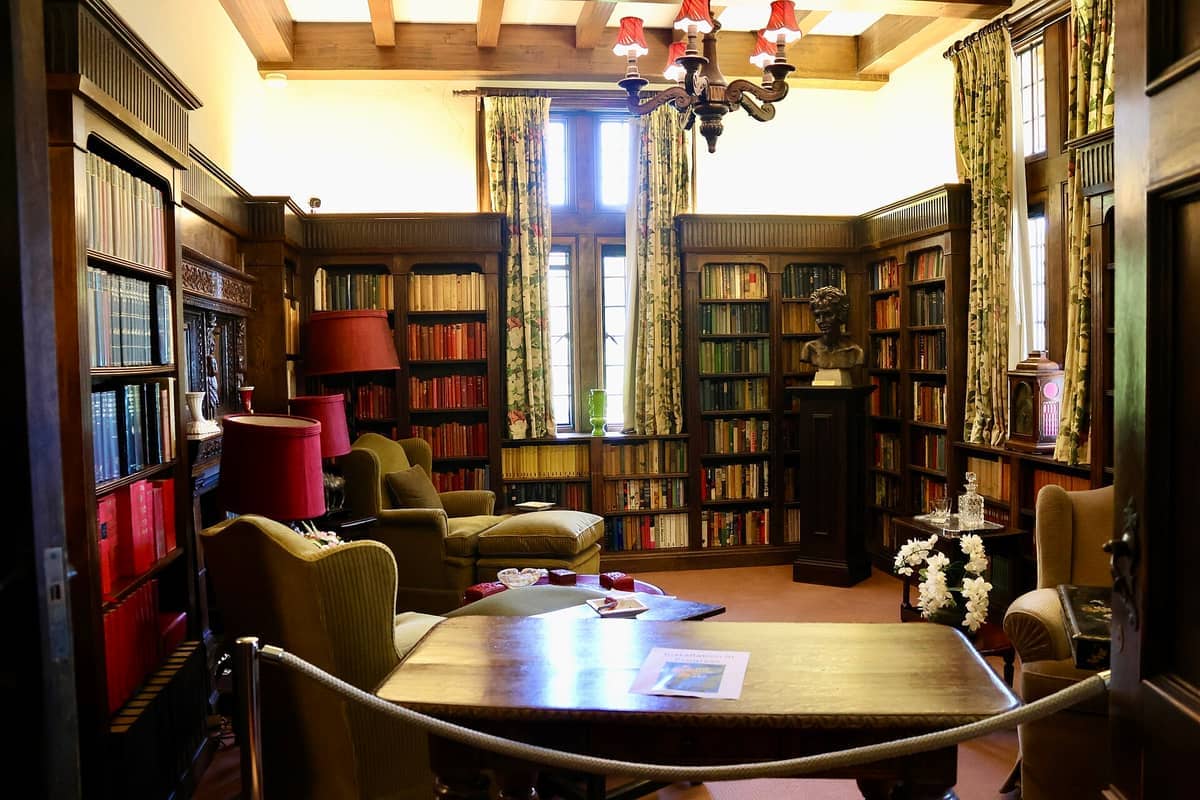
The design draws on English Arts and Crafts principles: local stone walls, steeply pitched rooflines, timber joinery crafted with evident care, and rooms arranged to maximize natural light and connection to the garden rather than to impress visitors with grand proportions. The result is a house that feels designed for actual living rather than display, which makes it unusual among heritage properties of comparable significance.
Inside, the audio tour — included in the standard A$20 adult admission — guides you through the main rooms at your own pace. The kitchen is notably complete, with its original fittings largely in place. The living spaces retain furniture selected by the Haywards, and the overall effect is less museum-sterile than many comparable properties. Light falls differently in each room depending on the time of day, and morning visits tend to catch the interior at its warmest. The house also has an elevator serving all three floors, making it accessible to visitors who cannot manage stairs.
Guided house tours are also available at the same price point (A$20 adult, A$18 concession, A$3 for children under 15) and offer more contextual detail about the Haywards and the design decisions behind the building. If you have a genuine interest in Australian design history or the Arts and Crafts movement, the guided option is worth choosing.
💡 Local tip
Arrive when the property opens at 10:00 am on a weekday for the quietest experience inside the house. Weekend afternoons draw more visitors, and the rooms feel noticeably smaller when crowded.
Tickets & tours
Live prices and dates from our booking partner. If you book, we may earn a commission at no extra cost to you.
Ultimate Adelaide and Hahndorf full-day tour
From 94 €Instant confirmationFree cancellationHalf-day Lofty Descents tour by bike
From 89 €Instant confirmationFree cancellationAdelaide kayak tour with expert instructors
From 51 €Instant confirmationFree cancellationTrue Crime Tour in Adelaide
From 21 €Instant confirmationFree cancellation
The Garden: What to Expect by Season
The garden at Carrick Hill was designed as an extension of the house rather than as a separate feature, and that relationship is still legible. Hedged compartments, terraced levels, and a deliberate sequence of views connect the built and planted elements. The garden at Carrick Hill was designed as an extension of the house rather than as a separate feature, and that relationship is still legible. Hedged compartments, terraced levels, and a deliberate sequence of views connect the built and planted elements. The design was modelled on the English country garden and park.
Spring, from September through November, is the most photogenic period: flowering bulbs, wisteria on the pergola structures, and fresh growth on the deciduous trees combine to make the garden genuinely attractive. Autumn brings a different set of colours as the trees turn, and the lower-angle light in March and April is flattering for photography. Summer can be harsh in the Adelaide Hills foothills, and some areas of the garden look stressed during prolonged heat. Winter sees the garden quieter and somewhat austere, though the stone architecture reads particularly well against bare branches.
The garden grounds are only partially accessible for mobility-impaired visitors, and the official visitor information notes that some areas are not easily accessible. The service entrance at 5 Meadowvale Road provides the closest drop-off point to the house for visitors with mobility needs. For a broader sense of gardens worth visiting in the region, the Mount Lofty Botanic Garden is about fifteen minutes further into the hills and operates at a different scale entirely.
The Gallery and Cultural Program
Alongside the heritage house, Carrick Hill maintains a gallery space that hosts changing exhibitions, typically with a focus on South Australian art and craft. The programming tends toward work that engages with the estate's design history or the broader applied arts tradition rather than contemporary fine art for its own sake, though this varies by exhibition. Check the official website before visiting if the gallery program influences your decision to come.
The estate occasionally hosts events, workshops, and seasonal programs, particularly around the garden calendar. Adelaide's broader cultural landscape offers plenty of context for this kind of programming: the Art Gallery of South Australia in the CBD and the South Australian Museum together cover the more encyclopedic end of the city's cultural offer, while Carrick Hill operates at a more intimate, domestic scale.
Getting There and Practical Planning
Carrick Hill sits at 46 Carrick Hill Drive, Springfield SA 5062. Visitors with mobility needs can use the service entrance at 5 Meadowvale Road for drop-off adjacent to the house.
Opening hours are Wednesday through Sunday, 10:00 am to 4:30 pm. The property is open on most public holidays with the same hours. Anzac Day is an exception: the estate opens at noon. It is closed on Good Friday and Christmas Day, and the House Museum closes entirely during July for conservation work. These are the kinds of details worth confirming on the official website before making a special trip.
Springfield sits at the southern edge of the broader Adelaide Hills area. Visitors combining Carrick Hill with a wider day out in the hills might also consider Waterfall Gully to the northeast, or pairing the visit with a drive through the Adelaide Hills toward Hahndorf or the Piccadilly Valley.
⚠️ What to skip
The estate is closed Monday and Tuesday. Many visitors arriving mid-week discover this the hard way. Double-check the day of your visit before heading out.
Who Will Get the Most From Carrick Hill
Visitors with a genuine interest in Australian design history, Arts and Crafts architecture, or heritage interiors are likely to find Carrick Hill genuinely rewarding. The level of preservation is unusual, and the audio tour provides enough contextual information that you do not need specialist knowledge to appreciate what you are seeing. Garden enthusiasts visiting in spring or autumn will also find the grounds worth their time.
Families with younger children may find the house museum less engaging for the children, though the garden provides outdoor space. The under-15 free entry on the audio tour and A$3 entry on the guided tour make the financial barrier minimal. Visitors primarily interested in a dramatic natural landscape or an active outdoor experience will likely find the property too sedate: Carrick Hill is quiet, unhurried, and essentially domestic in character. That is its appeal for the right visitor, and its limitation for anyone expecting spectacle.
For visitors building a broader itinerary around Adelaide's cultural attractions, the guide to the best museums in Adelaide situates Carrick Hill alongside the city's other heritage and cultural sites.
Insider Tips
- The house feels most atmospheric on overcast days, when the stone exterior darkens slightly and the interior lighting takes on a warmer quality. Clear-sky summer days can make the rooms feel bleached and flat by comparison.
- If you are visiting primarily for the garden, arrive in the first hour after opening. The garden sees minimal foot traffic in the morning, and the light is better for photography before noon.
- The audio tour is self-paced, which means you can linger in rooms that interest you without feeling pressured by a group. Budget at least 45 minutes for the house alone if you plan to actually read the interpretive material.
- Confirm the current gallery exhibition on the official website before visiting. Some exhibitions are significantly more interesting than others, and the gallery space is small enough that a weak show affects the overall visit.
- The service entrance at 5 Meadowvale Road is not obvious from the main approach. If you or a companion needs the accessible drop-off, look this up on a map before arrival rather than trying to find it on the day.
Who Is Carrick Hill For?
- Architecture and design history enthusiasts, particularly those with interest in the Arts and Crafts tradition
- Garden visitors in spring (September to November) and autumn (March to April)
- Travelers who prefer quiet, unhurried cultural experiences over high-traffic attractions
- Couples looking for a relaxed half-day away from the Adelaide CBD
- Visitors building a day itinerary through the Adelaide Hills foothills
Nearby Attractions
Other things to see while in Adelaide Hills:
- Belair National Park
Proclaimed in 1891, Belair National Park covers 840 hectares of native bushland in the Adelaide Hills, just 11 kilometres from the city centre. It offers walking trails, open grass areas, wildlife watching, and a genuine sense of space without requiring a full-day commitment.
- Cleland Wildlife Park
Cleland Wildlife Park sits within a 1,036-hectare national park in the Adelaide Hills, offering one of Australia's most intimate native wildlife experiences. Walk among free-roaming kangaroos, hand-feed wallabies, and get close to koalas — all within 20 minutes of the city centre.
- Gorge Wildlife Park
Set on 14 acres of Adelaide Hills bushland near Cudlee Creek, Gorge Wildlife Park has been introducing visitors to Australian native animals since 1965. It is one of the few places near Adelaide where you can hold a koala, hand-feed kangaroos, and observe over 150 species of Australian and exotic animals, birds, and reptiles in an unhurried, genuinely personal atmosphere.
- Hahndorf
Founded in 1839 by Prussian Lutheran settlers, Hahndorf is Australia's oldest surviving German settlement and a State Heritage Area in the Adelaide Hills. Expect a well-preserved heritage streetscape, independent food producers, cellar doors, and a relaxed pace that rewards a half-day at minimum.
Planning a trip? Discover personalized activities with the Nomado app.