Viru Gate: Tallinn's Medieval Gateway to the Old Town
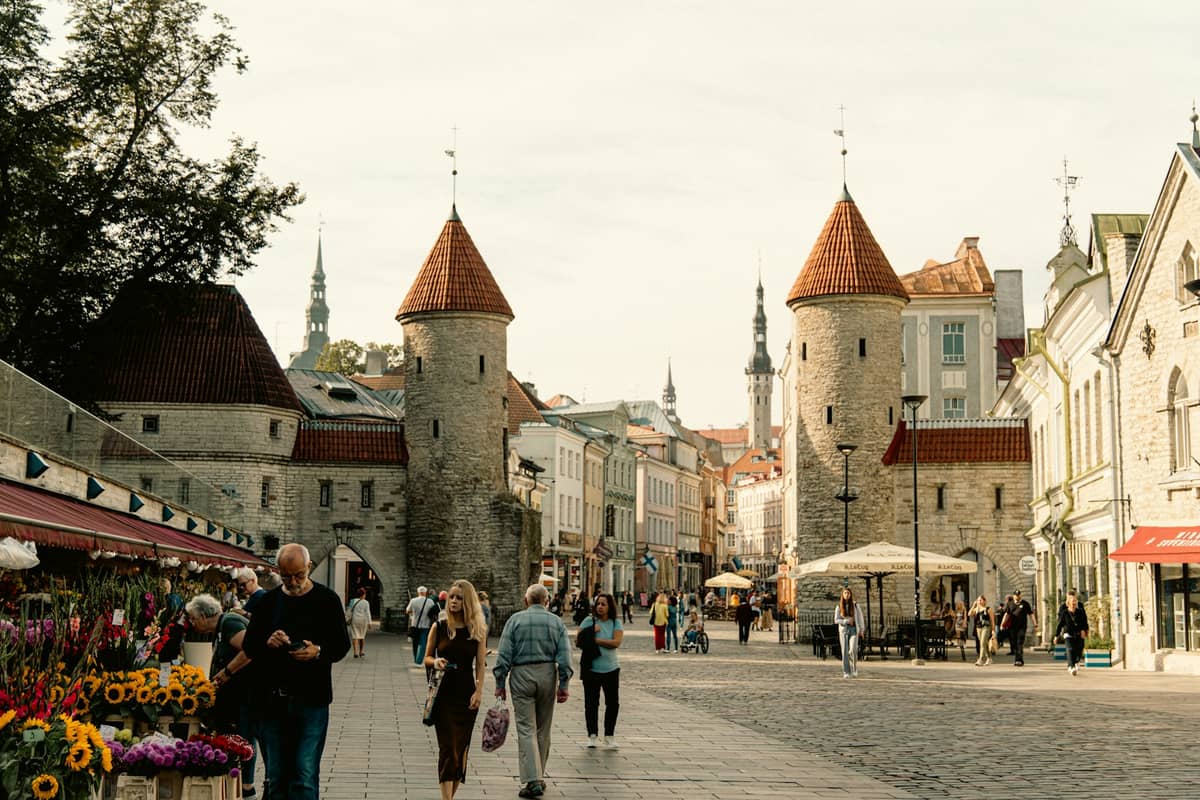
Viru Gate (Viru värav) marks the eastern entrance to Tallinn's UNESCO-listed Old Town, framed by two surviving medieval round towers. Free to visit at any hour, it serves as both a working pedestrian thoroughfare and one of the city's most photographed landmarks.
Quick Facts
- Location
- Viru tänav, Müürivahe 31, 10140 Tallinn
- Getting There
- Viru tram/bus stop by Viru Keskus — 2-minute walk
- Time Needed
- 10–20 minutes to explore the gate; longer if combined with a walk along the city walls
- Cost
- Free — no ticket, no booking required
- Best for
- First-time visitors, history enthusiasts, photographers, and anyone entering Old Town from the east
- Official website
- visitestonia.com/en/viru-gate
What Is Viru Gate?
Viru Gate — known in Estonian as Viru värav or Viru väravad — is what remains of the eastern city gate in Tallinn's medieval defensive wall. What you see today is a pair of compact round stone towers flanking the mouth of Viru Street, standing roughly four stories tall and built from the same pale limestone that gives Old Town its characteristic color. They are not museum pieces cordoned off by ropes. They are a living part of the city: pedestrians pass between them continuously throughout the day, and the gate serves as one of the primary pedestrian entrances into the UNESCO World Heritage-listed Old Town.
Originally, the gate complex was considerably larger. The two towers visible from Viru Street are the outer foregate towers; the inner gate and much of the connecting wall were demolished in the 19th century as the city expanded and medieval fortifications became obstacles rather than assets. What survived did so in part through luck and in part through later recognition of the Old Town's historic value. The road that passes through the gate was historically known as the Narva Road, since it formed the beginning of the main overland route toward Narva in eastern Estonia.
ℹ️ Good to know
Viru Gate is accessible 24 hours a day, 365 days a year. There is no entrance fee, no ticket booth, and no need to book. You walk through it the same way medieval merchants once did.
The Experience at Different Times of Day
The gate's character shifts dramatically depending on when you arrive. Early morning, before 9am, Viru Street is almost quiet. The cobblestones are damp from overnight rain or dew, the souvenir stalls along Müürivahe Street are still shuttered, and the towers catch the low eastern light in a way that makes the limestone look almost amber. If you want a photograph without a crowd, this is your window.
By mid-morning the transformation is complete. Tour groups funnel through in both directions, street vendors are set up along the walls, and the narrow passage between the towers creates a natural bottleneck. The sounds are layered: tour guides explaining medieval history in half a dozen languages, the clatter of rolling suitcases on cobblestones, and occasionally a street musician positioned just outside the towers. It is lively, but it can feel overwhelming if you have no specific reason to linger.
Evening brings a different atmosphere again. The tour groups thin out after dinner hours, the towers are lit from below by warm floodlights, and the gate takes on a theatrical quality. The flower sellers who set up along the Old Town wall just south of the gate are packing away their stalls. The arch frames a view straight down Viru Street toward the illuminated spires of the Old Town interior, and for a few minutes at dusk, the whole scene looks like a stage set.
Tickets & tours
Hand-picked options from our booking partner. Prices are indicative; availability and final rates are confirmed when you complete your booking.
Self-guided Discovery Walk of Tallinn city contrasts beyond the medieval walls
From 26 €Instant confirmationFree cancellationTallinn's art and culture tour with a local
From 62 €Instant confirmationFree cancellationHistorical walking tour of Tallinn with a local
From 599 €Instant confirmationFree cancellationIntroductory walking tour of Tallinn with a local guide
From 109 €Instant confirmationFree cancellation
Historical Context: More Than a Photo Backdrop
Tallinn's city walls, of which Viru Gate is a surviving component, were constructed and expanded over several centuries from the 13th through the 16th century. At their peak, the defenses included over 2 kilometers of wall, 46 towers, and multiple gate complexes. Tallinn (then called Reval, under the rule of the Teutonic Order and later the Hanseatic League) was a prosperous Baltic trading city, and its fortifications reflected both the wealth needed to build them and the genuine threats of medieval warfare.
The Viru Gate complex controlled the eastern approach to the city. Travelers arriving from Narva and the eastern territories would have entered through an outer gate first, then a second inner gate, creating a fortified killing ground between the two in case of attack. Only the outer foregate towers remain today. The broader story of the walls and their surviving towers is told in detail at the Kiek in de Kok tower museum, which is one of the most informative places to understand medieval Tallinn's defensive system.
For deeper context on the medieval period that produced Viru Gate and the surrounding Old Town, the Tallinn medieval history guide covers the city's Hanseatic trading past with useful precision.
What to Do Around the Gate
The gate is not a destination that demands extended time on its own. Most visitors spend 10 to 20 minutes here: looking at the towers from Viru Street, walking through the arch, and possibly taking photographs from both the Old Town side and the exterior side facing Viru Keskus shopping center. But the real value is in what surrounds it.
Immediately south of the gate, the stretch of Müürivahe Street running alongside the city wall is lined with small open-air market stalls selling hand-knitted wool goods: mittens, socks, hats, and sweaters in traditional patterns. This is one of the few genuinely local market experiences remaining near the Old Town center, and it runs from roughly spring through autumn. The quality is real and the prices are fair by comparison to souvenir shops a block away.
North of the gate, Viru Street leads directly into the heart of Old Town, past cafes and amber shops, eventually connecting to Town Hall Square. A full walking route that takes in Viru Gate as a starting point is mapped out in the Tallinn Old Town walking tour, which is worth reviewing before you set out.
The Tallinn city wall itself is walkable in sections nearby, and several towers along Müürivahe offer access to elevated walkways with views over the Old Town rooftops. These are worth combining with a visit to the gate if you have more than an hour in the area.
Practical Walkthrough: How to Approach and Explore
The easiest approach to Viru Gate is from the east, stepping out of Viru Keskus shopping center or arriving on foot from the nearby Viru tram and bus stop. From there, Viru Street runs almost perfectly straight toward the gate, and the two towers are visible from a distance. The approach along this stretch, with the medieval towers growing larger as you walk, is one of the more satisfying visual arrivals in the city.
Once you pass through the gate, you are on a slight uphill grade as Viru Street climbs toward Town Hall Square. The towers themselves have no regular public interior access; they are not generally open as viewing platforms or exhibition spaces in the way that some other Old Town towers are. The experience is entirely exterior: the stonework, the archway, the wooden gates (which are present but remain open), and the immediate streetscape on both sides.
💡 Local tip
Photography tip: For the classic twin-tower shot, position yourself on Viru Street about 40–50 meters east of the gate, ideally in the morning when the sun is behind you and the towers are front-lit. In the afternoon, the sun moves behind the towers and the photograph becomes a silhouette unless you're shooting deliberately for that effect.
Accessibility around the gate is generally good at street level. The paving is cobblestone, which means standard Old Town conditions: manageable but uneven underfoot, and uncomfortable for wheeled luggage or mobility aids. The passage through the gate is wide enough for multiple people abreast. There are no stairs at the gate itself, and the incline on Viru Street is gentle.
The Verdict: What This Is and Is Not
Viru Gate is one of the most photographed spots in Tallinn, which creates a slight expectation gap for some visitors. If you arrive expecting a museum experience, an interactive exhibit, or a tower you can climb, you will find none of that. The gate is exactly what it looks like: a medieval stone arch with two towers, open to the public as a functional street entrance, free, and without interpretation on site.
That said, dismissing it as just a photo opportunity underestimates what it actually provides. As the entry point into one of the best-preserved medieval city cores in Northern Europe, the moment of walking through the arch and into the Old Town is genuinely atmospheric. The transition from the glass and concrete of Viru Keskus to the limestone walls and cobblestones on the other side is abrupt and impressive. It is worth experiencing deliberately, even if it does not occupy much of your itinerary.
Visitors who want to combine the gate with a broader introduction to what Tallinn's Old Town has to offer should consult the things to do in Tallinn guide, which gives a fuller picture of how to structure time across the city.
⚠️ What to skip
Pickpocketing is more common in the area immediately around Viru Gate than elsewhere in Tallinn, particularly during cruise ship days when crowds are densest. Keep bags closed and valuables in front pockets when passing through.
Insider Tips
- The flower and wool stall sellers along Müürivahe Street, just south of the gate, are there from spring through autumn. Their knitted goods are made locally and are notably better quality than the manufactured souvenirs sold inside Old Town.
- Arrive before 8:30am on any day between June and August if you want the gate to yourself for photographs. The first tour groups typically arrive around 9–9:30am.
- Standing just inside the arch and looking back east toward Viru Keskus gives you a useful sense of how the medieval city once sat apart from the surrounding landscape — the boundary between old and new is unusually sharp here.
- The gate is occasionally used as a backdrop for events, film shoots, and seasonal decorations. Around Christmas, it is framed with lights and occasionally small market stalls extend from Müürivahe Street toward the arch itself.
- If you look up while standing beneath the arch, you can see the original stone construction clearly — the variation in block sizes and repair work across different centuries is visible to anyone who looks closely.
Who Is Viru Gate For?
- First-time visitors to Tallinn who want a proper, atmospheric entry into the Old Town
- Photographers looking for one of the city's defining architectural compositions
- History enthusiasts who want to trace the line of Tallinn's medieval fortifications
- Travelers combining Old Town exploration with the nearby city wall walk
- Budget travelers — the gate is free and the surrounding area has plenty of no-cost sights
Nearby Attractions
Other things to see while in Tallinn Old Town:
- Alexander Nevsky Cathedral
Rising above Toompea Hill with five gilded onion domes and a facade that dominates every Old Town panorama, Alexander Nevsky Cathedral is Tallinn's most visually assertive building. Built between 1895 and 1900, it remains an active Orthodox place of worship and a window into the city's layered Russian and Estonian history.
- Danish King's Garden
Tucked into the western slope of Toompea hill, the Danish King's Garden is a small, free public park woven into Tallinn's medieval fortifications. Open around the clock and steps from the Old Town's main streets, it offers a rare moment of calm alongside ancient towers and stone walls with an 800-year-old backstory.
- Fat Margaret
Fat Margaret (Paks Margareeta) is a squat, round cannon tower that has guarded the northern gate of Tallinn's Old Town since the early 16th century. Today it houses the Estonian Maritime Museum, with exhibits on seafaring history and a rooftop terrace overlooking the harbour. It is one of the few surviving medieval structures in Tallinn where you can explore both the architecture and a well-curated permanent collection under the same roof.
- Freedom Square
Freedom Square sits at the southern edge of Tallinn Old Town, anchoring the city's civic identity with the striking War of Independence Victory Column. Open around the clock and free to enter, it serves as a gathering point for national celebrations, winter markets, and everyday Tallinn life.