Danish King's Garden: Tallinn's Quiet Corner of Medieval Legend
Tucked into the western slope of Toompea hill, the Danish King's Garden is a small, free public park woven into Tallinn's medieval fortifications. Open around the clock and steps from the Old Town's main streets, it offers a rare moment of calm alongside ancient towers and stone walls with an 800-year-old backstory.
Quick Facts
- Location
- Lühike jalg 1, Toompea slope, Tallinn Old Town
- Getting There
- On foot from Town Hall Square via Lühike jalg street; no direct tram or bus stop inside the garden
- Time Needed
- 20–45 minutes
- Cost
- Free, open 24 hours a day, all year round
- Best for
- History lovers, quiet walkers, photographers, families with older children
- Official website
- visitestonia.com/en/danish-kings-garden
What Is the Danish King's Garden?
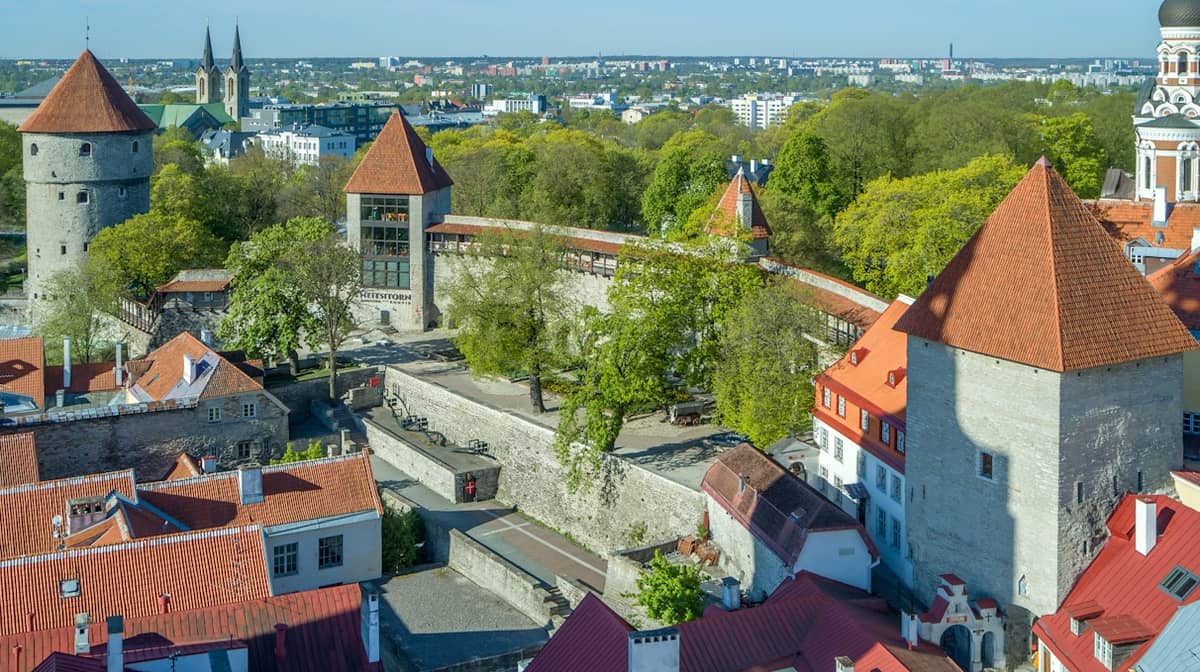
The Danish King's Garden (Estonian: Taani kuninga aed) is a small public park on the western side of Toompea hill, on the slope facing St. Nicholas Church, pressed against the medieval city wall and flanked by the Kiek in de Kök tower. It sits at the junction of the upper and lower sections of Tallinn Old Town, making it one of the few green spaces in the city centre where you can stand next to surviving 14th-century fortifications without paying a ticket.
The park is free, open all year round, and has no formal entrance gate. You simply walk in from Lühike jalg street, which is the historic short steep lane connecting lower Old Town to Toompea. Compared to the heavily photographed Town Hall Square, the garden tends to be noticeably quieter, even in summer. That is part of its appeal.
💡 Local tip
Walk up Lühike jalg (which literally means 'Short Leg' in Estonian) from the lower Old Town and the garden opens naturally on your left as the lane levels out near the top. The approach itself is part of the experience.
The Legend of the Dannebrog
The garden takes its name from a founding myth of the Kingdom of Denmark. In 1219, during the Battle of Lindanise, Danish crusaders led by King Valdemar II landed at what is now Tallinn Bay and fought a battle against Estonian tribes. According to legend, at a critical moment in the battle, a red-and-white flag fell from the sky and inspired the Danes to rally and win. That flag is considered the origin of the Dannebrog, Denmark's national flag, and the site of the supposed miracle is this hillside.
Whether you find that story plausible or not, the name stuck, and the garden has carried it ever since. The Danish conquest of 1219 is the reason Tallinn exists in its current form as a planned town: the Danes fortified the hill, the city grew downward from it, and the medieval street plan that tourists now call Old Town is largely a product of that period. Standing in this small park, you are at the symbolic point zero of Tallinn's urban history.
For deeper context on how Tallinn's medieval fortifications developed around this area, the Kiek in de Kök tower museum is immediately adjacent and covers the city's defensive history in considerable detail.
Tickets & tours
Hand-picked options from our booking partner. Prices are indicative; availability and final rates are confirmed when you complete your booking.
Historical walking tour of Tallinn with a local
From 599 €Instant confirmationFree cancellationIntroductory walking tour of Tallinn with a local guide
From 109 €Instant confirmationFree cancellationOld Tallinn walking tour
From 31 €Instant confirmationFree cancellationArchitectural walking tour of Tallinn with a Local
From 177 €Instant confirmationFree cancellation
The Setting: Walls, Towers, and an Unexpected Green Pocket
The garden occupies a narrow terraced slope. The ground underfoot is a mix of grass, worn stone, and exposed rock, typical of Toompea's natural limestone base. The city wall runs along the garden's western edge, its limestone blocks darkened with centuries of weathering. Kiek in de Kök rises directly alongside, its round artillery tower form making it one of the better-preserved examples of 15th-century defensive architecture in the Baltic region.
In spring and early summer, the grass fills in quickly and the garden takes on a softer character, with the stone towers providing a stark grey contrast to the green. In autumn, the few trees drop leaves onto the old cobbles, and the light turns low and golden in the late afternoon, which is when photographers tend to linger longest here. Winter is more austere: the grass disappears under snow, the walls stand stark white, and the place feels genuinely medieval in a way that no amount of summer tourist traffic can replicate.
The garden connects physically to the Tallinn city wall corridor, sections of which can be walked for a small fee. If you want to understand how the park fits into the broader fortification system, that walk is worth adding to your itinerary.
ℹ️ Good to know
The cobblestone surfaces and hillside inclines mean this garden is not easy to navigate in a wheelchair or with a pushchair. There are no ramps, lifts, or smooth paths. Visitors with limited mobility should assess access from Lühike jalg street carefully before committing to the climb.
When to Visit and What to Expect at Different Times
Early morning, roughly 7am to 9am, is the most atmospheric time. The garden is almost always empty, the light comes low over the Old Town rooftops, and the only sounds are pigeons and the occasional tram bell from the streets below. If you are staying nearby, this is worth getting up for.
By mid-morning on a summer day, tour groups begin filtering up Lühike jalg and the garden gains foot traffic, though it rarely reaches the density of Town Hall Square or the Patkuli viewing platform. Lunchtime is the busiest period: local office workers from Toompea sometimes eat here, and tourists use it as a rest point between the upper and lower Old Town. The space is small enough that even moderate crowds make it feel full.
Late afternoon, from around 4pm onward, is a reliable second window of calm. The tour buses have moved on and the garden settles. The tower walls catch the westerly afternoon light and the shadows from the battlements stretch long across the grass. For photography, this is the most rewarding hour.
💡 Local tip
If you visit in winter, bring proper footwear with grip. The stone paths on the Toompea slope become icy and genuinely slippery after overnight freezing, and there is no handrail for most of the approach from below.
Practical Walkthrough: Getting There and Combining It with Nearby Sights
The most natural approach is on foot from the lower Old Town. From Town Hall Square, walk west along Dunkri or Rüütli streets until you reach the foot of Lühike jalg, then follow the lane uphill. The garden appears on your left as you near the top, adjacent to the Kiek in de Kök tower entrance. The whole walk from the square takes around 8 to 10 minutes at a comfortable pace.
If you are coming from the upper Old Town, Toompea Castle, or the Alexander Nevsky Cathedral, the garden is a short downhill walk along the western edge of the plateau. It works well as a transitional point between upper and lower Old Town rather than a standalone destination.
For a logical half-day itinerary that builds the garden into a broader Old Town walk, the Tallinn Old Town walking tour guide sequences the main sights in a route that passes through here naturally.
There is no dedicated parking at or near the garden, as the surrounding streets in Old Town are largely pedestrianised or restricted. Public transport does not stop here directly. The nearest tram and bus connections, such as Vabaduse väljak, are at the edges of Old Town, around a 7 to 15 minute walk away. Arriving on foot from your accommodation or from the Old Town itself is the only practical option for most visitors.
Photography and What You Will Actually Photograph Here
The garden gives you one of the few ground-level angles on Kiek in de Kök that is not obstructed by parked cars or other modern intrusions. From the lower part of the garden, the tower rises cleanly above the wall line and the framing is straightforward. Wide-angle lenses work well given the confined space.
The city wall sections alongside the garden also photograph well in late afternoon light, when the texture of the limestone becomes visible. If there has been rain, the stone takes on a darker, more saturated tone and the moss patches between blocks turn bright green. Some photographers specifically wait for overcast days to shoot here because the diffused light eliminates the harsh shadows that the tower's bulk creates on sunny afternoons.
💡 Local tip
For a view that places the garden in context of the whole Old Town skyline, walk a few minutes further down Lühike jalg to the lower street level and look back uphill. The combination of the lane, the wall, and the tower forms a layered image that is far more interesting than any shot taken inside the garden itself.
Is It Worth the Detour?
The Danish King's Garden is not a grand park. There are no fountains, no formal flower beds, no cafe kiosk, and no particularly dramatic view from within the garden itself. It is a small grassy slope next to a medieval tower, and its value is almost entirely contextual: the history it represents, the wall it sits against, and the quiet it offers relative to the streets immediately surrounding it.
If you are already walking the Old Town, passing through costs nothing and adds genuine texture to the day. If you are on a tight schedule and have not yet seen the main Old Town sights, it should not be prioritised over the Town Hall Square area, the viewing platforms, or the towers. It earns its place as part of a walk, not as a destination in itself.
Visitors who want a more sweeping outdoor experience in Tallinn should consider Kadriorg Park instead, which offers considerably more space, formal gardens, and a palace.
Insider Tips
- The garden is directly adjacent to the Kiek in de Kök and Bastion Passages museum complex. If you want to understand the walls around you, buy a ticket there and walk the underground passages that tunnel beneath the garden's feet.
- Lühike jalg street itself is part of the experience. The lane is one of the oldest access routes in Tallinn and has been in continuous use since the medieval period. The art gallery tucked into the gate tower at the base of the lane is worth a quick look as you pass.
- In winter after a snowfall, the garden is one of the few spots in Old Town where the snow stays clean and undisturbed for hours. Early morning after overnight snow is a genuinely rare opportunity for photographs without crowds or footprints.
- The name 'Danish King's Garden' does not appear on all map apps. Search for 'Taani kuninga aed' or 'Kiek in de Kök' to locate it reliably in navigation tools.
- There are no toilets in the garden. The nearest public facilities are near Town Hall Square, roughly a 10-minute walk downhill.
Who Is Danish King's Garden For?
- History enthusiasts interested in medieval Baltic and Scandinavian history
- Photographers looking for uncommon ground-level angles on Old Town fortifications
- Visitors who want a quiet pause between the upper and lower parts of Old Town
- Families with older children who can manage the cobblestone inclines comfortably
- Travellers exploring Tallinn's medieval history on a free or low-budget itinerary
Nearby Attractions
Other things to see while in Tallinn Old Town:
- Alexander Nevsky Cathedral
Rising above Toompea Hill with five gilded onion domes and a facade that dominates every Old Town panorama, Alexander Nevsky Cathedral is Tallinn's most visually assertive building. Built between 1895 and 1900, it remains an active Orthodox place of worship and a window into the city's layered Russian and Estonian history.
- Fat Margaret
Fat Margaret (Paks Margareeta) is a squat, round cannon tower that has guarded the northern gate of Tallinn's Old Town since the early 16th century. Today it houses the Estonian Maritime Museum, with exhibits on seafaring history and a rooftop terrace overlooking the harbour. It is one of the few surviving medieval structures in Tallinn where you can explore both the architecture and a well-curated permanent collection under the same roof.
- Freedom Square
Freedom Square sits at the southern edge of Tallinn Old Town, anchoring the city's civic identity with the striking War of Independence Victory Column. Open around the clock and free to enter, it serves as a gathering point for national celebrations, winter markets, and everyday Tallinn life.
- Great Guild Hall
One of Tallinn's most striking Gothic buildings, the Great Guild Hall at Pikk 17 has anchored the city's merchant quarter since the early 15th century. Today it houses the Estonian History Museum, making it one of the most historically layered stops in the Old Town.