Kiek in de Kök: Inside Tallinn's Most Formidable Artillery Tower
Rising from Toompea Hill, Kiek in de Kök is one of the best-preserved medieval artillery towers in northern Europe. The 15th-century cannon tower now houses a serious fortifications museum and connects to a network of bastions tunnels that run beneath the Old Town walls. It rewards curious visitors with six floors of military history, panoramic city views, and one of Tallinn's most atmospheric underground experiences.
Quick Facts
- Location
- Komandandi tee 2, Toompea Hill, Tallinn Old Town
- Getting There
- 10-min walk from Vabaduse väljak (Freedom Square); trams 3 & 4 stop at Vabaduse väljak
- Time Needed
- 1.5–2.5 hours (tower + bastions tunnel tour)
- Cost
- Paid admission; free/discounted with Tallinn Card. Special pricing may apply on Tallinn Day (15 May) and Museum Night; check current details.
- Best for
- History enthusiasts, photographers, families with older children
- Official website
- linnamuuseum.ee/en/kiek-in-de-kok
What Is Kiek in de Kök?
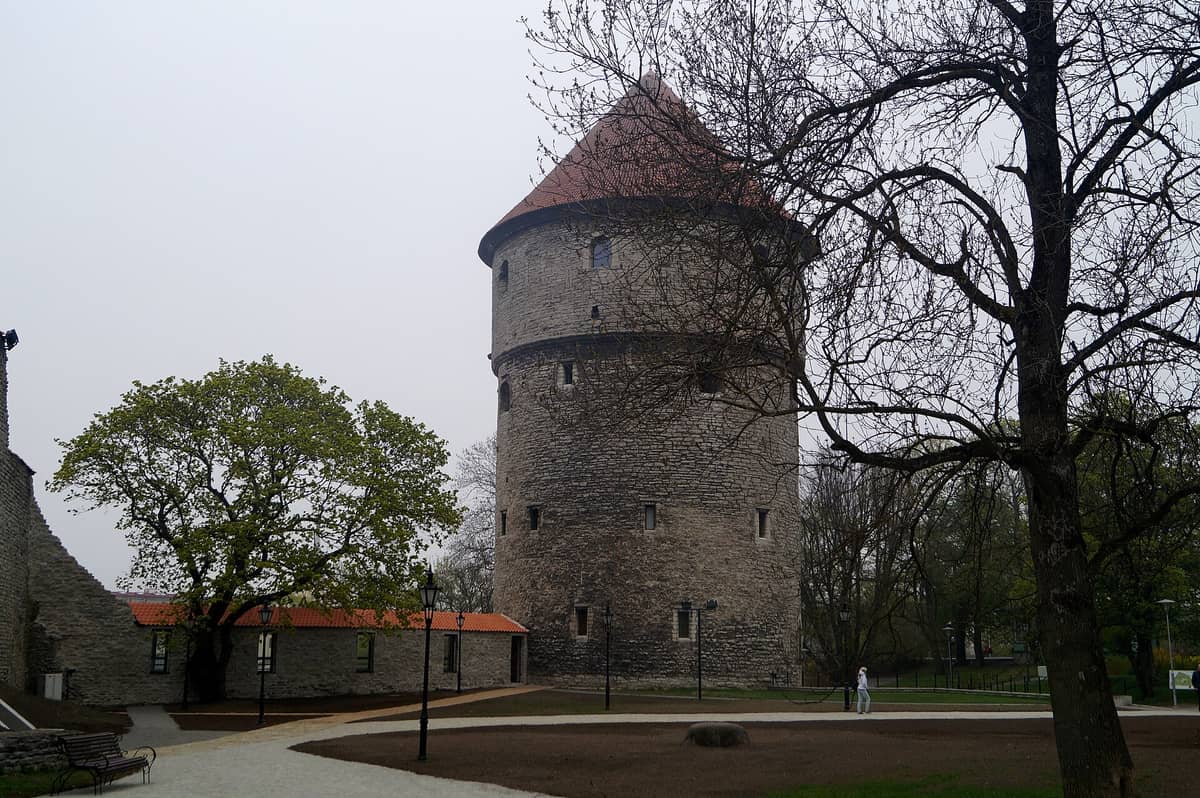
Kiek in de Kök is a late-medieval artillery tower whose construction began in 1475 and was completed in its original form in 1483 on the southwestern edge of Toompea Hill, forming a cornerstone of Tallinn's city fortifications. The name comes from Low German and translates roughly as 'peek into the kitchen,' a nickname medieval townsfolk gave it because the upper-floor soldiers could look directly down into the cooking areas of nearby houses. The tower is now home to the Kiek in de Kök Fortifications Museum, one of six branches of the Tallinn City Museum network.
At 38 metres tall with walls up to 4 metres thick, it was built to withstand artillery bombardment at a time when gunpowder weaponry was fundamentally changing how cities were defended. Six floors of exhibition space trace that transformation, from the stone cannon balls still lodged in the exterior walls (left from the Livonian War of the 16th century) to scale models of how the full defensive ring once encircled the city.
ℹ️ Good to know
The museum complex extends beyond the tower itself into the Bastion Tunnels and adjoining fortifications: a 17th-century network of underground passageways beneath the city walls, often sold as a combined ticket. Book the tunnel tour in advance during summer, as guided slots fill up.
The Tower Experience, Floor by Floor
You enter from Komandandi tee, a quiet lane that curves along the base of the old city wall. Even before you step inside, the scale of the stonework is striking. The tower's lower exterior shows pockmarks and embedded cannonballs from the Livonian War sieges of 1577, left deliberately in place as the most visceral kind of historical evidence.
Inside, the exhibitions occupy six vaulted floors connected by narrow stone staircases. The lower levels focus on the construction and strategic logic of Tallinn's medieval defences: maps, architectural models, and replica weapons that explain how the city held off repeated sieges. The middle floors shift to the human side of garrison life, with period artefacts, uniforms, and displays on the mercenary soldiers who manned these walls. The upper floors open up with city views that explain exactly why this position mattered militarily.
The top-floor windows give you unobstructed sightlines over the Danish King's Garden below and across the lower Old Town's rooftops toward Tallinn Bay. This is not the highest viewpoint in the city, but it is one of the most contextually satisfying: you understand the military geometry of the place simply by standing there.
💡 Local tip
Wear rubber-soled shoes. The stone steps inside the tower are worn smooth and can be slippery, especially in humid summer months or after rain.
Tickets & tours
Hand-picked options from our booking partner. Prices are indicative; availability and final rates are confirmed when you complete your booking.
Self-guided Discovery Walk of Tallinn city contrasts beyond the medieval walls
From 26 €Instant confirmationFree cancellationTallinn's art and culture tour with a local
From 62 €Instant confirmationFree cancellationHistorical walking tour of Tallinn with a local
From 599 €Instant confirmationFree cancellationIntroductory walking tour of Tallinn with a local guide
From 109 €Instant confirmationFree cancellation
The Bastion Tunnels: the Underground Extension
Below the tower, a separate experience awaits in the Bastion Tunnels, part of a fortification complex over 500 metres long dug beneath the city walls during the Swedish rule of Estonia. They were used as bomb shelters as recently as World War II, and traces of that later occupation sit alongside the original Swedish-era construction.
Guided tours lead you through low, dimly lit passageways where the air is noticeably cooler and slightly damp even in mid-summer. The guides move at a measured pace, stopping at alcoves to explain the defensive logic of each section. Sound effects and atmospheric lighting have been added at certain points, which some visitors will find immersive and others will find unnecessary. Either way, the physical reality of the tunnels, the weight of the earth above, the narrowness of the corridors, needs no embellishment.
The tunnel entrance is separate from the main tower door and signposted from Komandandi tee. If you plan to visit both, check the combined ticket option at the desk. More context on Tallinn's full circuit of surviving medieval defences is available in our guide to the Tallinn city wall.
How the Experience Changes Through the Day
Morning visits, particularly on weekdays, are the quietest. The museum currently opens at 11:00 and the first hour tends to see only a handful of visitors. The stone interiors hold the cool of the night well into midday, making a morning visit physically comfortable even in July when temperatures outside can reach 25°C.
Midday and early afternoon bring the bulk of tour groups, usually cruise ship passengers arriving between 10:00 and 14:00. The stairwells are narrow enough that passing a group going the opposite direction becomes genuinely awkward. If you arrive between 12:00 and 14:00 on a summer weekday, expect a slower, more crowded climb.
Late afternoon, from around 15:30 onward, is arguably the best window: the group tours have largely moved on, the light at the upper windows takes on a warmer angle, and the Danish King's Garden below is photogenic in the late sun. The museum complex currently closes at 18:00, so a 16:00 arrival still gives you ample time for the tower without needing to rush the tunnels.
⚠️ What to skip
The museum complex is currently closed on Mondays; if your Tallinn trip falls across a Monday, plan accordingly and check the latest schedule before you go.
Historical and Architectural Context
Kiek in de Kök was constructed during a period when Tallinn was a prosperous member of the Hanseatic League, a medieval trading alliance that stretched from the Baltic to the North Sea. The city's merchant wealth funded elaborate fortifications, and the surviving walls, towers, and gates represent one of the most complete medieval defensive systems in northern Europe. Tallinn's Old Town was designated a UNESCO World Heritage Site in 1997 largely because of this integrity of its medieval urban fabric and fortifications. For a broader introduction to how these defences fit into the city's history, the Tallinn medieval history guide provides useful background before you visit.
The artillery tower category that Kiek in de Kök represents emerged across European cities in the late 14th and 15th centuries, specifically to handle the new reality of gunpowder siege weapons. Earlier round towers were designed for archers; artillery towers like this one needed thicker walls at the base to absorb cannon fire and wider embrasures to accommodate guns that required more room to reload. The 1475 construction date places it near the peak of this architectural transition.
The cannonballs still embedded in the exterior walls are not decorative additions. They are original projectiles from the 1570s Livonian War, during which Russian forces besieged Tallinn repeatedly. The fact that the city never fell during those sieges is partly attributable to fortifications of this quality.
Practical Walkthrough: Getting There and What to Expect
The museum sits on Komandandi tee 2, on the slope of Toompea Hill just above the Danish King's Garden. From Freedom Square (Vabaduse väljak), walk uphill along Kaarli puiestee and follow the signs toward the city wall. The approach on foot takes around 10 minutes from the square and is uphill the whole way, which is worth knowing if you have mobility considerations.
Trams 3 and 4 stop at Vabaduse väljak and are the most straightforward public transport option from most parts of the city. Taxis and ride-hailing apps (Bolt is the dominant local platform) can drop you directly on Komandandi tee.
The Tallinn Card covers admission to Kiek in de Kök as part of its museum package. If you plan to visit multiple paid attractions over two or more days, the card generally pays for itself. Our Tallinn Card guide breaks down the maths by visit type so you can judge whether it fits your itinerary.
Detailed physical accessibility information is not clearly documented in the museum's online materials. The stone staircases and narrow passages in both the tower and the tunnels present real obstacles for visitors with limited mobility. It is worth contacting the museum directly before your visit if this is a concern.
Photography Inside the Tower
The interiors are darker than many visitors expect. The thick stone walls limit natural light to narrow window openings, and the artificial lighting in the exhibition spaces is deliberately low-key to preserve the atmosphere. A phone camera on auto mode will struggle in the lower floors. If photography matters to you, bring a camera with decent low-light capability or plan to shoot primarily from the upper windows, where natural light is much stronger.
The exterior of the tower, particularly from the Danish King's Garden below, photographs well in morning light when the stonework catches the eastern sun. The cannonball-pocked walls on the south side are best captured in the afternoon when the sun wraps around that face of the building.
Insider Tips
- On Tallinn Day (15 May) and Museum Night, special admission discounts often apply. If your trip overlaps with either date, check current pricing and timing your visit accordingly.
- The combined tower-and-tunnels ticket saves money over buying separately and is the best way to appreciate how the above-ground and underground defences worked together. Ask at the ticket desk about the current combined option.
- The Danish King's Garden directly below the tower is free to enter and gives you the best exterior view of Kiek in de Kök's lower walls, including the cannonball impacts. Spend 10 minutes there before going inside and the scale of the stonework will make more sense.
- If you visit outside the peak summer season, the museum complex is closed on Mondays but tends to be very quiet on other weekdays. You may have entire floors to yourself, which is a qualitatively different experience from a busy summer afternoon.
- The bastion tunnel tours run on a fixed schedule with a guide. Check current tour times when you buy your ticket rather than assuming you can join one immediately; waiting times of 30 to 45 minutes are common in summer.
Who Is Kiek in de Kök For?
- History enthusiasts who want more than a surface-level look at medieval military architecture
- Photographers interested in dramatic stonework, atmospheric interiors, and city panoramas
- Families with older children (10+) who can manage steep staircases and find the tunnel section genuinely exciting
- Travellers using a Tallinn Card who want to maximize its value across the city museum network
- Cold-weather visitors: the thick stone walls and underground tunnels make this one of the most satisfying indoor experiences in the city regardless of the season
Nearby Attractions
Other things to see while in Tallinn Old Town:
- Alexander Nevsky Cathedral
Rising above Toompea Hill with five gilded onion domes and a facade that dominates every Old Town panorama, Alexander Nevsky Cathedral is Tallinn's most visually assertive building. Built between 1895 and 1900, it remains an active Orthodox place of worship and a window into the city's layered Russian and Estonian history.
- Danish King's Garden
Tucked into the western slope of Toompea hill, the Danish King's Garden is a small, free public park woven into Tallinn's medieval fortifications. Open around the clock and steps from the Old Town's main streets, it offers a rare moment of calm alongside ancient towers and stone walls with an 800-year-old backstory.
- Fat Margaret
Fat Margaret (Paks Margareeta) is a squat, round cannon tower that has guarded the northern gate of Tallinn's Old Town since the early 16th century. Today it houses the Estonian Maritime Museum, with exhibits on seafaring history and a rooftop terrace overlooking the harbour. It is one of the few surviving medieval structures in Tallinn where you can explore both the architecture and a well-curated permanent collection under the same roof.
- Freedom Square
Freedom Square sits at the southern edge of Tallinn Old Town, anchoring the city's civic identity with the striking War of Independence Victory Column. Open around the clock and free to enter, it serves as a gathering point for national celebrations, winter markets, and everyday Tallinn life.