Alexander Nevsky Cathedral: Tallinn's Most Dramatic Skyline Landmark
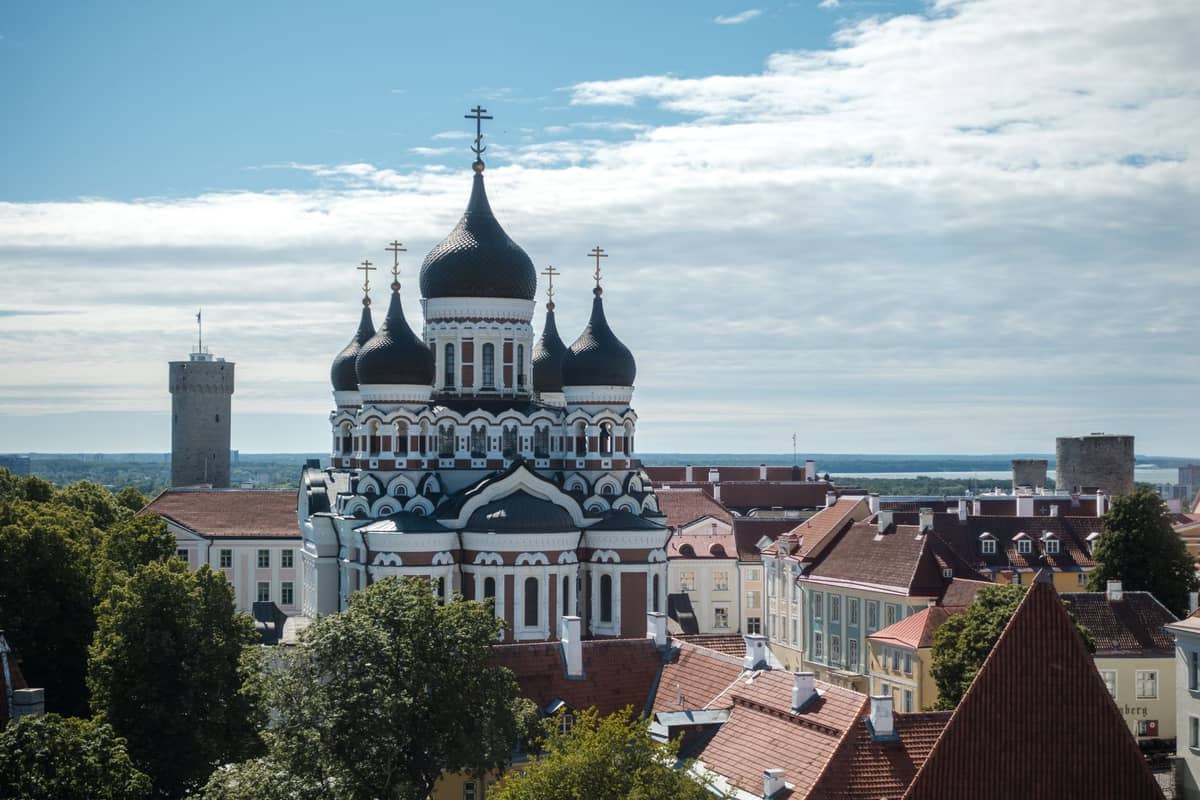
Rising above Toompea Hill with five gilded onion domes and a facade that dominates every Old Town panorama, Alexander Nevsky Cathedral is Tallinn's most visually assertive building. Built between 1895 and 1900, it remains an active Orthodox place of worship and a window into the city's layered Russian and Estonian history.
Quick Facts
- Location
- Lossi plats 10, Toompea Hill, Tallinn Old Town
- Getting There
- 10-15 min walk uphill from Viru Gate; taxis stop near Lossi plats and can drop you directly at the square
- Time Needed
- 30-45 minutes
- Cost
- Free entry
- Best for
- Architecture, Orthodox history, photography from the exterior
- Official website
- www.nevskysobor.ee
What You're Looking At
Alexander Nevsky Cathedral, known in Estonian as Aleksander Nevski katedraal, is Tallinn's largest and most ornate Orthodox cathedral. It stands on the highest point of Toompea Hill, occupying the same elevated plateau as the Estonian Parliament building and Toompea Castle. The juxtaposition is striking: medieval limestone walls, a pink Baroque parliament, and then this towering Russian Revival cathedral with five gilded onion domes. It was completed in 1900, consecrated on 30 April of that year by Bishop Agafangel of Riga and Mitava, and has been in continuous use as a functioning Orthodox church ever since.
The cathedral was designed by Mikhail Preobrazhensky in the Byzantine-Russian Revival style, a deliberate architectural statement of Imperial Russian presence in what was then the Governorate of Estonia. That political backstory adds an uncomfortable but essential layer to any visit. For many Estonians, the cathedral's location atop the hill, directly overlooking the old city, was never innocent. Demolition was seriously discussed after Estonian independence in 1918, and again briefly after 1991. It survived both debates and remains today both a place of active worship and one of the most photographed structures in the country.
ℹ️ Good to know
Open May 1 to September 30: Mon-Fri 08:00-18:00, Sat 08:00-19:00, Sun 08:00-18:00. The cathedral is open year-round but hours outside this period vary; check nevskysobor.ee before visiting in winter.
The Exterior: What to Look For Before You Go In
Most visitors spend more time outside than in, and the exterior rewards that attention. The main facade faces Lossi plats, the small square at the top of Toompea Hill. From this position, the cathedral fills your entire field of view. The five onion domes are covered in gilded sheet metal and catch the light differently throughout the day: flat and grey under overcast skies, blazing gold in late afternoon sun. The central dome rises to roughly 58 metres and can be seen from the Lower Town below.
The entrance portal is framed by an elaborate mosaic of Alexander Nevsky himself, the 13th-century Russian prince who defeated the Teutonic Knights at the Battle on the Ice in 1242. Irony runs deep here: it was partly the Teutonic Order's legacy that built medieval Tallinn. Using Alexander Nevsky as the cathedral's patron was a pointed choice by the Russian imperial administration. The mosaic work across the facade uses deep blues, crisp whites, and gold leaf, and is in excellent condition for a building of this age.
💡 Local tip
Photography tip: The best exterior shots are from the small viewing area near Patkuli Steps, where you can frame the domes against the Lower Town rooftops. At Lossi plats itself, you are too close for wide framing unless you use an ultra-wide lens.
Tickets & tours
Hand-picked options from our booking partner. Prices are indicative; availability and final rates are confirmed when you complete your booking.
Self-guided Discovery Walk of Tallinn city contrasts beyond the medieval walls
From 26 €Instant confirmationFree cancellationTallinn's art and culture tour with a local
From 62 €Instant confirmationFree cancellationHistorical walking tour of Tallinn with a local
From 599 €Instant confirmationFree cancellationIntroductory walking tour of Tallinn with a local guide
From 109 €Instant confirmationFree cancellation
Inside the Cathedral
Entry is free and open to the public, but this is an active place of worship, not a museum. Services are held regularly, and visitors are expected to dress modestly: shoulders and knees covered. Women are traditionally expected to cover their heads inside Orthodox churches, though enforcement is informal. The atmosphere inside is contemplative, often quiet in the early morning, busier in the mid-morning tourist window.
The interior is dim and rich with icon screens, candle smoke, and the low hum of chant during services. The iconostasis, the gilded screen separating the nave from the sanctuary, is elaborate and worth studying closely. Natural light enters through stained glass windows depicting Orthodox saints. The overall effect is of deep enclosure: the thick stone walls, dark wood, and low lighting create a sensory contrast with the bright cobblestones outside.
Interior photography is generally discouraged during services and may be restricted at busy times; follow posted signs and staff instructions. Do not attempt to photograph the iconostasis or congregation. If you visit during a service, move quietly around the edges and do not cross into restricted areas. The cathedral has 11 bells in its bell tower, cast in St. Petersburg, and if you happen to be nearby on a Sunday morning, the bell ringing is audible throughout the Upper Town.
How the Experience Changes by Time of Day
Early morning, before 9:00, is the best time to visit if you want the exterior largely to yourself. Tour groups begin arriving by 10:00 and Lossi plats gets crowded through noon. The square itself is small, so even thirty tourists with a guide creates a bottleneck. At peak hours in summer, it can feel like a traffic jam between the cathedral entrance and the parliament gate.
Late afternoon light, particularly from around 15:00-17:00 on clear days, is when the gilded domes are most photogenic. The sun comes from the west and hits the south-facing facade and domes at an angle that makes the gold appear almost incandescent. This is also when the square is busy, so you trade solitude for better light. In winter, the cathedral looks genuinely spectacular in snow, and the crowds thin dramatically. The domes against a white sky and fresh snowfall is one of those Tallinn images that does not feel manufactured.
If you plan to attend a service rather than just look around, Sunday mornings are the primary liturgical time. Services are conducted in Church Slavonic. Non-Orthodox visitors are welcome to observe respectfully.
Historical and Political Context
The cathedral was built during a period of Russification policy in the Baltic provinces, when the Russian imperial government actively promoted Orthodox Christianity and Russian culture over the predominantly Lutheran Estonian and German-speaking populations. Its placement on Toompea Hill, the political and symbolic heart of the city, was deliberate. For a full understanding of how this building fits into Tallinn's longer arc of occupation and independence, the Tallinn medieval history guide provides essential context, and the nearby Vabamu Museum of Occupations and Freedom addresses the Soviet era and its legacy directly.
During the Soviet period, the cathedral remained open as a place of worship, which was unusual given Soviet policies toward religion elsewhere. The Orthodox Church in Estonia operated here under the Moscow Patriarchate, and the cathedral was never converted or closed. After Estonian independence was restored in 1991, the question of the cathedral's future resurfaced politically, but it remained and continues as the seat of the Estonian Orthodox Church of the Moscow Patriarchate.
This is not neutral heritage. The cathedral is simultaneously a significant architectural achievement, a functioning religious institution, and a symbol that carries different meaning for different communities in Estonia. Visitors who engage with that complexity will leave with a more honest understanding of the city than those who simply photograph the domes and move on.
Getting There and Practical Walkthrough
The cathedral is at Lossi plats 10, at the top of Toompea Hill. The most common approach from the Tallinn Old Town is via Pikk jalg (Long Leg Lane) or Lühike jalg (Short Leg Lane), both of which climb from the Lower Town to the Upper Town. The walk from Viru Gate takes about 10-15 minutes, mostly uphill on cobblestones. Neither route is flat. Visitors with mobility limitations should be aware that there is no lift or ramp access to the Upper Town via these lanes. Taxis and ride-hailing cars can drop passengers directly at Lossi plats, which is accessible by road.
Once you are on the Toompea plateau, the cathedral is immediately visible. There is no ticketing, no queue, and no bag check. You simply enter through the main portal. Plan for 30-45 minutes inside if you are not attending a service, longer if you are. Combine the visit with the nearby Toompea viewing platforms and the Estonian Parliament building (exterior) for a natural circuit of the Upper Town.
If you have limited time, consider combining this stop with the Kohtuotsa viewing platform and Patkuli viewing platform, both a short walk from Lossi plats. Together these three stops make a compact Upper Town loop that takes under two hours.
Who Should Skip This
If you have no interest in religious architecture or the political history of the Baltic region, the exterior is still worth a look for five minutes, but a full visit is probably not worth your time. The interior, without context, is a dark room with icons. The story around it is what makes it significant. Visitors who are rushed and prioritising Old Town squares, the Town Hall area, or museums should put this lower on the list. It is also not suitable for visitors with serious mobility issues given the cobbled hill climb.
Those interested in what else Tallinn's Old Town has to offer architecturally should also spend time at Toompea Castle and Tallinn Cathedral, both within a few minutes walk and representing the very different Lutheran and medieval heritage of the same hill.
Insider Tips
- Arrive before 9:00 in summer for a crowd-free exterior. The light is cooler but the square is genuinely empty, which is rare.
- The bell tower holds 11 bells cast in St. Petersburg. If you are anywhere on Toompea on a Sunday morning, stop and listen rather than rushing past.
- The best photographs of the domes are not from directly in front of the cathedral. Walk 50 metres toward the Patkuli Steps viewpoint and shoot back. You get the domes with Lower Town rooftops in the foreground.
- Interior photography is not allowed during services and may be restricted at other times; obey all posted signs and staff instructions rather than trying to be discreet about it.
- In winter, even if hours are reduced or irregular, the exterior in snow is genuinely one of Tallinn's best visual experiences. Worth the cold.
Who Is Alexander Nevsky Cathedral For?
- Architecture and religious heritage enthusiasts who want to understand the Byzantine-Russian Revival style
- History-focused travellers interested in Baltic political history and the legacy of Imperial Russian rule
- Photographers working the Tallinn skyline and seeking the Upper Town's most dramatic single structure
- Visitors doing a full Old Town walking loop who want to understand every layer of Toompea Hill
- Winter travellers who will find the crowds thin and the cathedral in snow genuinely spectacular
Nearby Attractions
Other things to see while in Tallinn Old Town:
- Danish King's Garden
Tucked into the western slope of Toompea hill, the Danish King's Garden is a small, free public park woven into Tallinn's medieval fortifications. Open around the clock and steps from the Old Town's main streets, it offers a rare moment of calm alongside ancient towers and stone walls with an 800-year-old backstory.
- Fat Margaret
Fat Margaret (Paks Margareeta) is a squat, round cannon tower that has guarded the northern gate of Tallinn's Old Town since the early 16th century. Today it houses the Estonian Maritime Museum, with exhibits on seafaring history and a rooftop terrace overlooking the harbour. It is one of the few surviving medieval structures in Tallinn where you can explore both the architecture and a well-curated permanent collection under the same roof.
- Freedom Square
Freedom Square sits at the southern edge of Tallinn Old Town, anchoring the city's civic identity with the striking War of Independence Victory Column. Open around the clock and free to enter, it serves as a gathering point for national celebrations, winter markets, and everyday Tallinn life.
- Great Guild Hall
One of Tallinn's most striking Gothic buildings, the Great Guild Hall at Pikk 17 has anchored the city's merchant quarter since the early 15th century. Today it houses the Estonian History Museum, making it one of the most historically layered stops in the Old Town.