Toompea Castle: Estonia's Seat of Power on an Ancient Hilltop
Toompea Castle is both a medieval fortress and a living democracy — the limestone hill stronghold that has dominated Tallinn for eight centuries now serves as the seat of Estonia's Parliament. Free guided tours, iconic pink baroque facades, and position at the heart of Old Town make it one of the most historically loaded sites in the Baltic.
Quick Facts
- Location
- Lossi plats 1a, Toompea Hill, Tallinn Old Town
- Getting There
- Walk uphill from Old Town via Pikk jalg (Long Leg) or Lühike jalg (Short Leg) streets; both routes take 10–15 min on foot from Town Hall Square
- Time Needed
- 45–90 minutes for a guided tour; add 30 min if exploring the exterior and nearby viewpoints
- Cost
- Free; pre-registration required for weekday guided tours (Mon–Fri; no tours on weekends)
- Best for
- History enthusiasts, architecture lovers, and anyone curious about Estonian democracy and medieval heritage
- Official website
- www.riigikogu.ee/en/visit-us
What Is Toompea Castle, Exactly?
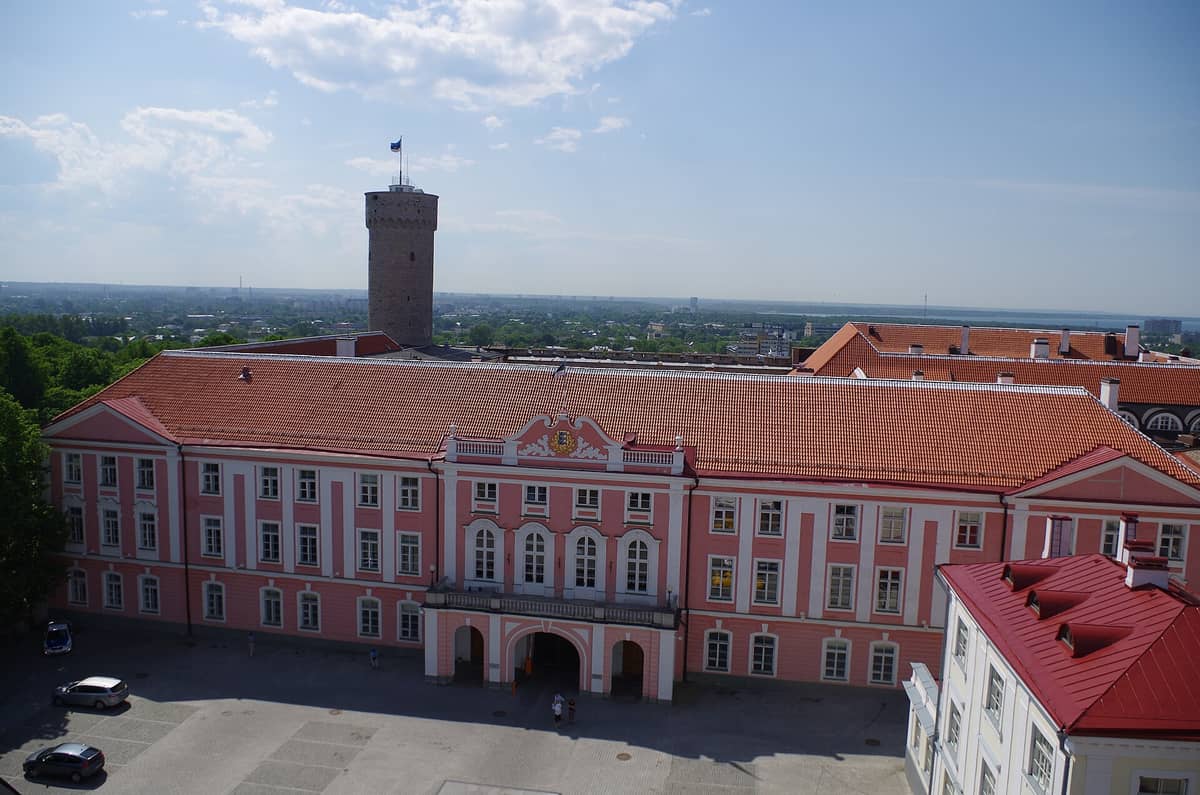
Toompea Castle is not a ruin, a museum, or a tourist replica. It is a working seat of government — the Estonian Parliament, known as the Riigikogu, convenes here in a building integrated directly into the medieval castle complex. That dual identity is what makes it genuinely unusual: the medieval fortifications date to the 13th–14th centuries, while inside the courtyard stands a salmon-pink Expressionist parliament building completed in 1922, the year newly independent Estonia needed a home for its legislature.
The site has served as a centre of power for roughly 800 years. Danish crusaders, the Teutonic Knights, Swedish governors, Russian tsars, and now a democratically elected Estonian parliament have all controlled this limestone hill above Tallinn. Visiting Toompea Castle means standing at the confluence of all those layers at once.
ℹ️ Good to know
Toompea Castle is not freely open to walk-in visitors. Access to the interior is through organised guided tours that must be pre-arranged through the Riigikogu website. The exterior and Tall Hermann Tower are visible from public areas without a tour booking.
The Approach: Walking Up to Toompea Hill
Most visitors arrive from Tallinn's lower Old Town, and the ascent itself sets the mood. Two medieval gateway streets lead up: Pikk jalg (Long Leg) is the gentler, wider route used by carriages in earlier centuries, while Lühike jalg (Short Leg) is steeper, narrower, and lined with galleries and craft shops. Both routes take around ten minutes on foot from Town Hall Square.
The cobblestones on both streets are original limestone, rounded smooth over centuries of use. In wet weather they become slick, so footwear with grip matters more than style. At the top of Pikk jalg, the pale yellow bulk of the Alexander Nevsky Cathedral fills the view immediately — an 1894 Russian Orthodox cathedral that the Soviet authorities considered demolishing and Estonian nationalists later debated removing. It remains, directly opposite the castle gate, which gives the castle square an atmosphere of layered political tension frozen in stone.
On weekday mornings before ten, this upper square is quiet enough that you can hear pigeons on the cathedral domes and footsteps echoing off the castle's limestone walls. By midday in summer, tour groups filter through and the dynamic shifts considerably. Arriving before 10:00 gives you the exterior almost to yourself.
Tickets & tours
Hand-picked options from our booking partner. Prices are indicative; availability and final rates are confirmed when you complete your booking.
Self-guided Discovery Walk of Tallinn city contrasts beyond the medieval walls
From 26 €Instant confirmationFree cancellationTallinn's art and culture tour with a local
From 62 €Instant confirmationFree cancellationHistorical walking tour of Tallinn with a local
From 599 €Instant confirmationFree cancellationIntroductory walking tour of Tallinn with a local guide
From 109 €Instant confirmationFree cancellation
The Castle Exterior and Tall Hermann Tower
The most immediately recognisable part of the complex is Tall Hermann (Pikk Hermann), the 48-metre tower at the castle's southwest corner. The Estonian flag flies from its summit — a tradition with deep symbolic weight. During the Soviet occupation the Estonian tricolour was banned; when it was raised again on February 24, 1989, the gesture was seen across the country as a signal that independence was genuinely returning. Today, the flag is raised at sunrise and lowered at sunset every day, and on national holidays the ceremony draws small crowds.
The outer walls visible from Lossi plats square date primarily from the 14th and 15th centuries, with significant rebuilding during Swedish rule in the 17th century and the construction of the late Baroque palace between 1767 and 1773. The round towers at the corners are largely medieval, though several were raised in height or reinforced over the centuries. The pink parliament building within the courtyard is a deliberate architectural contrast: its Expressionist-style interiors and facade elements, designed by Estonian architects Eugen Habermann and Herbert Johanson and completed in 1922, use a warm salmon render that stands out sharply against the grey limestone curtain wall behind it.
For the exterior and the castle square, no booking is required. The Kohtuotsa viewing platform and the Patkuli viewing platform are both a short walk from the castle and offer the best elevated views over Tallinn's lower Old Town rooftops and the harbour beyond. If the interior tour is not available on your visit date, these two spots ensure the trip to Toompea Hill is still worthwhile.
Inside the Castle: The Guided Tour Experience
Pre-registered guided tours run on weekdays (Monday through Friday); the castle is closed to visitors on weekends. Tours are free of charge, though this is subject to change and should be confirmed on the Riigikogu website before your visit.
The tour covers the parliament chamber itself, the historic halls of the medieval building, and the courtyard connecting the two architectural eras. Inside the 1922 parliament building, the debating chamber is modest by European standards — deliberately so, reflecting Estonia's civic rather than imperial tradition. The ceiling is decorated with painted coats of arms representing historical Estonian counties. The medieval section of the complex includes stone-vaulted rooms where governors and commanders held court for centuries; the contrast in scale and atmosphere between the two parts is stark and interesting.
Security screening applies on entry, similar to visiting any active government building. Bags go through scanners, and photography inside the parliament chamber may be restricted depending on whether the session is in recess or sitting. Tour guides speak English and can answer questions about both the building's history and current Estonian parliamentary procedure — most are knowledgeable and happy to engage beyond the standard script.
💡 Local tip
Register for tours in advance through riigikogu.ee. Walk-in access to the interior is not guaranteed. Tours fill up, particularly in summer months, so booking a few days ahead is practical if the interior visit matters to you.
Historical Context: Eight Centuries of Control
The hill itself was fortified well before any stone castle. Estonian tribes used the elevated limestone outcrop as a stronghold, and the site's strategic value over Tallinn Bay made it contested territory from the moment northern European powers arrived. The Danish king Valdemar II captured Tallinn in 1219 — the city's early history is explored in depth in the Tallinn medieval history guide — and Danish rule over the castle lasted until the Teutonic Order purchased Estonia in 1346.
The Order built the main stone castle that forms the basis of what stands today during the 13th and 14th centuries. Sweden took control in 1561 and held it until 1710, during which the castle was significantly rebuilt and expanded. Russia under Peter the Great captured Tallinn in 1710 and ruled through the imperial period until 1918, when Estonia declared independence at the end of World War One. The Soviet occupation from 1940 to 1991 did not alter the castle structure significantly, but it changed what the building symbolised for Estonians entirely.
The restoration of the Estonian flag to Tall Hermann in 1989 and formal independence in 1991 transformed Toompea Castle into a symbol of restored sovereignty. That political meaning still saturates the place, especially for Estonian visitors, in a way that is not always visible to arriving tourists but becomes clear when you watch Estonians interact with the space.
Practical Details and What to Know Before You Go
The address for the parliament complex is Lossi plats 1a, 15165 Tallinn, Estonia. There is no dedicated parking adjacent to the castle; Toompea Hill is best reached on foot. The uphill walk from the lower Old Town involves cobblestone streets that are manageable for most people but can be difficult for wheelchair users or those with limited mobility. Step-free access options and specific disability facilities should be confirmed directly with the Riigikogu before visiting.
Weather affects the exterior visit noticeably. On clear days the limestone walls pick up warm light in the late afternoon and the flag against a blue sky makes for strong photographs. In winter, light snow on the towers and rooftops creates a stark, austere atmosphere that many find more arresting than summer crowds. Rain turns the cobblestones glassy and the courtyard can feel exposed to the wind; a waterproof layer is useful even in summer. The interior tour is weather-independent.
If you are planning a full day in the area, combining Toompea Castle with the Kiek in de Kok tower and museum nearby gives a thorough picture of the medieval defensive system that once protected this hill. The Tallinn city wall stretches down from Toompea into the lower town and can extend a morning visit into a half-day walk through the defensive architecture of medieval Tallinn.
⚠️ What to skip
The castle is closed to interior visitors on Saturdays and Sundays. If you are visiting Tallinn only on a weekend, plan to explore the exterior, the castle square, and the nearby viewing platforms instead — and save the interior tour for a weekday.
Insider Tips
- Arrive at the castle square before 9:30 on a weekday. The exterior is almost empty before tour groups arrive, and the morning light on Tall Hermann and the Alexander Nevsky Cathedral domes is the best you will get all day.
- The Riigikogu occasionally organises special open days and public events around Estonia's national holidays (February 24 and June 23), which may include additional visiting opportunities. Check the official website before your trip if your dates overlap with these occasions.
- Photographers: the salmon-pink parliament building against the grey medieval curtain wall is best captured from inside the courtyard on the tour, not from the street. The contrast in colour and architectural era is the most visually interesting detail in the whole complex.
- Do not confuse Toompea Hill with the cathedral on it. The Alexander Nevsky Cathedral is directly opposite the castle entrance and draws its own crowds; the castle itself can be missed by visitors who stop at the cathedral and assume they have seen the main site.
- If the interior tour is not available, the short walk from the castle square to the Patkuli and Kohtuotsa viewing platforms takes under five minutes and offers the panorama over lower Old Town that most visitors come up to Toompea to find.
Who Is Toompea Castle For?
- History travellers who want to understand how Estonia moved from medieval conquest to modern independence
- Architecture enthusiasts interested in the collision of 13th-century limestone fortification and 1920s Expressionist civic design
- First-time visitors to Tallinn building a foundation for understanding the Old Town's geography and political history
- Travellers on a tight budget — the guided tour is free, the exterior is always accessible, and the nearby viewpoints cost nothing
- Visitors with an interest in European parliamentary democracy and the Baltic independence movements
Nearby Attractions
Other things to see while in Tallinn Old Town:
- Alexander Nevsky Cathedral
Rising above Toompea Hill with five gilded onion domes and a facade that dominates every Old Town panorama, Alexander Nevsky Cathedral is Tallinn's most visually assertive building. Built between 1895 and 1900, it remains an active Orthodox place of worship and a window into the city's layered Russian and Estonian history.
- Danish King's Garden
Tucked into the western slope of Toompea hill, the Danish King's Garden is a small, free public park woven into Tallinn's medieval fortifications. Open around the clock and steps from the Old Town's main streets, it offers a rare moment of calm alongside ancient towers and stone walls with an 800-year-old backstory.
- Fat Margaret
Fat Margaret (Paks Margareeta) is a squat, round cannon tower that has guarded the northern gate of Tallinn's Old Town since the early 16th century. Today it houses the Estonian Maritime Museum, with exhibits on seafaring history and a rooftop terrace overlooking the harbour. It is one of the few surviving medieval structures in Tallinn where you can explore both the architecture and a well-curated permanent collection under the same roof.
- Freedom Square
Freedom Square sits at the southern edge of Tallinn Old Town, anchoring the city's civic identity with the striking War of Independence Victory Column. Open around the clock and free to enter, it serves as a gathering point for national celebrations, winter markets, and everyday Tallinn life.