Freedom Square (Vabaduse väljak): Tallinn's Civic Heart
Freedom Square sits at the southern edge of Tallinn Old Town, anchoring the city's civic identity with the striking War of Independence Victory Column. Open around the clock and free to enter, it serves as a gathering point for national celebrations, winter markets, and everyday Tallinn life.
Quick Facts
- Location
- Vabaduse väljak, southern edge of Tallinn Old Town
- Getting There
- Walkable from Old Town; trams and buses stop nearby on Pärnu maantee
- Time Needed
- 20–40 minutes to walk through; longer during events
- Cost
- Free, open 24 hours year-round
- Best for
- History enthusiasts, photographers, and anyone based in Old Town
- Official website
- www.visittallinn.ee
What Is Freedom Square?
Freedom Square, known in Estonian as Vabaduse väljak, is Tallinn's principal civic plaza. It sits at the point where the medieval Old Town meets the modern city grid, making it one of the most-crossed patches of pavement in the Estonian capital. Unlike many European city squares that are ringed entirely by historic façades, this one has a deliberately open, contemporary quality — wide granite paving, clear sightlines toward the old limestone city walls, and a sense of deliberate civic intention rather than organic medieval growth.
The square in some form has existed since around 1910, but its name, purpose, and physical design have all been reshaped by Estonia's turbulent twentieth century. It was first officially called Freedom Square in 1939, a name that was erased under Soviet occupation in 1948 and then restored in 1989 as Estonia moved toward independence. Its current form was unveiled on 20 August 2009, the anniversary of Estonia's restored independence, after a major redesign that gave it the granite surface and the centerpiece monument it has today.
ℹ️ Good to know
The square is fully open and free at all hours. There are no gates, no ticket booths, and no required entry points. Simply walk in from any direction.
The War of Independence Victory Column
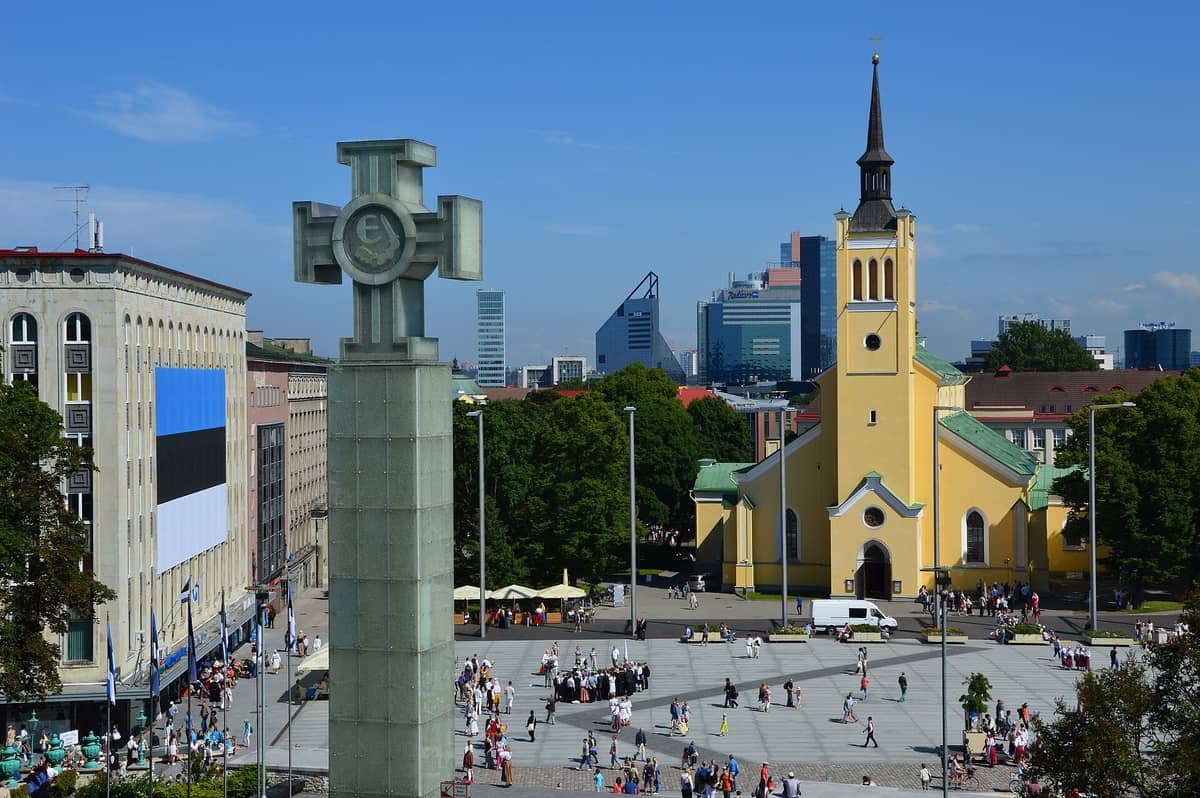
The dominant feature of the square is the War of Independence Victory Column, a tall glass cross that rises from the center of the plaza on a granite base. The column commemorates Estonia's victory in the War of Independence fought between 1918 and 1920, which established the first Republic of Estonia after the collapse of the Russian Empire. The cross form carries both secular and Lutheran cultural weight in Estonia, and the use of glass gives it an unusual visual quality: it catches daylight differently depending on the hour and season, appearing almost luminous in low winter sun and more transparent on overcast days.
The base of the column is engraved with the names of battles and fallen soldiers, and the surrounding granite plaza is inlaid with historical details for those who take the time to look down as well as up. Many visitors photograph it from a distance and move on, missing the closer-up details that reward a slower approach. Walk up to the base and take a few minutes with the inscriptions.
💡 Local tip
For the best photograph of the Victory Column with the Old Town towers in the background, position yourself on the northeastern side of the square, facing southwest. Late afternoon light in summer hits the glass cross well.
Tickets & tours
Hand-picked options from our booking partner. Prices are indicative; availability and final rates are confirmed when you complete your booking.
Self-guided Discovery Walk of Tallinn city contrasts beyond the medieval walls
From 26 €Instant confirmationFree cancellationTallinn's art and culture tour with a local
From 62 €Instant confirmationFree cancellationHistorical walking tour of Tallinn with a local
From 599 €Instant confirmationFree cancellationIntroductory walking tour of Tallinn with a local guide
From 109 €Instant confirmationFree cancellation
How the Square Changes Through the Day
Early morning, Freedom Square is nearly empty. The granite holds the cold in all seasons, and on weekdays before 8am you are likely to share it only with commuters cutting through on foot and the occasional runner. The surrounding streets carry tram noise and the smell of diesel from buses turning on Pärnu maantee, but the square itself is quiet enough that you can hear pigeons.
Midday brings a different energy. Tour groups arrive from Old Town, office workers cross it on lunch breaks, and the square becomes a transition point rather than a destination. The exposed granite can be warm underfoot in summer and ice-slick in winter, so footwear choice actually matters here. By early afternoon in peak summer, the plaza is at its most crowded, and the surrounding cafés on the square's edges fill quickly.
Evening is arguably the most rewarding time to visit. The Victory Column is illuminated after dark, and the Old Town towers visible to the north are lit against the sky. In summer, the square stays light until nearly midnight, and people linger. In winter, the darkness arrives by mid-afternoon and the square takes on a different mood: colder, quieter, and more austere, though during the Christmas market season it fills with lights and the smell of mulled wine from nearby stalls.
Historical and Cultural Context
To understand Freedom Square, it helps to understand that Estonia spent much of the twentieth century under occupation. The Soviet period, explored in depth at the Vabamu Museum of Occupations and Freedom, which sits directly adjacent to the square's southwestern edge, deliberately erased landmarks of Estonian national identity. The restoration of the square's name in 1989 was not a bureaucratic decision but a political act, made during the final years of Soviet rule when such gestures carried real risk.
The 2009 redesign was itself contentious. The Victory Column design was debated publicly for years, with disagreements about the use of a cross form and the scale of the monument. The result, as installed, is striking but deliberately restrained — there is no triumphalism in the design, no martial aggression. It reads more as a memorial than a monument to victory, which accurately reflects the Estonian relationship to that particular conflict.
Freedom Square is also adjacent to the southern stretch of Tallinn's medieval city wall. The towers and wall sections visible from the square connect directly to the broader fortification system described in the guide to the Tallinn City Wall. Standing at the square and looking north, you get one of the cleaner views of the medieval fortifications without having to navigate narrow lanes.
Events and Seasonal Use
Freedom Square functions as Tallinn's primary outdoor event space for national occasions. Estonian Independence Day on 24 February, Victory Day on 23 June, and Restoration of Independence Day on 20 August all see the square used for official ceremonies, outdoor concerts, or public gatherings. If your visit coincides with any of these dates, expect significant crowds, road closures in the area, and heightened security presence around the Victory Column.
During the December holiday period, the square hosts market stalls and seasonal events as part of Tallinn's broader Christmas celebrations. The main Town Hall Square Christmas market is the more traditional and photogenic of the two, but Freedom Square has its own program and is worth including in an evening stroll between the two. The combined walk takes under ten minutes.
Summer brings outdoor film screenings and occasional concerts. These events are announced through the city's official channels and Visit Tallinn's events calendar, and they are typically free or low-cost. The square's open layout makes it genuinely workable for large outdoor events in a way that the narrower spaces of Old Town cannot manage.
Practical Walkthrough: How to Approach the Square
Most visitors arrive at Freedom Square as part of a walk through Tallinn Old Town. The natural approach from the Old Town is through the southern streets, past the Kiek in de Kök tower and the Bastion Passages entrance. Coming from this direction, you descend slightly from the elevated medieval street level and arrive at the square with the city wall behind you, which gives a useful sense of the transition between eras.
From Viru Gate and the main Old Town entrance area, Freedom Square is about a 10-minute walk south. From the main train station, Balti jaam, it is approximately 15–20 minutes on foot or a short tram ride. The square sits on Pärnu maantee, which is served by several tram lines running between the city center and southern districts.
Accessibility is good throughout the square. The granite surface is predominantly flat and step-free, and accessible parking is available on the surrounding streets. The Vabamu museum adjacent to the square also has accessible facilities, which makes the whole area workable for visitors with mobility considerations.
⚠️ What to skip
In winter, the polished granite surface can become dangerously slippery after rain or light snow. The city does grit high-traffic areas, but exercise caution near the Victory Column base and on the northern edge of the square where shade keeps ice longer.
Is Freedom Square Worth Your Time?
Honestly, Freedom Square is not a destination in itself for most visitors. You will not spend an hour here the way you might in a museum or on a viewpoint. What it offers is context and transition: it is the physical hinge between medieval Tallinn and the modern city, and spending 20–30 minutes understanding what you are looking at pays off for the rest of your Old Town visit.
Visitors who walk straight through without pausing miss the monument's detail, the adjacent museum, and the wall views. Those who pair it with a visit to Kiek in de Kök Visitors who walk straight through without pausing miss the monument's detail, the adjacent museum, and the wall views. Those who pair it with a visit to Vabamu and the Bastion Passages, both a short walk away, get a much richer picture of Tallinn's layered history without significantly extending their itinerary., both a short walk away, get a much richer picture of Tallinn's layered history without significantly extending their itinerary.
Travelers looking purely for photogenic medieval aesthetics may find the square underwhelming compared to Town Hall Square. The contemporary granite redesign is not to everyone's taste, and if you have limited time, prioritizing the medieval core is reasonable. But for anyone with even a passing interest in Estonian history or modern design in a historic context, the square deserves more than a glance as you pass through.
Insider Tips
- The Vabamu Museum of Occupations and Freedom sits directly beside the square's southwestern edge. Pairing a visit to the square with even an hour in Vabamu transforms it from a scenic stopping point into something genuinely meaningful. Check Vabamu's opening hours before you go.
- If you are visiting during a national holiday, arrive early. By mid-morning on dates like 24 February (Independence Day), the square fills and the surrounding streets are often closed to traffic, affecting tram routes.
- The view from the square toward the medieval towers is better in winter when the trees along the northern edge have lost their leaves. Summer foliage partially obscures the wall section behind you when approaching from Old Town.
- There are benches along the square's perimeter but very few in the open center. If you want to sit and take in the space, head to the edges where café seating also spills out in warm months.
- The square's granite surface was specifically chosen for its Estonian origin. Several of the stone types used in the 2009 redesign came from Estonian quarries, which is a detail that goes unremarked by most visitor guides.
Who Is Freedom Square For?
- History travelers who want to understand Estonia's independence narrative beyond the Old Town
- Photographers looking for the transitional shot between medieval towers and modern civic design
- Visitors combining the square with Vabamu and Kiek in de Kök for a half-day history circuit
- Travelers visiting during national holidays or the Christmas season when the square hosts events
- Those with accessibility needs, as the flat granite surface and nearby facilities make this one of the more accessible outdoor spaces in central Tallinn
Nearby Attractions
Other things to see while in Tallinn Old Town:
- Alexander Nevsky Cathedral
Rising above Toompea Hill with five gilded onion domes and a facade that dominates every Old Town panorama, Alexander Nevsky Cathedral is Tallinn's most visually assertive building. Built between 1895 and 1900, it remains an active Orthodox place of worship and a window into the city's layered Russian and Estonian history.
- Danish King's Garden
Tucked into the western slope of Toompea hill, the Danish King's Garden is a small, free public park woven into Tallinn's medieval fortifications. Open around the clock and steps from the Old Town's main streets, it offers a rare moment of calm alongside ancient towers and stone walls with an 800-year-old backstory.
- Fat Margaret
Fat Margaret (Paks Margareeta) is a squat, round cannon tower that has guarded the northern gate of Tallinn's Old Town since the early 16th century. Today it houses the Estonian Maritime Museum, with exhibits on seafaring history and a rooftop terrace overlooking the harbour. It is one of the few surviving medieval structures in Tallinn where you can explore both the architecture and a well-curated permanent collection under the same roof.
- Great Guild Hall
One of Tallinn's most striking Gothic buildings, the Great Guild Hall at Pikk 17 has anchored the city's merchant quarter since the early 15th century. Today it houses the Estonian History Museum, making it one of the most historically layered stops in the Old Town.