Tallinn Town Hall Square (Raekoja plats): The Heart of the Old Town
Raekoja plats has anchored Tallinn's public life since the 15th century. Free to enter at any hour, this cobbled medieval square is framed by the 15th-century Town Hall and pastel merchant houses, and it shifts dramatically in atmosphere from morning calm to evening crowds.
Quick Facts
- Location
- Raekoja plats, Kesklinna linnaosa (Tallinn Old Town area)
- Getting There
- Walk from Viru Gate (5 min) or any Old Town entry point; no dedicated tram stop at the square itself
- Time Needed
- 30–60 minutes to absorb the square; longer if dining at a terrace cafe
- Cost
- Free; open 24/7 year-round
- Best for
- History, photography, seasonal markets, and orienting yourself in the Old Town
- Official website
- visitestonia.com/en/tallinn-town-hall-square
What Is Raekoja plats?
Town Hall Square, known in Estonian as Raekoja plats, is the central public square of Tallinn's medieval Old Town and one of the best-preserved urban spaces of its kind in Northern Europe. The square has functioned as a market, a civic gathering point, and the symbolic core of the city since at least the 15th century. It is not a reconstructed heritage attraction. The cobblestones underfoot, the Gothic Town Hall rising at the southeast end, and the tightly packed merchant facades on three sides are largely the real article.
The square sits within Tallinn's UNESCO-listed Old Town, a medieval street network that survived the 20th century with unusual structural integrity. Raekoja plats serves as the natural navigational anchor of the district: nearly every walking tour, whether self-guided or organized, passes through it at least once.
💡 Local tip
Orientation tip: The Town Hall tower is visible from many Old Town streets. If you can see it, you can find the square. Walk toward it and you will arrive at Raekoja plats within minutes.
The Architecture Around the Square
The dominant building is Tallinn Town Hall, a late Gothic structure completed in 1404. Its slender octagonal tower, topped by a weathervane figure known as Old Thomas (Vana Toomas), has been a city symbol since the 16th century. The tower is visible from several streets before you reach the square, and it provides an immediate sense of scale once you enter the open space. The building's pointed arches and pale stone facade look best in low-angle morning light, when the square is quiet and the shadows are long.
Flanking the Town Hall on three sides are rows of merchant houses, mostly dating from the 15th to 17th centuries, now occupied by cafes, restaurants, and tourist shops at street level. The facades range from ochre and terracotta to pale yellow and white. While some of the interiors have been heavily modernized, the street-level frontages preserve the rhythm of a medieval trading square. For more on the Town Hall building itself, see the dedicated page for Tallinn Town Hall.
At the north end of the square stands the Town Hall Pharmacy (Raeapteek), which has operated continuously from at least 1422 in the early 15th century and claims to be one of the oldest pharmacies in Europe still in use. It is worth a brief look inside: the original wooden shelving and apothecary jars create an atmosphere entirely at odds with the modern pharmacy counter occupying the same space.
Tickets & tours
Hand-picked options from our booking partner. Prices are indicative; availability and final rates are confirmed when you complete your booking.
Self-guided Discovery Walk in Tallinn legends of the Old Town
From 28 €Instant confirmationFree cancellationSelf-guided Discovery Walk of Tallinn city contrasts beyond the medieval walls
From 26 €Instant confirmationFree cancellationTallinn's art and culture tour with a local
From 62 €Instant confirmationFree cancellationHistorical walking tour of Tallinn with a local
From 599 €Instant confirmationFree cancellation
How the Square Changes Through the Day
Early morning, roughly between 7am and 9am, is when Raekoja plats is at its most photogenic and most peaceful. The cobblestones are often damp from overnight rain or dew, which deepens their color and adds reflections. Delivery vehicles occasionally cross the square, but foot traffic is minimal. The cafe terraces have not yet opened, and you can walk the full perimeter without weaving around umbrella stands or selfie sticks.
By mid-morning the square fills steadily. Tour groups arrive from around 10am, clustering near the Town Hall entrance or gathering at the center of the square where guides can be heard clearly. The stone surface amplifies sound considerably: a single tour guide speaking in the middle of the space carries well across the entire square, which can make the atmosphere feel more crowded than the actual headcount suggests.
Afternoon in summer is the peak, particularly between noon and 4pm. The terraces are full, live music occasionally plays from a small stage at the western end during festivals, and the square takes on the texture of a European town square at its most tourist-facing. This is not a criticism: it is lively and the energy is genuine. But visitors seeking solitude or undisturbed photography should avoid this window.
After 9pm in summer, something shifts. The tour groups have dispersed, the light turns golden, and locals begin to appear among the remaining visitors. The restaurants keep their terraces open late, and the Town Hall tower is lit at night, casting the Gothic stonework in warm amber. This is arguably the most atmospheric time to be in the square.
⚠️ What to skip
Midday in July and August is the most congested period. If you plan to photograph the square or simply want to take in the architecture without interruption, arrive before 9am or after 8pm.
Seasonal Events: Markets and Celebrations
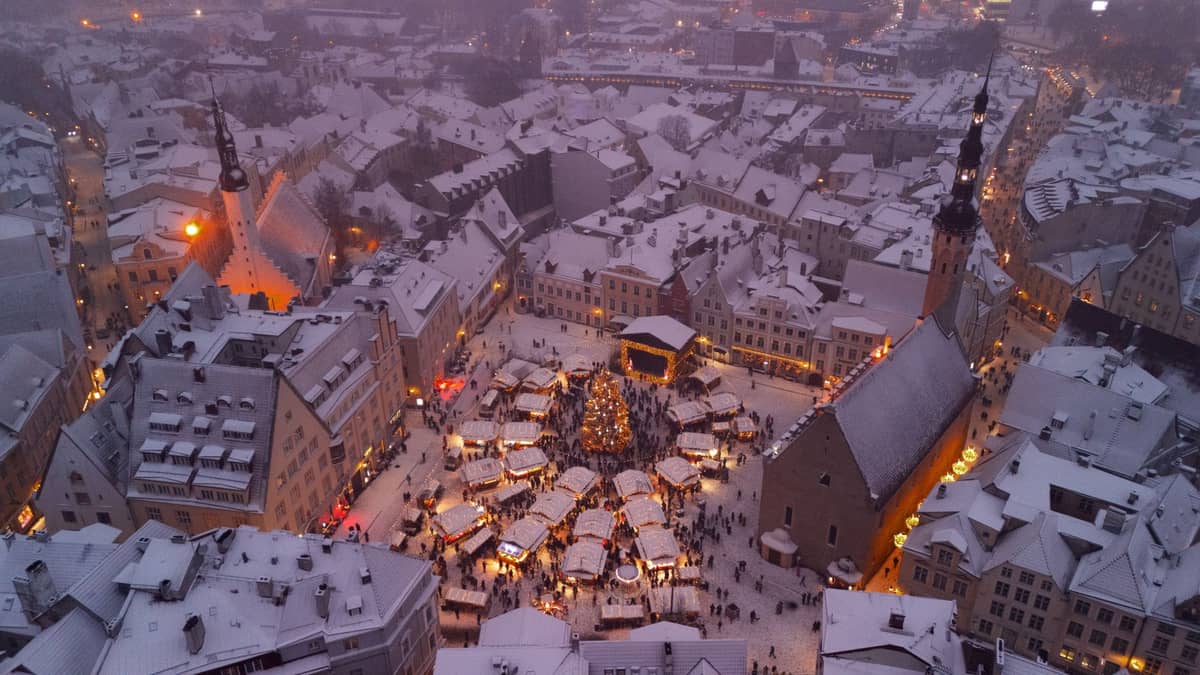
Raekoja plats hosts two events that transform its character entirely. The Christmas Market, which in 2026 runs from 20 November through 6 January, 2027, converts the square into a grid of wooden stalls selling mulled wine, marzipan (a Tallinn specialty with deep historical roots), handicrafts, and smoked meats. A large decorated tree anchors the center. The smell of cinnamon and woodsmoke, the crunch of gravel underfoot where the cobblestones are covered, and the low Baltic winter light create an atmosphere that draws visitors specifically for this experience. For timing and what to expect, see the Tallinn Christmas Market guide.
In summer, typically in late June, the Old Town Days festival uses Raekoja plats as its main stage, with medieval-themed markets, theatrical performances, and craft demonstrations. Dates and programming vary by year, so check the Visit Tallinn events calendar in advance if you are planning around this.
Practical Walkthrough: What to Do in and Around the Square
The square itself takes perhaps 15 minutes to walk at a measured pace, circling the perimeter and pausing at the Town Hall pharmacy and the cafe frontages. Most visitors spend longer because the square functions as a natural resting point: benches are available, and the terrace cafes offer a clear view of the Gothic facade while you eat or drink.
From Raekoja plats, the Old Town's main sights radiate outward within a short walk. St. Olaf's Church is a few minutes north. The Viru Gate, one of the most photographed entry points to the Old Town, is a 5-minute walk east. The upper town of Toompea, with its viewing platforms and castle, is a 10-minute uphill walk west. The square sits at the dead center of the walkable Old Town, making it an efficient base for exploring in any direction.
Photography from the square works best from the northwest corner, which gives you the broadest angle on the Town Hall tower without obstructions. For a view looking back across the square toward the merchant houses, position yourself near the Town Hall steps facing north. In summer, the cafe umbrellas break the sightlines considerably, so early mornings are again preferable for clean architectural shots.
ℹ️ Good to know
The Tallinn Card, available to tourists, covers free entry to many nearby museums and offers discounts on guided tours departing from the Old Town area. If you are planning a full day in the city, it may reduce costs significantly. See the Tallinn Card guide for current pricing and coverage.
Accessibility and Getting There
The square is paved with traditional cobblestones, which are uneven and can be difficult to navigate with a wheelchair, pushchair, or rolling luggage. There is no level, smooth path across the square's surface. Visitors with mobility considerations should approach from the Viru Gate direction, where the nearby streets have some smoother sections, and plan for slow, careful movement across the cobbles.
There is no tram or bus stop directly on the square. The closest public transport access points are on the edges of the Old Town. Taxis and ride-hailing apps (Bolt is the primary local option) can drop passengers at several surrounding streets. For a full overview of getting around the city, the guide to getting around Tallinn covers transport options in detail.
The square is open and free at all hours. There are no barriers, gates, or ticket checkpoints. Public toilets are available in the Town Hall building during its opening hours, and at several nearby cafes for customers.
The Verdict: Is It Worth Your Time?
Raekoja plats is genuinely impressive as a piece of living medieval urbanism. It is not a theme park reconstruction; these buildings have been here for centuries. That said, the square's central location and visual appeal mean it is heavily visited, and in peak summer months it can feel more like a staging area for tour groups than a place to absorb history quietly.
Visitors who come expecting a hidden or undiscovered experience will be disappointed. Visitors who come with realistic expectations, at a sensible time of day, will find it one of the more atmospheric public squares in Northern Europe. If you are spending more than a day in Tallinn, the square rewards a second visit at a quieter hour. For context on how it fits into a broader itinerary, see the Tallinn Old Town walking tour for a route that connects the square to the wider medieval district.
Visitors with very limited interest in medieval architecture or European history may find the square underwhelming compared to a museum or a waterfront. It is fundamentally a space to walk through, sit in, and observe, rather than a destination with a specific program or exhibit.
Insider Tips
- The Town Hall Pharmacy (Raeapteek) at the north end of the square is easy to walk past. Step inside briefly: the original wooden shelving and antique apothecary jars make it one of the more unusual interior spaces in the Old Town, and entry is free.
- If you want a view of the square from above without climbing a tower, the upper floors of the cafe on the northwest corner sometimes offer window seating with a direct sightline to the Town Hall facade. Ask at the counter rather than waiting for a ground-floor table.
- The cobblestones are significantly more slippery than they look in wet or icy conditions. Avoid smooth-soled shoes in autumn and winter, particularly on the approach streets which slope downhill toward the square.
- Marzipan sold around the square ranges from mass-produced tourist items to genuinely crafted confections. The Kalev marzipan shop near the square sells reliably good-quality pieces and has been operating in the Old Town for decades.
- For the Christmas Market, arriving on a weekday morning rather than a weekend afternoon means the stalls are still stocked, the mulled wine queues are short, and the square is quiet enough to photograph.
Who Is Town Hall Square For?
- First-time visitors to Tallinn who want a clear introduction to the medieval Old Town
- Architecture enthusiasts interested in late Gothic civic buildings
- Photographers working in early morning or evening light
- Families with children who need open space to move around between indoor sights
- Visitors in late November through January who want the Christmas Market atmosphere
Nearby Attractions
Other things to see while in Tallinn Old Town:
- Alexander Nevsky Cathedral
Rising above Toompea Hill with five gilded onion domes and a facade that dominates every Old Town panorama, Alexander Nevsky Cathedral is Tallinn's most visually assertive building. Built between 1895 and 1900, it remains an active Orthodox place of worship and a window into the city's layered Russian and Estonian history.
- Danish King's Garden
Tucked into the western slope of Toompea hill, the Danish King's Garden is a small, free public park woven into Tallinn's medieval fortifications. Open around the clock and steps from the Old Town's main streets, it offers a rare moment of calm alongside ancient towers and stone walls with an 800-year-old backstory.
- Fat Margaret
Fat Margaret (Paks Margareeta) is a squat, round cannon tower that has guarded the northern gate of Tallinn's Old Town since the early 16th century. Today it houses the Estonian Maritime Museum, with exhibits on seafaring history and a rooftop terrace overlooking the harbour. It is one of the few surviving medieval structures in Tallinn where you can explore both the architecture and a well-curated permanent collection under the same roof.
- Freedom Square
Freedom Square sits at the southern edge of Tallinn Old Town, anchoring the city's civic identity with the striking War of Independence Victory Column. Open around the clock and free to enter, it serves as a gathering point for national celebrations, winter markets, and everyday Tallinn life.