St. Olaf's Church: Tallinn's Medieval Giant Worth the Climb
St. Olaf's Church (Oleviste kirik) is one of Tallinn's most recognizable landmarks, its spire now reaching about 124 metres above the Old Town skyline after repeated reconstructions from the medieval era onward. The church interior is free to enter, while the tower observation platform offers some of the finest rooftop views in the city for €10.
Quick Facts
- Location
- Lai 50, Tallinn Old Town (Vanalinn), 10133, Estonia
- Getting There
- 10–15 min walk from Town Hall Square; Old Town is compact and pedestrian-friendly
- Time Needed
- 30–60 min (church + tower climb)
- Cost
- Church interior: free. Tower/observation platform: €10 per person (verify locally)
- Best for
- History lovers, photographers, and anyone wanting a panoramic view without the crowds of other city platforms
- Official website
- http://www.oleviste.ee
What Is St. Olaf's Church?
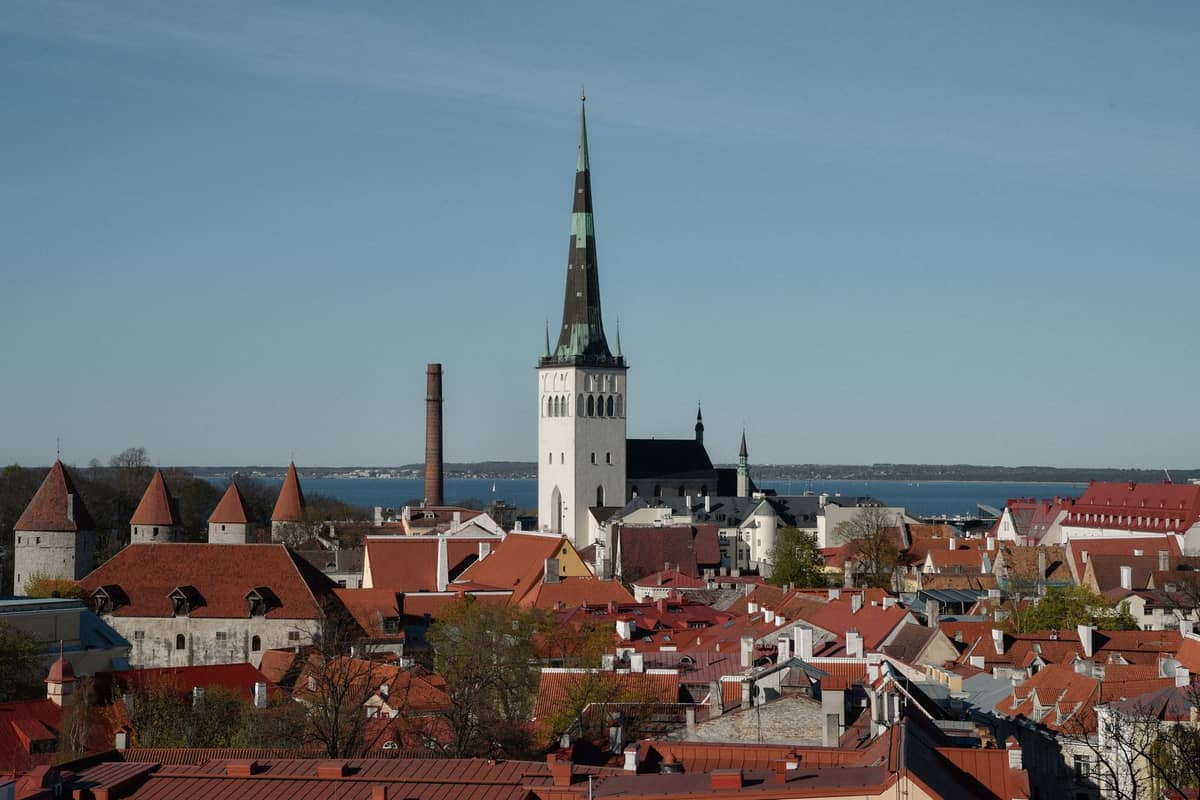
St. Olaf's Church, known in Estonian as Oleviste kirik, stands at the northern end of Tallinn's Old Town on Lai Street. Its needle-like spire reaches about 124 metres above the cobblestones, making it the tallest church building in Estonia and, during the 16th century, one of the tallest structures anywhere in Europe and possibly the world. In the 15th–16th centuries, the tower reportedly reached around 159 metres before successive lightning strikes forced rebuilding at a more modest height. Even so, the spire remains the defining vertical accent of the Old Town skyline, visible from the sea, from Toompea Hill, and from almost every rooftop terrace in the city.
The church is dedicated to Olaf II of Norway, the king later canonized as Saint Olaf and a patron figure for Scandinavian merchants. First recorded in documents from 1267, the church is believed to have been built as early as the 12th century, making it one of the oldest surviving ecclesiastical structures in Tallinn. For centuries it served the large community of Scandinavian traders who settled in Tallinn during the Hanseatic period, giving it a distinct identity from the German-dominated merchant churches elsewhere in the Old Town.
ℹ️ Good to know
The tower observation platform is seasonal: open 1 April to 31 October, daily 10:00–18:00. The church itself is generally accessible outside those dates. Always check current hours at oleviste.ee or with your hotel before making a dedicated trip.
The Tower Climb: What to Expect
The experience of climbing St. Olaf's tower is straightforwardly physical. You pay €10 at the entrance, push open a heavy wooden door, and commit to a narrow, steep stone staircase that winds upward through the core of the spire. There is no elevator. The steps are worn smooth in the centre from centuries of foot traffic, and the passage is tight enough that two adults passing each other in opposite directions requires a sideways shuffle and mutual goodwill. Handrails are present but the going is genuinely steep.
The reward at the top is proportional to the effort. The observation platform wraps around the exterior of the spire at a height where the entire Old Town layout becomes legible below you: the terracotta roof tiles of the medieval merchant houses, the green copper dome of Alexander Nevsky Cathedral on Toompea Hill, and the grey expanse of Tallinn Bay stretching north toward Helsinki. On clear summer mornings, you can trace the outline of the Gulf of Finland to the horizon. The platform is exposed to wind, so even in summer a light layer is sensible.
In terms of crowd dynamics, the tower sees its heaviest traffic between 11:00 and 14:00 on weekdays and throughout midday on weekends. Arriving at opening time, around 10:00, means you will often have the platform to yourself for a few minutes, which matters both for photography and for simply absorbing the view without jostling. Late afternoon, around 16:00–17:00, is another quieter window on most days.
⚠️ What to skip
The staircase is not accessible for visitors with limited mobility, those who use wheelchairs or walking aids, or parents with strollers. There is no alternative access to the platform. The church interior on the ground level is more accessible but still has some historic features and steps.
Tickets & tours
Hand-picked options from our booking partner. Prices are indicative; availability and final rates are confirmed when you complete your booking.
Self-guided Discovery Walk of Tallinn city contrasts beyond the medieval walls
From 26 €Instant confirmationFree cancellationTallinn's art and culture tour with a local
From 62 €Instant confirmationFree cancellationHistorical walking tour of Tallinn with a local
From 599 €Instant confirmationFree cancellationIntroductory walking tour of Tallinn with a local guide
From 109 €Instant confirmationFree cancellation
The Church Interior
Entry to the church nave is free of charge. The interior is spare by the standards of Central European Gothic churches: whitewashed walls, plain wooden pews, and clear glass in most windows, giving the space a cool, northern light even on grey days. The restraint is partly historical. St. Olaf's was seized during the Protestant Reformation in 1524, and much of its Catholic-era decoration was removed at that point. What remains is architecturally honest rather than ornate.
Despite the simplicity, the proportions are impressive at ground level. The nave is tall and narrow, drawing the eye upward in the way that Gothic architecture intends. A handful of memorial plaques and historical inscriptions line the walls, though signage in English is limited. Visitors who enter primarily to see the tower sometimes walk straight through without pausing, which is a small loss: the view of the vaulted ceiling from the centre of the nave, looking back toward the west door, is genuinely worth a moment.
St. Olaf's is an active Baptist congregation, which distinguishes it from several of the historic churches in the Old Town that now also function as museums or concert venues. Services are held regularly, so there are periods when the interior is closed to general visitors. For context on other medieval churches in the area, the best churches in Tallinn guide covers how St. Olaf's compares to nearby counterparts like Holy Spirit Church and Tallinn Cathedral.
Historical and Cultural Context
To understand why St. Olaf's Church exists where it does and why it was built so tall, it helps to know something about medieval Tallinn's commercial geography. The Old Town was divided, roughly speaking, between Toompea on the hill, where the Danish and later German nobles held political authority, and the Lower Town below, where the merchant guilds ran the actual economy. St. Olaf's stood at the northern edge of the Lower Town, near the original harbour, and served the Scandinavian merchants who formed a distinct community within the city's trading class.
The tower's extraordinary height in the 16th century, approximately 159 metres before it was struck by lightning and rebuilt, was not purely a spiritual statement. A church tower that could be seen from far out at sea functioned as a navigational landmark for ships approaching Tallinn Bay. Lightning is known to have struck the tower many times and caused extensive fires in 1625, 1820, and 1931, each followed by reconstruction to a progressively reduced height.
During the Soviet period, the church tower served a different purpose: Soviet intelligence reportedly used it as a radio surveillance post and antenna site. This chapter in the building's history fits into the broader pattern of repurposed landmarks across the city, a subject explored in depth in the Tallinn Soviet history guide.
Photography Tips and Best Light
From the outside, St. Olaf's spire photographs best from a distance rather than directly below. The courtyard on Lai Street does not give you enough separation to frame the full tower. Better vantage points for exterior shots are the Patkuli viewing platform on Toompea Hill, which puts the spire in context against the Lower Town rooftops, or the waterfront near the Linnahall, where the full silhouette rises above the city walls.
For interior shots, the nave is adequately lit in the morning but can feel dim in the late afternoon. Flash photography may or may not be permitted during services; check with staff on arrival. The view from the tower platform is cleanest in the first hour after opening, when early morning light falls across the Old Town from the east and haze has not yet built up over the bay. For a broader orientation to where St. Olaf's fits into Tallinn's panoramic viewpoints, the best viewpoints in Tallinn guide is a useful companion.
Fitting St. Olaf's Into Your Tallinn Day
St. Olaf's is at the northern end of the Old Town, slightly away from the main tourist circuit that runs between Town Hall Square, Toompea, and the Viru Gate. This means it is rarely as crowded as those central attractions, but it also means you may not stumble across it unless you plan to. From Town Hall Square, walk north on Pikk Street (the main artery of the Lower Town) and you will reach Lai Street and the church in about ten minutes on foot.
A focused visit covering the interior and the tower climb takes 30 to 45 minutes. Combined with a walk along the Tallinn city wall and a stop at the St. Catherine's Passage nearby, this northeastern corner of the Old Town makes a satisfying half-day loop. If you are working from a tighter itinerary, the Tallinn Old Town walking tour guide maps out how to incorporate St. Olaf's efficiently alongside the quarter's other highlights.
The church is not well-suited to visitors who are primarily interested in lavish interiors or extensive museum exhibits. If that is your priority, the Great Guild Hall or the Niguliste Museum will be more rewarding. St. Olaf's is, above all, an architectural experience best appreciated from the outside and from the top.
Insider Tips
- Arrive at 10:00 when the tower opens. The platform is often empty for the first 20–30 minutes, giving you undisturbed views and clean photographs before tour groups arrive.
- Wear rubber-soled shoes for the staircase. The medieval stone steps are worn smooth and can be slippery, particularly if wet from visitors who have come in from rain.
- The church interior is free, but it functions as an active place of worship. If a service is in progress, the nave is closed to general visitors. Midmorning on weekdays is usually the safest window.
- From the observation platform, the view north toward the sea is the least photographed angle in most travel images of Tallinn. Most visitors point their cameras south toward Toompea, so the harbour panorama is the one you are less likely to have seen before.
- The tower is closed from November through March. If you are visiting Tallinn in winter, you can still see the church interior for free, but plan your panoramic views at the Kohtuotsa or Patkuli platforms on Toompea instead.
Who Is St. Olaf's Church For?
- History and architecture enthusiasts drawn to Hanseatic and medieval Baltic heritage
- Photographers looking for rooftop views without the Toompea crowds
- Budget travellers: the tower at €10 is a very inexpensive elevated viewpoint in a European capital city
- Visitors on a first trip to Tallinn who want both historical context and a physical sense of the city's scale
- Walkers combining the northern Old Town loop with the city wall and St. Catherine's Passage
Nearby Attractions
Other things to see while in Tallinn Old Town:
- Alexander Nevsky Cathedral
Rising above Toompea Hill with five gilded onion domes and a facade that dominates every Old Town panorama, Alexander Nevsky Cathedral is Tallinn's most visually assertive building. Built between 1895 and 1900, it remains an active Orthodox place of worship and a window into the city's layered Russian and Estonian history.
- Danish King's Garden
Tucked into the western slope of Toompea hill, the Danish King's Garden is a small, free public park woven into Tallinn's medieval fortifications. Open around the clock and steps from the Old Town's main streets, it offers a rare moment of calm alongside ancient towers and stone walls with an 800-year-old backstory.
- Fat Margaret
Fat Margaret (Paks Margareeta) is a squat, round cannon tower that has guarded the northern gate of Tallinn's Old Town since the early 16th century. Today it houses the Estonian Maritime Museum, with exhibits on seafaring history and a rooftop terrace overlooking the harbour. It is one of the few surviving medieval structures in Tallinn where you can explore both the architecture and a well-curated permanent collection under the same roof.
- Freedom Square
Freedom Square sits at the southern edge of Tallinn Old Town, anchoring the city's civic identity with the striking War of Independence Victory Column. Open around the clock and free to enter, it serves as a gathering point for national celebrations, winter markets, and everyday Tallinn life.