St. Catherine's Passage: Tallinn's Most Atmospheric Medieval Lane
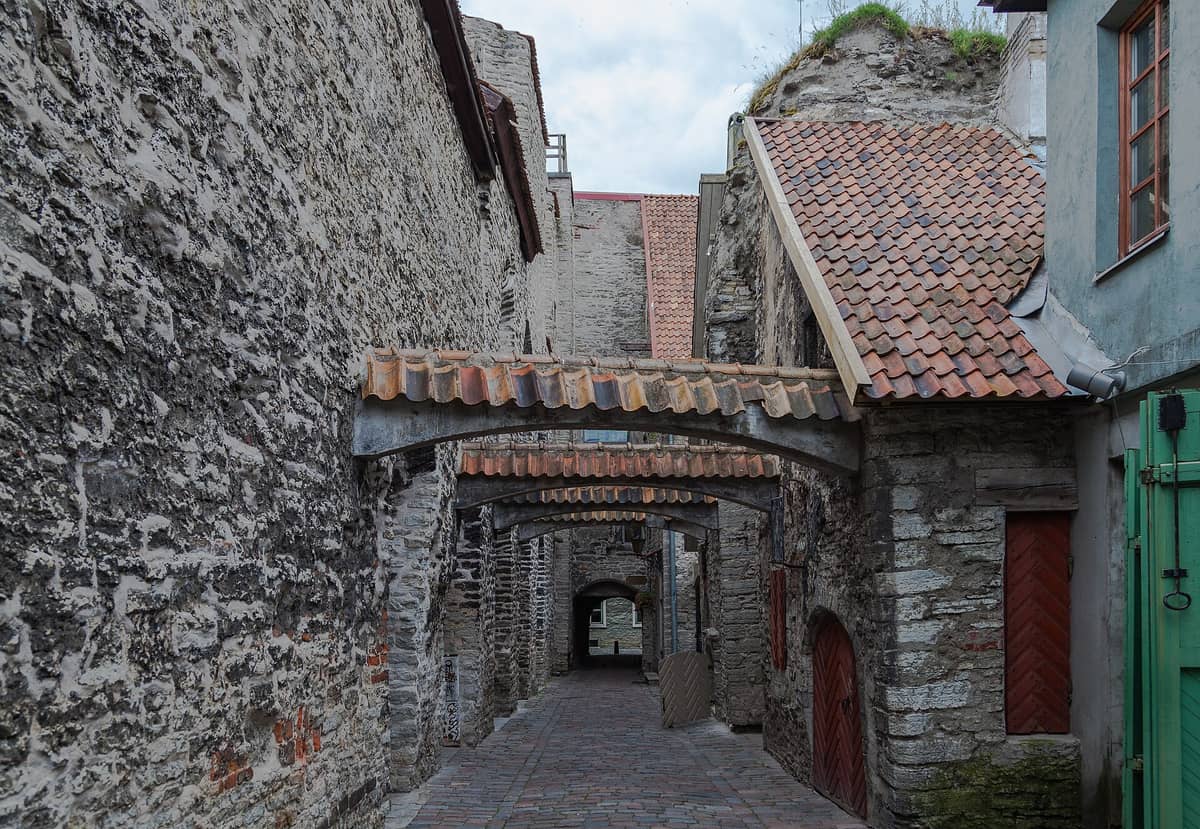
Katariina käik, or St. Catherine's Passage, is a narrow cobblestone alley threading through the heart of Tallinn's Old Town, flanked by the ruins of a 14th-century Dominican monastery and a row of quietly working artisan studios. It's free, it's open all hours, and it takes less than five minutes to walk — but it rewards those who slow down.
Quick Facts
- Location
- Tallinn Old Town — a medieval lane connecting Vene Street and Müürivahe Street
- Getting There
- On foot from Viru Gate (3-min walk); trams and buses stop at Viru stop
- Time Needed
- 15–45 minutes, depending on whether you browse the workshops
- Cost
- Free to walk through; artisan shops are browse-free with no obligation to buy
- Best for
- Architecture lovers, craft shoppers, photographers, medieval history enthusiasts
- Official website
- visitestonia.com/en/st-catherines-passage
What Is St. Catherine's Passage?
St. Catherine's Passage, known in Estonian as Katariina käik, is a short pedestrian alley in Tallinn's UNESCO-listed Old Town that runs between Vene Street and Müürivahe Street. It is not a tourist construction or a reconstructed heritage site. It is simply a medieval passage that has survived, more or less intact, alongside the outer wall of the Dominican monastery that once stood here. The lane is about 80 metres long and, in places, barely wide enough for two people to pass comfortably.
What makes it worth seeking out is the combination of things that rarely coexist: genuinely old stonework, working craftspeople, and a near-total absence of the souvenir-shop noise that fills much of the surrounding Old Town. Even on a busy summer afternoon, the passage has a noticeably quieter register than Raekoja plats or Pikk Street a few blocks away.
💡 Local tip
The passage has two entrances — one from Vene Street (signed) and one from Müürivahe Street. If you're coming from Viru Gate, approach via Müürivahe Street and walk it from south to north so the monastery wall is on your left and the workshops open to your right.
The History Behind the Walls
The lane takes its name from the Church of St. Catherine, which formed part of the Dominican monastery dating back to the 13th century. The Dominicans were among the most intellectually active orders in medieval Europe, and their Tallinn house was no exception — it served as a centre of education and manuscript production for the city's clerical and merchant classes.
The monastery was dissolved following the Reformation in the 16th century. What remained was repurposed, subdivided, and gradually absorbed into the urban fabric of the Old Town. The passage itself follows the line of the monastery's outer perimeter wall. The stones you walk past — rough-cut limestone blocks darkened with centuries of weathering — are the same material used throughout Tallinn's medieval architecture. Limestone was quarried locally and remains the defining texture of the Old Town.
The ruins visible along the passage are not fully excavated or interpreted with signage, so visitors with a deeper interest in Tallinn's medieval ecclesiastical history will get more from a visit to the Great Guild Hall, which houses the main Estonian History Museum collection. For context on the Dominican monastery itself, there is a separate museum entrance on Vene Street — a distinct attraction from the passage.
Tickets & tours
Hand-picked options from our booking partner. Prices are indicative; availability and final rates are confirmed when you complete your booking.
Self-guided Discovery Walk of Tallinn city contrasts beyond the medieval walls
From 26 €Instant confirmationFree cancellationTallinn's art and culture tour with a local
From 62 €Instant confirmationFree cancellationHistorical walking tour of Tallinn with a local
From 599 €Instant confirmationFree cancellationIntroductory walking tour of Tallinn with a local guide
From 109 €Instant confirmationFree cancellation
The Artisan Workshops
The buildings lining the north side of the passage house a small cluster of artisan studios, many of which have operated here for years. Glassblowers, textile weavers, jewellers, and leather workers have workshops that open directly onto the lane. The workshops are not performance spaces staged for tourists — these are functioning studios where you may see a craftsperson mid-project, hear the soft percussion of a loom, or catch the faint smell of heated metal.
Studios typically open around 11:00 and close by 17:00, though hours vary by workshop and season. Some close on Mondays or in the depths of winter. If you are coming specifically to visit a particular studio, it is worth checking in advance. That said, browsing is genuinely welcome, and there is no pressure to buy. Prices for handmade pieces reflect the labour involved — a hand-thrown ceramic cup or a piece of amber jewellery will not be cheap, but these are not factory goods.
ℹ️ Good to know
Workshop hours are roughly 11:00–17:00, with individual variation. The passage itself is open 24 hours, but if the studios are the draw, a weekday late-morning visit is your best window.
How It Changes Through the Day
Early morning, before 9:00, the passage belongs entirely to the light. The sun hits the south-facing workshop windows and throws long shadows across the cobblestones. There are almost no other visitors. The stones are damp with overnight moisture, and the lane smells of old limestone and, faintly, of wood from somewhere nearby. It is the best time to photograph the space without obstruction.
By midday in summer, tour groups file through steadily. The passage is narrow enough that a single group of twelve people effectively fills it. This is not a comfortable time to linger unless you are patient. The workshops, however, are open, and the contrast between the animated lane outside and the focused quiet inside each studio is striking.
Late afternoon, particularly on weekdays, is a practical compromise: the workshop lights are still on, the worst of the midday crowds have dispersed, and the lower sun angle creates good photographic conditions on the monastery wall. By early evening, the workshops close and the passage reverts to something more atmospheric and less purposeful — pleasant to walk through, but less active.
In winter, the passage takes on a different character entirely. Snow settles in the gaps between cobblestones, and the contrast between the pale stone walls and a grey Baltic sky is genuinely striking. Fewer tourists and softer light make it one of the better Tallinn winter photographs. Bring appropriate footwear; cobblestones with ice are a serious slip hazard.
Getting There and Practical Notes
St. Catherine's Passage is three minutes on foot from Viru Gate, the main pedestrian entry point into the Old Town from the modern city centre. Follow Viru Street through the gate, then turn right onto Müürivahe Street — the southern entrance to the passage is clearly marked on the left within 200 metres. Alternatively, enter from Vene Street if you are approaching from the Town Hall Square direction.
The passage is pedestrian-only and does not accommodate wheelchairs or pushchairs in any practical sense. The cobblestones are uneven, the lane narrows further at certain points, and there are no smooth bypasses. Visitors with mobility difficulties should note this is a genuine limitation, not a caveat.
Parking in Tallinn's Old Town is heavily restricted and not a realistic option for most visitors. If you are using public transport, the Viru stop serves multiple tram and bus routes. For a broader overview of getting around, the guide to getting around Tallinn covers all transport options clearly.
⚠️ What to skip
Cobblestones throughout Tallinn's Old Town become dangerously slippery in wet or icy conditions. In autumn and winter, wear shoes with grip — smooth-soled boots are a genuine safety issue, not a minor inconvenience.
Photography
St. Catherine's Passage is one of the more reliably photogenic spots in Tallinn's Old Town, but it requires patience. The lane is narrow enough that any people in the frame become compositionally dominant. The best strategy is to arrive early in the morning or late on a weekday afternoon when foot traffic is minimal. The monastery wall provides strong textural interest even in flat light. In summer, the overhanging greenery above some workshop doorways adds depth to framing.
Wide lenses are more useful here than telephoto. The confined space and the desire to include both the wall and the workshops in a single frame favours something in the 18–28mm range on a full-frame camera, or equivalent on crop sensors. Smartphone cameras with ultrawide modes work well for environmental shots; portrait mode is better reserved for detail shots of workshop interiors.
Is It Worth Your Time?
Honestly, St. Catherine's Passage is not a destination that justifies a dedicated trip from outside the city. It is a short lane. But it is genuinely good at what it does: providing a moment of actual medieval texture amid an Old Town that is, in places, heavily managed for tourism. The artisan workshops give it a purpose beyond scenery.
For visitors doing the Old Town walking tour, incorporating the passage is straightforward — it is almost impossible to walk the Old Town thoroughly without passing either end of it. Budget fifteen minutes, more if the workshops are open and you are inclined to browse.
Who might not get much from it: visitors primarily interested in Tallinn's contemporary culture, nightlife, or Soviet-era history will find almost nothing relevant here. The passage is medieval in character, craft-focused in offer, and slow in tempo. It is also not the right choice for visitors with mobility difficulties, given the cobblestone surface.
Insider Tips
- The entrance from Müürivahe Street is slightly less obvious and consequently less crowded than the Vene Street end — start here if you want to walk the lane with fewer people ahead of you.
- If the workshops are closed when you arrive, the passage is still worth walking for the wall itself. Look for the gravestone fragments embedded in the monastery wall — medieval epitaphs in Latin are visible in the stone, worn but legible in good light.
- The passage connects naturally to Müürivahe Street, where a row of market stalls sells knitwear made by local Estonian women. This stretch, just outside the passage exit, has been running in various forms for decades and is a good place to buy practical woolens at fair prices.
- In summer, late June evenings stay light past 22:00 in Tallinn. Walking the passage after the workshops close and the day-trip crowds have left gives you the lane almost entirely to yourself, with warm evening light on the stone.
- The Dominican Monastery museum on Vene Street is a separate paid attraction that provides far more historical context for the monastery complex than the passage itself does. If the history interests you, the museum visit is worth combining with a walk through the lane.
Who Is St. Catherine's Passage For?
- Architecture and medieval history enthusiasts who want texture beyond the main squares
- Craft and design shoppers looking for handmade work rather than mass-produced souvenirs
- Photographers seeking an early-morning Old Town shot with strong compositional interest
- Visitors on a tight schedule who want one genuinely atmospheric detour that takes under 20 minutes
- Travellers combining a broader Old Town walk who want to move off the main tourist corridors
Nearby Attractions
Other things to see while in Tallinn Old Town:
- Alexander Nevsky Cathedral
Rising above Toompea Hill with five gilded onion domes and a facade that dominates every Old Town panorama, Alexander Nevsky Cathedral is Tallinn's most visually assertive building. Built between 1895 and 1900, it remains an active Orthodox place of worship and a window into the city's layered Russian and Estonian history.
- Danish King's Garden
Tucked into the western slope of Toompea hill, the Danish King's Garden is a small, free public park woven into Tallinn's medieval fortifications. Open around the clock and steps from the Old Town's main streets, it offers a rare moment of calm alongside ancient towers and stone walls with an 800-year-old backstory.
- Fat Margaret
Fat Margaret (Paks Margareeta) is a squat, round cannon tower that has guarded the northern gate of Tallinn's Old Town since the early 16th century. Today it houses the Estonian Maritime Museum, with exhibits on seafaring history and a rooftop terrace overlooking the harbour. It is one of the few surviving medieval structures in Tallinn where you can explore both the architecture and a well-curated permanent collection under the same roof.
- Freedom Square
Freedom Square sits at the southern edge of Tallinn Old Town, anchoring the city's civic identity with the striking War of Independence Victory Column. Open around the clock and free to enter, it serves as a gathering point for national celebrations, winter markets, and everyday Tallinn life.